

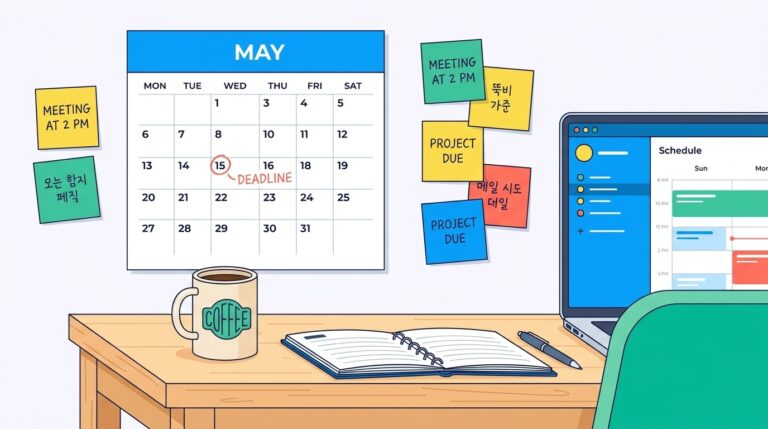
Master the Korean Office: How to Check Schedules Like a Pro
Hello! I am your Daily Hangul editor. If you’ve ever watched a Korean office drama like Business Proposal or Misaeng, you know the scene. The team leader suddenly claps their hands, looks around the room, and says something about a meeting or an unexpected hoesik (team dinner). Everyone scrambles to open their planners or calendar apps.
But what happens when your Korean colleague walks up to your desk and asks about your schedule? If you just stare at them like a deer in headlights, you might miss an important project sync—or worse, free Korean BBQ!
In Korean work culture, time is deeply connected to hierarchy and respect. Knowing how to politely check and share your schedule isn’t just about language; it’s about showing professional nunchi (social awareness). Today, we will learn the essential, A2-level Korean expressions you need to survive scheduling in a Korean office. This guide is built directly from the panic moments my actual expat students have experienced!
Phase 2: Core Expressions Deep Dive
1. 언제 시간 괜찮으세요? (When is a good time for you?)
- Pronunciation: eonje sigan gwaenchaneuseyo? [eon-je / shi-gan / gwaen-chan-euh-se-yo]
- Meaning: Literal: ‘When is your time okay?’ vs. Real nuance: ‘When would be a convenient time for you?’
- K-Culture Moment: You will hear this everywhere in corporate Korea. It’s the standard, polite way to ask a colleague or manager for a meeting. It softly respects their busy schedule rather than demanding their time.
- Editor’s Insight: Instead of asking ‘Are you free?’, Koreans ask if your time is okay. It feels much softer and less intrusive. The ‘으세요’ ending adds that crucial layer of business politeness.
- Situation Spectrum:
- Casual (Friends): ⚠️ (Too formal, use ‘언제 시간 돼?’)
- Semi-formal (Colleagues): ✅
- Formal (Bosses/Clients): ✅
- 🤔 Think About It: Why do Koreans avoid direct questions like ‘Are you free?’ (시간 있어요?) in the office? How does indirectly asking about ‘time’ instead of the ‘person’ change the feeling of the question?
2. 제 일정 확인해 볼게요. (Let me check my schedule.)
- Pronunciation: je iljeong hwaginhae bolgeyo. [je / il-jeong / hwa-gin-hae / bol-gge-yo]
- Meaning: Literal: ‘I will try checking my schedule.’ vs. Real nuance: ‘Let me double-check my calendar.’
- K-Culture Moment: When a senior asks if you can attend an afternoon meeting, you shouldn’t just say ‘No.’ You say this phrase first while quickly pulling up your company messenger calendar. It shows you are making an effort.
- Editor’s Insight: The ending ‘-아/어 볼게요’ means ‘I will try to do [action].’ It softens your response, making you sound cooperative and professional, rather than giving a cold ‘Yes’ or ‘No’.
- Situation Spectrum:
- Casual (Friends): ⚠️
- Semi-formal (Colleagues): ✅
- Formal (Bosses/Clients): ✅
3. 이번 주 일정표 공유해 주세요. (Please share this week’s schedule.)
- Pronunciation: ibeon ju iljeongpyo gongyuhae juseyo. [ee-beon / joo / il-jeong-pyo / gong-yu-hae / joo-se-yo]
- Meaning: Literal: ‘This week schedule share please.’ vs. Real nuance: ‘Could you please share this week’s schedule with me?’
- K-Culture Moment: Every Monday morning! Korean offices run on tight, synchronized schedules. Sharing your calendar via Slack, Teams, or KakaoWork is a basic courtesy.
- Editor’s Insight: ‘공유하다’ (to share) is a massive buzzword in Korean offices. You don’t just share schedules; you share files, ideas, and links. Memorize this verb!
- Situation Spectrum:
- Casual (Friends): 🚫
- Semi-formal (Colleagues): ✅
- Formal (Bosses/Clients): ⚠️ (Better to add ‘수고스러우시겠지만’ – ‘I know it’s a hassle, but…’)
Phase 3: Textbook vs. Real Korean
[Situation 1: Asking if they are available]
* 📖 Textbook Korean: 시간 있으십니까? (Do you have time? – Too stiff and militaristic!)
* 🗣️ Real Korean: 언제 시간 되세요? (When does your time work?)
* 💡 Why the difference?: Modern Korean offices prefer the soft ‘-요’ form over the rigid ‘-까/다’ form for daily scheduling to create a friendlier atmosphere.
[Situation 2: Saying you will check your calendar]
* 📖 Textbook Korean: 일정표를 보겠습니다. (I will look at the schedule.)
* 🗣️ Real Korean: 스케줄 한 번 볼게요. (Let me just check my schedule.)
* 💡 Why the difference?: Korean business culture loves English loanwords! Words like ‘스케줄’ (schedule), ‘미팅’ (meeting), and ‘피드백’ (feedback) are used daily for efficiency.
Bottom Note: For A2 learners, using ‘스케줄’ instead of ‘일정표’ can actually make you sound much more like a local professional!
Phase 4: Cultural Context — K-Culture Deep Dive
4-1. Non-Verbal Elements: The Art of Office Nunchi
In a Korean office, you never interrupt a colleague who is typing furiously or staring intensely at their monitor. This is where Nunchi (the subtle art of reading the room) comes in. Before saying ‘언제 시간 괜찮으세요?’, make soft eye contact, wait for them to pause, or gently say ‘팀장님, 잠시 시간 괜찮으세요?’ (Team Leader, do you have a brief moment?).
4-2. K-Drama Connection: The ‘Sync-Up’ Scene
Have you noticed in K-Dramas how team members always seem to know exactly where their boss is? (‘The Director is at an external meeting until 3 PM!’). In Korean work culture, schedules are often fully transparent within a team. Knowing your team’s schedule is considered a basic part of your job. While Western cultures might value calendar privacy, Korean teams operate as a single unit. If your boss asks ‘What’s your schedule today?’, it’s not micromanagement—it’s standard teamwork!
Phase 5: Real-Life Roleplay Scenario
Setting: Monday morning, 9:30 AM. A sleek, open-plan office in Gangnam. You are drinking your iced Americano.
Characters:
– YOU: An expat who joined the marketing team 3 months ago.
– Minsu: Your 30-year-old Korean colleague. Friendly, but always busy.
Minsu: 00씨, 이번 주 금요일에 우리 팀 회식 있는 거 아시죠? 🍻
(00-ssi, ibeon ju geumyoire uri tim hoesik inneun geo asijyo?)
[00, you know we have a team dinner this Friday, right?]
(🎭 Stage Direction: Minsu rolls his office chair over to your desk)
YOU: 아, 정말요? 저는 아직 못 들었어요.
(A, jeongmallyo? jeoneun ajik mot deureosseoyo.)
[Oh, really? I haven’t heard about it yet.]
Minsu: 앗, 캘린더에 일정표 공유해 드렸는데! 확인 안 해보셨어요?
(At, kaellindeoe iljeongpyo gongyuhae deuryeonneunde! hwagin an haebosyeosseoyo?)
[Oops, I shared the schedule on the calendar! Didn’t you check it?]
🔀 Your Turn! How should you reply?
– A) “아니요, 안 봤어요.” (No, I didn’t see it.)
– B) “진짜요? 제 스케줄 한 번 확인해 볼게요!”
– C) “저는 금요일에 바빠요.”✅ Best Choice: B — Reason: It shows proactive effort (‘Let me check my schedule!’).
⚠️ Choice A & C Analysis: ‘A’ sounds blunt and unapologetic. ‘C’ (‘I’m busy on Friday’) is a huge office taboo without checking the team schedule first!
(Continuing with B)
YOU: 진짜요? 제 스케줄 한 번 확인해 볼게요! 잠시만요.
(Jinjjayo? je seukejul han beon hwaginhae bolgeyo! jamsimanyo.)
[Really? Let me check my schedule real quick! Just a moment.]
Minsu: 네, 천천히 보세요. 이번엔 소고기 회식이에요!
(Ne, cheoncheonhi boseyo. ibeonen sogogi hoesigieyo!)
[Take your time. It’s beef for dinner this time!]
Phase 6: 10-Second Shadowing Drill
Practice reading this aloud with the correct pauses and emotion!
😊 대리님, / 언제 시간 / 괜찮으세요? (daerinim, / eonje sigan / gwaenchaneuseyo?)
🤔 잠시만요, / 제 일정 / 확인해 볼게요. (jamsimanyo, / je iljeong / hwaginhae bolgeyo.)
🙏 스케줄 / 공유해 / 주세요~ (seukejul / gongyuhae / juseyo~)
Phase 7: K-Culture Mini Dictionary
Here are the top keywords for Korean office scheduling!
1. 눈치
* Romanization: nunchi
* English: Social situational awareness / Reading the room
* Context: The most critical skill in Korea. Knowing when to ask your boss about their schedule based on their mood and how hard they are typing.
2. 스케줄
* Romanization: seukejul
* English: Schedule
* Context: The Konglish (Korean-English) word used more often in daily office chats than the native Korean word ‘일정표’ (iljeongpyo).
3. 회의
* Romanization: hoeui
* English: Meeting
* Context: Formal meetings. If it’s a casual quick chat, Koreans often use the English loanword ‘미팅’ (miting).
4. 회식
* Romanization: hoesik
* English: Company/Team Dinner
* Context: Not just eating, but an extension of work where team bonding happens (often over K-BBQ and Soju). Always check your schedule for these!
Phase 8: Traveler Survival Kit (Business & Transit)
Even if you’re just visiting Korea for a quick business trip, checking times and schedules is vital. Here are your survival phrases:
🆘 Survival Phrase #1: 몇 시에 만날까요?
– 🇰🇷 (myeot sie mannalkkayo?)
– 🗣️ English: What time should we meet?
– 📍 Use it: Setting up coffee meetings or client dinners.
– 💡 Pro Tip: Koreans are incredibly punctual for business meetings. Always aim to arrive 10 minutes early.🆘 Survival Phrase #2: 장소가 어디예요?
– 🇰🇷 (jangsoga eodiyeyo?)
– 🗣️ English: Where is the location?
– 📍 Use it: Confirming the meeting room or restaurant.📌 Editor’s Travel Note
– Useful Apps: Never use Google Maps in Korea! Download Naver Map or KakaoMap to check transit schedules perfectly.
– Punctuality: In Korean business, 2:00 PM means starting the discussion at 2:00 PM, not walking into the building at 2:00 PM.
Phase 9: Critical Thinking — “A Step Deeper”
Language & Power in Korean Scheduling
In English, you can easily say, “Are you free at 3 PM?” to both a junior colleague and a CEO. In Korean, language reflects power dynamics. You cannot ask a boss “시간 있어요?” (Do you have time?). Instead, you must ask, “언제 시간 괜찮으세요?” (When is your time okay?). You elevate the concept of their time as something valuable that you are requesting permission to use. This isn’t just grammar; it’s a deep cultural reflection of how Korean society views age, rank, and respect in the workplace.
💬 Your Turn: How do you politely ask for a senior leader’s time in your home country? Is it direct or indirect? Share in the comments!
Phase 10: FAQ & Avoiding Misunderstandings
Q: Can I use “시간 있어요?” (Do you have time?) to my boss?
A: NO! 🚫 This sounds very casual and slightly confrontational, like you are challenging them. Always use “시간 괜찮으세요?” for anyone higher in rank or age.
Q: What if I really don’t have time for a meeting?
A: Never just say “안 돼요” (No/I can’t). Say: “죄송하지만, 제가 그 시간에는 일정이 있습니다.” (I’m sorry, but I have a schedule at that time.)
❌ Common Mistake #1: Saying “너 스케줄 뭐야?” (What is your schedule?) to a colleague. ‘너’ (You) is extremely rude in the office. Use their title (e.g., 대리님, 매니저님) instead of ‘you’.
Phase 11: Summary & Action Items
One-Liner Summary: Soften your scheduling requests by asking “Is your time okay?” (시간 괜찮으세요?) and always show effort by “checking your schedule” (스케줄 확인해 볼게요).
Your Action Missions:
– 🥉 Bronze: Say “제 일정 확인해 볼게요” to your mirror 3 times.
– 🥈 Silver: Write your Friday schedule in Korean in the comments!
– 🥇 Gold: Use “언제 시간 괜찮으세요?” next time you ask a Korean friend or colleague to meet up!
K-Culture Mission:
Open your Google/Apple Calendar right now and change the title of one of your upcoming meetings to ‘회의’ (hoeui) or ‘스케줄’ (seukejul)!
Phase 12: Quiz — Interactive Challenge
1. Situational Judgment: Your team leader asks if you can have a quick meeting at 2 PM. You need to check your planner first. What do you say?
– A) 시간 없어요. (I don’t have time.)
– B) 잠시만요, 제 일정 확인해 볼게요. (Just a moment, let me check my schedule.)
– C) 너 스케줄 공유해 주세요. (Share your schedule.)
2. True or False – K-Culture Edition:
In a Korean office, asking for someone’s schedule is considered a severe invasion of personal privacy, and team members rarely share calendars.
(Answers: 1. B – It’s polite and cooperative. / 2. False – Transparent schedule sharing is the backbone of Korean office teamwork!)
Frequently Asked Questions (FAQ)
Q: What does "언제 시간 괜찮으세요? (When is a good time for you?)" mean in Korean and how do you pronounce it?
A: In Korean, "언제 시간 괜찮으세요? (When is a good time for you?)" is pronounced [eonje sigan gwaenchaneuseyo? [eon-je / shi-gan / gwaen-chan-euh-se-yo] and means: Literal: 'When is your time okay?' vs. Real nuance: 'When would be a convenient time for you?'
Q: What does "제 일정 확인해 볼게요. (Let me check my schedule.)" mean in Korean and how do you pronounce it?
A: In Korean, "제 일정 확인해 볼게요. (Let me check my schedule.)" is pronounced [je iljeong hwaginhae bolgeyo. [je / il-jeong / hwa-gin-hae / bol-gge-yo] and means: Literal: 'I will try checking my schedule.' vs. Real nuance: 'Let me double-check my calendar.'
Q: What does "이번 주 일정표 공유해 주세요. (Please share this week's schedule.)" mean in Korean and how do you pronounce it?
A: In Korean, "이번 주 일정표 공유해 주세요. (Please share this week's schedule.)" is pronounced [ibeon ju iljeongpyo gongyuhae juseyo. [ee-beon / joo / il-jeong-pyo / gong-yu-hae / joo-se-yo] and means: Literal: 'This week schedule share please.' vs. Real nuance: 'Could you please share this week's schedule with me?'






