

Phase 1: Empathy (Immersive Open)
Hello! I am the Lead Editor of Daily Hangul.
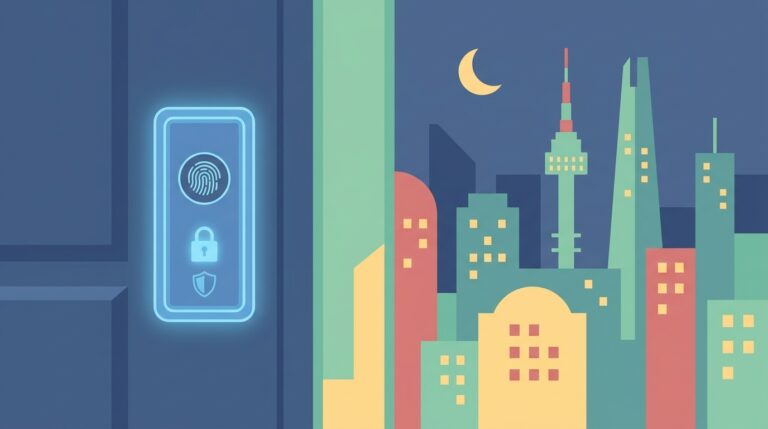
Picture this: You are watching a suspenseful K-Drama. The chaebol heir casually presses his thumb against the glowing keypad of his penthouse’s smart lock, or an antagonist secretly lifts a fingerprint using transparent tape to breach a highly secured corporate vault. While these scenes make for great television, they highlight a very real aspect of modern life in South Korea. Korea is an IT powerhouse. From convenience stores equipped with palm-vein scanners to Incheon Airport’s facial recognition ‘Smart Pass’, biometric authentication is everywhere.
But what happens when that data is compromised? At a C2 (Advanced) proficiency level, simply knowing how to say “My password is wrong” isn’t enough. You need to understand the sophisticated, yet colloquially nuanced, ways Koreans discuss cybersecurity, data breaches, and biometric theft in corporate environments and daily life.
This guide is crafted from the real experiences of advanced learners and expatriates working in Korea’s tech hubs like Pangyo. Let’s elevate your Korean to decode not just the language, but the cultural anxiety and tech-savvy mindset embedded within it.
Phase 2: In-Depth Analysis of Core Expressions
1. 개인정보가 털리다
- Pronunciation: [gae-in-jeong-bo-ga teol-li-da] (teol-li-da sounds like the quick, sweeping sound of dusting off a rug)
- Meaning: Literal: ‘Personal information is dusted off/shaken out’ / Real Nuance: ‘Personal data has been hacked, breached, or stolen.’
- K-Culture Moment: You will hear this constantly in Korean offices or among friends when news breaks about a major bank or social media platform suffering a data leak. It is the go-to slang for any cyber breach.
- Editor’s Insight: While formal news uses words like ‘유출’ (leak), everyday Koreans universally use ‘털리다’ to express the helpless, invasive feeling of being digitally robbed. It implies a total loss of control.
- Situation Spectrum:
- Casual (Friends): ✅
- Semi-formal (Colleagues): ✅ (Commonly used in casual office chatter)
- Formal (Boss/Elders/Official Reports): 🚫 (Use 유출되다 instead)
- 🤔 Think About It: The verb 털리다 was originally used for physical robberies (e.g., having your pockets picked). Why do you think Koreans adopted this very physical, violent verb for invisible digital crimes?
2. 도용당하다
- Pronunciation: [do-yong-dang-ha-da] (do-yong sounds like ‘do wrong’)
- Meaning: Literal: ‘To suffer stealthy usage’ / Real Nuance: ‘To have one’s identity, biometrics, or personal info stolen and used by someone else (Identity Theft).’
- K-Culture Moment: In a K-Drama, when the protagonist realizes someone else used their fingerprint data to access a restricted server or open an account, they would shout, “내 지문이 도용당했어!” (My fingerprint was stolen/used!).
- Editor’s Insight: It emphasizes the unauthorized use of the data, not just the leak itself. If your face ID is used by someone wearing a high-tech mask to bypass security, your data was 도용당한 것.
- Situation Spectrum:
- Casual (Friends): ✅
- Semi-formal (Colleagues): ✅
- Formal (Boss/Elders): ✅ (Highly appropriate for all levels)
- 🤔 Think About It: Korean heavily uses the passive suffix ‘-당하다’ (to suffer an action) for crimes. How does your native language grammatically frame the victim in cybercrimes?
3. 보안이 뚫리다
- Pronunciation: [bo-an-i ttul-li-da] (ttul-li-da sounds like a drill punching through a wall)
- Meaning: Literal: ‘Security is pierced/punctured’ / Real Nuance: ‘Security has been breached or compromised.’
- K-Culture Moment: Picture a tense boardroom scene in a tech thriller. The CTO slams their hands on the table: “서버 보안이 뚫렸습니다!” (Server security has been breached!).
- Editor’s Insight: It paints a vivid picture of a wall or shield being punctured. It is used for everything from a bypassed smart lock on an apartment door to a national firewall being hacked.
- Situation Spectrum:
- Casual (Friends): ✅
- Semi-formal (Colleagues): ✅
- Formal (Boss/Elders): ✅
- 🤔 Think About It: Describing digital security as a physical barrier that gets ‘pierced’ (뚫리다) shows how we spatialize the digital world. What imagery does your language use for a security breach?
Phase 3: Textbook vs. Real Korean
[Situation 1: Discovering a biometric data breach]
* 📖 Textbook Korean: 제 생체 인식 정보가 유출되었습니다. (My biometric recognition information has been leaked.)
* 🗣️ Real Korean: 아, 내 지문 또 털렸어. (Ah, my fingerprint got hacked again.)
* 💡 Why is it different?: Koreans prefer short, highly expressive verbs (털리다) to convey frustration, replacing clinical terms with emotional slang in daily life.
[Situation 2: Warning someone about identity theft]
* 📖 Textbook Korean: 타인이 당신의 정보를 사용할 위험이 있습니다. (There is a risk that others may use your information.)
* 🗣️ Real Korean: 그거 그러다 명의 도용당해요. 조심하세요. (You’re gonna get your identity stolen like that. Be careful.)
* 💡 Why is it different?: ‘명의 도용’ (Identity theft) is an advanced but ubiquitous term in Korean society due to the prevalence of online banking and real-name verification systems.
Bottom Note: At the C2 level, it is crucial to know both the formal (유출, 침해) and informal (털리다, 뚫리다) terms and switch between them fluidly depending on whether you are writing an official incident report or venting to a colleague over coffee.
Phase 4: Cultural Context — K-Culture Deep Dive
4-1. Non-Verbal Cues: The Nunchi of Security
When typing a passcode on a smart lock or taking off a mask for a facial scan in front of others, the Korean concept of Nunchi (social awareness) plays a huge role. It is considered basic etiquette to physically turn your head away or take a step back when someone is entering their apartment code or authenticating their banking app. Staring is not just rude; it raises immediate red flags about your intentions.
4-2. K-Culture Connection: K-Drama & Hyper-Connectivity
The K-Drama Trope: You’ve definitely seen this trope: The main character is running away, they reach a high-tech glass door, and a hacker sidekick bypasses the retina scan remotely just in time.
Reality Check: While retina scans aren’t in every home, digital door locks certainly are. South Korea transitioned away from physical keys almost entirely over the last two decades. Now, the shift is toward biometric access (fingerprint door locks, vein-recognition at automated convenience stores). This hyper-digital lifestyle means that when a breach occurs, the impact is comprehensive. A stolen fingerprint doesn’t just compromise an email; it might open your front door and empty your bank account simultaneously.
Phase 5: Real-Life Roleplay Scenario
Setting: Friday, 7 PM. A trendy, minimalist cafe in Pangyo (Korea’s Silicon Valley). You are sitting with Min-su, your Korean coworker from the IT department. You are both scrolling through the news on your phones while waiting for your coffee.
Characters:
– YOU: An expat tech consultant working in Korea. You take privacy very seriously.
– Min-su (32): Your Korean coworker. Relaxed, slightly cynical about cybersecurity because “everything gets leaked anyway.”
Dialogue:
Min-su: 아, 뉴스 봤어요? A은행 생체 데이터 서버 뚫렸대요.
(a, nyuseu bwasseoyo? A-eunhaeng saengche deiteo seobeo ttullyeotdaeyo.)
[Translation: Ah, did you see the news? They say A Bank’s biometric data server got breached.]
YOU: 네, 방금 봤어요. 지문이랑 홍채 정보까지 다 털렸다던데, 진짜 심각하네요.
(ne, banggeum bwasseoyo. jimunirang hongchae jeongbokkaji da teollyeotdadeonde, jinjja simgakh네요.)
[Translation: Yeah, I just saw it. I heard even fingerprint and iris data got hacked, it’s really serious.]
Min-su: 어차피 개인정보는 공공재 아니에요? 제 정보는 이미 전 세계에 다 돌아다닐걸요.
(eochapi gaeinjeongboneun gonggongjae anieyo? je jeongboneun imi jeon segyee da doradanilgeollyo.)
[Translation: Isn’t personal information basically public property anyway? My data is probably floating all around the world already.]
YOU: 에이, 비밀번호는 유출되면 바꾸면 그만이지만, 생체 정보는 도용당하면 답이 없잖아요.
(ei, bimilbeonhoneun yuchuldwaemyeon bakkumyeon geumanijiman, saengche jeongboneun doyongdanghamyeon dabi eopjanayo.)
[Translation: Come on, if a password is leaked you can just change it, but if biometric data is stolen, there’s no fixing that.]
(🎭 Stage Direction: Min-su takes a sip of his coffee and sighs)
Min-su: 듣고 보니 그렇네요. 손가락을 바꿀 수도 없고… 그럼 얼굴 인식 앱도 쓰면 안 되려나?
(deutgo boni geureonneyo. songarageul bakkul sudo eopgo… geureom eolgul insik aepdo sseumyeon an doeryeona?)
[Translation: Now that you mention it, you’re right. It’s not like I can change my fingers… Should I stop using facial recognition apps too?]
YOU: 편리하긴 한데, 보안 생각하면 좀 망설여지죠.
(pyeollihagin hande, boan saenggakhamyeon jom mangseollyeojijyo.)
[Translation: It is convenient, but when you think about security, it makes you hesitate.]
Min-su: 전 그냥 다 귀찮아서 비밀번호 ‘0000’으로 해두고 지문 안 쓰려고요.
(jeon geunyang da gwichanaseo bimilbeonho ‘0000’euro haedugo jimun an sseullyeogoyo.)
[Translation: I’m just too lazy for all this, I’m going to set my password to ‘0000’ and not use fingerprints.]
🔀 Your Turn! How should you respond to Min-su’s terrible security habit?
– A) 그러시면 안 됩니다. 보안 규정을 준수하십시오. (Very rigid, sounds like a textbook or HR manual.)
– B) 아휴, 그러다 진짜 통장 잔고까지 다 털려요! 당장 바꾸세요. (Playful but firm warning using local slang.)
– C) 대박! 저도 0000으로 할래요. (Agreeing to a terrible idea.)✅ Best Choice: B — Reason: It perfectly utilizes the slang ‘털리다’ (hacked/emptied) to warn him about the real-world consequence (losing money) while maintaining a friendly, banter-like tone appropriate for coworkers.
⚠️ Choice A Analysis: At a C2 level, you must understand situational appropriateness. Using formal HR language in a cafe makes you sound like a robot, breaking the rapport.
Phase 6: 10-Second Shadowing Drill
Let’s practice the rhythm and intonation of a crucial warning.
😤 제 / 생체 정보가 / 도용당한 것 / 같아요! (je / saeng-che jeong-bo-ga / do-yong-dang-han geot / ga-ta-yo!)
Emotion: Urgent and firm. Speak this as if you are standing at a bank counter realizing your account was accessed remotely.
Phase 7: K-Culture Mini Dictionary
1. 털리다 (teol-li-da)
* English: To be hacked / robbed of data
* Context: The ultimate Korean slang for any loss of digital privacy. Derived from physically shaking the dust off something until nothing is left.
2. 공공재 (gong-gong-jae)
* English: Public goods
* Context: A cynical, dark-humor joke among Koreans. Since major corporations have been hacked so many times, Koreans jokingly call their personal data a “public good” that everyone in the world already has access to.
3. 도어락 (do-eo-rak)
* English: Digital door lock
* Context: The quintessential Korean home security device. The transition from passcodes to fingerprint/facial recognition 도어락 is a massive industry in Korea.
4. 눈치 (nun-chi)
* English: Social awareness / tact
* Context: In the realm of biometrics and passwords, having nunchi means instinctively looking away when someone is authenticating their device or opening a door.
Phase 8: Traveler Survival Kit
As a traveler or expat, you will encounter biometric security immediately upon landing at Incheon Airport, and throughout automated stores in Seoul.
🆘 Survival Phrases for Biometric Hurdles
– 🇰🇷 “지문 인식이 잘 안 돼요.” (ji-mun in-si-gi jal an dwae-yo.)
– 🗣️ English: My fingerprint isn’t being recognized well.
– 📍 Where to use: Airport immigration, automated convenience stores, bank tellers.
– 💡 Pro Tip: If your hands are dry (common in Korean winters), gently blow on your thumb to add slight moisture before pressing the scanner. It’s a common trick locals use!📌 Editor’s Travel Note
– Smart Pass (스마트패스): Incheon Airport uses a facial recognition system called Smart Pass. Registering via the app before arriving saves you massive amounts of time at departure.
– Unmanned Stores (무인점포): Many 24-hour ice cream or ramyeon shops require you to scan a credit card or biometric data (like palm veins) just to open the sliding door at night for security purposes. Don’t panic if the door doesn’t slide open automatically!
Phase 9: Critical Thinking — “One Step Deeper”
Media vs Reality: The Paradox of Hyper-Security and “Public” Privacy
🧠 Think Deeper:
South Korea presents a fascinating paradox regarding cybersecurity. In K-Dramas and tech advertisements, Korea is portrayed as a hyper-secure, futuristic utopia where biometric scanners protect everything from penthouses to smartphones. However, the reality is that rapid digitalization outpaced privacy regulations for a long time. This led to massive, nationwide data leaks in the 2010s, giving birth to the cynical joke that Korean resident registration numbers are “global public goods.” As an advanced learner, observing how Koreans simultaneously embrace cutting-edge biometric convenience while expressing deep distrust (via words like ‘털리다’ and ‘도용당하다’) gives you profound insight into the society’s complex relationship with technology.💬 Your Turn: How does your native culture balance the convenience of biometric technology (like facial recognition) with the fear of digital identity theft? Share your thoughts below!
Phase 10: FAQ & Avoiding Mistakes
Q: Can I use ‘털리다’ in a business meeting if we are discussing a competitor’s data breach?
A: No. Even if you are talking about a competitor, using ‘털리다’ in a formal meeting is too casual and unprofessional. Use ‘보안이 침해되었습니다’ (Security was compromised) or ‘데이터가 유출되었습니다’ (Data was leaked).
Q: Is it okay to ask a Korean friend to register my fingerprint on their smart lock so I can visit easily?
A: Maybe, but tread carefully. Sharing a passcode is common among close friends or couples, but registering a fingerprint feels highly permanent and intimate. Unless you are living together or are extremely close, it might be an overstep.
❌ Common Mistake at C2 Level: Translating “Identity Theft” literally into “정체성 도둑질” (jeong-che-seong do-duk-jil).
✅ Do this instead: Always use the culturally accurate legal term: 명의 도용 (myeong-ui do-yong – theft of one’s registered name/identity).
Phase 11: Summary & Action Items
- One-Liner Summary: To speak about cybersecurity like a true local, master the balance between formal terms like ‘도용’ (identity theft) and expressive office slang like ‘털리다’ (hacked).
-
Action Mission 3 Steps:
- 🥉 Bronze (Solo): Read a Korean news headline about an IT breach and practice summarizing it aloud using the word ‘보안이 뚫리다’.
- 🥈 Silver (Online): Change your smartphone’s language to Korean and navigate to the ‘생체 인식 및 보안’ (Biometrics and Security) settings tab to familiarize yourself with the UI vocabulary.
- 🥇 Gold (Real-world): Next time you pass through Incheon Airport or use an automated kiosk in Seoul, observe the ‘안면 인식’ (Facial Recognition) instructions and read them aloud.
- K-Culture Mission: Watch a modern tech-thriller K-Drama (like Start-Up or any corporate revenge drama). Spot the scene where a server is breached or a door lock is hacked, and listen carefully to see if the characters use ‘뚫리다’ or ‘털리다’!
Phase 12: Quiz — Interactive Challenge
1. Situational Judgment: Your company’s internal server was hacked due to a phishing email, and employee fingerprints were leaked. You are reporting this to the CEO. Which sentence is appropriate?
A) 사장님, 우리 서버가 완전히 털렸습니다!
B) 대표님, 사내 서버 보안이 뚫려 생체 정보가 유출되었습니다.
C) 대표님, 직원들 지문이 도용당하기 좋은 날씨입니다.
2. Fill in the Blank:
“이 링크 절대 누르지 마. 내 친구 이거 눌렀다가 은행 계좌 다 ( _______ ).”
(Don’t ever click this link. My friend clicked it and his bank account got hacked/emptied.)
3. True or False — K-Culture Edition:
“In Korea, it is considered perfectly polite to stare at someone’s fingers to memorize their passcode in case they forget it.” (T/F)
(Answers: 1. B – You must use formal language like 유출되다 with the CEO. 2. 털렸어. 3. False – Having ‘nunchi’ means looking away!)
Frequently Asked Questions (FAQ)
Q: What does "개인정보가 털리다" mean in Korean and how do you pronounce it?
A: In Korean, "개인정보가 털리다" is pronounced [gae-in-jeong-bo-ga teol-li-da] and means: Literal: 'Personal information is dusted off/shaken out' / Real Nuance: 'Personal data has been hacked, breached, or stolen.'
Q: What does "도용당하다" mean in Korean and how do you pronounce it?
A: In Korean, "도용당하다" is pronounced [do-yong-dang-ha-da] and means: Literal: 'To suffer stealthy usage' / Real Nuance: 'To have one's identity, biometrics, or personal info stolen and used by someone else (Identity Theft).'
Q: What does "보안이 뚫리다" mean in Korean and how do you pronounce it?
A: In Korean, "보안이 뚫리다" is pronounced [bo-an-i ttul-li-da] and means: Literal: 'Security is pierced/punctured' / Real Nuance: 'Security has been breached or compromised.'






