

Hello there! I’m the Lead Editor of Daily Hangul, your veteran tutor and local culture navigator.
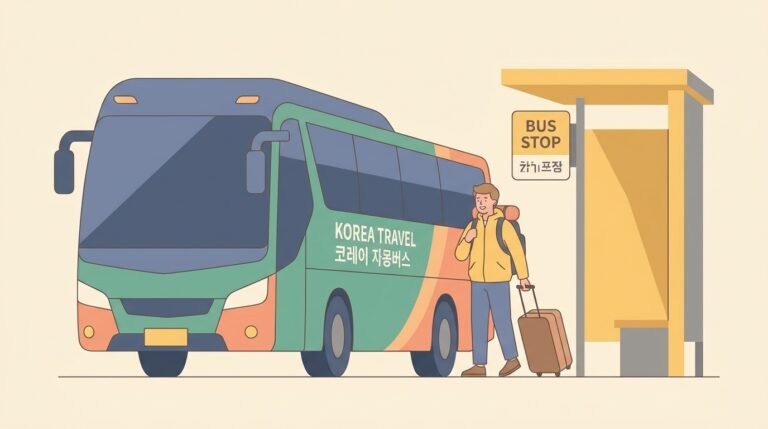
Imagine this: You’ve had the trip of a lifetime in Korea. You’ve eaten your weight in K-BBQ, visited the filming locations of your favorite K-Dramas, and your suitcase is now dangerously close to the weight limit, stuffed with K-Beauty masks and snacks. You’re standing at the bus stop, waiting for the Airport Limousine. Suddenly, a massive bus pulls up. The driver hops out, looking at your giant bags.
Panic sets in. Does this bus go to the airport? Does it go to Terminal 1 or 2? How do I tell him I need him to open the luggage compartment?
Don’t worry! Every traveler faces this exact ‘final boss’ moment. Today, we’re going to learn exactly what to say to hop on that bus smoothly and end your trip like a true local. No textbook robot-talk here—just the real, survival Korean you need right at the bus stop. Let’s dive in!
Phase 2: Deep Dive into Core Expressions
Here are the top three phrases you need when that airport bus arrives.
1. 이거 인천공항 가요?
- Pronunciation: igeo incheon-gonghang gayo? [ee-guh in-chun-gong-hang ga-yo?]
- Meaning: Literal: Does this go to Incheon Airport? / Real nuance: “Hey, is this the right bus for the airport?”
- K-Culture Moment: You’ll see this all the time. A bus pulls up, the doors hiss open, and someone sticks their head in to quickly confirm the destination before tapping their card. It’s fast, efficient, and very Korean.
- Editor’s Insight: This is a lifesaver. You don’t need a long, complicated sentence. Just point to the bus and ask this. It’s polite enough (ending in ‘yo’) but quick enough for the fast-paced bus environment.
- Situation Spectrum:
- Friendly (Casual): ✅ (If you drop the ‘yo’)
- Strangers/Bus Drivers (Semi-formal): ✅ (Perfect as is)
- Formal: ⚠️ (A bit too casual for a strict business meeting, but fine for transit)
- 🤔 Think About It: Notice how there is no “Excuse me, sir” or “Do you know if…” at the beginning? Korean transit culture prioritizes speed (Ppalli-ppalli). Why do you think polite brevity is valued here?
2. 가방 넣을게요.
- Pronunciation: gabang neoeulgeyo. [ga-bang nuh-eul-geh-yo.]
- Meaning: Literal: I will put the bag in. / Real nuance: “I have luggage to put in the compartment underneath.”
- K-Culture Moment: The bus driver (Gisa-nim) is usually sitting in the driver’s seat. If you have big luggage, you need him to press the button to open the side doors of the bus. Shouting this politely while gesturing to your bag gets the job done instantly.
- Editor’s Insight: The ending ‘~을게요 (~eulgeyo)’ means “I will do [action].” It’s a soft way of announcing your intention so the listener can react. You aren’t commanding the driver; you’re just letting him know your plan!
- Situation Spectrum:
- Friends: ✅
- Service Staff/Drivers: ✅
- Formal: 🚫
- 🤔 Think About It: Instead of saying “Open the door, please,” Koreans say “I will put my bag in.” How does focusing on your action rather than giving a command change the polite tone of the interaction?
3. 제1 터미널이요. (or 제2 터미널이요.)
- Pronunciation: je-il teomineoriyo. (je-i teomineoriyo.) [jeh-il tuh-mi-nul-ee-yo.]
- Meaning: Terminal 1, please. (Terminal 2, please.)
- K-Culture Moment: When loading your bags, the driver will almost always ask which terminal you are going to, because they group the luggage by terminal to make unloading faster!
- Editor’s Insight: Just say the number and add ‘~이요 (~iyo)’ to make it a polite noun ending. It’s the ultimate hack for sounding fluent without forming a full sentence.
- Situation Spectrum:
- Answering a question politely: ✅
Phase 3: Textbook vs. Real Korean
[Situation 1: Asking if it’s the right bus]
* 📖 Textbook Korean: 이 버스는 인천국제공항으로 갑니까? (Does this bus proceed to Incheon International Airport?)
* 🗣️ Real Korean: 기사님, 이거 공항 가요? (Driver, does this go to the airport?)
* 💡 Why the difference?: Textbooks teach full, grammatically complete sentences. Real life demands speed, so Koreans drop subjects and particles.
[Situation 2: Getting help with luggage]
* 📖 Textbook Korean: 제 수하물을 짐칸에 실어 주시겠습니까? (Would you kindly load my baggage into the cargo hold?)
* 🗣️ Real Korean: 짐 좀 넣을게요~ (I’ll just put my luggage in~)
* 💡 Why the difference?: Sounding too formal can actually create distance. A friendly, slightly casual announcement feels warmer and more cooperative to the driver.
Phase 4: Cultural Context — K-Culture Deep Dive
4-1. Non-verbal Communication: The “Eye Smile” and the Hustle
Bus stops in Seoul wait for no one. When the Airport Limousine arrives, have your transportation card (T-Money) or credit card ready in your hand. When telling the driver you have luggage, make eye contact, give a slight bow of the head, and point to your suitcase. The Nunchi (reading the room) here is knowing that the bus needs to keep moving, so being prepared is the best form of politeness.
4-2. K-Travel Connection: The Luxury of the Airport Limousine
If you’ve watched K-Dramas, you might have seen a character tearfully looking out the window of a bus as they leave Seoul. That’s likely the Airport Limousine! Unlike regular city buses, these are plush, comfortable, and have massive reclining seats. It’s the perfect place to take a nap and process all your amazing travel memories.
Surviving the Ride:
1. Always wear your seatbelt (it’s the law, and they will check!).
2. Do not talk loudly on your phone. Koreans treat these buses like quiet zones.
3. Listen for the announcements. They will announce “Terminal 1” and “Terminal 2” in English, Korean, Chinese, and Japanese.
Phase 5: Interactive Roleplay Scenario
Setting: It’s 6:00 AM on a crisp morning in Hongdae. The street is quiet. You are standing at the Airport Bus Stop with two heavy suitcases. The iconic luxury bus pulls up.
Characters:
– YOU: Sad to leave Korea, but desperate to catch your flight.
– Driver (Gisa-nim): A middle-aged man in a neat uniform. He looks in a hurry but is ready to help.
Dialogue:
(The bus doors hiss open. The driver steps out briefly.)
Gisa-nim: 어디 가세요? (eodi gaseyo?)
[Where are you going?]
YOU: 공항 가요. 이거 인천공항 가요? (gonghang gayo. igeo incheon-gonghang gayo?)
[I’m going to the airport. Does this go to Incheon Airport?]
Gisa-nim: 네, 타세요. 짐 있어요? (ne, taseyo. jim isseoyo?)
[Yes, get on. Do you have luggage?]
YOU: 네! 가방 넣을게요. (ne! gabang neoeulgeyo.)
[Yes! I’ll put my bag in.]
(🎭 Stage Direction: You point to your two massive suitcases.)
Gisa-nim: 아이고, 무겁네. 1터미널? 2터미널? (aigo, mugeomne. il-teomineol? i-teomineol?)
[Oh my, it’s heavy. Terminal 1? Terminal 2?]
🔀 YOUR TURN! How do you answer?
– A) 저는 제1 여객터미널로 갑니다. (jeoneun je-il yeogaek-teomineollo gamnida.)
– B) 1터미널이요! 감사합니다! (il-teomineoriyo! gamsahamnida!)
– C) 1! (il!)✅ Best Choice: B. It’s polite, clear, and includes a “Thank you” which drivers always appreciate!
⚠️ Choice A Analysis: Way too robotic and long. The driver is holding heavy bags!
⚠️ Choice C Analysis: Just shouting the number is a bit rude. Always attach ‘~이요 (iyo)’ to soften it.
Gisa-nim: 네, 알겠습니다. (ne, algetseumnida.)
[Okay, understood.]
YOU: 감사합니다! (gamsahamnida!)
[Thank you!]
Phase 6: 10-Second Shadowing Drill
Practice these aloud! Pay attention to the pauses (/) and the emotion tags.
- 🙋♀️ (Urgently asking): 기사님! / 이거 / 인천공항 가요? (gisa-nim! / igeo / incheon-gonghang gayo?)
- 🧳 (Politely indicating): 저 / 가방 좀 / 넣을게요~ (jeo / gabang jom / neoeulgeyo~)
- ✈️ (Clearly answering): 제 1터미널 / 이요! (je il-teomineol / iyo!)
Phase 7: K-Culture Mini Dictionary
| Korean | Romanization | English | Context |
|---|---|---|---|
| 기사님 | gisa-nim | Driver (Polite) | The standard, respectful way to address any driver in Korea (taxi, bus, etc.). |
| 공항 리무진 | gonghang rimujin | Airport Limousine | The special, comfortable buses dedicated to airport routes. |
| 짐 / 가방 | jim / gabang | Luggage / Bag | ‘Jim’ refers to baggage/stuff in general, while ‘gabang’ is a specific bag. Both work! |
| 티머니 | timeoni | T-Money Card | Korea’s universal transit card. A must-have for any traveler. |
| 눈치 | nunchi | Nunchi (Social sense) | The subtle art of reading the situation—like knowing to have your card ready quickly! |
Phase 8: Traveler’s Survival Kit
🆘 Survival Phrases for Transit
– 🇰🇷 “얼마예요?” (eolmayeyo?) – How much is it?
– 🇰🇷 “여기서 내려주세요.” (yeogiseo naeryeojuseyo.) – Please let me off here. (Great for taxis!)
– 🇰🇷 “카드 돼요?” (kadeu dwaeyo?) – Do you accept credit cards?📌 Editor’s Travel Note
– Apps: Download Naver Map or KakaoMap. Google Maps doesn’t provide walking/driving directions well in Korea. They will tell you exactly which bus number to look for!
– Payment: Most Airport Limousines accept international credit cards (Visa/Mastercard) directly on the tap machine, or you can use a loaded T-Money card. Cash is rarely accepted on buses in Seoul now!
– Tipping: Do I tip the driver for loading my heavy bags? NO! Korea does not have a tipping culture. A bright “감사합니다 (Thank you)” and a bow are the best tips you can give.
Phase 9: Critical Thinking — “One Step Deeper”
Language & Efficiency (Ppalli-ppalli Culture)
When learning Korean, you might notice that textbooks are full of long, beautiful, honorific sentences. But when you step onto the streets of Seoul, the language suddenly becomes very short. “이거 공항 가요?” (Does this go to the airport?) drops the subject, the object particle, and the formal ending. This isn’t because Koreans are rude; it reflects the famous Ppalli-ppalli (hurry, hurry) culture. In a fast-paced society, especially in transportation, brevity is a form of politeness. Taking up too much time with long sentences at a busy bus door is actually considered slightly inconsiderate to the people waiting behind you!
💬 Your Turn: In your home country, do people use different “street language” for public transport compared to how they talk in an office? Let us know in the comments!
Phase 10: FAQ & Avoiding Mistakes
Q: “Can I use ‘안녕’ (Annyeong) to the bus driver?”
No! 🚫 ‘Annyeong’ is strictly for close friends. To a bus driver, always use the formal “안녕하세요 (Annyeong haseyo)” when boarding.
Q: “What if I don’t know my terminal?”
Check your e-ticket before the bus arrives! Korean Air, Delta, Air France, and KLM usually use Terminal 2. Most others (like Asiana, Jeju Air) use Terminal 1. The driver cannot check this for you.
❌ Common Mistake #1: Standing in the middle of the road to flag down the bus.
✅ Do this instead: Stand clearly on the sidewalk near the bus stop sign. Make eye contact with the driver as the bus approaches. They will pull over safely.
Phase 11: Summary & Action Items
One-Liner Summary: To smoothly catch the airport bus, just point and ask “이거 인천공항 가요?” and tell the driver “가방 넣을게요” for your luggage!
Your Action Missions:
– 🥉 Bronze: Stand in front of your suitcase right now and say “가방 넣을게요” three times.
– 🥈 Silver: Write down your terminal number and practice saying it in Korean (e.g., 제 1터미널이요!).
– 🥇 Gold: On your next trip to Korea, confidently speak these phrases to the Airport Limousine driver!
🎬 K-Culture Mission:
Next time you watch a K-Drama and someone is leaving the country, look closely at the bus they get on. Is it an Airport Limousine? Try to spot if they use a T-Money card!
Phase 12: Quiz — Interactive Challenge
1. Fill in the Blank:
You want to tell the driver you have bags to put underneath the bus. You say:
“저 _________ 넣을게요.” (I will put my bag in.)
2. True or False — K-Culture Edition:
“You should give the bus driver a $5 tip for helping you lift a heavy suitcase.”
3. Situational Judgment:
The bus arrives, but you are confused if it goes to Terminal 1. What is the most natural thing to ask quickly?
– A) 기사님, 안녕?
– B) 이거 1터미널 가요?
– C) 제 수하물을 1터미널로 부탁합니다.
(Answers: 1. 가방(gabang), 2. False! No tipping in Korea. 3. B)
Safe travels, and see you in the next lesson! ✈️🇰🇷
Frequently Asked Questions (FAQ)
Q: What does "이거 인천공항 가요?" mean in Korean and how do you pronounce it?
A: In Korean, "이거 인천공항 가요?" is pronounced [igeo incheon-gonghang gayo? [ee-guh in-chun-gong-hang ga-yo?] and means: Literal: Does this go to Incheon Airport? / Real nuance: "Hey, is this the right bus for the airport?"
Q: What does "가방 넣을게요." mean in Korean and how do you pronounce it?
A: In Korean, "가방 넣을게요." is pronounced [gabang neoeulgeyo. [ga-bang nuh-eul-geh-yo.] and means: Literal: I will put the bag in. / Real nuance: "I have luggage to put in the compartment underneath."
Q: What does "제1 터미널이요. (or 제2 터미널이요.)" mean in Korean and how do you pronounce it?
A: In Korean, "제1 터미널이요. (or 제2 터미널이요.)" is pronounced [je-il teomineoriyo. (je-i teomineoriyo.] and means: Terminal 1, please. (Terminal 2, please.)







