

Phase 1: Empathy & Immersion
Hello! I’m the Lead Editor of Daily Hangul.
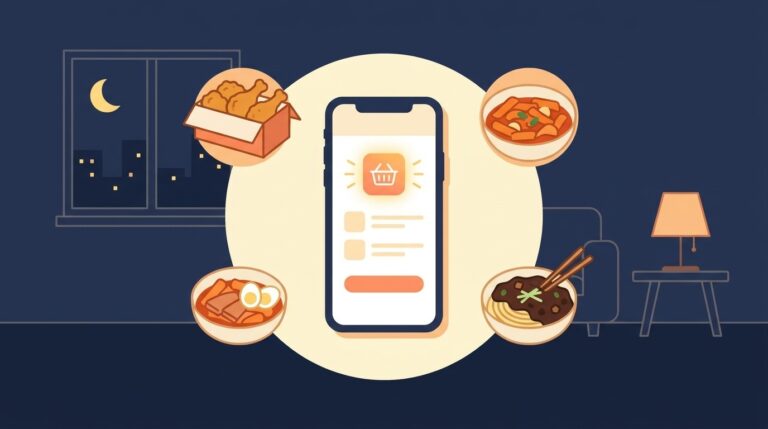
Picture this: It’s 11:30 PM. You’re bundled up on your couch, completely absorbed in the latest episode of a hit K-Drama. Suddenly, the main characters move to a dimly lit rooftop, pop open a can of beer, and start unpacking a mountain of delivery food. The crispy sound of fried chicken. The vibrant red of spicy Tteokbokki. Your mouth starts watering. You decide to open a Korean delivery app (like Baemin or Yogiyo) to satisfy that late-night craving.
But wait! If you just order a single box of plain fried chicken, you’re missing out on a massive cultural phenomenon. In Korea, we don’t just ‘order food’—we engineer ‘Kkul-johap’ (꿀조합), the ultimate food combinations.
Why does this matter? Knowing how to pair foods isn’t just about taste; it’s a social currency in Korea. If you know exactly what side dish to order with your spicy noodles, your Korean friends will look at you with deep respect and say, “Wow, you really know how to eat! (먹을 줄 아시네요!)” Today, we are going beyond textbook Korean to teach you the advanced, delicious art of Korean delivery culture.
Phase 2: Deep Dive into Core Expressions
Here are the top expressions you need to navigate the sophisticated world of Korean food pairings.
1. 꿀조합 (Kkul-johap)
- Pronunciation: [kkul-jo-hap] (Sounds like kkool-jo-hap. The double consonant ‘ㄲ’ requires a tense, sharp ‘k’ sound, like the ‘k’ in ‘skill’.)
- Meaning: Literal = Honey combination. Real nuance = The absolute best, fail-proof pairing of items (mostly food, but can be applied to people or items).
- K-Culture Moment: You’re watching a K-Pop idol’s V-Live Mukbang, and they introduce their secret convenience store recipe. “Guys, this ramen and this cheese is an insane kkul-johap!”
- Editor’s Insight: The word ‘honey’ (꿀) in modern Korean slang is used as an intensifier meaning ‘very good’ or ‘sweet deal’ (e.g., 꿀팁 – honey tip/great advice).
- Situation Spectrum:
- Casual with friends: ✅
- Semi-formal (Co-workers at lunch): ✅
- Formal (Boss/Elders): 🚫 (Too slangy for a formal dinner)
- 🤔 Think About It: Why do Koreans love creating and sharing specific ‘recipes’ and combos on social media? How does this reflect the collective, trend-driven nature of modern Korean society?
2. 맵단짠 (Maep-dan-jjan)
- Pronunciation: [maep-dan-jjan] (Sounds like map-dahn-jjan. Emphasize the final ‘jjan’ with a slightly squeaky, tight sound.)
- Meaning: Literal = Spicy, sweet, salty. Real nuance = The holy trinity of flavor that keeps you eating infinitely.
- K-Culture Moment: Think of eating fiery spicy Tteokbokki (맵), following it with a sip of sweet Coolpis drink (단), and then a bite of salty seaweed rice balls (짠). It’s the rollercoaster of flavors that prevents flavor fatigue!
- Editor’s Insight: Koreans believe extreme flavors shouldn’t stand alone. If there’s something spicy, you must neutralize it with something sweet or savory. It’s the yin and yang of Korean gastronomy.
- Situation Spectrum:
- Casual with friends: ✅
- Semi-formal (Co-workers): ✅
- Formal (Boss/Elders): ⚠️ (Not offensive, but very casual)
- 🤔 Think About It: Does your home country have a specific flavor profile that people consider ‘addictive’? How does it compare to the Korean obsession with spicy-sweet-salty dynamics?
3. 국룰 (Gungnul)
- Pronunciation: [gung-nul] (The spelled ‘국룰’ undergoes nasalization to sound like goong-nool.)
- Meaning: Literal = National rule. Real nuance = An unspoken, universally accepted standard or pairing.
- K-Culture Moment: In a group chat, someone asks, “Should we get cheese balls with our fried chicken?” The immediate response is, “Obviously. Chicken and cheese balls are gungnul.”
- Editor’s Insight: It’s not a legal rule, but breaking a ‘gungnul’ might earn you a playful side-eye from your Korean friends.
- Situation Spectrum:
- Casual with friends: ✅
- Semi-formal (Co-workers): ⚠️ (Good for young teams, maybe not with the CEO)
- Formal (Boss/Elders): 🚫
- 🤔 Think About It: The word ‘국’ (nation) is used heavily in Korean slang (e.g., 국민 여동생 – Nation’s little sister). What does this reveal about Korea’s strong sense of national identity and shared experiences?
Phase 3: Textbook vs. Real Korean
Let’s see how these phrases transform in the wild when ordering late-night snacks.
[Suggesting what to order together]
* 📖 Textbook Korean: 떡볶이와 튀김을 같이 먹으면 아주 맛있습니다. (Tteokbokki and fried food are very delicious when eaten together.)
* 🗣️ Real Korean: 떡볶이에 튀김은 완전 꿀조합이지! (Tteokbokki and fried food are a total kkul-johap!)
* 💡 Why the difference?: Real Korean uses dynamic, expressive slang (완전 – totally) to convey excitement, whereas textbook Korean remains dangerously calm about a very exciting topic: food.
[Stating an obvious, popular pairing]
* 📖 Textbook Korean: 보통 삼겹살을 먹을 때 소주를 마십니다. (Usually, when eating pork belly, people drink soju.)
* 🗣️ Real Korean: 삼겹살에 소주? 그거 완전 국룰이잖아. (Pork belly and soju? That’s totally a gungnul.)
* 💡 Why the difference?: Koreans love shared cultural touchstones. Using “국룰” instantly bonds the speakers over a shared cultural understanding.
Bottom Note: For C1 learners, mastering words like Kkul-johap and Gungnul will immediately elevate your fluency from ‘foreigner who studied hard’ to ‘honorary local’.
Phase 4: Cultural Context — K-Culture Deep Dive
4-1. Non-Verbal Elements: The Art of Unpacking
In Korea, delivery food isn’t just eaten; it’s presented. When the food arrives, there is an unspoken Nunchi (눈치 – social awareness) regarding the setup. You don’t just rip open bags. One person quickly lays out the plastic mat, another fetches extra chopsticks, and someone carefully peels off the vacuum-sealed plastic using that tiny plastic knife provided. The climax? Arranging the Kkul-johap items perfectly together so everyone can take their “인증샷” (In-jeung-syat – proof shot/photo for social media) before the first bite.
4-2. K-Food Connection: The Mukbang Synergy
The concept of Kkul-johap exploded alongside Korea’s Mukbang (eating broadcast) culture. YouTubers realized that eating one giant bowl of spicy noodles was visually appealing, but wrapping those spicy noodles around a juicy hot dog or a slice of pork belly created “flavor synergy” that drove viewers wild. When you order delivery in Korea, you are essentially recreating your own mini-Mukbang. It’s also why delivery menus constantly evolve, offering bizarre but brilliant sides (like adding sweet condensed milk bread to spicy octopus) to cater to this Maep-dan-jjan craze.
Phase 5: Real-Life Roleplay Scenario
Setting: It’s 8:00 PM on a Friday. You and two Korean friends are sitting on a picnic mat at Yeouido Hangang Park. The cool river breeze is blowing. Your friend Minji pulls out her phone and opens the “Baemin” (Delivery) app.
Characters:
– YOU: An expat living in Seoul, determined to prove your local food knowledge.
– Minji (28): Your foodie friend who takes delivery very seriously.
Dialogue:
Minji: 아, 한강 오니까 진짜 배고프다. 우리 뭐 시킬까? 📱
(Ah, hangang onikka jinjja baegopeuda. Uri mwo sikilkka?)
[Ah, being at the Han River makes me so hungry. What should we order?]
(🎭 Stage Direction: Minji starts scrolling rapidly through the app)
YOU: 한강에서는 치맥이 진리 아니야?
(Hangang-eseoneun chimaek-i jinri aniya?)
[Isn’t chicken and beer the absolute truth at the Han River?]
Minji: 오~ 역시 아네! 그럼 무슨 치킨 먹을래? 양념? 후라이드?
(O~ yeoksi ane! Geureom museun chikin meogeullae? Yangnyeom? Huraideu?)
[Oh~ as expected, you know! Then what kind of chicken? Seasoned? Fried?]
YOU: 반반 무많이!
(Banban mu-mani!)
[Half and half, with lots of radishes!]
Minji: 좋아. 근데 치킨만 시키면 섭섭하지. 사이드 메뉴 뭐 추가할까?
(Joa. Geunde chikin-man sikimyeon seopseophaji. Saideu menyu mwo chugahalkka?)
[Good. But it’s sad to just order chicken. What side menu should we add?]
🔀 Your Turn! How do you respond?
– A) “콜라 하나 추가하자.” (Let’s add one cola.)
– B) “치킨에는 치즈볼이 국룰이지! 무조건 추가해.”
– C) “아무거나 시켜. 다 좋아.”✅ Best Choice: B — “치킨에는 치즈볼이 국룰이지! 무조건 추가해.” (Cheese balls with chicken is the national rule! You must add it.)
Why?: This proves you understand the Kkul-johap culture. Option A is too basic, and Option C shows a lack of passion for the sacred act of ordering food!
Minji: 대박! 너 한국인 다 됐네. 치즈볼 추가 완료! 리뷰 이벤트로 감자튀김도 받을게!
(Daebak! Neo hangugin da dwaenne. Chijeubol chuga wallyo! Ribyu ibenteuro gamjatwigimdo badeulge!)
[Wow! You’re basically Korean now. Cheese balls added! I’ll get french fries through the review event too!]
Phase 6: 10-Second Shadowing Drill
Practice this sentence to sound like a local when defending your food choices!
😤 엽떡에 / 허니콤보는 / 완전 / 국룰이잖아요! (Yeop-ddeog-e / heoni-kombo-neun / wanjeon / gungnur-ijanayo!)
- Pausing: Pause briefly at the slashes
/. - Intonation: Emphasize “완전” (wanjeon) and raise your pitch slightly at “잖아요” to show friendly conviction!
- Emotion: Say it with the passionate defense of a true foodie.
Phase 7: K-Culture Mini Dictionary
| Korean | Romanization | English | Cultural Context |
|---|---|---|---|
| 배민 / 요기요 | baemin / yogiyo | Baemin / Yogiyo | The two biggest food delivery apps in Korea. “Baemin” is short for Baedal-ui-minjok (Nation of Delivery). |
| 리뷰 이벤트 | ribyu ibenteu | Review Event | A system where restaurants give free side dishes (like cheese sticks) if you promise to leave a 5-star review. |
| 단짠단짠 | dan-jjan-dan-jjan | Sweet and Salty | The repetitive cycle of eating something sweet, then something salty, creating infinite appetite. |
| 겉바속촉 | geot-ba-sok-chok | Crispy outside, soft inside | An essential acronym to describe perfect fried food or bread. |
Phase 8: Traveler Survival Kit
Ordering delivery as a traveler can be tricky without a resident registration number, but you can use global versions of apps or ask your hotel concierge.
🆘 Survival Expressions for Delivery
– 🇰🇷 “문 앞에 두고 가주세요.” (Mun ape dugo gajuseyo.)
– 🗣️ Pronunciation: Moon ahp-e doo-go gah-joo-se-yo.
– 📍 Context: The default delivery method in modern Korea. “Please leave it at the door.” It’s contactless and convenient.
– 💡 Pro Tip: Delivery apps usually have this as a single checkbox, but if you’re ordering over the phone, use this phrase.📌 Editor’s Travel Note
– Useful Apps: Yogiyo and Coupang Eats are often friendlier to foreign credit cards than Baemin.
– Payment: If you select “만나서 결제” (Pay upon meeting), you can pay the driver with physical cash or a foreign card using their portable terminal!
– Tipping: There is absolutely NO tipping culture for delivery drivers in Korea. The delivery fee (배달비) is already included in your app total.
Phase 9: Critical Thinking Corner — “One Step Deeper”
Food & Identity: The Communal Pot
Why do Koreans order a massive, family-sized bowl of Tteokbokki to share instead of individual portions? In many Western cultures, delivery means getting “my burger” and “my fries.” In Korea, the delivery culture strongly reflects Jeong (정 – deep emotional connection and affection) and commensality (eating together). By plunging your spoons into the same massive bowl of spicy noodles and negotiating who gets the last piece of the Kkul-johap cheese ball, Koreans reaffirm their social bonds and equality within the group. The act of sharing the entire meal, rather than isolating it, is how Koreans say “We are family (식구 – literally ‘mouths that eat together’).”
🧠 Think Deeper: As Korea becomes more globalized, the rise of “1인 가구” (single-person households) is changing this, bringing “1인분 배달” (single-portion delivery) to apps. Are we losing the communal Jeong?
💬 Your Turn: Does your culture prefer sharing large platters or ordering strictly individual meals? Share in the comments!
Phase 10: FAQ & Avoiding Misunderstandings
- Q: Can I tell my boss that the restaurant we went to is a “꿀조합”?
- A: Maybe. If your boss is relatively young or your company culture is casual, it’s a great way to sound trendy. But in a highly formal business dinner with executives, stick to “정말 잘 어울립니다” (They pair really well together).
- Q: I asked for the “Review Event” item but forgot to write the review. Is that illegal?
- A: No, but it’s called ‘먹튀’ (Meok-twi – Eat and run) in slang. It’s considered extremely bad manners. Store owners check, and you might get blacklisted by that restaurant. Always leave your 5 stars and photo!
❌ Common Mistake: Ordering multiple main dishes instead of finding a Kkul-johap.
✅ Do this instead: Don’t order Fried Chicken AND Pizza AND Bossam for just three people. Order one main dish (Spicy Chicken Feet) and complement it with side dishes that create the Maep-dan-jjan synergy (Steamed egg, flying fish roe rice balls, and cool peach drinks).
Phase 11: Summary & Action Items
- One-Liner Summary: Mastering Korean delivery isn’t just about the main dish; it’s about crafting the ultimate Kkul-johap (honey combination) to create the perfect Maep-dan-jjan (spicy-sweet-salty) synergy!
Action Mission 3 Steps:
* 🥉 Bronze: Say “이거 완전 꿀조합이네!” (This is a total kkul-johap!) out loud 3 times right now.
* 🥈 Silver: Leave a comment below telling us what your home country’s “Gungnul” (national rule) food pairing is (e.g., “In the US, burgers and fries are Gungnul!”).
* 🥇 Gold: Watch a Korean Mukbang on YouTube today and try to identify at least two Kkul-johap pairings the creator is using.
Phase 12: Quiz — Interactive Challenge
1. Fill in the Blank:
“떡볶이 먹을 때 쿨피스 마시는 건 완전 ( ______ )이지!”
(When eating Tteokbokki, drinking Coolpis is totally a ______!)
A) 불법 (Illegal)
B) 국룰 (National rule)
C) 금지 (Forbidden)
2. True or False – K-Culture Edition:
When your delivery food arrives in Korea, you should give the driver a 10% tip if the food arrived very quickly.
3. Situational Judgment:
You are eating extremely spicy Korean chicken feet (닭발). What is the culturally correct Kkul-johap item to eat next to achieve Maep-dan-jjan?
A) Very spicy Shin Ramyun
B) Plain water
C) Steamed egg (계란찜) and sweet pickled radishes
(Answers: 1: B, 2: False – No tipping in Korea!, 3: C – To neutralize the spice!)
Frequently Asked Questions (FAQ)
Q: What does "꿀조합 (Kkul-johap)" mean in Korean and how do you pronounce it?
A: In Korean, "꿀조합 (Kkul-johap)" is pronounced [kkul-jo-hap] and means: Literal = Honey combination. Real nuance = The absolute best, fail-proof pairing of items (mostly food, but can be applied to people or items).
Q: What does "맵단짠 (Maep-dan-jjan)" mean in Korean and how do you pronounce it?
A: In Korean, "맵단짠 (Maep-dan-jjan)" is pronounced [maep-dan-jjan] and means: Literal = Spicy, sweet, salty. Real nuance = The holy trinity of flavor that keeps you eating infinitely.
Q: What does "국룰 (Gungnul)" mean in Korean and how do you pronounce it?
A: In Korean, "국룰 (Gungnul)" is pronounced [gung-nul] and means: Literal = National rule. Real nuance = An unspoken, universally accepted standard or pairing.






