

Phase 1: Empathy (The K-Culture Cold Open)
Hello! I’m the Lead Editor at Daily Hangul. Imagine this: You are watching a K-Drama. The grandfather steps into a boiling hot bath in a public sauna (Jjimjilbang). Steam is rising everywhere. He closes his eyes, exhales a deep breath, and says with a satisfied smile, “Ahhh~ It’s so cold!” (Ah~ Siwonhada!)
Wait, what? Boiling water is… cool? Did the subtitles make a mistake?
Welcome to the ultimate Korean language paradox! If you have ever been to a Korean sauna, or if you plan to visit one on your next trip to Seoul, you need to know how to express that unique feeling of being cleansed, relaxed, and totally refreshed. This isn’t just about taking a bath; it’s a cultural ritual. Today, I’ll teach you exactly what to say when you step out of the sauna feeling like a brand new person.
(Note: This lesson is based on real questions from my beginner students who were very confused during their first Korean spa visit!)
Phase 2: Deep Dive into Core Expressions
Let’s look at the absolute must-know phrases for coming out of the sauna feeling refreshed.
1. 진짜 개운해요! (I feel really refreshed!)
- Pronunciation: Jinjja gaeunhaeyo! [gae sounds like ‘get’ without the ‘t’, eun uses the ‘eu’ sound, which sounds like the disgusted sound you make when stepping in gum.]
- Meaning: Literal (It is refreshed) vs. Real (I feel completely cleansed, light, and refreshed).
- K-Culture Moment: You just stepped out of the shower after sweating in the hot kiln (Hanjeungmak). You stretch your arms. This is the exact moment you say this phrase. You can also use it in the morning after a really good night’s sleep!
- Editor’s Insight: This word implies that a heavy burden (like stress, dirt, or fatigue) has been completely washed away.
- Situation Spectrum:
- Friends (Casual): ✅ (진짜 개운하다! – Jinjja gaeunhada!)
- Co-workers (Semi-formal): ✅ (개운하네요. – Gaeunhaneyo.)
- Boss/Elders (Formal): ✅ (개운합니다. – Gaeunhamnida.)
- 🤔 Think About It: Why is there a specific word just for the feeling of ‘dirt and fatigue being washed away’? What does this tell us about the Korean bathing culture?
2. 아~ 시원하다! (Ah~ That hits the spot!)
- Pronunciation: A~ siwonhada!
- Meaning: Literal (It is cool/cold) vs. Real (It feels refreshing / It hits the spot).
- K-Culture Moment: You step into the hot bath. Your muscles relax. You let out a deep breath and say this. Yes, the water is 40°C, but you say “It’s cool!”
- Editor’s Insight: To Koreans, releasing blocked energy, tension, or sweat makes the body feel ‘refreshed’ or ‘breezy’ inside, even if the external temperature is hot.
- Situation Spectrum:
- Friends (Casual): ✅
- Co-workers (Semi-formal): ⚠️ (Better to say 시원해요 – Siwonhaeyo)
- Boss/Elders (Formal): 🚫 (This is more of an exclamation to yourself)
- 🤔 Think About It: Does your language have a word that changes meaning entirely depending on the situation (like temperature vs. feeling)?
3. 바나나 우유 하나 주세요. (One banana milk, please.)
- Pronunciation: Banana uyu hana juseyo.
- Meaning: I would like one banana milk.
- K-Culture Moment: It’s an unspoken rule in Korea. After you sweat in the sauna and take a bath, you MUST buy the iconic yellow Binggrae Banana Milk at the counter. It’s the ultimate reward.
- Editor’s Insight: The sweetness and coolness of the milk perfectly balance the heat and dehydration from the sauna.
Phase 3: Textbook vs. Real Korean
Let’s see how real Koreans speak in the spa compared to textbooks!
[Expressing you feel good after a bath]
* 📖 Textbook Korean: 저는 지금 기분이 좋습니다. (Jeoneun jigeum gibuni jotsseumnida – I feel good right now.)
* 🗣️ Real Korean: 아~ 개운하다! (A~ gaeunhada! – Ah~ I feel refreshed!)
* 💡 Why is it different?: Saying “My mood is good” sounds robotic. “Gaeunhada” captures the specific physical and mental lightness you feel after washing.
[Stepping into a hot tub]
* 📖 Textbook Korean: 물이 아주 따뜻합니다. (Muri aju ttatteuthamnida – The water is very warm.)
* 🗣️ Real Korean: 캬~ 시원하다! (Kya~ siwonhada! – Kya~ That hits the spot!)
* 💡 Why is it different?: Koreans use physical temperature words to describe emotional/internal release. The sound “Kya~” is essential!
Phase 4: Cultural Context — K-Culture Deep Dive
4-1. Non-Verbal Cues (The “Kyaa” Sound)
When saying “시원하다” (Siwonhada), language alone isn’t enough. You must add the sound effect! Exhaling loudly like “캬~” (Kyaa~) or “으아~” (Eu-ah~) shows you are truly enjoying the moment. Also, lightly patting your own shoulders or neck while saying it makes you look 100% like a local.
4-2. K-Food Connection: The Holy Trinity of Post-Sauna
In K-Dramas, you’ll always see characters in the sauna eating three things:
1. 바나나 우유 (Banana Milk): Sweet and cold.
2. 식혜 (Sikhye): Sweet traditional rice punch, usually served ice-cold in a plastic cup.
3. 맥반석 계란 (Roasted Eggs): Brown eggs roasted in the hot kiln.
Drama Trope Alert: Friends or lovers often crack these eggs on each other’s foreheads. It’s a classic sign of affection (or playful revenge)!
Phase 5: Real-Life Roleplay Scenario
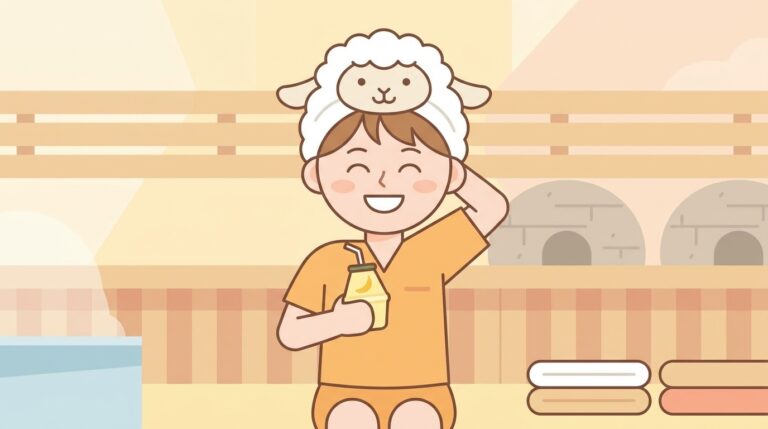
Setting: Saturday afternoon inside a massive Jjimjilbang in Seoul. You and your Korean friend, Minji, just stepped out of the 60°C Hanjeungmak (hot kiln). You are both wearing the standard orange sauna uniforms and the famous ‘Yang-meori’ (sheep head) towel.
Characters:
– YOU: A foreigner in Korea, trying the Jjimjilbang for the first time.
– Minji (28): Your friendly Korean friend who loves sauna dates.
Dialogue:
Minji: 휴, 진짜 덥다! 괜찮아요? 🚿
(Hyu, jinjja deopda! Gwaenchanayo?)
[Phew, it’s really hot! Are you okay?]
YOU: 네, 근데 땀을 너무 많이 흘렸어요. 💦
(Ne, geunde ttameul neomu mani heullyeosseoyo.)
[Yes, but I sweated too much.]
Minji: 우리 이제 씻고 나가요.
(Uri ije ssitgo nagayo.)
[Let’s wash up and go out now.]
(…30 minutes later, after a refreshing shower…)
YOU: 와, 진짜 개운해요!
(Wa, jinjja gaeunhaeyo!)
[Wow, I feel really refreshed!]
Minji: 그렇죠? 그게 찜질방의 매력이에요. 😄
(Geureochyo? Geuge jjimjilbang-ui maeryeogieyo.)
[Right? That’s the charm of the Jjimjilbang.]
YOU: 몸이 너무 가벼워요.
(Momi neomu gabyeowoyo.)
[My body feels so light.]
Minji: 야, 이제 뭐 좀 마셔야죠.
(Ya, ije mwo jom masyeoyajyo.)
[Hey, we need to drink something now.]
YOU: 아, 목말라요.
(A, mongmallayo.)
[Ah, I’m thirsty.]
Minji: 뭐 마실래요? 제가 쏠게요!
(Mwo masillaeyo? Jaega ssolgeyo!)
[What do you want to drink? It’s on me!]
🔀 Your Turn! How should you reply?
– A) “물 주세요.” (Water, please.)
– B) “바나나 우유 먹을래요!” (I want banana milk!)
– C) “아무거나 좋아요.” (Anything is fine.)✅ Best Choice: B! While water is fine, asking for Banana Milk (or Sikhye) shows you truly understand Korean sauna culture. Minji will be extremely impressed by your local knowledge!
Phase 6: 10-Second Shadowing Drill
Practice saying these out loud. Pay attention to the pauses (/) and the emotion!
😌 (Deep breath) 아~ / 진짜 / 개운하다!
(A~ / jinjja / gaeunhada!)
[Ah~ I feel really refreshed!]
😋 (Excited) 여기 / 바나나 우유 / 두 개 주세요!
(Yeogi / banana uyu / du gae juseyo!)
[Over here, two banana milks, please!]
Phase 7: K-Culture Mini Dictionary
| 한국어 (Korean) | Romanization | English | Context/Meaning |
|---|---|---|---|
| 찜질방 | jjimjilbang | Korean public sauna | A 24-hour bathhouse with hot kilns, sleeping areas, and snack bars. |
| 개운하다 | gaeunhada | To feel refreshed | The physical and mental lightness after washing or sleeping. |
| 시원하다 | siwonhada | Refreshing / Cool | Used for cold weather, but also for hot soup, massages, and hot baths! |
| 양머리 | yang-meori | Sheep head | Folding a towel to look like sheep horns. A cute sauna tradition! |
| 때밀이 | ttaemiri | Body scrub | The intense (and painful) Korean full-body exfoliation service. |
Phase 8: Traveler Survival Kit
If you visit a Jjimjilbang, keep these phrases handy!
🆘 Survival Phrases
– 🇰🇷 “수건 하나 더 주세요.” (Sugeon hana deo juseyo.)
– 🗣️ [One more towel, please.]
– 📍 Where to use: At the front desk or locker room counter.
- 🇰🇷 “이거 어떻게 계산해요?” (Igeo eotteoke gyesanhaeyo?)
- 🗣️ [How do I pay for this?]
- 📍 Where to use: At the snack bar.
📌 Editor’s Travel Note: The Magic Key!
– Cash vs. Key: Do not bring cash or your credit card into the sauna! When you enter, you get a locker key bracelet. You use this bracelet to tap and pay for EVERYTHING (food, massage chairs). You pay the total bill at the front desk when you leave.
– Towels: Men usually have unlimited towels in the locker room, but women are given exactly two towels at the front desk (due to different usage habits). Don’t lose them!
Phase 9: Critical Thinking — “One Step Deeper”
🧠 Think Deeper: Language & Culture – The Paradox of “Siwonhada”
Why do Koreans associate boiling hot baths and spicy, boiling soups with the word for “cool” (Siwonhada)? This stems from traditional Korean medicine concepts. It’s believed that sweating and opening your pores releases trapped heat, toxins, and internal stress (Hwa). When that heavy, blocked energy leaves your body, the resulting sensation is light, breezy, and “cool.” So, when a Korean says a hot bath is “cool,” they aren’t talking about the water’s temperature—they are talking about their soul feeling liberated!
💬 Your Turn: Does your culture have a unique remedy for stress or fatigue that foreigners might find strange? Share it in the comments!
Phase 10: FAQ & Avoiding Misunderstandings
Q: Can I wear a swimsuit in the bath area?
No! This is a very common foreigner mistake. In the gender-segregated bath areas, everyone must be 100% naked. It might feel awkward at first, but no one is looking at you. (However, in the shared Jjimjilbang areas, you wear the provided orange/pink uniform!).
Q: Can I say “개운하다(gaeunhada)” when I drink cold water?
Not really. For cold drinks, just use “시원하다” (siwonhada). Gaeunhada is strictly for the feeling of your body recovering (after a shower, after sweating, or after a long sleep).
❌ Common Mistake: Translating “I’m hot” literally in the sauna.
Do NOT say: “저는 핫해요.” (Jeoneun hataeyo). This slang actually means “I am sexy/popular”!
✅ Do this instead: Say “너무 더워요” (Neomu deowoyo – It is too hot) or just “덥다!” (Deopda!).
Phase 11: Summary & Action Items
📌 One-Liner Summary: Say “Siwonhada” when you get in the hot tub, say “Gaeunhada” when you step out, and always drink Banana Milk!
🎯 Action Missions:
– 🥉 Bronze (Solo): Stand in front of your mirror after your next shower and loudly say, “아~ 개운하다!”
– 🥈 Silver (Online): Fold a towel into a ‘Yang-meori’ (search YouTube for a tutorial!), take a selfie, and post it to a Korean learning community with the word #개운해요.
– 🥇 Gold (Real Life): Visit a Korean Spa (they exist in many major cities worldwide now!) and use your magic key bracelet to order Banana Milk in Korean.
Phase 12: Quiz — Interactive Challenge
1. You are stepping into a very hot bath. What is the most natural thing to say?
A) 아~ 따뜻하다! (Ah~ warm!)
B) 아~ 시원하다! (Ah~ cool/refreshing!)
C) 아~ 핫해요! (Ah~ sexy!)
2. Fill in the blank: The most popular drink to buy after a Korean sauna is _______.
A) 소주 (Soju)
B) 따뜻한 커피 (Hot coffee)
C) 바나나 우유 (Banana milk)
3. True or False: You should bring your credit card into the sauna room to buy snacks.
A) True
B) False
(Answers: 1. B – because of the cultural paradox! / 2. C – It’s the ultimate post-sauna ritual. / 3. False – You pay by tapping your locker key bracelet!)
Frequently Asked Questions (FAQ)
Q: What does "진짜 개운해요! (I feel really refreshed!)" mean in Korean and how do you pronounce it?
A: In Korean, "진짜 개운해요! (I feel really refreshed!)" is pronounced [Jinjja gaeunhaeyo! [gae sounds like 'get' without the 't', eun uses the 'eu' sound, which sounds like the disgusted sound you make when stepping in gum.] and means: Literal (It is refreshed) vs. Real (I feel completely cleansed, light, and refreshed).
Q: What does "아~ 시원하다! (Ah~ That hits the spot!)" mean in Korean and how do you pronounce it?
A: In Korean, "아~ 시원하다! (Ah~ That hits the spot!)" is pronounced [A~ siwonhada!] and means: Literal (It is cool/cold) vs. Real (It feels refreshing / It hits the spot).
Q: What does "바나나 우유 하나 주세요. (One banana milk, please.)" mean in Korean and how do you pronounce it?
A: In Korean, "바나나 우유 하나 주세요. (One banana milk, please.)" is pronounced [Banana uyu hana juseyo.] and means: I would like one banana milk.







