

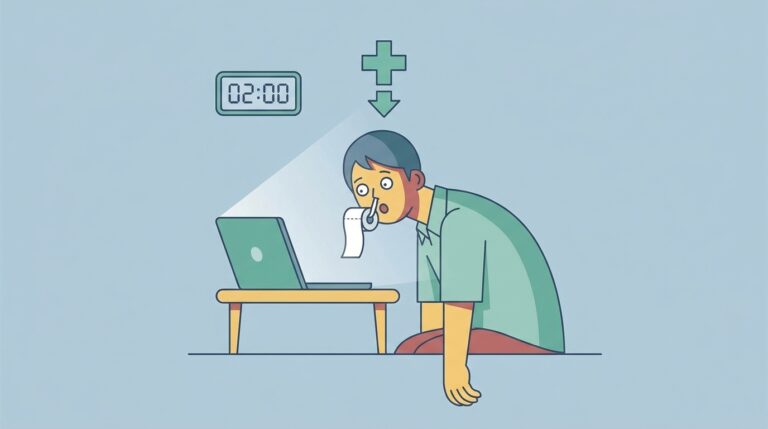
Phase 1: Empathy (The K-Drama Nosebleed Moment)
Hello! I’m your Daily Hangul Editor.
Picture this: You are watching a classic K-Drama. The protagonist, a high school student preparing for the Suneung (college entrance exam), is studying at 2 AM. Suddenly, a drop of blood falls onto their textbook. They gasp, grab a tissue, and instantly tilt their head back, pinching the bridge of their nose. Or maybe it’s a passionate office worker who has pulled three all-nighters in a row. The iconic ‘K-Drama Nosebleed’ (코피) is the ultimate cinematic badge of honor for extreme hard work and passion.
But here is the problem: As an advanced Korean learner and a rational adult, you know that tilting your head back during a nosebleed is a huge medical no-no.
What happens when your Korean colleague, exhausted from preparing a presentation, actually gets a nosebleed and instinctively pulls a K-Drama move? At a C2 level, simply shouting “Oh no, hospital!” isn’t enough. You need the exact vocabulary to confidently manage the situation, explain the correct posture (leaning forward), and navigate the cultural nuance of caring for someone in Korea. Let’s dive into the real, life-saving Korean expressions you won’t easily find in standard textbooks.
Phase 2: Core Expressions Deep Dive
1. 고개를 뒤로 젖히지 말고, 앞으로 숙이세요.
- Pronunciation: gogaereul dwiro jeochiji malgo, apeuro sugiseyo. [Think of ‘jeochiji’ as sounding like a gentle sneeze ‘choo-chi’, and ‘sugi’ rhymes with ‘boogie’]
- Meaning: Don’t tilt your head back, lean it forward.
- K-Culture Moment: You are in a study cafe in Sinchon. The student next to you gets a nosebleed and immediately looks up at the ceiling. You gently hand them a wet tissue and offer this precise advice.
- Editor’s Insight: The verb ‘젖히다’ (to tilt back/bend back) and ‘숙이다’ (to bow/lean forward) are perfect antonyms here. While ‘숙이다’ is often associated with bowing (인사할 때 고개를 숙이다), here it implies a protective physical posture.
- Situation Spectrum:
- Friends (Casual): ✅ (고개 뒤로 젖히지 말고 앞으로 숙여!)
- Colleagues (Semi-formal): ✅
- Boss/Elders (Formal): ⚠️ (Needs softening: 부장님, 고개를 앞으로 숙이시는 게 좋습니다.)
- 🤔 Think About It: Why does Korean have so many specific verbs for body movements (e.g., 젖히다, 숙이다, 끄덕이다, 갸우뚱하다)? It reflects a high-context culture where subtle physical cues often carry as much meaning as spoken words.
2. 콧방울 양쪽을 꽉 누르셔야 해요.
- Pronunciation: kotbangul yangjjogeul kkwak nureusyeoya haeyo. [‘kkwak’ sounds like the quack of a duck, short and tight]
- Meaning: You need to pinch both sides of your nostrils firmly.
- K-Culture Moment: The school nurse (보건 선생님) in a K-Drama firmly instructing a student.
- Editor’s Insight: ‘콧방울’ (literally ‘nose drops’) refers to the fleshy sides of the nostrils. Notice the mimetic word (의태어) ‘꽉’ (tightly/firmly). In Korean emergencies, we rely heavily on these sound/action words because they convey urgency and intensity much faster than descriptive adjectives.
- Situation Spectrum:
- Friends (Casual): ✅ (코 꽉 잡아!)
- Colleagues (Semi-formal): ✅
- Boss/Elders (Formal): ✅ (콧방울을 꽉 누르십시오.)
- 🤔 Think About It: Can you think of other Korean mimetic words used in emergencies? (e.g., 꾹 누르다, 휙 피하다).
3. 피가 목으로 넘어가면 삼키지 말고 뱉으세요.
- Pronunciation: piga mogeuro neomeogamyeon samkiji malgo baeteuseyo.
- Meaning: If the blood goes down your throat, don’t swallow it, spit it out.
- K-Culture Moment: A doctor at an ENT clinic (이비인후과) explaining post-treatment care.
- Editor’s Insight: ‘넘어가다’ usually means ‘to cross over’ or ‘to move on’, but anatomically, it vividly describes fluids going down the wrong pipe or down the throat. ‘뱉다’ (to spit) is direct but necessary here for medical reasons.
- Situation Spectrum:
- Friends (Casual): ✅ (피 넘어가면 뱉어.)
- Colleagues (Semi-formal): ✅
- Boss/Elders (Formal): ✅
Phase 3: Textbook vs. Real Korean
[Situation 1: Discovering the nosebleed]
* 📖 Textbook: 코피가 나고 있습니다. 괜찮습니까? (You are bleeding from the nose. Are you okay?)
* 🗣️ Real Korean: 헐, OOO씨 코피 나요! 일단 여기 휴지요. (Omg, you’re getting a nosebleed! Here’s a tissue first.)
* 💡 Why the difference?: Real emergencies start with an exclamation (‘헐’, ‘어머’) and immediate action (‘일단’ – first of all) rather than analytical statements.
[Situation 2: Instructing the posture]
* 📖 Textbook: 지혈을 돕기 위해 머리를 앞쪽으로 기울이십시오. (Please incline your head forward to assist hemostasis.)
* 🗣️ Real Korean: 고개 뒤로 하면 안 돼요! 앞으로 푹 숙이세요.
* 💡 Why the difference?: Koreans use ‘푹’ (deeply) to emphasize the degree of the action. It’s direct, caring, and efficient.
Phase 4: Cultural Context — K-Culture Deep Dive
4-1. Non-verbal ‘Nunchi’ in Medical Moments
If a colleague gets a nosebleed in a public office setting, the ultimate Nunchi (눈치) move is to block them from the view of others while handing them tissues. In Korea, showing physical vulnerability (like bleeding) in a professional setting can make the person feel deeply embarrassed. Shielding them physically and keeping your voice low, rather than making a huge dramatic scene, is highly appreciated.
4-2. The ‘Passion’ Trope in K-Dramas
In Western media, a spontaneous nosebleed often hints at a severe underlying illness (or telekinetic powers, a la Stranger Things). In K-Dramas, it is almost exclusively a symbol of 열정 (Passion) and 과로 (Overwork).
If someone gets a ‘쌍코피’ (double nosebleed) while studying, their parents might secretly feel a twinge of pride amidst their worry, as it physically proves how hard the student is working. However, this romanticization of exhaustion is slowly changing in modern Korean society, which is pushing back against toxic work cultures.
Phase 5: Real-Life Roleplay Scenario
Setting: 10:30 PM. A dimly lit meeting room at your company in Gangnam. You and your passionate junior colleague, Min-su (28), are finalizing a pitch deck for tomorrow. Min-su has been drinking iced Americanos all day without eating properly.
Characters:
– YOU (The Reader): An expat senior manager who cares about their team.
– Min-su (28): Hardworking, slightly stressed, tends to watch too many K-Dramas.
Dialogue:
Min-su: 책임님, 이 슬라이드 데이터만 수정하면 끝날 것 같… 어? (Chaegimnim, i seullaideu deiteoman sujeonghamyeon kkeunnal geot gat… eo?)
[Manager, if I just edit the data on this slide, I think we’ll be… huh?]
(🎭 Stage Direction: Min-su touches his nose, looks at his hand, and gasps. Blood! He immediately throws his head back to look at the ceiling.)
YOU: 헉, 민수 씨 코피 나요! (Heok, Minsu ssi kopi nayo!)
[Gasp, Min-su, your nose is bleeding!]
Min-su: 으아, 죄송합니다. 며칠 밤을 새웠더니… (Eua, joesonghamnida. Myeochil bameul saewotdeoni…)
[Ugh, I’m sorry. I’ve stayed up all night for a few days so…]
YOU: 사과할 일이 아니에요. 일단 이거 받아요. (Sagwahal iri anieyo. Ildan igeo badayo.)
[This is nothing to apologize for. Take this first.] (Hands over a tissue)
🔀 Your Turn! How do you correct his posture?
– A) “목을 뒤로 굽히지 마세요. 위험해요.”
– B) “민수 씨, 고개 뒤로 젖히면 피가 기도로 넘어가요. 고개 앞으로 푹 숙이세요!”
– C) “쌍코피네요? 열정이 대단합니다.”✅ Best Choice: B — It explicitly corrects the dangerous K-Drama posture, explains why (blood going down the airway), and uses the correct C2 vocabulary (젖히다/숙이다).
⚠️ Choice A Analysis: ‘목을 굽히다’ is anatomically weird; ‘고개를 젖히다’ is the natural collocation.
⚠️ Choice C Analysis: Funny, but not appropriate while he is actively bleeding and panicking!
Min-su: 아, 뒤로 넘기면 안 되나요? 드라마에선 다 이러던데… (A, dwiro neomgimyeon an doenayo? Deuramaeseon da ireodeonde…)
[Oh, shouldn’t I tilt it back? They all do this in dramas…]
YOU: 절대 안 돼요. 콧등 아래쪽을 꽉 누르고 입으로 숨 쉬세요. (Jeoldae an dwaeyo. Kotdeung araejjogeul kkwak nureugo ibeuro sum swiseyo.)
[Absolutely not. Pinch the lower part of your nose bridge tightly and breathe through your mouth.]
Phase 6: 10-Second Shadowing Drill
Master the tone of an urgent but caring colleague!
😤 고개를 / 뒤로 젖히면 / 안 돼요! / 앞으로 / 푹~ / 숙이세요!
(gogaereul / dwiro jeochimyeon / an dwaeyo! / apeuro / puk~ / sugiseyo!)
Phase 7: K-Culture Mini Dictionary
| 한국어 | Romanization | English | Context |
|---|---|---|---|
| 쌍코피 | ssangkopi | Double nosebleed | Slang for bleeding from both nostrils; a comedic symbol of extreme exhaustion. |
| 밤샘 | bamsaem | Staying up all night | The root cause of the K-Drama nosebleed. |
| 눈치 | nunchi | Social intuition | Knowing to quietly hand a tissue without making a scene. |
| 이비인후과 | ibiinhugwa | ENT Clinic | Where you go in Korea if a nosebleed won’t stop. (Ear-Nose-Throat) |
| 지혈 | jihyeol | Hemostasis / Stopping the bleeding | A high-level medical term good to know for emergencies. |
Phase 8: Traveler & Expat Survival Kit
Even if you aren’t in a meeting, a dry Korean winter can easily cause nosebleeds while traveling!
🆘 Survival Expressions
– 🇰🇷 “근처에 문 연 약국 있나요?” (geuncheoe mun yeon yakguk innayo?)
– 🗣️ Meaning: Is there an open pharmacy nearby?
– 📍 Where to use: Asking hotel concierges or convenience store clerks.
- 🇰🇷 “지혈할 수 있는 솜이나 거즈 있나요?” (jihyeolhal su inneun somina geojeu innayo?)
- 🗣️ Meaning: Do you have cotton or gauze to stop bleeding?
- 📍 Where to use: Inside the pharmacy.
📌 Editor’s Medical Note
– Where to go: In many Western countries, you might go to a General Practitioner (내과/가정의학과). In Korea’s highly specialized medical system, if you have an unstopping nosebleed, search for the nearest 이비인후과 (ENT clinic) on Naver Maps. They have specialized suction and cauterization tools ready to go.
Phase 9: Critical Thinking — “One Step Deeper”
Media vs. Reality: The Romanticization of Overwork
Why do K-Dramas make nosebleeds look… almost heroic? The ‘K-Drama Nosebleed’ perfectly encapsulates Korea’s complex relationship with labor and academic pressure. In a hyper-competitive society, a physical breakdown was historically viewed as the ultimate visual proof that you gave 100% of your effort. It romanticizes the sacrifice of the body for the sake of success. However, as the younger generation prioritizes ‘Work-Life Balance’ (워라밸), this trope is increasingly used for comedy rather than genuine drama, reflecting a societal shift away from glorifying pure exhaustion.
🧠 Think Deeper:
Does your home country’s media have a specific physical trope that symbolizes hard work or stress? How does it compare to the Korean nosebleed?💬 Your Turn: Let us know in the comments how your culture reacts to overwork in movies vs. reality!
Phase 10: FAQ & Avoiding Misunderstandings
- Q: In an emergency, is it okay to drop honorifics (존댓말) and use Banmal?
- A: Maybe, but be careful. If it’s a life-or-death split-second emergency (“Watch out!”), short banmal is natural. But for instructing first aid like a nosebleed, maintain politeness with
~(으)세요. It shows respect and keeps the situation calm.
- A: Maybe, but be careful. If it’s a life-or-death split-second emergency (“Watch out!”), short banmal is natural. But for instructing first aid like a nosebleed, maintain politeness with
- Q: Can I just tell them to put a tissue up their nose?
- A: Koreans often roll up a tissue and plug the nose (휴지로 틀어막다). It’s a common cultural practice, though ENT doctors advise against it as removing it can restart the bleeding. You might see this often!
❌ Common Mistake: Using ‘목’ (neck/throat) instead of ‘고개’ (head/posture) when telling someone to nod or tilt.
✅ Do this: Say “고개를 푹 숙이세요” (Tilt your head down). “목을 숙이세요” sounds unnatural, like you are asking them to physically bend their neck bones.
Phase 11: Summary & Action Items
- One-Liner Summary: To treat a nosebleed and sound like an advanced Korean speaker, tell them to stop acting like a K-Drama character and say: “고개를 뒤로 젖히지 말고 앞으로 숙이세요!”
-
Action Mission 3 Steps:
- 🥉 Bronze: Say “고개를 앞으로 숙이세요” out loud 3 times while physically mimicking the motion.
- 🥈 Silver: Write a short diary entry in Korean about the last time you were so tired you felt like you’d get a ‘쌍코피’.
- 🥇 Gold (Real Life): Next time you watch a K-Drama and someone gets a nosebleed, shout the correct medical advice at the screen in Korean!
- K-Culture Mission: Go to a Korean webtoon platform (like Naver Webtoon) or search images for ‘쌍코피’. Notice how it’s drawn with comedic exaggeration to show someone who has studied all night!
Phase 12: Interactive Quiz
1. Situational Judgment: Your boss gets a nosebleed during a meeting and tilts his head back. What is the most polite yet effective C2-level response?
– A) 부장님, 고개 뒤로 하면 피 먹어요!
– B) 부장님, 고개를 뒤로 젖히지 마시고 앞으로 숙이시는 게 지혈에 좋습니다.
– C) 헐, 부장님 쌍코피 대박!
(Answer: B. It maintains deep respect while providing exact medical reasoning using advanced vocabulary.)
2. Fill in the Blank:
피가 뒤로 ( _____ ) 기도로 들어갈 수 있으니 뱉으셔야 합니다.
(Answer: 넘어가면 – goes down/crosses over)
3. True or False – Culture Edition:
In modern Korean corporate culture, getting a nosebleed from working 3 days straight is universally praised by HR as a sign of an excellent employee. (T/F)
(Answer: False. While historically romanticized, modern HR and younger workers view extreme overwork negatively, preferring efficiency and work-life balance.)
Frequently Asked Questions (FAQ)
Q: What does "고개를 뒤로 젖히지 말고, 앞으로 숙이세요." mean in Korean and how do you pronounce it?
A: In Korean, "고개를 뒤로 젖히지 말고, 앞으로 숙이세요." is pronounced [gogaereul dwiro jeochiji malgo, apeuro sugiseyo. [Think of 'jeochiji' as sounding like a gentle sneeze 'choo-chi', and 'sugi' rhymes with 'boogie'] and means: Don't tilt your head back, lean it forward.
Q: What does "콧방울 양쪽을 꽉 누르셔야 해요." mean in Korean and how do you pronounce it?
A: In Korean, "콧방울 양쪽을 꽉 누르셔야 해요." is pronounced [kotbangul yangjjogeul kkwak nureusyeoya haeyo. ['kkwak' sounds like the quack of a duck, short and tight] and means: You need to pinch both sides of your nostrils firmly.
Q: What does "피가 목으로 넘어가면 삼키지 말고 뱉으세요." mean in Korean and how do you pronounce it?
A: In Korean, "피가 목으로 넘어가면 삼키지 말고 뱉으세요." is pronounced [piga mogeuro neomeogamyeon samkiji malgo baeteuseyo.] and means: If the blood goes down your throat, don't swallow it, spit it out.






