

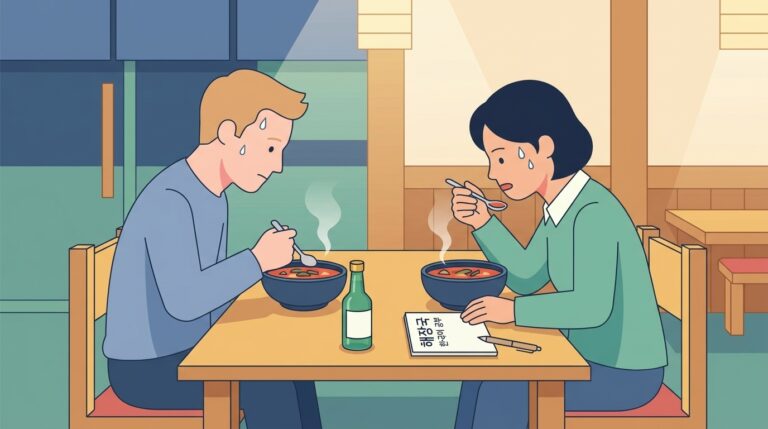
Surviving the Morning After: The Ultimate B2 Guide to Korean ‘Haejang’ Culture
Phase 1: Empathy & K-Culture Cold Open
Hello! This is your Daily Hangul Editor.
Picture this K-Drama scene: It’s 9:00 AM. The camera pans across a brightly lit Seoul office. The protagonist, who was cheerfully clinking soju glasses and shouting “Geonbae!” at a barbecue restaurant until 2 AM last night, is now slumped over their desk. Their eyes are red, they are holding an iced Americano like a lifeline, and they whisper a single, desperate word to their coworker: “Haejang…”
If you work, study, or even just socialize in Korea, you will inevitably experience the Hoesik (회식, Company Dinner) culture. But what textbooks often forget to teach you is the survival ritual that happens the morning after.
Knowing how to navigate the hangover—and knowing exactly what to say to your Korean colleagues to suggest grabbing a cure—is the ultimate insider move. It shifts you from “foreigner trying to speak Korean” to “one of us.”
This guide is based on real SOS messages I’ve received from my intermediate (B2) students who found themselves staring at a boiling bowl of red soup at lunch, wondering why everyone was sweating and smiling. Let’s dive into the art of Haejang (해장)!
Phase 2: Core Expressions Deep Dive
1. 속이 안 좋아요
- Pronunciation: [sogi an joayo]
- Meaning: (Literal) My inside is not good. / (Real nuance) My stomach is upset / I feel nauseous.
- K-Culture Moment: You are standing by the office water cooler. Your senior looks at your pale face. You rub your stomach slightly and drop this phrase. Instantly, they understand you’ve had too much Somaek (Soju + Beer) the night before.
- Editor’s Insight: We don’t usually say “my stomach hurts” (배가 아파요) for a hangover. ‘배’ is the physical belly, but ‘속’ (inside) refers to your internal condition, specifically digestion or nausea. It’s also used when you’re emotionally upset, but in the morning after a Hoesik, it means 100% hangover.
- Situation Spectrum:
- Close Friends (Casual – 속 안 좋아): ✅
- Coworkers (Semi-formal): ✅
- Boss (Formal – 속이 안 좋습니다): ⚠️ (Use with caution; better to just say you’re generally unwell to the boss!)
- 🤔 Think About It: Why does Korean have a specific word for ‘inside’ (속) to describe physical and emotional states? How do you express an ‘upset stomach’ in your native language—is it physical or emotional?
2. 우리 해장하러 가요
- Pronunciation: [uri haejanghareo gayo]
- Meaning: (Literal) Let’s go do hangover-cure. / (Real nuance) Let’s go grab some hangover food.
- K-Culture Moment: The clock strikes 11:30 AM. Eye contact is made across the cubicles. The unspoken agreement is sealed with this phrase. You are heading to the nearest Gukbap (soup and rice) restaurant.
- Editor’s Insight: Haejang acts almost like a verb. It’s not just “eating”; it’s a therapeutic ritual. When you suggest this, you are telling your coworker, “I acknowledge our shared suffering, let us heal together.”
- Situation Spectrum:
- Close Friends (Casual – 해장하러 가자): ✅
- Coworkers (Semi-formal): ✅
- Boss (Formal): 🚫 (Let the boss suggest it first!)
- 🤔 Think About It: Do you have a specific verb or cultural ritual dedicated entirely to “curing a hangover” in your country?
3. 국물이 시원해요
- Pronunciation: [gungmuri siwonhaeyo]
- Meaning: (Literal) The broth is cool. / (Real nuance) The broth is so refreshing / It hits the spot!
- K-Culture Moment: You take a spoonful of boiling, spicy, red Jjamppong (spicy seafood noodle soup). You are sweating. You let out a deep “Ahhh~” and say this. Your Korean colleagues will instantly give you a standing ovation.
- Editor’s Insight: This is the ultimate Korean paradox. ‘시원하다’ means ‘cool’ or ‘refreshing’ (like an ocean breeze). But Koreans use it for boiling hot soup! It describes the sensation of your insides being “cleared out” or “unclogged.”
- Situation Spectrum:
- Close Friends (Casual – 아, 시원하다!): ✅
- Coworkers (Semi-formal): ✅
- Boss (Formal – 국물이 시원하네요): ✅
- 🤔 Think About It: Can “hot” and “refreshing” coexist in your culture’s culinary vocabulary?
Phase 3: Textbook vs. Real Korean
[Describing your Hangover]
* 📖 Textbook Korean: 저는 어제 술을 많이 마셔서 머리가 아픕니다. (I drank a lot of alcohol yesterday, so my head hurts.)
* 🗣️ Real Korean: 아, 숙취… 해장 절실해요. (Ah, hangover… I desperately need Haejang.)
* 💡 Why it’s different: Textbooks focus on grammatical cause and effect. Real Koreans focus on the immediate sensation and the solution. ‘절실하다’ (desperate) adds that dramatic, relatable flair.
[Suggesting Lunch]
* 📖 Textbook Korean: 술을 깨기 위해 국물을 먹읍시다. (Let us eat broth to sober up.)
* 🗣️ Real Korean: 오늘 점심은 짬뽕 콜? (Jjamppong for lunch today, deal?)
* 💡 Why it’s different: “콜” (Call) is widely used slang adopted from poker/gaming, meaning “I’m in” or “Deal.” It makes you sound instantly fluent and casual.
Bottom Note: For B2 level, try to drop the overly rigid ‘-(스)ㅂ니다’ endings with close coworkers and adopt natural ‘해요체’ (polite/informal) mixed with daily buzzwords like “콜?” (Call?).
Phase 4: Cultural Context — K-Culture Deep Dive
4-1. Non-verbal Communication: The “Ahhh” Sound
Language isn’t just words; it’s sound effects! When eating Haejang soup, sipping silently is almost a sin. You need to make a hearty “크으~” (Keu-eu~) or “아~” (Ahhh~) sound after swallowing the hot broth. It shows that the soup is working its magic. Also, wiping sweat from your forehead with a napkin while maintaining eye contact with your coworker is a silent nod of solidarity.
4-2. K-Food Connection: The “Fire vs. Fire” Philosophy
Why do Koreans eat spicy, boiling soup when their stomachs are already irritated from alcohol? This is rooted in the concept of 이열치열 (I-yeol-chi-yeol), which means “fighting heat with heat.”
Koreans believe that sweating out the toxins through spicy foods like Gamjatang (Pork bone stew) or Kongnamul-gukbap (Bean sprout soup) is the fastest way to recover. Next time you watch a K-Drama, notice what they eat the morning after drinking—it’s almost never a salad!
Phase 5: Real-life Roleplay Scenario
Setting: Friday, 11:45 AM. The office break room. Last night was the marketing team’s Hoesik, and it ended at a Karaoke room at 2 AM. You and your coworker Minsu are standing by the water purifier, both looking like zombies.
Characters:
– YOU (The Reader): B2 level Korean speaker. You like Korean food but your stomach is currently fragile.
– Minsu (32): Your friendly Korean coworker who bought you too many Soju shots last night.
Dialogue:
Minsu: 〇〇씨, 괜찮아요? 어제 너무 달렸죠? 😅
(〇〇-ssi, gwaenchayo? Eoje neomu dallyeotjyo?)
〇〇, are you okay? We ran too hard (drank too much) yesterday, right?
YOU: 아… 속이 너무 안 좋아요. 죽겠어요.
(Ah… sogi neomu an joayo. Jukgesseoyo.)
Ah… my stomach feels terrible. I’m dying.
Minsu: 저도요. 우리 빨리 해장하러 가요. 메뉴는 생각해 놨어요?
(Jeodoyo. Uri ppalli haejanghareo gayo. Menyuneun saenggakae nwasseoyo?)
Me too. Let’s go get Haejang quickly. Did you think of a menu?
🔀 Your Turn! How do you reply?
– A) 콩나물국밥 어때요? 국물이 시원하잖아요!
– B) 전 해장으로 느끼한 피자가 먹고 싶어요.
– C) 저는 그냥 아이스 아메리카노만 마실게요.✅ Best Choice Analysis:
– A (Classic): The safest, most culturally integrated choice. Minsu will love you.
– B (The MZ Generation Haejang): Surprisingly common among young Koreans! Greasy food for haejang is a trendy alternative.
– C (Survival Mode): Also very common, but Minsu might insist you eat real food to survive the afternoon.
(Let’s continue with A)
YOU: 콩나물국밥 어때요? 국물이 시원하잖아요!
(Kongnamulgukbap eottaeyo? Gungmuri siwonhajannayo!)
How about bean sprout soup? The broth is so refreshing!
Minsu: 오~ 〇〇씨 진짜 한국인 다 됐네요! 가시죠, 제가 쏠게요!
(Oh~ 〇〇-ssi jinjja hangugin da dwaenneyo! Gasijyo, jaega ssolgeyo!)
Oh~ You’ve become a true Korean! Let’s go, it’s my treat!
(🎭 Stage Direction: Minsu grabs his coat energetically, miraculously cured by the mere thought of soup.)
Phase 6: 10-Second Shadowing Drill
Practice the rhythm and emotion. Pay attention to the pauses (/) and stretch the vowels where indicated (~)!
🥺 아~ / 속이 너무 / 안 좋아요...
(ah~ / sogi neomu / an joayo…)- Emotion: Weak, rubbing your stomach.
😤 오늘 점심은 / 무조건 / 짬뽕입니다!
(oneul jeomsimeun / mujogeon / jjamppong-imnida!)- Emotion: Determined, pointing your finger. “Today’s lunch is unconditionally Jjamppong!”
😊 크으~ / 국물이 / 진짜 시원해요!
(keu-eu~ / gungmuri / jinjja siwonhaeyo!)- Emotion: Refreshed, after swallowing hot soup.
Phase 7: K-Culture Mini Dictionary
| Korean | Romanization | English | Context |
|---|---|---|---|
| 회식 | hoesik | Company dinner | Team bonding event, usually involving a lot of alcohol and meat. |
| 해장 | haejang | Hangover cure | The act of recovering from drinking, usually through food. |
| 해장국 | haejangguk | Hangover soup | A category of hot, hearty soups designed to cure hangovers. |
| 숙취해소제 | sukchwihaesoje | Hangover drink/pill | Sold at convenience stores. Eaten before or after drinking. |
| 필름이 끊기다 | pilleumi kkeunkida | To black out | Literal: “The film is cut.” Used when you can’t remember last night. |
Phase 8: Traveler Survival Kit
If you find yourself in Korea after a wild night out, you might not have the energy for a restaurant. Your best friend is the convenience store (GS25, CU, 7-Eleven).
🆘 Survival Phrases for the Convenience Store
– 🇰🇷 “숙취해소제 어딨어요?” (sukchwihaesoje eodisseoyo?)
– 🗣️ Sound-alike: [sook-chwi-hae-so-jeh uh-di-sso-yo?]
– 📍 Where to use: Any convenience store or pharmacy.
– 💡 Pro Tip: Hangover drinks (like Condition or Dawn 808) are usually kept in a small heated cabinet near the cashier, or in the refrigerated section. Look for the 2+1 or 1+1 tags! Koreans love buying 2+1 and giving the extras to their coworkers the next morning to build Jeong (affection).📌 Editor’s Travel Note
– Pharmacy vs. Convenience Store: Convenience stores sell general “hangover beverages,” but if your hangover is severe, go to a Yakguk (Pharmacy) and say “숙취약 주세요” (Hangover medicine, please). The pharmacist will give you a potent combo of a drink and pills.
Phase 9: Critical Thinking — “One Step Deeper”
Food & Identity: The Cycle of Shared Suffering and Healing
🧠 Think Deeper:
In Korean corporate culture, Hoesik is often seen as an extension of work—a way to break down hierarchical barriers over drinks. But the true team bonding often happens the next day during Haejang. By sweating over the same boiling soup and collectively complaining about hangovers, coworkers share vulnerability. It is a cycle of shared suffering (drinking together) and shared healing (eating together) that builds “Jeong” (정), the deep Korean sense of communal affection.💬 Your Turn: Does your workplace have a culture of socializing outside of hours? How do colleagues bond over shared struggles in your culture? Let us know in the comments!
Phase 10: FAQ & Avoiding Misunderstandings
Q: Can I tell my boss “저 숙취 있어요” (I have a hangover)?
A: NO! 🚫 Even if you drank with your boss the night before, directly saying you have a hangover to a superior sounds unprofessional. Instead, use a polite excuse: “몸이 좀 안 좋습니다” (I’m not feeling very well).
Q: Does “시원하다” (Siwonhada) only apply to spicy soup?
A: Maybe. It applies to anything that relieves you! A cold beer on a hot day is siwonhada. A boiling soup on a hungover stomach is siwonhada. Even getting a good shoulder massage is siwonhada!
❌ Common Mistake #1: Ordering “Cold soup” by mistake.
✅ Do this instead: Don’t ask the waiter for “시원한 국물” expecting it to be temperature-cold. If you want cold noodles, you must specifically order Naengmyeon (냉면). If you ask for siwonhan gukmul, they will bring you a hot, refreshing broth!
Phase 11: Summary & Action Items
One-Liner Summary: Master the art of the morning after by suggesting Haejang (해장) and complimenting the hot broth as Siwonhaeyo (시원해요)!
Action Mission 3 Steps:
– 🥉 Bronze (Solo): Stand in front of your mirror and practice the “Ahhh~ Gungmuri siwonhaeyo” acting 3 times.
– 🥈 Silver (Online): Post on your language exchange app: “What is your favorite 해장국?”
– 🥇 Gold (Real Life): Next time you drink with a Korean friend, text them the next morning: “속 안 좋죠? 해장하러 가요!”
🎬 K-Culture Mission:
Go to a Korean convenience store (or an Asian supermarket) and buy a Korean hangover drink or instant spicy ramen (like Shin Ramyun). Cook it, eat it, and try to feel the “Siwonhada” sensation!
Phase 12: Quiz — Interactive Challenge
1. Situational Judgment:
You are eating a boiling hot Gamjatang (Pork bone soup) with your manager. You take a sip and it perfectly cures your hangover. What is the most culturally appropriate B2-level response?
– A) 매워요! (It’s spicy!)
– B) 아~ 국물이 시원하네요! (Ah~ the broth is refreshing!)
– C) 저 숙취 있어요. (I have a hangover.)
2. Fill in the Blank:
“어제 소주를 너무 많이 마셨더니 ( _____ )이/가 안 좋아요.”
(I drank too much soju yesterday, so my ( _____ ) is not good.)
– A) 배
– B) 속
– C) 머리
3. True or False — K-Culture Edition:
“In Korea, people only eat cold foods to cure a hangover because their bodies are already hot from the alcohol.” (T/F)
👀 Click here for answers!
1. B – It shows you understand the Korean concept of “Siwonhada” even for hot soups. ‘A’ is okay but basic. ‘C’ is a big no-no to a manager!
2. B (속) – While your head (머리) might hurt, ‘속이 안 좋다’ is the most natural idiom for feeling hungover/nauseous.
3. False – Koreans love “I-yeol-chi-yeol” (fighting heat with heat) and usually eat boiling hot, spicy soups for Haejang!
Frequently Asked Questions (FAQ)
Q: What does "속이 안 좋아요" mean in Korean and how do you pronounce it?
A: In Korean, "속이 안 좋아요" is pronounced [sogi an joayo] and means: (Literal) My inside is not good. / (Real nuance) My stomach is upset / I feel nauseous.
Q: What does "우리 해장하러 가요" mean in Korean and how do you pronounce it?
A: In Korean, "우리 해장하러 가요" is pronounced [uri haejanghareo gayo] and means: (Literal) Let's go do hangover-cure. / (Real nuance) Let's go grab some hangover food.
Q: What does "국물이 시원해요" mean in Korean and how do you pronounce it?
A: In Korean, "국물이 시원해요" is pronounced [gungmuri siwonhaeyo] and means: (Literal) The broth is cool. / (Real nuance) The broth is so refreshing / It hits the spot!







