

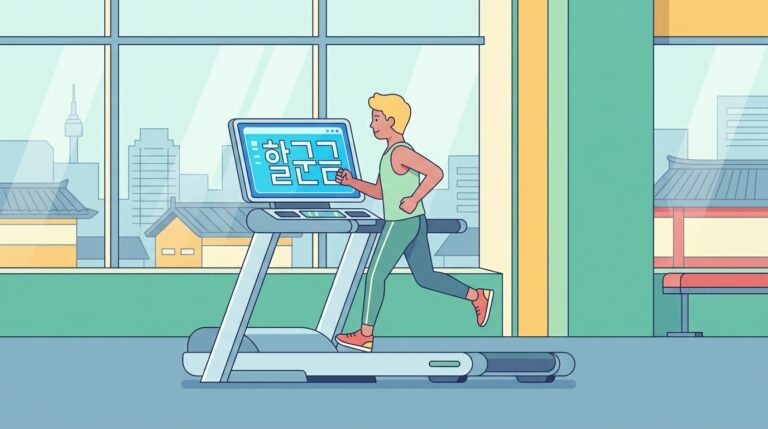
Surviving a Korean Gym: Master the Treadmill and Workout Like a K-Drama Lead
Phase 1: Empathy & K-Culture Cold Open
Hello! I’m your Daily Hangul Editor, your personal veteran tutor and Seoul culture navigator.
Imagine this: You’ve just watched a K-Drama where the handsome CEO aggressively runs on a treadmill, sweating perfectly while brooding over his complicated love life. Inspired, you decide to hit the local gym (헬스장, helseujang) in Seoul. You walk in, ready to sweat, but suddenly you realize… the treadmill buttons are entirely in Korean! To make matters worse, a staff member is pointing at your shoes and crossing their arms. What went wrong?
Navigating a Korean gym can be a culturally unique experience. From strict shoe etiquette to Konglish terms like “Running Machine,” stepping onto a treadmill here is more than just a workout—it’s a cultural immersion. Today, we’ll learn exactly what to say so you don’t freeze up when you want to get your daily steps in.
Note: This guide is based on real panicked text messages from my beginner students who found themselves stranded in a Seoul gym!
Phase 2: Core Expressions Deep Dive
Here are the absolute essential survival phrases for your A2 (Beginner) level gym experience.
1. 다 쓰셨어요? (Are you done using this?)
- Pronunciation: da sseusyeosseoyo? [da / sseu-shuss-uh-yo?]
- Sound guide: The ‘eu’ in ‘sseu’ sounds like the disgusted groan you make when stepping in sticky gum.
- Meaning: Literal: Have you used it all? / Real nuance: Are you finished with this machine?
- K-Culture Moment: Korean gyms during peak evening hours (6 PM – 8 PM) are packed. People sometimes leave their towels on a treadmill to “reserve” it while they get water. If you’re unsure if a machine is free, a polite tap on the shoulder and this phrase works like magic.
- Editor’s Insight: This phrase isn’t just for gyms! You can use it at cafes for empty chairs or at offices for shared printers. It feels polite, non-confrontational, and perfectly natural.
- Situation Spectrum:
- Casual with friends: ✅ (다 썼어? – da sseosseo?)
- Gym strangers/Semi-formal: ✅ (Perfect fit)
- Formal/Elders: ⚠️ (A bit too direct; add “혹시” (by any chance) at the beginning)
- 🤔 Think About It: Koreans highly value shared spaces and “nunchi” (reading the room). Why do you think asking “Have you used it all?” is preferred over “Can I use this?”
2. 이거 어떻게 켜요? (How do I turn this on?)
- Pronunciation: igeo eotteoke kyeyo? [ee-guh / uh-ttuh-keh / kyuh-yo?]
- Meaning: Literal & Real: How do I turn this on?
- K-Culture Moment: Korean treadmills often come with built-in TVs so you can watch K-Dramas or variety shows while running. But the remote controls are attached to the dashboard and covered in Korean text. When you’re helplessly mashing buttons, this is the phrase to use to ask the trainer for help.
- Editor’s Insight: The verb “켜다” (kyeoda) means to turn on (electronics). Memorize this chunk! It’s a lifesaver for treadmills, air conditioners, and Korean hotel room lights.
- Situation Spectrum:
- Casual with friends: ✅
- Gym staff/Semi-formal: ✅
- Formal/Elders: ⚠️ (Add “실례하지만” – Excuse me)
- 🤔 Think About It: Korean fitness culture heavily integrates entertainment (TVs on every machine). Does your home country do this, or do people mostly stare out the window or at their phones?
3. 속도 좀 낮춰주세요 (Please lower the speed)
- Pronunciation: sokdo jom natchwojuseyo [sok-doh / johm / naht-chwo-joo-seh-yo]
- Meaning: Literal: Please lower the speed a little. / Real: Slow it down, please!
- K-Culture Moment: If you sign up for PT (Personal Training) in Korea, trainers are notoriously passionate. They will push you to your limits! If your trainer cranks up your treadmill speed and you feel like you might fly off, you desperately need this phrase.
- Editor’s Insight: “좀” (jom) literally means “a little,” but in Korean, it’s used to soften requests so you don’t sound bossy. Always sprinkle “jom” into your requests!
- Situation Spectrum:
- Casual with friends: ✅ (속도 좀 낮춰 – sokdo jom natchwo)
- Trainer/Semi-formal: ✅
- Formal/Elders: 🚫 (You wouldn’t dictate speed to a boss!)
- 🤔 Think About It: Why do Koreans use “좀” (a little) even when they want a big change? It’s all about preserving harmony and not sounding demanding.
Phase 3: Textbook vs. Real Korean
Let’s upgrade your textbook Korean to what people actually say while sweating it out in Gangnam.
[Situation 1: Talking about your workout]
* 📖 Textbook Korean: 저는 러닝머신에서 달리고 있습니다. (I am running on the treadmill – Very stiff and robotic)
* 🗣️ Real Korean: 저 지금 러닝머신 뛰고 있어요. (I’m running on the treadmill right now.)
* 💡 Why the difference?: Koreans rarely use the formal “-고 있습니다” in daily text messages. We also drop the location particle “에서” (on) to speak faster.
[Situation 2: Expressing you are tired after the run]
* 📖 Textbook Korean: 저는 매우 피곤합니다. (I am very tired.)
* 🗣️ Real Korean: 아, 힘들어 죽겠어요. (Ah, I’m going to die from exhaustion!)
* 💡 Why the difference?: Koreans love dramatic expressions! Adding “~죽겠다” (to death) emphasizes extreme emotion, whether it’s being tired, hungry, or happy.
[Situation 3: Posting on Social Media]
* 📖 Textbook Korean: 오늘 운동을 마쳤습니다. (I finished today’s exercise.)
* 🗣️ Real Korean: #오운완 (#O-Woon-Wan)
* 💡 Why the difference?: “오운완” is a massive K-slang abbreviation for “오늘 운동 완료” (Today’s Workout Complete). You will see this on every K-Pop idol’s Instagram story!
Phase 4: Cultural Context — K-Culture Deep Dive
4-1. Non-Verbal Communication: The “Indoor Shoe” Rule
If there’s one thing you take away from this post, let it be this: NEVER wear your street shoes on a Korean treadmill. Korean gyms require strict “실내 운동화” (sillae undonghwa – indoor exercise shoes). You must bring clean shoes in a bag and change in the locker room. If you step on a treadmill with muddy street shoes, the staff will use serious nunchi (glaring) to make you step down!
4-2. The K-Drama “Brooding Run”
If you’ve watched 200+ K-Dramas like I have, you know the classic trope: The male lead experiences a misunderstanding with the female lead. The next scene immediately cuts to him running on a treadmill at max speed in a dark, empty gym, sweat glistening, jaw clenched.
Critical View: While dramas make gyms look like dramatic, empty modeling runways, a real Korean gym at 7 PM is a vibrant, crowded community center where grandmas are briskly walking on treadmills while watching daily soap operas. Don’t expect to have the place to yourself!
Phase 5: Real-Life Roleplay Scenario
Setting: Friday evening, 7:30 PM. A bustling local Health-jang near Hongdae. Dance-pop music is blasting. Every single treadmill is taken, but you notice one machine where a towel is draped over the handle, and a Korean guy is standing next to it looking at his phone.
Characters:
– YOU: A foreigner who just wants to run 3 kilometers and go eat Korean BBQ.
– Min-su (28): A friendly local gym-goer wearing the gym’s standard-issue orange uniform.
Dialogue:
YOU: 저기요… 혹시 이거 다 쓰셨어요? 💦
(jeogiyo… hoksi igeo da sseusyeosseoyo?)
[Excuse me… by any chance, are you done using this?]
Min-su: 아, 네! 다 썼어요. 쓰셔도 돼요.
(a, ne! da sseosseoyo. sseusyeodo dwaeyo.)
[Ah, yes! I’m all done. You can use it.]
(🎭 Stage Direction: Min-su quickly grabs his towel and water bottle.)
YOU: 감사합니다! 근데… 이거 어떻게 켜요?
(gamsahamnida! geunde… igeo eotteoke kyeyo?)
[Thank you! But… how do I turn this on?]
Min-su: 아, 여기 초록색 ‘시작’ 버튼 누르시면 돼요.
(a, yeogi choroksaek ‘sijak’ beoteun nureusimyeon dwaeyo.)
[Ah, you just need to press this green ‘Start’ button here.]
YOU: 아하! 속도는 어떻게 높여요?
(aha! sokdoneun eotteoke nopyeoyo?)
[Aha! How do I raise the speed?]
Min-su: 여기 플러스(+) 버튼 계속 누르세요.
(yeogi peulleoseu(+) beoteun gyesok nureuseyo.)
[Keep pressing the plus (+) button here.]
🔀 Your Turn! How do you reply?
– A) “오케이, 굿바이!” (Okay, goodbye! – A bit awkward)
– B) “네, 감사합니다! 수고하세요~” (Yes, thank you! Keep up the good work~)
– C) “너 참 친절하다!” (You are so kind! – Wait, this is 반말/casual language!)✅ Best Choice: B — Saying “수고하세요” (su-go-ha-se-yo) is the ultimate polite sign-off in Korea when someone helps you or does a service for you.
⚠️ Choice C Analysis: Using “너” (you) and casual language to a stranger will make Min-su extremely uncomfortable, even if your intention is sweet!
Bonus Roleplay: Getting Gym Clothes
Most Korean gyms provide uniform T-shirts and shorts so you don’t have to ruin your own clothes.
YOU: 운동복은 어디 있어요?
(undongbogeun eodi isseoyo?)
[Where are the gym clothes?]
Staff: 저기 탈의실 앞에 사이즈별로 있어요.
(jeogi taruisil ape saijeubyeollo isseoyo.)
[They are in front of the locker room, sorted by size.]
Phase 6: 10-Second Shadowing Drill
Read these out loud! Pay attention to the pauses (/) and the emotion tags.
- 🥺 Asking politely: 저기요, / 이거 / 다 쓰셨어요?
(jeogiyo, / igeo / da sseusyeosseoyo?) - 😕 Looking confused: 혹시… / 이거 / 어떻게 켜요?
(hoksi… / igeo / eotteoke kyeyo?) - 😤 Out of breath: 아, / 힘들어 / 죽겠어요!
(a, / himdeureo / jukgesseoyo!)
Phase 7: K-Culture Mini Dictionary
| 한국어 | Romanization | English | Cultural Context |
|---|---|---|---|
| 헬스장 | helseujang | Gym | Konglish combining “Health” and “Jang” (place). A fitness center. |
| 러닝머신 | reoningmeosin | Treadmill | Konglish for “Running Machine.” Don’t say “treadmill” in Korea; they won’t understand! |
| 실내 운동화 | sillae undonghwa | Indoor shoes | Mandatory clean shoes used ONLY inside the gym. |
| 오운완 | ounwan | #WorkoutComplete | An Instagram hashtag used by K-Pop idols and locals after working out. |
| 운동복 | undongbok | Gym clothes | Uniforms provided by gyms, much like Korean saunas (jjimjilbangs). |
Phase 8: Traveler’s Survival Kit
Even if you’re just visiting Seoul for a week, you might want to work out. Many gyms offer 1-day passes!
🆘 Traveler’s Top 3 Gym Phrases
1. 🇰🇷 “일일권 있나요?” (irilgwon innayo?)
– 🗣️ Pronunciation: [ee-ril-gwon / een-nah-yo?]
– 💡 Meaning: Do you have a one-day pass?
2. 🇰🇷 “운동복 빌려주나요?” (undongbok billyeojunayo?)
– 🗣️ Pronunciation: [oon-dong-bok / beel-lyuh-joo-nah-yo?]
– 💡 Meaning: Do you lend out gym clothes?
3. 🇰🇷 “여기 와이파이 비밀번호 뭐예요?” (yeogi waipai bimilbeonho mwoyeyo?)
– 🗣️ Pronunciation: [yuh-gee / wi-fi / bee-meel-bun-ho / mwo-yeh-yo?]
– 💡 Meaning: What is the Wi-Fi password here? (Crucial for treadmill entertainment!)📌 Editor’s Travel Note
– Navigating: Search “헬스장” on KakaoMap or Naver Map, NOT “Gym.”
– Pricing: A 1-day pass usually costs between 15,000 KRW to 30,000 KRW.
– Showers: Korean gyms usually provide towels, body wash, and even basic skincare (toner/lotion) in the locker rooms. Just bring yourself and your indoor shoes!
Phase 9: Critical Thinking Corner — “A Step Deeper”
Global Era Korean: The Konglish Phenomenon
Have you noticed we call it a “Running Machine” (러닝머신) and a “Health-jang” (헬스장)? In the 1980s and 90s, when Western fitness culture was imported to Korea, English words were seen as sophisticated. However, Koreans adapted these words to fit their own cultural logic. “Running” + “Machine” is arguably a much more literal and logical description of the equipment than the English word “Treadmill” (which historically referred to a punishment device in prisons!).
🧠 Think Deeper:
Konglish isn’t “broken English”—it’s English localized to fit Korean society’s functional needs. By understanding Konglish, you’re understanding how Korea digests global culture.💬 Your Turn: Does your native language borrow English words but change their meanings completely? Let me know in the comments!
Phase 10: FAQ & Avoiding Misunderstandings
Q: “Can I wear a sports bra only or go shirtless like in Western gyms?”
No! Korean gyms lean conservative. Women usually wear t-shirts over sports bras, and men must keep their shirts on. Being overly exposed is considered a lack of etiquette (nunchi).
Q: “Can I use ‘다 쓰셨어요?’ to an older person?”
Maybe. It’s grammatically polite, but if the person is significantly older (like a grandparent age), add “어르신” (elder) or “혹시” (by any chance) to soften it. “혹시 다 쓰셨나요?” is safer.
❌ Common Mistake #1: Walking straight into the gym with the sneakers you wore on the subway.
✅ Do this instead: Take off your street shoes at the entrance lockers, walk in your socks to the changing room, and put on your clean sillae undonghwa (indoor shoes).
Phase 11: Summary & Action Items
One-Liner Summary: Remember your indoor shoes, call it a Running Machine, and politely ask “다 쓰셨어요?” to claim your spot!
Action Mission:
– 🥉 Bronze (Solo): Stand in front of a mirror and ask your reflection, “이거 어떻게 켜요?” three times.
– 🥈 Silver (Online): Go to your favorite K-Pop idol’s Instagram and look for the #오운완 hashtag!
– 🥇 Gold (Real-world): Next time you visit Korea, get a 1-day pass at a local Health-jang and successfully start the treadmill.
Phase 12: Quiz — Interactive Challenge
1. Situational Judgment: You want to run, but someone left a towel on the treadmill 10 minutes ago. They just walked back. What is the MOST natural thing to say?
– A) 비켜주세요. (Move away.)
– B) 혹시 이거 다 쓰셨어요? (By any chance, are you done using this?)
– C) 내 자리예요. (It’s my seat.)
2. True or False – K-Culture Edition:
“It is perfectly fine to wear the sneakers you walked the streets of Seoul with onto the gym treadmill.”
3. Fill in the Blank:
“Today’s workout was so hard! I’m going to die! 아, 힘들어 _______!”
🚨 Click here for Answers!
1. B (Polite and non-confrontational. A and C are very rude!)
2. False! (Indoor shoes are strictly required!)
3. 죽겠어요 (jukgesseoyo – going to die)
Ready to hit the treadmill? Let me know in the comments if you’ve ever experienced gym culture shock in Korea! See you in the next Daily Hangul post!
Frequently Asked Questions (FAQ)
Q: What does "다 쓰셨어요? (Are you done using this?)" mean in Korean and how do you pronounce it?
A: In Korean, "다 쓰셨어요? (Are you done using this?)" is pronounced [da sseusyeosseoyo? [da / sseu-shuss-uh-yo?] and means: a key conversational Korean expression covered in this lesson.
Q: What does "이거 어떻게 켜요? (How do I turn this on?)" mean in Korean and how do you pronounce it?
A: In Korean, "이거 어떻게 켜요? (How do I turn this on?)" is pronounced [igeo eotteoke kyeyo? [ee-guh / uh-ttuh-keh / kyuh-yo?] and means: Literal & Real: How do I turn this on?
Q: What does "속도 좀 낮춰주세요 (Please lower the speed)" mean in Korean and how do you pronounce it?
A: In Korean, "속도 좀 낮춰주세요 (Please lower the speed)" is pronounced [sokdo jom natchwojuseyo [sok-doh / johm / naht-chwo-joo-seh-yo] and means: Literal: Please lower the speed a little. / Real: Slow it down, please!







