

Phase 1: Empathy & The “K-Culture” Cold Open
Hello there! I’m your lead editor and cultural navigator at Daily Hangul.
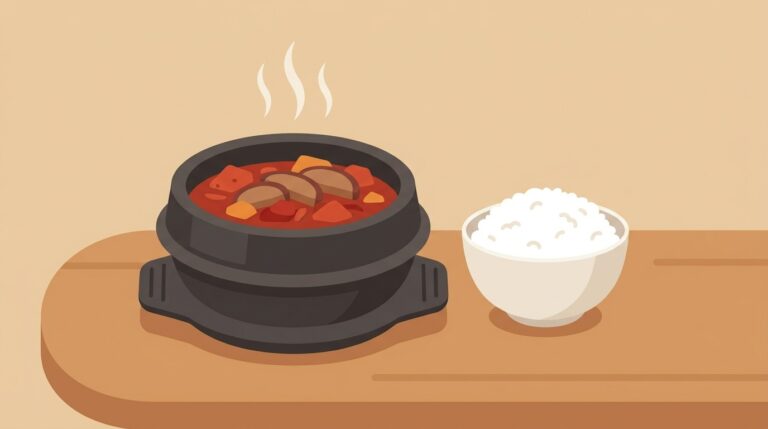
Imagine this: It’s a rainy Friday evening in Seoul. You’ve had a long week, and your Korean friends drag you into a slightly loud, incredibly cozy restaurant tucked away in an alley of Jongno. In the center of the table sits a worn-out black clay pot (뚝배기). Inside, a massive quarter-head of aged, ruby-red Kimchi is bubbling away, draped over thick slices of pork belly. The savory, slightly sour, and intensely garlic-infused steam hits your face.
You take your first bite. Your eyes widen. Your friend looks at you expectantly and asks, “어때요? (How is it?)”
If you answer, “음… 맛있어요 (Mmm… It’s delicious),” you are missing a massive opportunity! While “맛있어요” is perfectly fine for a beginner, you’re at the B2 level now. In K-Dramas, when characters eat true soul food like Kimchi-jjim (Braised Kimchi), they don’t just say it’s “delicious.” They close their eyes, let out a deep sigh of satisfaction, and use words that describe the history, the texture, and the very soul of the dish.
Today, we are going completely beyond textbook Korean. We are going to learn how to express the “deep flavor” of Korean steamed and braised dishes (찜 요리) exactly like a local who has lived in Seoul for 10 years. Let’s make your Korean sound as rich and layered as the Kimchi-jjim itself!
Phase 2: Core Expressions Deep Dive
To capture the essence of Kimchi-jjim, you need to understand that this isn’t just spicy cabbage. It’s about fermentation, time, and slow cooking. Here are the top 3 expressions you absolutely need.
1. 깊고 진한 맛이에요.
- Pronunciation: [Gip-go jin-han mas-i-e-yo] + [Gip-go sounds like ‘geep-go’. Jin-han sounds like ‘jeen-hahn’.]
- Meaning: Literal: It’s a deep and rich flavor. / Real nuance: The flavor is complex, hearty, and full of umami developed over a long time.
- K-Culture Moment: Picture a food documentary or a K-Drama where a character visits an old grandma’s countryside restaurant. They take one sip of the thick broth, close their eyes, and nod solemnly. This is the ultimate compliment to the chef’s dedication.
- Editor’s Insight: This isn’t for light, refreshing soups. This is for heavy, hearty, soul-warming stews. When you say this, you acknowledge the time it took to age the Kimchi and boil the broth.
- Situation Spectrum:
- Casual with friends: ✅ (Usually shortened to “와, 진짜 진하다!”)
- Semi-formal (Co-workers): ✅
- Formal (Elders/Boss): ✅ (Perfectly polite and appreciative)
- 🤔 Think About It: Why do Koreans value “deep” (깊은) flavors so much? In a fast-paced modern society (빨리빨리), traditional slow-cooked foods represent nostalgia, patience, and the care of a mother. Does your culture have a concept of “deep” flavor tied to time?
2. 밥도둑이에요!
- Pronunciation: [Bap-do-dug-i-e-yo] + [Bap (rhymes with hop) – do (doe) – duk (duck)]
- Meaning: Literal: It’s a rice thief! / Real nuance: This dish is so incredibly savory and delicious that it steals the rice from your bowl (meaning you keep eating more rice because it pairs so perfectly).
- K-Culture Moment: You’ll see this phrase flashed on the screen in big, bold, colorful letters on every Korean food variety show (like Mukbang YouTube channels or shows like Delicious Guys).
- Editor’s Insight: This is arguably the highest praise you can give to a salty, savory Korean side dish or stew. It shows you deeply understand the Korean dining dynamic: Rice is the main character, and side dishes exist to compliment it.
- Situation Spectrum:
- Casual with friends: ✅
- Semi-formal (Co-workers): ✅ (Great icebreaker at team dinners!)
- Formal (Elders/Boss): ⚠️ (A bit too casual/slangy for highly formal settings, but elders might find it cute if a foreigner says it with a big smile.)
- 🤔 Think About It: Calling food a “thief” is technically a negative word turned into an extreme positive. Can you think of any slang in your native language where a “bad” word means something amazingly good? (Like “sick” or “wicked” in English!)
3. 고기가 푹 익어서 입에서 녹아요.
- Pronunciation: [Go-gi-ga puk ig-eo-seo ib-e-seo nog-a-yo] + [Puk (like ‘pook’ in spooky, but punchy). Nog-a-yo (No-gah-yo).]
- Meaning: Literal: The meat is thoroughly cooked so it melts in the mouth. / Real nuance: The meat has been braised for so long it’s incredibly tender and falls apart perfectly.
- K-Culture Moment: When the main characters in a drama are eating braised pork ribs (Galbi-jjim) or Kimchi-jjim, they will literally pull the meat apart with just their chopsticks to show the camera how tender it is.
- Editor’s Insight: The magic word here is 푹 (puk). It’s an adverb that means “thoroughly” or “deeply” (often related to boiling or resting). It adds a visceral, sensory feeling to your sentence. It’s the difference between saying “It’s cooked” and “It’s slow-cooked to absolute perfection.”
- Situation Spectrum:
- Casual with friends: ✅
- Semi-formal (Co-workers): ✅
- Formal (Elders/Boss): ✅
Phase 3: Textbook vs. Real Korean
Let’s see how these concepts translate from the classroom to the bustling streets of Seoul.
[Situation 1: Expressing how delicious the thick broth is]
* 📖 Textbook Korean: 국물이 아주 맛있습니다. (The broth is very delicious.)
* 🗣️ Real Korean: 와… 국물 폼 미쳤다. 완전 진해요! (Wow… the state of this broth is crazy. It’s completely deep!)
* 💡 Why the difference?: Koreans love using slightly exaggerated slang (폼 미쳤다 – literally “form is crazy”, meaning top-tier) among peers to show genuine, unbridled enthusiasm.
[Situation 2: Reacting to the tender meat]
* 📖 Textbook Korean: 돼지고기가 부드럽습니다. (The pork is soft.)
* 🗣️ Real Korean: 야, 고기 푹 익은 거 봐. 씹을 것도 없어! (Hey, look how thoroughly cooked the meat is. There’s nothing even to chew!)
* 💡 Why the difference?: “There’s nothing to chew” (씹을 것도 없다) is a highly idiomatic way Koreans praise tender meat, highlighting efficiency and ultimate comfort.
Bottom Note: For B2 level, stick to phrases like “완전 밥도둑이에요” or “국물이 진짜 진해요”. They are incredibly natural without crossing the line into overly aggressive internet slang.
Phase 4: Cultural Context — K-Culture Deep Dive
4-1. Non-Verbal Cues: The Art of the “Ahhh”
In Korea, expressing that food hits the spot isn’t just about words. It’s highly auditory. When eating a hot, deep-flavored stew like Kimchi-jjim, it is culturally acceptable (and encouraged!) to make a deep, satisfied sighing sound after your first sip of the broth.
Take a spoonful, swallow, and let out a hearty “아~ (Ahhh)” followed by “좋다 (Good)” or “진하다 (Deep)”. It shows the chef (or whoever brought you there) that you are truly feeling the soul of the food.
4-2. The Magic Ingredient: 묵은지 (Mugeunji)
You cannot talk about Kimchi-jjim without mentioning 묵은지 (Mugeunji). Mugeunji is Kimchi that has been aged for at least six months, sometimes years, at a low temperature. It loses its crunchy texture but gains an incredibly complex, sour, and savory depth.
In K-Dramas, you will often see a mother packing jars of her precious Mugeunji for her children living in the city. When you tell a Korean, “이 묵은지 진짜 제대로네요 (This aged kimchi is truly legit),” they will look at you with deep respect. You aren’t just eating food; you are understanding their culinary heritage.
Phase 5: Real-Life Roleplay Scenario
Let’s put you in the director’s chair.
- Setting: Friday night, 7:30 PM. A famous Kimchi-jjim restaurant near Gongdeok Station. The windows are steamed up. The smell of braised pork and aged garlic fills the air.
- Characters:
- YOU: An expat working in Seoul, out for a casual dinner with your team.
- Minsu (32): Your humorous and very “local” Korean coworker who prides himself on knowing all the best foodie spots.
Minsu: 여기가 제가 제일 좋아하는 맛집이에요! 어때요, 냄새부터 장난 아니죠?
(Yeogi-ga je-ga jeil joaha-neun matjib-i-e-yo! Eottae-yo, naemsae-buteo jangnan ani-jyo?)
[This is my favorite restaurant! How is it, the smell is no joke, right?]
(🎭 Stage Direction: Minsu hands you a pair of metal chopsticks and a spoon.)
YOU: 네, 진짜 배고파졌어요!
(Ne, jinjja baegopa-jyeoss-eo-yo!)
[Yes, I’ve gotten really hungry!]
Minsu: 자, 일단 국물부터 드셔보세요.
(Ja, ildan gungmul-buteo deusyeo-bose-yo.)
[Here, try the broth first.]
(🎭 Stage Direction: You take a spoonful of the dark red, bubbling broth. It’s incredibly flavorful and rich.)
YOU: 와… 국물이 진짜 깊고 진해요.
(Wa… gungmul-i jinjja gip-go jin-hae-yo.)
[Wow… the broth is really deep and rich.]
Minsu: 그렇죠? 여기 묵은지를 1년 동안 숙성시킨대요. 고기도 한번 드셔보세요.
(Geureochyo? Yeogi mugeunji-reul 1-nyeon dongan suksong-sikin-dae-yo. Gogi-do hanbeon deusyeo-bose-yo.)
[Right? They say they age the Kimchi here for a year. Try the meat too.]
(🎭 Stage Direction: You pick up a piece of pork. It practically falls apart on your chopsticks.)
🔀 Your Turn! How do you react to the amazingly tender meat?
– A) “음, 돼지고기가 아주 부드럽습니다.” (Umm, the pork is very soft.)
– B) “완전 미쳤어요!” (It’s totally crazy!)
– C) “와, 고기가 푹 익어서 입에서 그냥 녹아요. 완전 밥도둑인데요?”✅ Best Choice: C — Why? It perfectly combines the sensory description (푹 익어서 입에서 녹아요) with the ultimate cultural compliment (밥도둑). Minsu will probably insist on buying your dinner after hearing this!
⚠️ Choice A Analysis: Too stiff and textbook for a loud, casual Friday night dinner.
⚠️ Choice B Analysis: A bit too informal for a coworker setting, even if friendly.
Phase 6: 10-Second Shadowing Drill
Time to get your tongue used to the rhythm! Pay attention to the pauses (/) and the elongated emphasis (~).
😲 와, / 국물이 / 진~~~짜 / 끝내줘요! / 완전 / 밥도둑이에요.
(Wa, / gungmul-i / jin~~~jja / kkeut-nae-jwo-yo! / wanjeon / bap-do-dug-i-e-yo.)
[Emotion Tag: Eyes wide with pleasant surprise, nodding enthusiastically]
Tip: Stretch the “진” in “진짜” to show genuine amazement!
Phase 7: K-Culture Mini Dictionary
| Korean | Romanization | English | Cultural Context |
|---|---|---|---|
| 뚝배기 | ttukbaegi | Earthenware pot | Retains heat beautifully. Food served in this stays bubbling hot throughout the meal. |
| 묵은지 | mugeunji | Aged Kimchi | The older, the deeper the flavor. The crown jewel of braised dishes. |
| 밥도둑 | bapdoduk | Rice Thief | A dish so savory you eat multiple bowls of rice. A massive compliment. |
| 앞치마 | apchima | Apron | Essential when eating red stews! Always ask for one to protect your shirt. |
| 정 | jeong | Deep affection/bond | The invisible warmth in Korean relationships, often expressed by sharing food. |
Phase 8: Traveler Survival Kit
If you are traveling in Korea and want to experience authentic Kimchi-jjim, you will likely be in a busy, local eatery where English isn’t widely spoken. Here is your survival kit.
🆘 Survival Phrases TOP 3
– 🇰🇷 “여기 앞치마 좀 주시겠어요?” (Yeogi apchima jom ju-si-gess-eo-yo?)
– 🗣️ Meaning: Could I get an apron here, please?
– 📍 Where to use: As soon as you sit down at any stew/braised food restaurant. Red broth will splash.
- 🇰🇷 “공기밥 하나 추가요!” (Gonggi-bap hana chuga-yo!)
- 🗣️ Meaning: One more bowl of rice, please!
- 📍 Where to use: When the dish is a true “Rice Thief” and you need more carbs.
🇰🇷 “집게랑 가위 좀 주세요.” (Jibge-rang gawi jom juse-yo.)
- 🗣️ Meaning: Tongs and scissors, please.
- 📍 Where to use: Kimchi-jjim usually comes with massive, uncut leaves of Kimchi. You need these tools to cut it yourself!
📌 Editor’s Travel Note
– The Scissors Culture: Don’t be shocked when Koreans use large kitchen scissors to cut meat and Kimchi right at the table. It’s incredibly efficient!
– To Tear or To Cut?: Purists say tearing Kimchi lengthwise with your chopsticks tastes better than cutting it with scissors. Give it a try if you want to look like a true connoisseur!
Phase 9: Critical Thinking — “One Step Deeper”
Food & Identity: The Concept of Sharing and ‘Jeong’ (정)
Traditionally, a dish like Kimchi-jjim is served in one large pot placed in the center of the table. Everyone dips their spoons into the same broth and uses their personal chopsticks to pull apart the Kimchi. In older K-Dramas, you might even see an elder using their own chopsticks to tear a piece of Kimchi and place it directly on your bowl of rice. This is a profound expression of 정 (Jeong)—deep affection, care, and communal bonding.
However, Korean culture is dynamic. Especially post-pandemic, younger generations and urbanites strongly prefer using shared ladles (국자) and separate serving plates (앞접시) for hygiene.
🧠 Think Deeper: The evolution of how Koreans eat communal stews reflects a fascinating tension between preserving traditional warmth (Jeong) and adapting to modern, globalized standards of hygiene and individualism.
💬 Your Turn: In your culture, is sharing food from a central communal pot common? How do you show affection through food? Let me know in the comments!
Phase 10: FAQ & Avoiding Misunderstandings
Q: Can I tell the restaurant owner “밥도둑이에요!”?
A: Absolutely! If it’s a casual, locally-owned restaurant, the “이모님” (Auntie/Owner) will absolutely love it. It will make her day.
Q: I can’t handle spicy food well. Is Kimchi-jjim very spicy?
A: Actually, because it is slow-cooked and often contains a lot of pork fat, Kimchi-jjim is usually much milder and sweeter than fresh Kimchi stew (Kimchi-jjigae). But you can always ask: “조금 덜 맵게 해 주실 수 있나요? (Can you make it a bit less spicy?)”
❌ Common Mistake #1: Using the word “시원하다” (Refreshing/Cool) incorrectly.
✅ How to fix it: While Koreans do use “시원하다” for hot soups to mean “it hits the spot,” it’s usually reserved for clear broths (like seafood soup). For thick, heavy, red, pork-based stews like Kimchi-jjim, stick to “진하다” (Deep/Rich).
Phase 11: Summary & Action Items
One-Liner Summary: To praise deep, slow-cooked Korean dishes, go beyond “delicious” and use sensory, culturally rich phrases like “It’s a rice thief” (밥도둑) and “The broth is deep” (국물이 진하다).
Your 3-Step Action Mission:
– 🥉 Bronze (Solo): Stand in front of your mirror and practice the 10-second shadowing drill with maximum emotion.
– 🥈 Silver (Online): Find a YouTube Mukbang video of someone eating Kimchi-jjim. Leave a comment in Korean: “완전 밥도둑처럼 보이네요!” (It looks exactly like a rice thief!)
– 🥇 Gold (Real World): Visit a Korean restaurant, order a braised dish or stew, and confidently ask for an apron: “앞치마 좀 주시겠어요?”
🌟 Special K-Culture Mission:
The next time you watch a K-Drama and the characters are eating at a local restaurant, look closely at how they interact with the food. Do they use scissors? Do they share a pot? Do they do the satisfied “Ahhh”? Spotting these details means you’re truly understanding Korea!
Did you learn something new today? Which expression are you most excited to use? Tell me below!
Phase 12: Interactive Challenge (Quiz)
Let’s test your new local knowledge! (Highlight the black blocks to see the answers).
1. Situational Judgment: You are at a team dinner. The boss orders a massive Galbi-jjim (Braised Short Ribs). You taste it and the meat is incredibly tender. What is the BEST thing to say to impress your Korean colleagues?
A) “고기가 나쁘지 않네요.” (The meat isn’t bad.)
B) “고기가 푹 익어서 입에서 녹아요.”
C) “폼 미쳤다!”
Click to reveal answer
Answer: B. It is the perfect blend of natural phrasing and appropriate politeness for a team setting. A is too indifferent, and C is too slangy for the boss.
2. True or False – K-Culture Edition: When eating Kimchi-jjim at a restaurant, you should NEVER ask for a pair of scissors, as the chef will be highly offended that you want to cut their food.
Click to reveal answer
Answer: False! Scissors (가위) are a staple at Korean dining tables. The Kimchi is purposely served long so you can see it hasn’t been recycled from another table, and you are expected to cut it yourself!
Frequently Asked Questions (FAQ)
Q: What does "깊고 진한 맛이에요." mean in Korean and how do you pronounce it?
A: In Korean, "깊고 진한 맛이에요." is pronounced [Gip-go jin-han mas-i-e-yo] and means: Literal: It's a deep and rich flavor. / Real nuance: The flavor is complex, hearty, and full of umami developed over a long time.
Q: What does "밥도둑이에요!" mean in Korean and how do you pronounce it?
A: In Korean, "밥도둑이에요!" is pronounced [Bap-do-dug-i-e-yo] and means: Literal: It's a rice thief! / Real nuance: This dish is so incredibly savory and delicious that it steals the rice from your bowl (meaning you keep eating more rice because it pairs so perfectly).
Q: What does "고기가 푹 익어서 입에서 녹아요." mean in Korean and how do you pronounce it?
A: In Korean, "고기가 푹 익어서 입에서 녹아요." is pronounced [Go-gi-ga puk ig-eo-seo ib-e-seo nog-a-yo] and means: Literal: The meat is thoroughly cooked so it melts in the mouth. / Real nuance: The meat has been braised for so long it's incredibly tender and falls apart perfectly.







