

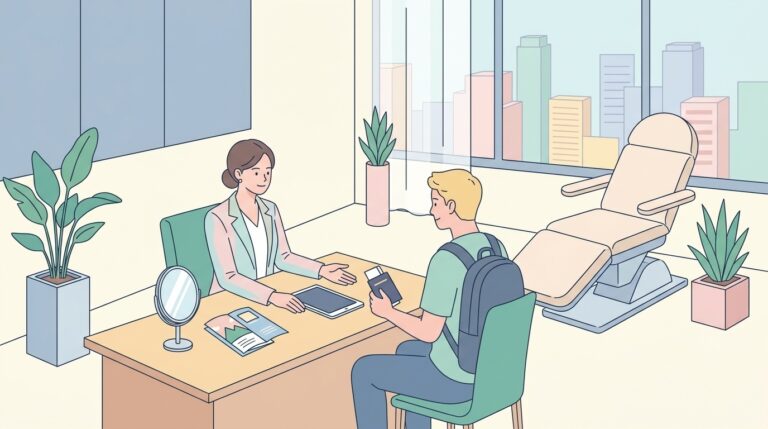
Phase 1: Empathy & The Gangnam Clinic Vibe
Hello! I’m the Senior Editor at Daily Hangul.
Imagine this: You step out of Gangnam Station Exit 10. The streets are lined with sleek, towering glass buildings. You walk into a clinic, but it doesn’t look like a hospital—it looks like the VIP lounge of a 5-star hotel in a K-Drama. A polished Consultation Manager (상담실장) hands you an iced Americano and leads you to a private room. You are here for the ultimate K-Beauty medical tourism package.
But wait. When it’s time to discuss the actual details—the nuances of your desired look, the limits of the aftercare package, and the exact downtime—the basic “How much is it?” just won’t cut it. At a C2 mastery level, you aren’t just surviving a transaction; you are negotiating your health, aesthetics, and finances in a high-context culture.
If you don’t know the precise vocabulary, you might end up paying for a ‘premium’ package that lacks crucial post-op treatments, or worse, you might not properly communicate your aesthetic boundaries to the surgeon. Today, we are diving deep into the sophisticated language of Korean medical tourism. This guide is based on real experiences of expats and medical tourists navigating the neon-lit corridors of Gangnam’s aesthetic industry.
Phase 2: Core Expressions for High-Stakes Consultations
Let’s look at the essential phrases you need to sound like an informed, highly capable patient, not just a naive tourist.
1. 최대한 자연스러우면서도 입체감을 살려주세요.
- Pronunciation: choedaehan jayeonseureou-myeonseodo ipchegam-eul sallyeojuseyo.
- Sound-alike guide: [chweh-dae-han ja-yun-seu-ruh-oo-myun-suh-doh ip-che-gam-eul sal-lyuh-joo-seh-yo]
- Meaning: Please make it look as natural as possible while enhancing the dimensional volume.
- K-Culture Moment: The “Gangnam Beauty” trope in K-Dramas often critiques overly dramatic plastic surgery. The modern trend in Korean aesthetics is 꾸안꾸 (effortless beauty). When you say this to a doctor, they immediately know you understand modern K-Beauty standards: you want subtle enhancements, not a cookie-cutter face.
- Editor’s Insight: The word ‘입체감’ (dimensionality/volume) is a major buzzword in Korean cosmetics and surgery. It refers to a face that isn’t flat, usually achieved through subtle fat grafting or fillers. This phrase perfectly balances restraint (자연스럽게) with desire (입체감).
- Situation Spectrum:
- Close friends (Casual): 🚫 (Too clinical)
- Medical Staff (Semi-formal/Formal): ✅ (Perfect)
- 🤔 Think About It: Why does Korean beauty place such a heavy emphasis on “looking natural” while simultaneously normalizing surgical enhancement? How does this paradox reflect societal pressures?
2. 사후 관리 프로그램은 패키지에 어디까지 포함되나요?
- Pronunciation: sahu gwalli peurogeuraem-eun paekiji-e eodikkaji pohamdoenayo?
- Sound-alike guide: [sah-hoo gwal-lee pro-gu-rem-eun peh-ki-jee-eh uh-dee-kka-jee po-ham-dweh-na-yo]
- Meaning: Up to what extent is the post-op care program included in the package?
- K-Culture Moment: You’re sitting with the Consultation Manager. They’ve just offered you a “VIP Foreigner Package.” In Korea, surgery is only half the battle; Sahu Gwalli (사후 관리 – aftercare) like deswelling lasers, pumpkin extract treatments, and hyperbaric oxygen chambers are crucial.
- Editor’s Insight: Using “어디까지” (up to where / to what extent) instead of a simple “Is it included?” shows high-level fluency. It signals that you know packages have tiers, and you want to know the exact boundaries of what you are paying for.
- Situation Spectrum:
- Consultation Desk (Formal): ✅
- 🤔 Think About It: In many Western countries, aftercare is solely medical (check-ups). In Korea, it’s often framed as a spa-like service. How does this blur the line between medical treatment and luxury hospitality?
3. 회복 기간 동안 일상생활에 지장은 없나요?
- Pronunciation: hoebok gigan dongan ilsangsaenghwal-e jijang-eun eomnayo?
- Sound-alike guide: [hweh-bok gee-gan dong-an il-sang-seng-hwal-eh jee-jang-eun uhm-na-yo]
- Meaning: Will there be any disruption to my daily life during the recovery period?
- K-Culture Moment: Korean society is fast-paced (빨리빨리 culture). People often get minor procedures on a Friday and return to the office on Monday. “일상생활에 지장” (interference with daily life) is the ultimate metric for how invasive a procedure is.
- Editor’s Insight: At a C2 level, you avoid asking “How long will it hurt?” Instead, you ask about functionality. “지장” means obstacle or hindrance. It’s an elegant, highly natural way to ask about downtime.
- Situation Spectrum:
- Consultation/Doctor (Formal): ✅
Phase 3: Textbook vs. Real Korean
How do native speakers actually negotiate and ask questions in a clinic?
[Asking about Side Effects]
* 📖 Textbook Korean: 부작용이 있습니까? (Are there side effects?)
* 🗣️ Real Korean: 혹시 나중에 이물감이 느껴지거나 처짐 현상은 없겠죠? (Is there a chance I might feel a foreign body sensation or experience sagging later on?)
* 💡 Why the difference?: C2 learners should specify what kind of side effects they are worried about. “이물감” (feeling of a foreign object, e.g., implants) and “처짐” (sagging) show that you’ve done your research.
[Asking for a Discount on Packages]
* 📖 Textbook Korean: 깎아주세요. (Please give me a discount.)
* 🗣️ Real Korean: 눈이랑 코 같이 진행할 건데, 혹시 사후 관리 몇 회 서비스로 더 넣어주실 수 있나요? (I’ll be doing my eyes and nose together; could you perhaps throw in a few more aftercare sessions as a service?)
* 💡 Why the difference?: Directly asking to slash the price (깎아주세요) at a high-end clinic can feel awkward. Instead, Koreans negotiate by asking for 서비스 (free add-ons). Adding a 붓기 레이저 (deswelling laser) session costs the clinic very little but adds immense value to you.
Bottom Note: At the C2 level, your goal is smooth negotiation. You want to be polite but firm, ensuring you get exactly what you want without sounding overly aggressive.
Phase 4: Cultural Context — K-Culture Deep Dive
4-1. Non-Verbal Elements & ‘Nunchi’ in the Clinic
In a Korean plastic surgery consultation, Nunchi (눈치 – the ability to read the room) is paramount. The person you spend the most time with isn’t usually the doctor; it’s the 상담실장 (Consultation Manager). They are essentially highly skilled salespeople. They might gently point out a flaw you never noticed (“Oh, while we’re doing the nose, balancing the chin would make your side-profile perfect…”).
Pro-tip: Maintain polite eye contact, nod to show you are listening, but hold your ground. Bring a picture of a celebrity (like a K-Pop idol) as a reference, but hand over your phone with two hands to show respect.
4-2. The “Pumpkin Juice” Phenomenon (K-Food/Lifestyle Link)
If you watch any K-Drama or vlog involving plastic surgery, you will see the protagonist obsessively drinking brown liquid from pouches. This is 호박즙 (Pumpkin extract juice). In Korean traditional medicine, pumpkin is believed to drastically reduce swelling (붓기). Many medical tourism packages actually include a premium box of 호박즙 waiting for you in your hotel room.
Critical View: The normalization of drinking pumpkin juice and walking around Gangnam with a face mask and a swollen face reflects how unstigmatized cosmetic procedures have become in Korean urban centers. It’s almost a badge of self-improvement.
Phase 5: Real-Life Roleplay Scenario
Setting: Tuesday afternoon, inside a minimalist, marble-floored consultation room in Sinsa-dong. Soft jazz is playing. You’ve just finished speaking with the doctor and are now finalizing your medical tourism package (surgery, hotel stays, airport transfers) with the Consultation Manager.
Characters:
– YOU (The Reader): An expat or savvy medical tourist who has done extensive research. You want value and safety.
– Manager Kim (상담실장): A perfectly groomed, extremely polite, but persuasive coordinator.
Dialogue:
Manager Kim: 고객님, 원장님 상담은 잘 끝나셨나요? 그럼 저희 VIP 풀패키지로 견적 내드릴게요.
(gogaengnim, wonjangnim sangdam-eun jal kkeunnasyeonnayo? geureom jeo-hui VIP pulpaekiji-ro gyeonjeok naedeurilgeyo.)
[Client, did your consultation with the director go well? Then I’ll write up the estimate for our VIP full package.]
YOU: 네, 원장님이 최대한 자연스럽게 입체감을 살려주신다고 해서 마음이 놓였어요.
(ne, wonjangnim-i choedaehan jayeonseureopge ipchegam-eul sallyeojusindago haeseo maeum-i noyeosseoyo.)
[Yes, I was relieved when the director said he would enhance the volume as naturally as possible.]
Manager Kim: 맞아요. 원장님이 그쪽으로 워낙 유명하시거든요. 패키지에는 공항 픽업, 제휴 호텔 3박, 그리고 기본 수술비가 포함되어 있습니다.
(majayo. wonjangnim-i geujjogeuro wonak yumyeonghasigeodeunyo. paekiji-eneun gonghang pigeop, jehyu hotel sambak, geurigo gibon susulbi-ga pohamdoeeo itseumnida.)
[That’s right. He is very famous for that. The package includes airport pick-up, 3 nights at our partner hotel, and the basic surgery fee.]
YOU: 사후 관리 프로그램은 패키지에 어디까지 포함되나요?
(sahu gwalli peurogeuraem-eun paekiji-e eodikkaji pohamdoenayo?)
[Up to what extent is the post-op care program included in the package?]
Manager Kim: 기본적으로 붓기 완화 레이저 2회가 들어갑니다.
(gibonjeogeuro butgi wanhwa reijeo ihoe-ga deureogaminda.)
[Basically, two sessions of swelling-relief laser are included.]
🔀 Your Turn! How do you negotiate for more at a C2 level?
– A) “너무 비싸요. 깎아주세요.” (Too expensive. Give me a discount.)
– B) “회복 기간이 좀 걱정돼서요. 혹시 결제 오늘 바로 하면, 사후 관리 2회만 서비스로 더 넣어주실 수 있나요?”
– C) “진짜요? 대박. 그냥 할게요.”✅ Best Choice: B — “I’m a bit worried about the recovery period. By any chance, if I pay in full today, could you throw in two more aftercare sessions as a service?”
Why? This leverages the Korean business culture of ‘서비스’ (free additions) and gives the manager a reason (immediate payment) to justify the perk to their boss.
⚠️ Choice A Analysis: Bluntly asking to cut the price at a premium medical facility is seen as lacking tact. You negotiate value, not just the base price.
Phase 6: 10-Second Shadowing Drill
Practice this advanced sentence to sound incredibly natural. Pay attention to the pauses (/) and the intonation tags.
😊 원장님, / 저는 화려한 것보다는 / 최대한 자연스럽게 / 🥺 입체감만 살려주셨으면 좋겠어요.
(wonjangnim, / jeoneun hwaryeohan geot-bodaneun / choedaehan jayeonseureopge / ipchegam-man sallyeojusyeosseumyeon jokesseoyo.)
“Director, rather than a dramatic look, I’d really like it if you could just enhance the volume as naturally as possible.”
Voice Tip: Speak calmly and confidently. The slight pause before “입체감만” emphasizes exactly what you want.
Phase 7: K-Culture Mini Dictionary (Aesthetic Edition)
| Korean | Romanization | English | Cultural Context |
|---|---|---|---|
| 상담실장 | sangdamsiljang | Consultation Manager | The key liaison in clinics who discusses pricing, packages, and coordinates your schedule. |
| 사후 관리 | sahu gwalli | Post-operative care | A massive industry in itself, involving lasers, skincare, and spa treatments to speed up recovery. |
| 붓기 / 호박즙 | butgi / hobakjeup | Swelling / Pumpkin Juice | Swelling is the enemy of plastic surgery. Koreans religiously drink pumpkin extract to reduce butgi. |
| 다운타임 | dauntaim | Downtime | Konglish used to describe the time needed to stay hidden before returning to normal life. |
| 화려하게 vs 자연스럽게 | hwaryeohage vs jayeonseureopge | Glamorous/Dramatic vs Natural | The two main spectrums of K-Beauty requests. “화려하게” implies a highly noticeable, doll-like change. |
Phase 8: Traveler’s Survival Kit (Medical Tourism Edition)
If you are traveling to Korea specifically for medical procedures, here are the top survival phrases and tips you must know.
🆘 Survival Phrases for Medical Tourists
– 🇰🇷 “택스리펀드(부가세 환급) 서류 챙겨주세요.” (taekseu-ripeondeu seoryu chaenggyeojuseyo.)
– 🗣️ Meaning: Please prepare the tax refund documents.
– 📍 Where to use: At the clinic’s checkout desk.
– 💡 Pro Tip: Cosmetic surgery for foreigners in Korea is eligible for a VAT refund (around 7-9% back). You MUST get the specific medical tax refund form from the clinic and scan it at the airport kiosk before departing!📌 Editor’s Travel Note: Medical Safety
– Beware of Shadow Doctors (유령 수술): Always ask: “수술실에 CCTV가 있나요?” (Do you have CCTV in the operating room?) Legitimate clinics proudly advertise this for transparency.
– Medical Disputes: If something goes terribly wrong, do not fight the clinic alone. Contact the Medical Area Dispute Mediation and Arbitration Agency (의료분쟁조정중재원). They have services in English.
– Translators: Do not rely purely on Papago for medical terms. If your package doesn’t include an official Medical Tourism Coordinator (의료관광 코디네이터), hire one independently.
Phase 9: “A Step Deeper” — Critical Thinking
Media vs. Reality: The Commodification of Beauty
🧠 Think Deeper:
K-Dramas and K-Pop often portray flawless, glass-skin beauty as effortless. However, navigating Gangnam’s medical tourism reveals a hyper-capitalist reality: beauty is commodified into “packages” complete with hotel stays and airport limousines. Language reflects this reality. You aren’t just a “환자” (patient); you are a “고객님” (valued client). The vocabulary blends medical terminology with retail negotiation (서비스, 패키지, 환급). This linguistic shift begs the question: when medical care becomes a luxury tourism product, how does it change the power dynamic between doctor and patient?💬 Your Turn: Does your home country have a robust medical tourism industry? How does the language used by doctors in your country differ from the hospitality-driven language of Korean aesthetic clinics? Let us know in the comments!
Phase 10: FAQ & Avoiding Common Mistakes
Q: Is it rude to bring a picture of a K-Pop idol to the consultation?
No, it’s highly encouraged! Doctors prefer visual references to abstract words. Just be prepared for the doctor to measure your face and politely tell you that your bone structure can’t handle Irene’s nose.
Q: The clinic asked me to sign a consent form, but it’s only in Korean. Can I just use a translation app?
Absolutely not. For medical tourism, by law, major clinics catering to foreigners must provide official consent forms translated into your language, or provide a certified coordinator.
❌ Common Mistake #1: Saying “아프지 않게 해주세요” (Please don’t make it hurt) to the surgeon.
✅ Do this instead: At a C2 level, express functional concerns. “마취 깨고 나서 통증 관리는 어떻게 진행되나요?” (How is pain management handled after waking up from anesthesia?)
Phase 11: Summary & Action Items
- One-Liner Summary: Mastering C2-level medical Korean means shifting your vocabulary from basic transactions to negotiating nuanced aesthetic desires, aftercare boundaries, and functional recovery.
-
Action Mission 3 Steps:
- 🥉 Bronze (Solo): Read the 10-second shadowing drill out loud in the mirror, practicing the polite but firm tone.
- 🥈 Silver (Online): Go to a K-Beauty expat forum and read reviews. Spot words like 다운타임 (downtime) and 사후 관리 (aftercare) in the wild.
- 🥇 Gold (Real World): If you are considering a procedure (even dermatology), use the phrase “사후 관리 프로그램은 어디까지 포함되나요?” during your consultation.
- K-Culture Mission: Watch an episode of a Korean reality show or drama that features a dermatology or plastic surgery clinic. Listen carefully to how the 상담실장 speaks to the client. Notice the extremely polite, elevated honorifics they use!
Phase 12: Interactive Challenge — Quiz
1. Situational Judgment: You want a nose job, but you don’t want it to look obviously fake. You want to keep it subtle but defined. Which phrase should you use?
– A) “아무도 모르게 수술해 주세요.”
– B) “최대한 자연스러우면서도 입체감을 살려주세요.”
– C) “제일 크고 화려하게 해주세요.”
2. Fill in the Blank:
“수술 후 _________를 줄이기 위해 호박즙을 많이 마셔야 해요.”
(After surgery, I need to drink a lot of pumpkin juice to reduce _________.)
3. True or False:
As a foreign tourist getting cosmetic surgery in Korea, you can get a VAT (Tax) refund at the airport if you have the proper clinic documents.
Answers (Click to reveal)
1. B – “자연스럽게” (naturally) combined with “입체감” (dimensionality/volume) is the exact K-Beauty standard for this request. (A is a bit dramatic, C is the exact opposite of what you want).
2. 붓기 (butgi – swelling)
3. True! Always ask for the Tax Refund paperwork at the desk.
Frequently Asked Questions (FAQ)
Q: What does "최대한 자연스러우면서도 입체감을 살려주세요." mean in Korean and how do you pronounce it?
A: In Korean, "최대한 자연스러우면서도 입체감을 살려주세요." is pronounced [choedaehan jayeonseureou-myeonseodo ipchegam-eul sallyeojuseyo.] and means: Please make it look as natural as possible while enhancing the dimensional volume.
Q: What does "사후 관리 프로그램은 패키지에 어디까지 포함되나요?" mean in Korean and how do you pronounce it?
A: In Korean, "사후 관리 프로그램은 패키지에 어디까지 포함되나요?" is pronounced [sahu gwalli peurogeuraem-eun paekiji-e eodikkaji pohamdoenayo?] and means: Up to what extent is the post-op care program included in the package?
Q: What does "회복 기간 동안 일상생활에 지장은 없나요?" mean in Korean and how do you pronounce it?
A: In Korean, "회복 기간 동안 일상생활에 지장은 없나요?" is pronounced [hoebok gigan dongan ilsangsaenghwal-e jijang-eun eomnayo?] and means: Will there be any disruption to my daily life during the recovery period?







