Phase 1: Empathy & Immersion
Hello, language explorers! It’s your Daily Hangul Editor.
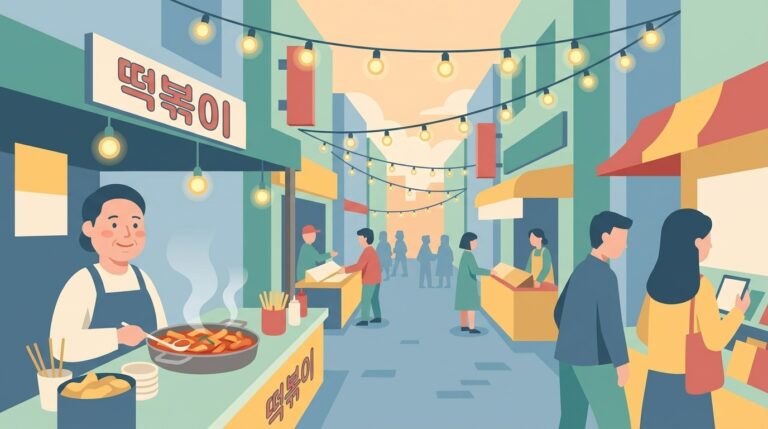
Picture this: You are wandering through the neon-lit alleys of Gwangjang Market or navigating the endless maze of Namdaemun. The sizzle of bindaetteok (mung bean pancakes) fills the air, and the steam from towering stacks of mandu (dumplings) makes your mouth water. It feels exactly like a scene from a K-Drama or Netflix’s Street Food: Asia.
But then, reality hits. You want to buy a scarf, grab some tteokbokki, or just ask how much something is. The vendor is bustling, chatting loudly with the next stall, and your polite, textbook “Jeogiyo…” (Excuse me) gets completely swallowed by the market noise. You stand there, feeling a bit lost, wondering how the locals manage to seamlessly chat, joke, and even get extra food from these busy vendors.
Don’t worry! Market Korean is a whole different beast from textbook Korean. If you don’t know the unwritten rules of the alleyways, you might end up paying tourist prices or missing out on the legendary Korean Jeong (warmth/connection). This guide is built from the real experiences of my students who went from being shy tourists to confident market navigators. Let’s dive in!
Phase 2: Core Expressions Deep Dive
1. 사장님! / 이모님!
- Pronunciation: [sajang-nim] / [imo-nim]
- Sound-alike guide: ‘Sajang’ sounds like “sah-jahng” + ‘nim’ (like neem tree). ‘Imo’ sounds like “emo” (the music genre) + ‘nim’.
- Meaning: Boss! / Auntie! (Real nuance: A friendly, respectful way to call a vendor’s attention).
- K-Culture Moment: In K-Dramas, whenever the main characters are drinking soju at a pojangmacha (street tent) after a hard day, they raise their hand and confidently yell, “Imonim! One more bottle of soju here!” It instantly changes the vibe from a sterile restaurant to a cozy, familiar space.
- Editor’s Insight: Forget “Jeogiyo” (Excuse me) in traditional markets. If the vendor is an older woman, calling her Imonim (literally: Mother’s sister) instantly builds a bridge. If it’s a man, or if you want to be slightly more formal, Sajangnim (Boss) is your golden ticket. It shows respect for their business while keeping things warm.
- Situation Spectrum:
- Market vendors & small restaurants (Casual/Warm): ✅
- High-end department stores (Formal): 🚫 (Stick to Jeogiyo here)
- Young part-time workers at a cafe: 🚫 (They aren’t the boss or an auntie!)
- 🤔 Think About It: Why do Koreans use family terms (Aunt, Uncle, Older Brother/Sister) for complete strangers? How does this reflect the traditional Korean view of society as one big extended family?
2. 이거 조금만 깎아주세요~
- Pronunciation: [igeo jogeum-man kkakka-juseyo]
- Sound-alike guide: ‘Kkakka’ sounds like a sharp, tense “caca”. Make sure to tense your throat!
- Meaning: Please cut the price a bit (Literal) / Can you give me a little discount? (Real nuance).
- K-Culture Moment: You’ll see this on Korean variety shows all the time. Idols given a mission with a tight budget will use their best puppy-dog eyes and say, “Sajangniiim~ Kkakka-juseyo~” to save a few bucks.
- Editor’s Insight: Haggling (heungjeong) is an art form in traditional markets, especially for clothing, souvenirs, or bulk items (less so for a $3 street food snack). The secret ingredient? A smile and a slightly playful tone. If you sound too serious or demanding, it won’t work.
- Situation Spectrum:
- Traditional Markets (Namdaemun, Dongdaemun): ✅
- Underground Shopping Malls (Goto Mall): ⚠️ (Sometimes possible if paying cash)
- Convenience stores / Supermarkets / Franchises: 🚫 (Prices are fixed!)
- 🤔 Think About It: Haggling isn’t just about saving money; it’s a playful social interaction. In your culture, is haggling seen as a battle of wits, a friendly chat, or simply rude?
3. 많이 파세요!
- Pronunciation: [mani paseyo]
- Sound-alike guide: ‘Mani’ sounds like “mah-nee” + ‘paseyo’ (pah-seh-yo).
- Meaning: Sell a lot! (Literal) / Wishing you good business! (Real nuance).
- K-Culture Moment: When leaving a mom-and-pop shop, a market stall, or getting out of a taxi, locals use this instead of a simple “Goodbye.” It’s the ultimate warm-hearted sign-off.
- Editor’s Insight: Saying “Annyeonghi gyeseyo” (Goodbye) is totally fine, but dropping “Mani paseyo!” as you walk away with your hot hotteok (sweet pancake) will make the vendor’s day. It shows you understand the heart of Korean working-class culture.
- Situation Spectrum:
- Small businesses & Market stalls: ✅
- Taxis (Saying “mani beoseyo” – earn a lot): ✅
- Corporate offices: 🚫
Phase 3: Textbook vs. Real Korean
[Getting the Vendor’s Attention]
* 📖 Textbook Korean: 저기요. (Jeogiyo. / Excuse me.)
* 🗣️ Real Korean: 사장님~! / 이모님~! (Sajangnim~! / Imonim~!)
* 💡 Why the difference?: Traditional markets operate on Jeong (emotional connection). Using family or respectful titles bridges the gap between stranger and friend.
[Asking for a Better Deal]
* 📖 Textbook Korean: 너무 비쌉니다. 할인을 원합니다. (Neomu bissamnida. Harineul wonhamnida. / It is too expensive. I want a discount.)
* 🗣️ Real Korean: 에이~ 사장님, 조금만 깎아주세요~ (Ei~ Sajangnim, jogeum-man kkakka-juseyo~ / Aw come on Boss, just a little discount~)
* 💡 Why the difference?: Direct demands sound cold and confrontational. Adding “Ei~” (a playful sigh) and asking them to “cut” the price makes it a friendly negotiation.
[Saying Goodbye]
* 📖 Textbook Korean: 안녕히 계십시오. (Annyeonghi gyesipsio. / Please stay peacefully.)
* 🗣️ Real Korean: 수고하세요! / 많이 파세요! (Sugohaseyo! / Mani paseyo! / Keep up the good work! / Sell a lot!)
* 💡 Why the difference?: Acknowledging someone’s hard work and wishing them prosperity is highly valued in Korea’s fast-paced, hardworking society.
Bottom Note: At the B1 level, mastering these slight shifts from rigid textbook grammar to relational, context-heavy phrases will instantly upgrade your Korean from “foreigner who studied” to “local insider.”
Phase 4: Cultural Context — K-Culture Deep Dive
4-1. Non-Verbal Cues in the Market
In a bustling alley, your body language speaks volumes.
* The Two-Handed Rule: Even in a chaotic market, when you hand over cash or your credit card, try to use two hands (or support your right elbow with your left hand). It’s a deep-rooted sign of respect.
* Eye Contact & Nunchi: Don’t stare intensely during haggling; keep it light and smiley. Use your Nunchi (social situational awareness)—if there’s a huge line behind you, don’t spend five minutes haggling over a $2 keychain.
4-2. The Magic of ‘Deom’ (덤) & K-Food Culture
If you’ve watched K-Dramas featuring traditional markets or eaten at Gwangjang Market, you might have noticed vendors tossing an extra piece of fried food into the bag or giving an extra scoop of side dishes. This is called 덤 (Deom)—the concept of giving a little extra for free.
It’s not a marketing gimmick; it’s a physical manifestation of Jeong (warm affection). If you chat politely, use phrases like “Imonim”, and smile, you are highly likely to experience Deom.
* Critical View: Today, popular tourist markets can sometimes feel commercialized, and the traditional Jeong might be harder to find amidst the crowds. But venture just one alley deeper into the less touristy zones, and that warm, loud, generous market culture is still very much alive.
Phase 5: Real-World Roleplay Scenario
Setting: Friday evening, 6:30 PM. The vintage clothing alley in Dongdaemun Market. Racks of clothes are packed tightly together. You found an awesome oversized retro jacket, but it doesn’t have a price tag.
Characters:
* YOU: An international student looking for a cool, affordable outfit.
* Sajangnim (50s, Male): The stall owner. Looks a bit grumpy but is actually quite chatty.
Dialogue:
YOU: 사장님, 이거 얼마예요? 🧥
(Sajangnim, igeo eolmayeyo?)
[Boss, how much is this?]
Sajangnim: 아, 그거? 그거 진짜 좋은 거야. 5만 원.
(A, geugeo? geugeo jinjja joeun geoya. Oman won.)
[Ah, that? That’s really good quality. 50,000 won.]
(🎭 Stage Direction: He aggressively brushes a piece of lint off the jacket to show its quality)
YOU: 헉, 5만 원이요? 학생한테는 조금 비싼데…
(Heok, oman woniyo? Haksaenghanteneun jogeum bissande…)
[Gasp, 50,000 won? That’s a bit expensive for a student…]
Sajangnim: 원래 6만 원 받는 건데, 내가 5만 원에 주는 거야.
(Wollae yungman won banneun geonde, naega oman wone juneun geoya.)
[I usually get 60,000 won for it, but I’m giving it to you for 50,000.]
YOU: 현금으로 낼게요! 사장님, 4만 원에 주시면 안 돼요?
(Hyeongeumeuro naelgeyo! Sajangnim, saman wone jusimyeon an dwaeyo?)
[I’ll pay in cash! Boss, can’t you give it to me for 40,000 won?]
Sajangnim: 아이구, 4만 원은 밑지는 장사야. 안 돼, 안 돼.
(Aigu, saman woneun mitjineun jangsaya. An dwae, an dwae.)
[Oh man, at 40,000 won I’m losing money. No way, no way.]
(🎭 Stage Direction: He waves his hand, but he is smiling slightly)
🔀 Your Turn! How do you respond?
– A) “아, 네. 알겠습니다. 안녕히 계세요.” (Ah, okay. Goodbye. – Walks away)
– B) “에이~ 사장님 최고! 조금만 깎아주세요~ 네?”
– C) “이거 인터넷에서는 3만 원이던데요?”✅ Best Choice: B — “Ei~ Boss, you’re the best! Just cut the price a little bit~ Yeah?”
Reason: It’s playful, feeds his ego, and embraces the haggling dance. He’ll likely meet you in the middle at 45,000 won.
⚠️ Choice A Analysis: Safe, but you lose the jacket. Sometimes walking away does make them call you back with a lower price, but it’s a gamble!
🚫 Choice C Analysis: Confrontational. Comparing their goods to internet prices insults their pride and kills the Jeong vibe.
Sajangnim: (Laughs) 아유, 알았어! 4만 5천 원! 더는 안 돼!
(Ayu, arasseo! Saman ocheon won! Deoneun an dwae!)
[Oh alright! 45,000 won! No lower!]
YOU: 우와, 감사합니다! 많이 파세요!
(Uwa, gamsahamnida! Mani paseyo!)
[Wow, thank you! Sell a lot!]
Phase 6: 10-Second Shadowing Drill
Take 10 seconds to practice this. Pay attention to the pauses (/) and the intonation!
🥺 에이~ / 사장님~! / 이거 / 조~~금만 / 깎아주세요~!
(Ei~ / sajangnim~! / igeo / jo~~geumman / kkakka-juseyo~!)
- Pro Tip: Drag out the “jo~” in jogeumman to sound extra pleading and friendly. Pitch your voice slightly higher at the end!
Phase 7: K-Culture Mini Dictionary
| Korean | Romanization | English | Contextual Meaning |
|---|---|---|---|
| 눈치 | nunchi | Social awareness | The ability to read the room. Crucial when deciding if a vendor is too busy to haggle. |
| 정 | jeong | Warm affection/Bond | The emotional connection and generosity unique to Korean community culture. |
| 흥정 | heungjeong | Haggling/Bargaining | The verbal dance of negotiating a price, mostly done in traditional markets. |
| 단골 | dangol | Regular customer | If you visit a stall often, you become a dangol, which guarantees extra food or discounts! |
| 덤 | deom | Extra (Service) | The extra handful of fries or dumplings a vendor gives you out of the goodness of their heart. |
Phase 8: Traveler Survival Kit
Are you heading to a Korean market soon? Screenshot this survival card!
🆘 Market Survival Expressions TOP 4
1. 🇰🇷 “이거 얼마예요?” (igeo eolmayeyo?)
– 🗣️ “How much is this?”
2. 🇰🇷 “먹고 갈게요 / 포장해 주세요” (meokgo galgeyo / pojanghae juseyo)
– 🗣️ “I’ll eat here / Please pack it to go (Takeaway).”
3. 🇰🇷 “현금 영수증은 괜찮아요” (hyeongeum yeongsujeungeun gwaenchanayo)
– 🗣️ “I don’t need a cash receipt.” (Saying this when paying cash sometimes makes vendors more willing to give a discount).
4. 🇰🇷 “계좌이체 되나요?” (gyejwa-iche doenayo?)
– 🗣️ “Can I do a bank transfer?”📌 Editor’s Travel Note
– Payment: Korea is a “card-only” utopia 99% of the time, BUT traditional markets are the exception. Always carry some 10,000 won bills. If you live in Korea, vendors love 계좌이체 (bank transfers). You’ll see their account numbers taped to the walls.
– Tipping: DO NOT TIP. It will cause absolute panic and confusion. If you want to show appreciation, just say “너무 맛있어요! 많이 파세요!” (It’s so delicious! Sell a lot!).
Phase 9: Critical Thinking — “One Step Deeper”
Food & Identity: The Taste of ‘Jeong’ in a Modernizing Society
Traditional markets are often called the “living museums of Jeong.” In modern Seoul, where people order groceries on apps and eat alone in sleek apartments, the market alley remains a place of intense, noisy human connection. When an Ajumma piles your plate high with extra food (Deom) and tells you to “eat up because you look too thin,” she’s crossing boundaries in a way that modern etiquette might frown upon, yet it reflects an older, communal Korean identity where food is love, and strangers are just extended family you haven’t fed yet.
💬 Your Turn: Does your home country have spaces like this, where the old ways of community and loud, friendly interactions survive against modernization? Share your thoughts in the comments!
Phase 10: FAQ & Anti-Mistake
Q: Can I haggle for street food like Tteokbokki?
No. Food prices are generally fixed and already very cheap. Haggling is reserved for clothing, souvenirs, bags, and sometimes bulk fresh produce (if you’re buying a lot).
Q: Can I call a young female vendor ‘Imonim’?
No! Calling a 20-something or 30-something woman “Auntie” will deeply offend her. Stick to Sajangnim (Boss) or Jeogiyo (Excuse me) if they look young.
❌ Common Mistake #1: Pointing at an item and aggressively saying “Discount!” in English or broken Korean without greeting the vendor first.
✅ Do this instead: Smile, ask “Sajangnim, how much is this?”, show genuine interest in the item, and then playfully ask, “Jogeum-man kkakka-juseyo~”
Phase 11: Summary & Action Items
- One-Liner Summary: Ditch the textbook “Jeogiyo”, call out “Sajangnim!” with a smile, and embrace the playful art of market haggling to unlock true Korean Jeong.
Your Action Missions:
* 🥉 Bronze (Solo): Stand in front of your mirror and practice saying 에이~ 사장님 조금만 깎아주세요~ with your most charming smile.
* 🥈 Silver (Online): Go to a K-Culture community or our comment section and write a sentence about what you would buy at a Korean market using today’s words.
* 🥇 Gold (Real World): Visit a local Korean grocery store or market in your area, and as you leave, confidently tell the cashier: “Mani paseyo!”
🌟 Special K-Culture Mission:
Open Google Street View or YouTube and search for “Gwangjang Market Walking Tour.” As you “walk” past the stalls, try calling out the appropriate titles (Sajangnim/Imonim) in your head based on who is running the stall!
Phase 12: Interactive Challenge (Quiz)
1. Situational Judgment: You are buying 3 pairs of socks at Namdaemun Market. The total is 12,000 won. You want to ask for a slight discount. What is the most natural thing to say?
* A) 비쌉니다. 할인을 요구합니다.
* B) 사장님~ 만 원에 주시면 안 돼요?
* C) 이모님, 덤 주세요!
2. True or False – K-Culture Edition:
* If the food is really good at a market stall, you should leave a 10% tip on the counter to show respect. (T/F)
3. Fill in the Blank:
You just finished an amazing bowl of Kalguksu (knife-cut noodles) in the market alley. You pay the lady, grab your bag, and say: “너무 맛있어요! ( _________ )!”
(Scroll down for answers!)
Click to reveal answers
- B is perfect. You casually suggest rounding down to 10,000 won (Man won). A is too robotic/aggressive. C is asking for extra items (Deom), not a discount.
- False. No tipping in Korea! It will cause confusion. Just say thank you warmly.
- 많이 파세요 (Mani paseyo) – “Sell a lot!”
Frequently Asked Questions (FAQ)
Q: What does "사장님! / 이모님!" mean in Korean and how do you pronounce it?
A: In Korean, "사장님! / 이모님!" is pronounced [sajang-nim] and means: a key conversational Korean expression covered in this lesson.
Q: What does "이거 조금만 깎아주세요~" mean in Korean and how do you pronounce it?
A: In Korean, "이거 조금만 깎아주세요~" is pronounced [igeo jogeum-man kkakka-juseyo] and means: a key conversational Korean expression covered in this lesson.
Q: What does "많이 파세요!" mean in Korean and how do you pronounce it?
A: In Korean, "많이 파세요!" is pronounced [mani paseyo] and means: a key conversational Korean expression covered in this lesson.