

Phase 1: Empathy (Immersive K-Culture Cold Open)
Hello! I’m your Lead Editor from Daily Hangul, your veteran tutor and local Seoul guide.
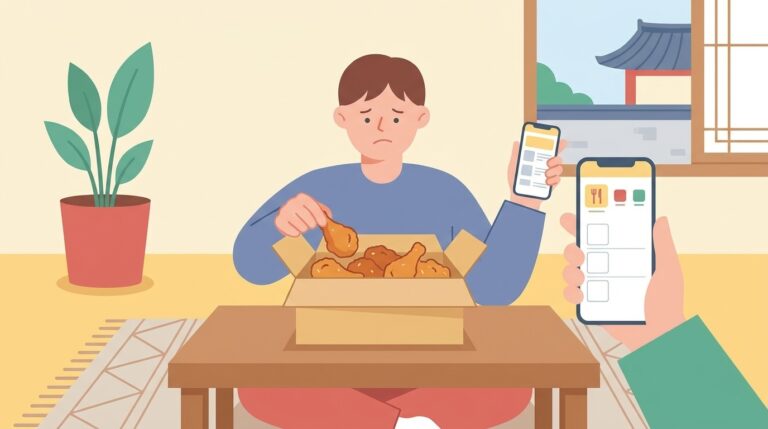
Imagine this: It’s a rainy Friday night in your Seoul Airbnb. You’re binge-watching the latest K-Drama, and the characters are eating mouth-watering Korean fried chicken (Chimaek, anyone?). You get inspired, pull out your phone, and successfully navigate a Korean delivery app for the first time. Ding dong! The food is here! You eagerly open the box… but the chicken is completely cold.
Your heart drops. In textbooks, you learned how to order, but what do you do when something goes wrong? You don’t want to sound rude or like a Jin-sang (a nightmare customer), but you also paid good money for that meal.
Don’t worry. I’ve seen countless expat friends and students freeze in this exact moment. Today, we’re going to learn the polite, culturally nuanced way to give feedback when your delivery food arrives cold. This post is built entirely on the real panic moments my B1-level students have shared with me. Let’s dive into the “Nation of Delivery” (배달의 민족) and learn how to handle this like a true local!
Phase 2: Deep Dive into Core Expressions
When we complain in Korean, the key is separating the issue from the person. We don’t attack; we state the unfortunate situation.
1. 음식이 너무 식어서 왔어요.
- Pronunciation: Eumsigi neomu sigeoseo wasseoyo. [sigeoseo sounds like “seek-uh-so”]
- Meaning: Literal (The food came too cooled down) vs Real (The food arrived completely cold).
- K-Culture Moment: You’re leaving a slightly disappointed but polite review on Baemin (a popular delivery app). You want the owner to know, but you don’t want to ruin their day.
- Editor’s Insight: This is the absolute golden phrase. Notice we don’t say “You gave me cold food.” We say “The food arrived cold.” It blames the delivery process, saving face for the restaurant owner.
- Situation Spectrum:
- Casual (Friends): ✅
- Semi-formal (Restaurant staff/Delivery app): ✅
- Formal (Boss): 🚫 (You wouldn’t complain to your boss about this!)
- 🤔 Think About It: Why does Korean use “왔어요” (came) here? By making the food the subject that “came” cold, we remove the direct blame from the restaurant. Does your native language have a passive way to soften complaints?
2. 배달이 오래 걸려서 다 식었어요.
- Pronunciation: Baedari orae geollyeoseo da sigeosseoyo. [sigeosseoyo sounds like “seek-uh-so-yo”]
- Meaning: Literal (Delivery took a long time so it all cooled down) vs Real (It got cold because the delivery was late).
- K-Culture Moment: You call the restaurant. The owner is apologetic. You use this phrase to show you understand it was probably the delivery rider’s delay, not bad cooking.
- Editor’s Insight: 식다 (sikda) means “to cool down from a hot state.” Never use 차갑다 (chagapda – to be cold like ice water) for hot food that lost its heat. If you say “치킨이 차가워요,” Koreans will imagine your chicken was kept in a freezer!
- Situation Spectrum:
- Casual: ✅
- Semi-formal: ✅
- Formal: ⚠️
- 🤔 Think About It: Korea is famous for its Ppali-ppali (hurry up) culture. When delivery takes long, it’s a big deal. How long do you usually wait for food delivery in your country?
3. 다음에는 따뜻하게 보내 주세요.
- Pronunciation: Da-eumeneun ttatteuthage bonae juseyo.
- Meaning: Literal (Next time, please send it warmly) vs Real (I’ll let it slide this time, but please make sure it’s hot next time).
- K-Culture Moment: You decided to just microwave the food, but you leave this as a review note. It’s the ultimate “Jeong” (정 – affection/compassion) move.
- Editor’s Insight: This phrase is the secret to getting excellent service on your next order. It shows you plan to be a returning customer despite the mistake.
- Situation Spectrum:
- Casual: 🚫
- Semi-formal: ✅
- Formal: ⚠️
- 🤔 Think About It: Koreans often give a second chance rather than demanding an immediate refund. Does this reflect a community-first mindset?
Phase 3: Textbook vs Real Korean
Let’s look at how language shifts from the classroom to the streets of Seoul.
[Situation 1: Leaving a Review on a Delivery App]
* 📖 Textbook Korean: 음식의 온도가 낮습니다. 실망했습니다. (The temperature of the food is low. I am disappointed.)
* 🗣️ Real Korean: 사장님, 치킨이 다 식어서 왔어요 ㅠㅠ 다음에 주문할 땐 신경 써 주세요~
* 💡 Why the difference?: Calling the owner “사장님” (Boss) builds an instant relationship. Using “ㅠㅠ” (crying face) shows you are sad rather than aggressively angry, which gets a much warmer apology in Korean culture.
[Situation 2: Calling to complain about a very late, cold order]
* 📖 Textbook Korean: 배달원이 늦게 와서 음식이 차갑습니다. (The delivery person came late, so the food is cold.)
* 🗣️ Real Korean: 배달이 너무 늦어서 음식이 다 식었네요…
* 💡 Why the difference?: Real Korean heavily utilizes the “~네요” ending to softly express realization or mild surprise, acting as a polite buffer rather than a direct accusation.
Bottom Note: For B1 (Intermediate) learners, using “식어서 왔어요” with a slightly soft, trailing voice is the perfect sweet spot between stating your rights and maintaining politeness.
Phase 4: Cultural Context — K-Culture Deep Dive
4-1. Non-Verbal Nunchi (눈치)
When making a complaint over the phone, your tone of voice is everything. Do not use an aggressive, loud voice. Instead, use a slightly higher pitch with a trailing off tone: “사장님… 치킨이 다 식어서 왔는데요오…” This triggers the owner’s Nunchi. They will immediately sense your disappointment and jump in to apologize before you even ask for a refund.
4-2. The “Review Event” Dilemma (K-Food / App Culture)
If you’ve ever used Baemin or Yogiyo, you know about the “Review Event” (리뷰 이벤트). Restaurants offer free cheese balls or extra fries if you promise to leave a 5-star review.
But what if you promised 5 stars, got the free cheese balls, but the main dish arrived cold? This is a moral dilemma even Koreans struggle with!
Often, Koreans will still leave 5 stars out of loyalty to the “promise,” but write nicely in the text: “별점 5개 드려요. 그런데 음식이 너무 식어서 와서 아쉬웠어요.” (I’m giving 5 stars. But it was a shame the food arrived so cold.) This is a prime example of balancing honesty with Jeong.
Phase 5: Real-Life Roleplay Scenario
Setting: Friday night, 8:00 PM. Your hotel room in Myeongdong. You ordered spicy Tteokbokki after a long day of sightseeing. It finally arrives after 70 minutes, but it’s lukewarm and the rice cakes are stiff. You decide to call the restaurant.
Characters:
– YOU: A hungry expat/tourist who really wanted hot Tteokbokki.
– 사장님 (Owner): The busy, slightly stressed, but kind owner of the Tteokbokki shop.
Dialogue:
사장님: 네, 동대문 엽기떡볶이입니다~
(Ne, Dongdaemun yeopgitteokbokgi-imnida~)
[Yes, this is Dongdaemun Yupdduk~]
(🎭 Stage Direction: You can hear loud kitchen noises and delivery riders shouting in the background)
YOU: 여보세요, 아까 떡볶이 배달 시켰는데요.
(Yeoboseyo, akka tteokbokki baedal sikyeonneundeyo.)
[Hello, I ordered Tteokbokki delivery earlier.]
사장님: 아, 네 고객님! 배달 잘 받으셨나요?
(Ah, ne gogaengnim! Baedal jal badeuseyonnayo?)
[Ah, yes customer! Did you receive the delivery well?]
YOU: 받긴 받았는데… 음식이 너무 식어서 왔어요.
(Batgin badanneunde… eumsigi neomu sigeoseo wasseoyo.)
[I received it, but… the food arrived too cold.]
사장님: 헉, 정말요? 오늘 비가 와서 배달 기사님 배차가 늦어졌나 봐요. 정말 죄송합니다 ㅠㅠ
(Heok, jeongmalyo? Oneul biga waseo baedal gisanim baechaga neujeojeonna bwayo. Jeongmal joesonghamnida TT)
[Gasp, really? It rained today so it seems the delivery driver dispatch was delayed. I am so sorry TT]
🔀 Your Turn! How do you respond?
– A) “환불해 주세요.” (Please give me a refund.)
– B) “네, 알겠습니다. 다시 데워 먹을게요.” (Yes, I understand. I’ll heat it up and eat it.)
– C) “아… 네. 다음에는 따뜻하게 보내 주세요.”
(Ah… yes. Please send it warm next time.)✅ Best Choice: C — Reason: It acknowledges their apology, establishes you aren’t an unreasonable customer, but firmly sets a standard. The owner will likely offer you a freebie next time!
⚠️ Choice A Analysis: While technically okay if the food is completely ruined, asking for a refund immediately without hearing them out first can be seen as overly aggressive in Korea unless the mistake was entirely the restaurant’s fault.
사장님: 고객님, 정말 죄송해서 어쩌죠. 다음번에 주문하실 때 메모 남겨주시면, 제가 서비스 팍팍 드리겠습니다!
(Gogaengnim, jeongmal joesonghaeseo eojjeojyo. Da-eumbone jumunhasil ttae memo namgyeojusimyeon, jaega seobiseu pakpak deurigetseumnida!)
[Customer, I am so sorry, what should I do. Next time you order, if you leave a memo, I will give you lots of free service (extras)!]
YOU: 아, 네 감사합니다. 수고하세요~
(Ah, ne gamsahamnida. Sugohaseyo~)
[Ah, yes thank you. Keep up the good work~]
Phase 6: 10-Second Shadowing Drill
Let’s practice the flow and intonation. Remember to pause at the slashes (/)!
🥺 사장님, / 배달은 잘 받았는데요... / 음식이 너무 / 식어서 왔어요.
(sajangnim, / baedareun jal badanneundeyo… / eumsigi neomu / sigeoseo wasseoyo.)
Pro-tip: Drag out the “요” at the end of “받았는데요” just a tiny bit. It shows you are hesitant to complain, which makes Koreans much more sympathetic to your situation!
Phase 7: K-Culture Mini Dictionary
| Korean | Romanization | English | Context |
|---|---|---|---|
| 눈치 | nunchi | Social awareness | Reading the room. Knowing how to complain without causing a scene. |
| 배달의 민족 | baedalui minjok | Delivery Nation | Korea’s nickname and the name of the biggest delivery app (Baemin). |
| 진상 | jinsang | Unreasonable customer | Someone who yells, demands impossible refunds, or acts entitled. |
| 리뷰 이벤트 | ribyu ibenteu | Review event | A common culture where restaurants give free food in exchange for a 5-star review promise. |
| 서비스 | seobiseu | “Service” (Freebie) | When a restaurant gives you extra food for free to show appreciation or apologize. |
Phase 8: Traveler Survival Kit
If you are traveling in Korea, ordering delivery is a must-do bucket list item (like ordering chicken to the Han River!). But apps often require a Korean phone number.
🆘 Survival Expressions for Hotel Delivery
– 🇰🇷 “프론트데스크죠? 배달 음식 시켰는데, 로비로 가면 되나요?”
(peuronteu-deseukeujyo? baedal eumsik sikyeonneunde, robiro gamyeon doenayo?)
– 🗣️ “Is this the front desk? I ordered delivery food, should I go to the lobby?”
– 📍 Where to use: Calling the hotel reception.
– 💡 Pro Tip: Many Korean hotels do not allow delivery drivers to go up to guest floors for security reasons. You almost always have to meet them at the 1st-floor lobby!📌 Editor’s Travel Note
– Useful Apps: If you don’t have a Korean ARC (Alien Registration Card) or phone number, apps like Shuttle Delivery or Creatrip are highly recommended as they accept foreign credit cards and have English interfaces.
– Tipping: There is absolutely NO tipping culture in Korea, even for delivery drivers! Do not try to hand them cash; it will just cause an awkward moment.
Phase 9: Critical Thinking Corner — “A Step Deeper”
Food & Identity: Why Warm Food Matters in Korea
In Korea, asking “Have you eaten?” (밥 먹었어요?) is literally a way of saying “How are you?” Food is heavily tied to affection, care, and community (Jeong). Historically, offering a “warm bowl of rice” (따뜻한 밥 한 끼) was the ultimate sign of hospitality.
Therefore, when a restaurant owner hears that your food arrived cold, they don’t just see it as a mechanical failure; it feels like a failure of hospitality. That is why they often over-apologize or try to make it right with “Service” (freebies) next time. They want to ensure you feel cared for, not just fed.
🧠 Think Deeper:
The clash between the intense Ppali-ppali (fast) delivery culture and the traditional desire for warm, comforting meals creates an interesting dynamic in modern Korea.💬 Your Turn: How is food tied to hospitality in your culture? Is a cold meal seen as a major offense, or just a minor inconvenience? Let me know in the comments!
Phase 10: FAQ & Avoiding Mistakes
Q: Can I use “식어서 왔어요” to my Korean mother-in-law if she gives me cold food?
A: NO! 🚫 “~아/어서 왔어요” implies a transaction/delivery. If a family member gives you food that cooled down, playfully say “어머니, 밥이 좀 식었네요~ 데워 먹을게요!” (Mother, the rice cooled down a bit~ I’ll heat it up!).
Q: Can I ask the delivery driver to take it back?
A: Rarely. Drivers in Korea are usually independent contractors for agencies, not restaurant employees. Complaining to the driver won’t fix the issue. Always contact the restaurant directly.
❌ Common Mistake #1: Using “차갑다” (Chagapda).
🗣️ “사장님, 치킨이 차가워요!” (Boss, the chicken is cold-as-ice!)
✅ Do this instead: “치킨이 식었어요.” (The chicken lost its heat.)❌ Common Mistake #2: Being overly direct.
🗣️ “음식이 식었어요. 환불해 주세요.” (Food is cold. Refund me.)
✅ Do this instead: “음식이 식어서 왔네요. 혹시 어떻게 안 될까요?” (The food arrived cold. Is there anything we can do about it? – Let them offer the solution!)
Phase 11: Summary & Action Items
One-Liner Summary: When your Korean delivery arrives cold, use “음식이 식어서 왔어요” (eumsigi sigeoseo wasseoyo) to complain politely without placing direct blame.
Action Mission:
– 🥉 Bronze: Say “음식이 식어서 왔어요” out loud 3 times with a slightly sad facial expression.
– 🥈 Silver: Leave a comment on this post writing what your favorite Korean delivery food is, using today’s phrase in a sentence!
– 🥇 Gold: Next time you order food in Korea (or at a Korean restaurant abroad), ask the waiter: “음식이 식었는데, 다시 데워 주실 수 있나요?” (The food got cold, could you heat it up again?)
🎬 K-Culture Mission:
Watch one episode of Hospital Playlist or Let’s Eat and count how many times they order delivery food! Notice how they talk to the delivery riders (usually a quick “수고하세요!” – Keep up the good work!).
Phase 12: Quiz — Interactive Challenge
1. Situational Judgment: You ordered Jajangmyeon, but it arrived late and lost all its heat. You call the restaurant. Which is the MOST natural thing to say?
– A) 짜장면이 너무 차가워요! (Jajangmyeon is too cold like ice!)
– B) 배달이 오래 걸려서 다 식었어요. (Delivery took long so it all cooled down.)
– C) 사장님을 당장 바꾸세요! (Put the boss on the phone right now!)
2. True or False – K-Culture Edition:
– If your delivery driver is late, you should give them a smaller tip. (T / F)
(Scroll down for answers!)
Click here for Answers
1. B is the correct answer! ‘A’ uses the wrong word for cold food (차가워요 instead of 식었어요). ‘C’ is a total Jinsang move.
2. False! There is no tipping culture in Korea. The delivery fee (배달팁) is paid automatically through the app.
Frequently Asked Questions (FAQ)
Q: What does "음식이 너무 식어서 왔어요." mean in Korean and how do you pronounce it?
A: In Korean, "음식이 너무 식어서 왔어요." is pronounced [Eumsigi neomu sigeoseo wasseoyo. [sigeoseo sounds like "seek-uh-so"] and means: Literal (The food came too cooled down) vs Real (The food arrived completely cold).
Q: What does "배달이 오래 걸려서 다 식었어요." mean in Korean and how do you pronounce it?
A: In Korean, "배달이 오래 걸려서 다 식었어요." is pronounced [Baedari orae geollyeoseo da sigeosseoyo. [sigeosseoyo sounds like "seek-uh-so-yo"] and means: Literal (Delivery took a long time so it all cooled down) vs Real (It got cold because the delivery was late).
Q: What does "다음에는 따뜻하게 보내 주세요." mean in Korean and how do you pronounce it?
A: In Korean, "다음에는 따뜻하게 보내 주세요." is pronounced [Da-eumeneun ttatteuthage bonae juseyo.] and means: Literal (Next time, please send it warmly) vs Real (I'll let it slide this time, but please make sure it's hot next time).







