

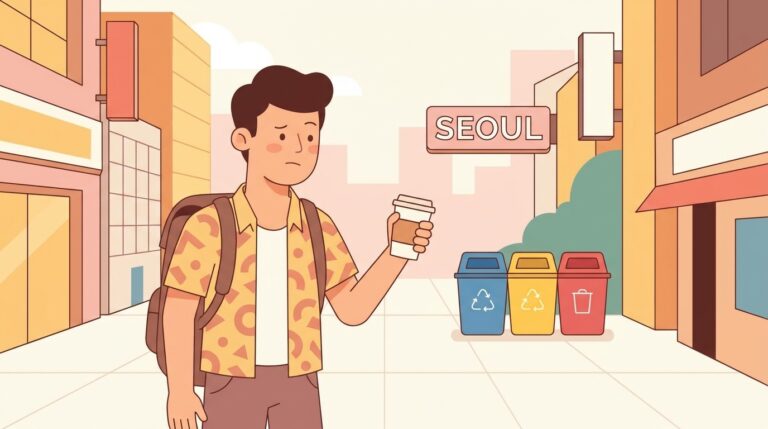
Phase 1: Empathy & The “Where is the Trash Can?” Panic
Hello there! I’m your Daily Hangul Editor.
Picture this: You’re walking down the vibrant streets of Hongdae. You just finished a delicious iced Americano, and now you’re holding an empty plastic cup. You look left… you look right… Wait, where are all the public trash cans?
If you’ve watched Korean dramas, you might have noticed those scenes where neighbors awkwardly bump into each other while wearing sweatpants, holding giant plastic bags. That’s the famous Korean neighborhood recycling area. Korea has one of the strictest and most efficient waste management systems in the world.
As a tourist or expat, the lack of street trash cans and the terrifying red warning signs saying “쓰레기 무단 투기 금지” (No Illegal Dumping) can be super intimidating. Toss that cup in the wrong place, and you might get a hefty fine—or worse, an intense scolding from a local ahjumma.
Don’t worry! I’ve seen countless of my students panic over an empty wrapper. Today, I’m going to teach you exactly how to ask for help and avoid the ultimate cultural faux pas of littering in Korea.
Phase 2: Core Expressions Deep Dive
Let’s break down the most essential expressions you need when you’re holding garbage and don’t know what to do.
1. 쓰레기는 어디에 버려요?
- Pronunciation: sseuregineun eodie beoryeoyo? [Suh-reh-gee-neun uh-dee-eh buh-ryuh-yo?]
- Meaning: Where do I throw away the trash? (Literal: As for trash, where do I throw it?)
- K-Culture Moment: You’re at a convenience store after eating a cup ramyeon. You need to throw away the cup, but there are four different bins. You approach the cashier with a polite smile and ask this.
- Editor’s Insight: The word ‘쓰레기’ (sseuregi) means trash, and ‘버리다’ (beorida) means to throw away. It’s polite, direct, and the absolute safest way to ask for directions to a bin.
- Situation Spectrum:
- Casual (Friends): ✅ (Say: 쓰레기 어디 버려? – sseuregi eodi beoryeo?)
- Semi-formal (Clerks, Strangers): ✅
- Formal (Bosses, Elders): ⚠️ (Better to say: 쓰레기통이 어디 있나요? – Where is the trash can?)
- 🤔 Think About It: Why are there so few public trash cans in Korea? It’s actually to prevent people from bringing their household trash to the streets! Korea uses a pay-as-you-go trash bag system. Does your country have a similar rule?
2. 여기에 버리면 안 돼요.
- Pronunciation: yeogie beorimyeon an dwaeyo. [Yuh-gee-eh buh-ree-myun ahn dwae-yo.]
- Meaning: You shouldn’t throw it here. / No littering here.
- K-Culture Moment: You’re about to drop a tissue into a random box on the street, and a local store owner rushes out, waving their hands and saying this.
- Editor’s Insight: The grammar
~면 안 되다means “you shouldn’t” or “you are not allowed to.” If you hear this, freeze! You are about to break a community rule.- Situation Spectrum:
- Casual: ✅ (여기 버리면 안 돼)
- Semi-formal: ✅
- Formal: 🚫 (It sounds like you are scolding someone older, which is a big no-no!)
- 🤔 Think About It: Koreans often police their own neighborhoods. Maintaining a clean street is seen as a collective responsibility. How would people in your culture react if they saw someone littering?
3. 분리수거 해야 돼요.
- Pronunciation: bullisugeo haeya dwaeyo. [Bool-lee-soo-guh hae-ya dwae-yo.]
- Meaning: You have to separate the recycling.
- K-Culture Moment: You move into a Korean Airbnb or apartment. Your host points to five different colored bins on the balcony and drops this line. Welcome to Korean adulting!
- Editor’s Insight: ‘분리수거’ (bullisugeo) is a massive part of Korean life. It literally means “separate collection.” You separate paper, plastic, vinyl, glass, and food waste.
- Situation Spectrum:
- Casual: ✅
- Semi-formal: ✅
- Formal: ⚠️
- 🤔 Think About It: What does the complex “bullisugeo” system tell us about the Korean mindset regarding community rules and the environment?
Phase 3: Textbook vs. Real Korean
Let’s look at how “No Littering” and “Throwing away trash” evolve from the textbook to the streets.
[Situation 1: Looking for a place to toss your cup]
* 📖 Textbook Korean: 쓰레기통이 어디에 있습니까? (Where is the trash receptacle?)
* 🗣️ Real Korean: 이거 어디다 버려요? (Where do I throw this?)
* 💡 Why the difference?: Koreans love efficiency. Instead of using the formal word for trash, they just hold up the item and say “이거” (this) plus the verb.
[Situation 2: Seeing a strict “No Littering” sign]
* 📖 Textbook Korean: 쓰레기 무단 투기를 금지합니다. (Illegal dumping of garbage is prohibited.)
* 🗣️ Real Korean: (Spoken by a grumpy neighbor) 거기 쓰레기 버리지 마세요! (Don’t throw trash there!)
* 💡 Why the difference?: “무단 투기 금지” is heavy legal or administrative jargon (using Hanja/Chinese characters) used exclusively on official signs and CCTV warnings. In daily life, people use simple verbs.
Bottom Note: For B1 learners, stick to “어디에 버려요?” It’s perfectly polite and natural for any everyday situation!
Phase 4: Cultural Context — K-Culture Deep Dive
4-1. The Non-Verbal “Nunchi” of Trash
In Korea, reading the room (Nunchi) is crucial, especially regarding rules. If you are at a cafe and you see locals carefully pouring leftover ice into a specific bucket, stacking their plastic cups, and putting the paper sleeves in a different bin… do the same! Do not just dump your entire tray into one bin. If an older person corrects you with “여기에 버리면 안 돼요,” simply nod slightly, say “아, 죄송합니다!” (Ah, I’m sorry!), and fix it. Arguing about trash is never a good idea.
4-2. The “Recycling Area” K-Drama Trope
If you watch slice-of-life K-Dramas, you will inevitably see the 분리수거 (Bullisugeo) scene. Usually, it happens late at night. The male lead is wearing a stretched-out t-shirt, sorting his crushed beer cans, and the female lead walks out in her pajamas. They have a heart-to-heart conversation over the plastics bin.
Why does this trope exist? Because taking out the recycling is a universal, unglamorous chore that every single Korean resident must do, usually on a specific assigned day of the week. It strips away the glamour and shows the characters in their most authentic, everyday state.
Phase 5: Real-Life Roleplay Scenario
Setting: 11:30 PM. Outside a convenience store near the Han River. You and your Korean friend Min-su just finished eating spicy cup ramyeon at the plastic tables outside.
Characters:
– YOU: An expat who has been in Korea for a few months, but you still get confused by the garbage bins.
– Min-su (32): Your friendly Korean coworker who is acting as your local guide today.
Dialogue:
Min-su: 아, 배부르다! 이제 가자.
(Ah, baebureuda! Ije gaja.)
[Ah, I’m full! Let’s go now.]
YOU: 그래. 근데 나 이 라면 국물 남았는데…
(Geurae. Geunde na i ramyeon gungmul namanneunde…)
[Yeah. But I have some ramen soup left…]
Min-su: 아, 그거 쓰레기통에 그냥 버리면 안 돼. 음식물 쓰레기야.
(A, geugeo sseuregitonge geunyang beorimyeon an dwae. Eumsingmul sseuregiya.)
[Ah, you shouldn’t just throw that in the trash can. It’s food waste.]
YOU: 아, 진짜?
(A, jinjja?)
[Ah, really?]
Min-su: 응. 국물은 저기 통에 따로 버려야 돼.
(Eung. Gungmureun jeogi tonge ttaro beoryeoya dwae.)
[Yeah. You have to throw the soup separately into that bucket over there.]
🔀 Your Turn! How do you reply?
– A) “너무 복잡해! 그냥 바닥에 버릴래.” (Too complicated! I’ll just throw it on the ground.)
– B) “아, 알겠어. 저기에 버리고 올게!” (Ah, got it. I’ll go throw it there and come back!)
– C) “쓰레기 무단 투기를 금지합니다.”✅ Best Choice: B — It acknowledges the rule and shows you are willing to follow it.
⚠️ Choice C Analysis: You are quoting a legal sign to your friend! It sounds like you suddenly became a robot or a police officer.
🚫 Choice A Analysis: You will definitely get a fine, and Min-su might pretend he doesn’t know you.
Phase 6: 10-Second Shadowing Drill
Let’s practice asking for the trash can politely. Read this out loud, paying attention to the pauses!
🥺 죄송한데, / 이거 / 어디에 버려요?
(joe-song-han-de, / i-geo / eo-di-e beo-ryeo-yo?)
Tone Guide: Say it slightly apologetically (🥺), as if you are sorry to bother them, with a slight upward inflection at the end.
Phase 7: K-Culture Mini Dictionary
| Korean | Romanization | English | Cultural Context |
|---|---|---|---|
| 분리수거 | bullisugeo | Recycling / Sorting trash | The strict system of separating paper, plastics, cans, glass, and vinyl. |
| 종량제 봉투 | jongnyangje bongtu | Standardized trash bag | You MUST buy these specific bags from a local supermarket to throw away general household trash. You cannot use a random grocery bag! |
| 음식물 쓰레기 | eumsingmul sseuregi | Food waste | Food waste goes into specific yellow/green bags or special bins. It is processed to become animal feed or fertilizer. |
| 무단 투기 | mudan tugi | Illegal dumping | You’ll see this on red warning signs (CCTV 녹화중 – CCTV recording). Fines can be up to 1,000,000 KRW! |
Phase 8: Traveler’s Survival Kit
If you are traveling in Korea, you will generate trash (coffee cups, street food skewers). Here is your survival kit!
🆘 Survival Expressions
– 🇰🇷 “이거 어디다 버려요?” (igeo eodida beoryeoyo?)
– Where do I throw this?
– 🇰🇷 “플라스틱은 어디예요?” (peullaseutigeun eodiyeyo?)
– Where does the plastic go? (Great for cafe recycling stations)
– 🇰🇷 “종량제 봉투 하나 주세요.” (jongnyangje bongtu hana juseyo.)
– Please give me one standard trash bag. (If you are staying in an Airbnb)📌 Editor’s Travel Note
– Where ARE the trash cans?: You can usually find trash cans inside subway stations, inside convenience stores, or near public restrooms.
– The Pocket Rule: Always carry a small plastic bag or ziplock in your daypack. You will likely end up carrying your empty coffee cup for a few blocks. Just accept it as part of the Seoul experience!
– Street Food: If you eat street food in Myeongdong, give the empty skewer or cup back to the stall owner you bought it from. They usually have a dedicated bag for their customers’ trash.
Phase 9: Critical Thinking — “One Step Deeper”
Community vs. Individual: The Logic Behind the Trash Bags
Why does Korea use the Jongnyangje (종량제 – pay-as-you-go) trash bag system? Introduced in 1995, this system forces residents to buy specific municipal garbage bags. The cost of the bag includes the tax for waste disposal. It perfectly reflects the Korean societal value of collective responsibility combined with financial incentive. By making people pay for the volume of trash they produce, it heavily encourages them to recycle (since recycling is free!). It shows how the Korean government uses structural rules to enforce a shared environmental duty.
💬 Your Turn: Does your city charge you based on how much trash you throw away, or is it a flat tax? How do you feel about Korea’s system? Let us know in the comments!
Phase 10: FAQ & Avoiding Misunderstandings
Q: “Can I just flush my tissues down the toilet?”
Maybe. In modern buildings and hotels, yes. But in older subway stations or older buildings, you will see a sign saying: 휴지는 휴지통에 (Tissues in the trash can). Because older plumbing pipes are narrow, flushing tissues can clog them!
Q: “If I buy a trash bag in Seoul, can I use it in Busan?”
No! Every district (구 – gu) has its own specific trash bag. A bag bought in Gangnam cannot be used in Mapo-gu.
❌ Common Mistake #1: Throwing an unwashed delivery food container into the recycling.
✅ Do this instead: In Korea, if a plastic container is stained with red pepper paste (gochujang) or grease, it is NO LONGER recyclable. You must wash it first. If it won’t come clean, it goes into the general trash bag!
Phase 11: Summary & Action Items
- One-Liner Summary: To avoid hefty fines and angry stares, politely ask “이거 어디에 버려요?” (Where do I throw this?) and always look out for recycling bins.
Your Missions:
– 🥉 Bronze (Solo): Stand in front of your own trash can at home and say “여기에 버리면 안 돼요!” with your best dramatic K-Drama actor face.
– 🥈 Silver (Online): Find a K-Drama scene involving a recycling area and share it with your study group, pointing out the “Bullisugeo” (분리수거).
– 🥇 Gold (Real Life): Next time you are at a Korean cafe or convenience store, ask the staff “이거 어디에 버려요?” instead of just guessing!
Engage: What’s the strictest recycling rule in your home country? Tell us below!
Phase 12: Quiz — Interactive Challenge
1. Situational Judgment: You are at a cafe. You have an iced latte with ice left in the plastic cup. You are about to leave. What is the proper Korean way to dispose of it?
– A) Throw the whole cup, ice included, into the first bin you see.
– B) Leave it on the table; someone will clean it.
– C) Pour out the ice/liquid into the designated liquid bucket, then throw the plastic cup in the plastic bin.
(Answer: C! This is the standard ‘bullisugeo’ etiquette in Korean cafes!)
2. Fill in the Blank:
A: 이 종이컵 ________ 버려요?
B: 아, 저기 쓰레기통에 버리세요.
– A) 언제 (When)
– B) 어디에 (Where)
– C) 왜 (Why)
(Answer: B. 어디에 버려요? = Where do I throw it?)
3. True or False – K-Culture Edition:
You can throw leftover fried chicken bones into the “Food Waste” (음식물 쓰레기) bin.
(Answer: FALSE! Animal bones, eggshells, and onion skins are considered GENERAL TRASH in Korea because they cannot be processed into animal feed. Crazy, right?)
Frequently Asked Questions (FAQ)
Q: What does "쓰레기는 어디에 버려요?" mean in Korean and how do you pronounce it?
A: In Korean, "쓰레기는 어디에 버려요?" is pronounced [sseuregineun eodie beoryeoyo? [Suh-reh-gee-neun uh-dee-eh buh-ryuh-yo?] and means: Where do I throw away the trash? (Literal: As for trash, where do I throw it?)
Q: What does "여기에 버리면 안 돼요." mean in Korean and how do you pronounce it?
A: In Korean, "여기에 버리면 안 돼요." is pronounced [yeogie beorimyeon an dwaeyo. [Yuh-gee-eh buh-ree-myun ahn dwae-yo.] and means: You shouldn't throw it here. / No littering here.
Q: What does "분리수거 해야 돼요." mean in Korean and how do you pronounce it?
A: In Korean, "분리수거 해야 돼요." is pronounced [bullisugeo haeya dwaeyo. [Bool-lee-soo-guh hae-ya dwae-yo.] and means: You have to separate the recycling.







