

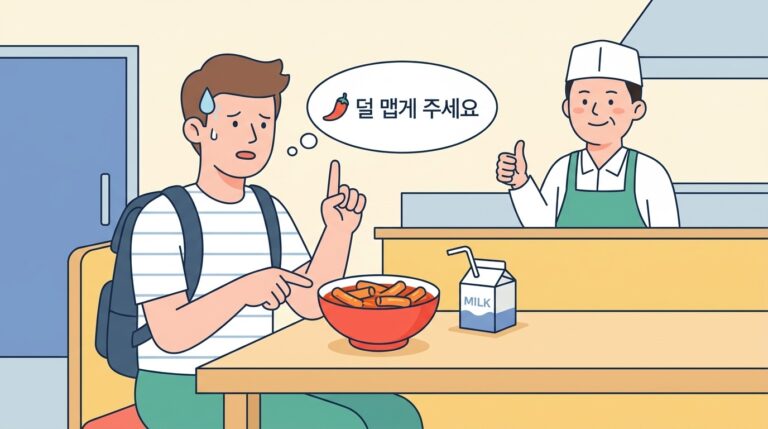
Hello! I’m your editor at Daily Hangul, and I’m so excited to guide you through today’s lesson.
Imagine this: You’re watching a K-Drama. The main characters are sitting in a cozy pojangmacha (street tent), laughing as they share a bubbling, bright red pot of tteokbokki. It looks absolutely delicious. Inspired, you fly to Seoul, walk into a local restaurant, and confidently order the same dish. You take one bite, and suddenly… your soul leaves your body. You are crying, sweating, and chugging water while the Korean grandma serving you smiles and says, “Aigoo, it’s not even spicy!”
If you’ve ever been a victim of the “Korean standard of spicy,” you are not alone. Knowing how to adjust the spice level in Korea isn’t just a language skill—it is a vital survival tactic! Today, we are going to learn exactly how to save your tastebuds while still enjoying the amazing world of K-Food. Everything here is based on the tears and triumphs of my real students. Let’s dive in!
Phase 2: Core Expressions Deep Dive
Here are the lifesavers you need when ordering at a Korean restaurant.
1. 덜 맵게 해 주세요
- Pronunciation: deol maepge hae juseyo [Sounds like: dull mep-ge heh joo-seh-yo]
- Meaning: Please make it less spicy. (Literal: less spicily make please)
- K-Culture Moment: You are at a Galbi-jjim (braised short ribs) restaurant. The menu has pepper icons next to the dishes. You want some kick, but you don’t want to breathe fire. This is your go-to phrase!
- Editor’s Insight: The word ‘덜’ (deol) means ‘less’. It’s the magic word. It shows you respect the chef’s original recipe but just need a slight modification for your mortal tongue.
- Situation Spectrum:
- Friends (Casual): ✅ (Say: 덜 맵게 해 줘)
- Waitstaff (Semi-formal): ✅ (This is perfect)
- High-end Dining (Formal): ⚠️ (You might want to say “조금 덜 맵게 조리해 주실 수 있나요?”)
- 🤔 Think About It: Why not just ask for “no spice”? Because in Korean cooking, the red chili powder (gochugaru) is often what gives a dish its core flavor, not just its heat!
2. 안 맵게 해 주세요
- Pronunciation: an maepge hae juseyo [Sounds like: ahn mep-ge heh joo-seh-yo]
- Meaning: Please make it not spicy. (Literal: not spicily make please)
- K-Culture Moment: You are ordering for your child, or you truly have zero tolerance for spice. You use this at a fried chicken shop to ensure the sauce has zero heat.
- Editor’s Insight: Be careful! ‘안’ (an) means ‘not’. However, for some traditional dishes (like Kimchi stew), making it completely non-spicy is impossible because the base ingredients are inherently spicy.
- Situation Spectrum:
- Friends (Casual): ✅
- Waitstaff (Semi-formal): ✅
- High-end Dining (Formal): ⚠️
- 🤔 Think About It: Have you noticed how some menus will have a “순한맛” (mild flavor) option especially for kids? It shows how Koreans segregate food by age and spice tolerance!
3. 신라면보다 매워요?
- Pronunciation: sinramyeonboda maewoyo? [Sounds like: shin-rah-myun-bo-da meh-wo-yo?]
- Meaning: Is it spicier than Shin Ramyun?
- K-Culture Moment: You are at a trendy Mara-tang or Tteokbokki spot where you have to choose a spice level from 1 to 5. You have no idea what “Level 2” means.
- Editor’s Insight: Shin Ramyun is the ultimate, universally agreed-upon standard of spiciness in Korea. If you ask this, every single Korean will instantly understand your question and give you an accurate answer.
- Situation Spectrum:
- Friends (Casual): ✅
- Waitstaff (Semi-formal): ✅ (Very commonly used!)
- High-end Dining (Formal): 🚫 (Too casual for fine dining)
- 🤔 Think About It: Why does an entire nation use one specific brand of instant noodles as a unit of measurement?
Phase 3: Textbook vs. Real Korean
Let’s look at how language shifts from the classroom to the bustling streets of Seoul.
[Situation 1: Asking to tone down the heat]
* 📖 Textbook Korean: 조금 덜 맵게 요리해 주시겠습니까? (Would you please cook it a little less spicy?)
* 🗣️ Real Korean: 덜 맵게 해 주세요. (Make it less spicy, please.)
* 💡 Why the difference?: Korean restaurant culture is fast-paced (Ppalli-ppalli culture). Long, overly polite sentences can actually confuse busy waitstaff. Clear, concise, and polite is the way to go!
[Situation 2: Confessing you can’t handle spice]
* 📖 Textbook Korean: 저는 매운 음식을 잘 못 먹습니다. (I am not good at eating spicy food.)
* 🗣️ Real Korean: 저 맵찔이예요. (I’m a “spicy wimp”.)
* 💡 Why the difference?: Maep-jjil-i (맵찔이) is a fun slang term combining ‘spicy’ and ‘loser/wimp’. It’s super trendy and using it will instantly make your Korean friends laugh and feel closer to you.
Bottom Note: For A2 learners, using “덜 맵게 해 주세요” is your safest, most natural bet for everyday restaurant interactions!
Phase 4: Cultural Context — K-Culture Deep Dive
4-1. The Non-Verbal Language of Spice
When you ask for less spice, your body language matters! Don’t look terrified. Just smile slightly, maybe point to the menu item, and use a soft hand gesture. Koreans are very observant (thanks to Nunchi culture) and the staff will immediately catch on that you, as a foreigner, might need a milder option.
4-2. The K-Food Connection: Why so red?
Have you ever wondered why so much Korean food is red? Interestingly, chili peppers were only introduced to Korea in the 16th century! Today, spicy food is deeply tied to stress relief. You’ll often hear Koreans say, “스트레스 풀린다!” (My stress is relieved!) while eating extremely spicy Buldak (fire chicken) or Jjamppong (spicy seafood noodle soup). Sweating it out over a spicy meal is considered a cathartic, communal experience.
A Critical Look: Because spice is tied to stress relief, sometimes Koreans assume everyone likes it. If a waiter says, “에이, 안 매워요!” (Oh, it’s not spicy!), remember: That is the Korean standard. Their “not spicy” might still make your nose run!
Phase 5: Real-Life Roleplay Scenario
Let’s put you right in the middle of the action.
- Setting: Friday night, 7:30 PM. A buzzing Tteokbokki franchise in Hongdae. K-Pop is blasting, and every table has a giant pan of bubbling red sauce.
- Characters:
- YOU: A Korean language learner who loves the taste of Korean food, but your stomach strongly disagrees with high spice levels.
- Minji (25): Your Korean friend who has a lot of “Maep-busim” (pride in eating spicy food).
- Staff: A busy, fast-talking college student working part-time.
Minji: 여기 로제 떡볶이 세트 하나 주시고요, 맵기는 3단계로 해주세요!
(Yeogi roje tteokbokki seteuhana jusigoyo, maepgineun sam-dangyero haejuseyo!)
[Translation] We’ll have one Rosé Tteokbokki set, and make it a level 3 spicy!
YOU: 잠깐만 민지야! 3단계? 그거 많이 매워?
(Jamkkanman Minji-ya! Sam-dangye? Geugeo mani maewo?)
[Translation] Wait a minute Minji! Level 3? Is that very spicy?
Minji: 음, 별로 안 매워. 그냥 신라면 정도?
(Eum, byeollo an maewo. Geunyang sinramyeon jeongdo?)
[Translation] Hmm, not really. Just about Shin Ramyun level?
Staff: 손님, 저희 3단계는 불닭볶음면보다 조금 더 맵습니다. 괜찮으시겠어요?
(Sonnim, jeoheui sam-dangyeneun buldakbokkeummyeon-boda jogeum deo maepseumnida. Gwaenchaneushigesseoyo?)
[Translation] Customer, our level 3 is a bit spicier than Buldak (Fire Chicken) Noodles. Will that be okay?
(🎭 Stage Direction: Your eyes go wide. Buldak noodles?! You know those are lethal.)
🔀 Your Turn! How do you respond to save your life?
– A) “아… 네, 괜찮아요. 그냥 3단계 주세요.” (Ah… yes, it’s fine. Just give us level 3.)
– B) “저기요, 그럼 1단계로 덜 맵게 해 주세요!”
– C) “민지야, 나 갈게. 안녕.” (Minji, I’m leaving. Bye.)✅ Best Choice: B — “Excuse me, then please make it less spicy at Level 1!” You communicated clearly with the staff and saved your stomach.
⚠️ Choice A Analysis: You are being too polite and you will definitely regret this in the bathroom tomorrow.
🌟 Bonus K-Culture Scenario: Convenience Store
You are at a GS25 convenience store at midnight, holding a spicy cup noodle.
YOU: 이거 많이 매워요?
(Igeo mani maewoyo?)
[Translation] Is this very spicy?
Cashier: 네, 그거 엄청 매워요. 스트링 치즈 같이 넣어서 드세요!
(Ne, geugeo eomcheong maewoyo. Seuteuring chijeu gachi noeoseo deuseyo!)
[Translation] Yes, that’s super spicy. Put some string cheese in it and eat it together!
(Pro Tip: Adding cheese or a soft-boiled egg is the ultimate Korean hack to survive spicy ramen!)
Phase 6: 10-Second Shadowing Drill
Let’s practice speaking! Follow the intonation marks (/) and try to match the emotion.
🥺 저기요! / 이거 / 조금만 / 덜 맵게 해 주세요~
(jeogiyo! / igeo / jogeumman / deol maepge hae juseyo~)
[Emotion: Politely pleading to save your tastebuds]
Read it out loud 3 times. Imagine you are making eye contact with the friendly restaurant owner!
Phase 7: K-Culture Mini Dictionary
Here are some spicy vocabulary words to level up your K-Culture knowledge!
| Korean | Romanization | English | Cultural Context |
|---|---|---|---|
| 맵찔이 | maep-jjil-i | Spicy wimp | A cute, self-deprecating slang for someone who can’t handle spice. |
| 맵부심 | maep-bu-sim | Spice pride | The absolute pride someone takes in being able to eat extremely spicy food without sweating. |
| 불맛 | bul-mat | Fire flavor | A smoky, wok-hei flavor often found in spicy stir-fries or Jjamppong. It implies a delicious, savory heat. |
| 순한맛 | sun-han-mat | Mild flavor | The safest option on the menu. Often recommended for children or ‘maepjjiri’. |
| 단짠단짠 | dan-jjan-dan-jjan | Sweet and salty | The perfect flavor combo. Often, Koreans eat something sweet right after eating something spicy and salty! |
Phase 8: Traveler Survival Kit
If you are traveling in Korea, you will be eating out a lot. Here is your ultimate restaurant survival card.
🆘 Survival Phrases for K-Food Dining
– 🇰🇷 “이거 맵나요?” (igeo maemnayo?)
– 🗣️ Meaning: Is this spicy?
– 📍 Where to use: Any restaurant before you commit to ordering a dish.
- 🇰🇷 “마요네즈 있어요?” (mayonejeu isseoyo?)
- 🗣️ Meaning: Do you have mayonnaise?
- 📍 Where to use: Jjukkumi (spicy baby octopus) or Dakbal (spicy chicken feet) restaurants. Mayo kills the heat!
📌 Editor’s Travel Note
– Red doesn’t always mean danger: Sometimes red soup is just flavorful, not violently spicy (like mild Kimchi Jjigae). But clear soup (like white Jjamppong) can secretly contain invisible Cheongyang (extremely hot) green peppers!
– Water is self-serve: If your mouth is on fire, don’t wait for the waiter. Look for a sign that says “물은 셀프” (Water is self-serve) and run to the water purifier!
Phase 9: Critical Thinking Corner — “One Step Deeper”
Food & Identity: The Cult of Spiciness
In modern Korea, spicy food is deeply intertwined with the fast-paced, high-pressure lifestyle of students and office workers. When Koreans get stressed from exams or working overtime, they often seek out dishes like Buldak or Yeopgi Tteokbokki (notorious for extreme heat). The physical reaction of sweating and panting is viewed as a way of releasing mental tension—literally “sweating out the stress.” This collective experience of suffering through a deliciously fiery meal brings friends and coworkers closer together, strengthening social bonds through shared culinary endurance.
💬 Your Turn: Does your culture have a specific food people eat when they are stressed? Do you use food to “sweat out” your negative emotions? Let me know in the comments below!
Phase 10: FAQ & Avoiding Misunderstandings
Q: If I say “안 맵게 해 주세요” (Make it not spicy), will the food be completely mild?
Maybe, but often no. If the dish is fundamentally built on a spicy sauce (like spicy stir-fried pork), the chef can only reduce the spice, not eliminate it. If you need zero spice, you must order a naturally non-spicy dish like Bulgogi or Gimbap.
Q: What if the waiter says “조금 매워요” (It’s a little spicy)?
A: Take this as a warning! A Korean’s “little spicy” is often a foreigner’s “very spicy.” Always ask for it to be made milder just in case.
❌ Common Mistake: Saying “안 매워요 해 주세요” (an maewoyo hae juseyo).
✅ Do This Instead: Say “안 맵게 해 주세요” (an maepge hae juseyo). You must use the adverb form ‘-게’ (ge) when asking someone to make it a certain way!
Phase 11: Summary & Action Items
🔥 One-Liner Summary: To save your mouth from K-Food fire, politely smile and say, “덜 맵게 해 주세요” (Make it less spicy, please)!
Your Action Missions:
– 🥉 Bronze (Solo): Stand in front of a mirror, look mildly distressed, and say “덜 맵게 해 주세요” three times.
– 🥈 Silver (Online): Go to a K-Drama or K-Pop clip on YouTube where someone is eating spicy food, and comment: “나도 맵찔이야…” (I’m a spicy wimp too…)
– 🥇 Gold (Real Life): Next time you visit a Korean restaurant, use “신라면보다 매워요?” to check the spice level before ordering.
🎥 K-Culture Mission:
Go to your local Asian supermarket. Find a pack of Shin Ramyun and a pack of Buldak Ramen. Look at the Scoville scale (SHU) on the back. Now you know the exact numerical difference between standard K-Spice and extreme K-Spice!
Phase 12: Quiz — Interactive Challenge
Test your K-Spice survival skills!
1. You are at a restaurant and want to order Tteokbokki, but you are terrible with spicy food. What is the most natural thing to say to the waiter?
A) 저는 매운 음식을 잘 못 먹습니다.
B) 덜 맵게 해 주세요.
C) 고추장 빼 주세요 (Take out the chili paste).
💡 Answer: B. (A is too textbook, and C will ruin the dish because Tteokbokki is made of chili paste!)
2. Fill in the blank: If you want to ask if the dish is spicier than the national standard noodle, you say “_______보다 매워요?”
💡 Answer: 신라면 (Shin Ramyun)
3. True or False: In Korea, a clear, white soup is always 100% safe and non-spicy.
💡 Answer: False! Watch out for clear soups like ‘Nagasaki Jjamppong’ or ‘Bugeo-guk’. They often hide invisible slices of Cheongyang green peppers that pack a serious punch!
Frequently Asked Questions (FAQ)
Q: What does "덜 맵게 해 주세요" mean in Korean and how do you pronounce it?
A: In Korean, "덜 맵게 해 주세요" is pronounced [deol maepge hae juseyo [Sounds like: dull mep-ge heh joo-seh-yo] and means: Please make it less spicy. (Literal: less spicily make please)
Q: What does "안 맵게 해 주세요" mean in Korean and how do you pronounce it?
A: In Korean, "안 맵게 해 주세요" is pronounced [an maepge hae juseyo [Sounds like: ahn mep-ge heh joo-seh-yo] and means: Please make it not spicy. (Literal: not spicily make please)
Q: What does "신라면보다 매워요?" mean in Korean and how do you pronounce it?
A: In Korean, "신라면보다 매워요?" is pronounced [sinramyeonboda maewoyo? [Sounds like: shin-rah-myun-bo-da meh-wo-yo?] and means: Is it spicier than Shin Ramyun?







