

Phase 1: Empathy (Immersive Opening)
Hello there! This is your editor from Daily Hangul.
Picture this: You are watching a K-Drama like Hospital Playlist (슬기로운 의사생활), and you see the main characters—doctors by day—jamming out as a band by night. Or maybe you’re watching your favorite K-Pop idol casually strumming a guitar on a V-Live stream. Suddenly, it hits you. “I want to learn an instrument too!”
So, you decide to ask your Korean friend for advice. But… how do you naturally bring this up without sounding like a robotic language textbook?
Asking about hobbies in Korea is more than just an exchange of information; it’s the ultimate ice-breaker. Koreans love sharing recommendations, and knowing how to ask for them perfectly opens the door to deeper friendships (and maybe even a new jamming buddy!).
This guide is based on real questions from our B1-level learners who wanted to join the vibrant Korean adult hobby scene but didn’t know the right words. Let’s dive in!
Phase 2: Core Expressions Deep Dive
1. 악기 하나 배우고 싶은데, 뭐가 좋을까요?
- Pronunciation: ak-gi ha-na bae-u-go si-peun-de, mwo-ga jo-eul-kka-yo?
(Tip: The ‘eu’ in ‘bae-u-go’ sounds like the disgusted “ugh” sound you make when stepping in gum. Make it short!)- Meaning: I want to learn an instrument, what would be good? (Literal) vs. I’m thinking of picking up an instrument, any recommendations? (Real nuance)
- K-Culture Moment: You’ll often hear this in cafes when friends are discussing their New Year’s resolutions or complaining about being bored on weekends. It’s an open-ended question that invites the listener to share their own experiences.
- Editor’s Insight: The word 하나 (one) here doesn’t strictly mean the number “1.” It adds a casual nuance, softening the sentence. It sounds much more natural than just saying “악기 배우고 싶어요.”
- Situation Spectrum:
- Close Friends (Casual): ✅ (Change to: 뭐가 좋을까?)
- Colleagues (Semi-formal): ✅
- Boss/Elders (Formal): ⚠️ (A bit too casual for the CEO, but fine for a friendly manager)
- 🤔 Think About It: Why do Koreans often use “-은/는데” (but/so…) to end the first clause? It leaves the statement slightly “unfinished,” giving the listener space to gently step in with their opinion. Does your language have a similar conversational cushion?
2. 제가 완전 생초보라서요.
- Pronunciation: je-ga wan-jeon saeng-cho-bo-ra-seo-yo.
- Meaning: Because I am a complete beginner.
- K-Culture Moment: Koreans love using prefixes to emphasize things. ‘생’ (saeng) literally means ‘raw,’ but here it means ‘pure’ or ‘absolute.’ You’ll hear gamers and hobbyists use “생초보” (complete noob/beginner) all the time!
- Editor’s Insight: This is a fantastic self-deprecating phrase. Admitting you are a “saeng-chobo” instantly makes the other person want to help you. It’s endearing and very natural.
- Situation Spectrum:
- Close Friends (Casual): ✅
- Colleagues (Semi-formal): ✅
- Boss/Elders (Formal): 🚫 (Use “제가 아직 많이 부족해서요” instead)
- 🤔 Think About It: Humility is a huge virtue in Korean culture. By lowering your own skill level from the start, you relieve the pressure. How do people in your culture declare their beginner status?
3. 혹시 다룰 줄 아는 악기 있으세요?
- Pronunciation: hok-si da-rul jul a-neun ak-gi i-sseu-se-yo?
- Meaning: By any chance, is there an instrument you know how to play?
- K-Culture Moment: The magic word here is 혹시 (hoksi). It translates to “by any chance,” and Koreans use it constantly to soften a question so it doesn’t sound like an interrogation.
- Editor’s Insight: Notice we use 다루다 (to handle/deal with) instead of 치다 (to hit/play). In Korean, you use different verbs for different instruments (치다 for piano/guitar, 불다 for flute, 켜다 for violin). If you don’t know which verb to use, “다룰 줄 알다” (know how to handle/play) is your safe, catch-all lifesaver!
- Situation Spectrum:
- Close Friends (Casual): ✅ (Change to: 다룰 줄 아는 악기 있어?)
- Colleagues (Semi-formal): ✅
- Boss/Elders (Formal): ✅
- 🤔 Think About It: Why does Korean have different verbs for playing different instruments, unlike English which just uses “play”? It’s highly visual and action-oriented!
Phase 3: Textbook vs. Real Korean
[Scenario 1: Asking for a recommendation]
* 📖 Textbook Korean: 무슨 악기를 배우는 것이 좋습니까? (Which instrument is good to learn?)
* 🗣️ Real Korean: 뭐 배우는 게 좋아요? 추천 좀 해 주세요. (What’s good to learn? Give me a recommendation.)
* 💡 Why the difference?: Textbooks teach the formal ‘-습니까’ form, but in reality, Koreans use the softer ‘-아/어요’ form with the magic word ‘좀’ (a little/please) to sound much friendlier.
[Scenario 2: Explaining you have no talent]
* 📖 Textbook Korean: 저는 재능이 없습니다. (I have no talent.)
* 🗣️ Real Korean: 제가 완전 똥손이라서요… (Because I have total “poop hands”…)
* 💡 Why the difference?: 똥손 (ddong-son) literally translates to “poop hands,” meaning you are clumsy or bad at doing things with your hands. It’s a hilarious, self-deprecating slang that instantly gets a laugh.
Bottom Note: For B1 learners, using words like
생초보or똥손with friends will make you sound incredibly fluent. Just keep them out of serious business meetings!
Phase 4: Cultural Context — K-Culture Deep Dive
4-1. Non-Verbal Cues (The Art of Nunchi)
When asking a Korean for advice, Nunchi (눈치) is key. Don’t just ask and wait for an answer. Lean in, nod enthusiastically (리액션 – reaction), and say “아~ 진짜요?” (Ah~ really?) or “오! 대박” (Oh! Awesome) while they explain. Koreans often test the waters to see if you are genuinely interested before giving a deep recommendation.
4-2. The “Hobby Academy” Culture (성인 학원)
If you ask a Korean friend about learning an instrument, there’s a 99% chance they will recommend going to a 학원 (Hagwon – Academy). While self-teaching via YouTube is popular globally, Korea has a massive culture of “Adult Academies” (성인 음악학원).
Why? Because these academies are not just for learning; they are social hubs! Many adult piano or guitar academies host “Wine & Jazz” nights, MTs (Membership Training trips), and networking parties. It’s a very K-Drama-esque way to make friends outside of work. If you say you want to learn an instrument, your friend might immediately pull up KakaoMap to find a trendy academy nearby.
Phase 5: Real-Life Roleplay Scenario
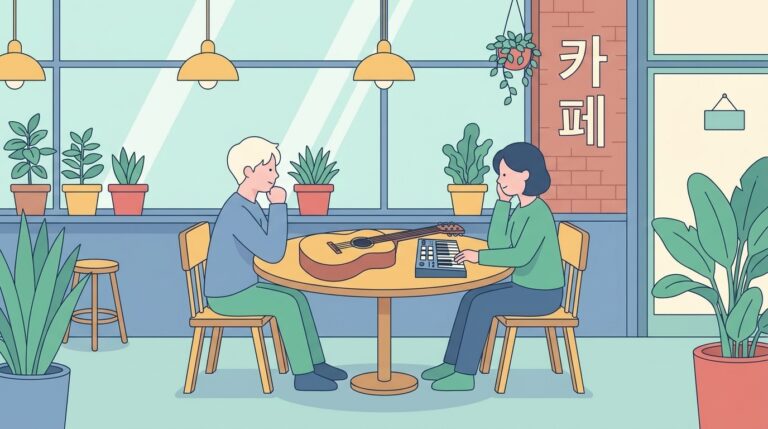
Setting: Saturday afternoon, 2 PM. A minimalist cafe in Hongdae. You are having coffee with your Korean friend, Min-ji, who you know plays the acoustic guitar beautifully.
Characters:
– YOU: An expat working in Korea, looking for a way to relieve stress after work.
– Min-ji (28): Your friendly, outgoing Korean friend who goes to an adult music academy.
Dialogue:
YOU: 민지 씨, 저 요즘 퇴근하고 너무 심심해요.
(min-ji ssi, jeo yo-jeum toe-geun-ha-go neo-mu sim-sim-hae-yo.)
[Min-ji, I’m so bored after work these days.]
Min-ji: 맞아요, 직장인은 취미가 필수예요!
(ma-ja-yo, jik-jang-i-neun chwi-mi-ga pil-su-ye-yo!)
[Right, a hobby is a must for office workers!]
YOU: 그래서 악기 하나 배우고 싶은데, 뭐가 좋을까요?
(geu-rae-seo ak-gi ha-na bae-u-go si-peun-de, mwo-ga jo-eul-kka-yo?)
[So I want to learn an instrument, what would be good?]
Min-ji: 오! 어떤 스타일 좋아해요? 클래식? 아니면 밴드 음악?
(o! eo-tteon seu-ta-il jo-a-hae-yo? keul-lae-sik? a-ni-myeon baen-deu eu-mak?)
[Oh! What style do you like? Classic? Or band music?]
🔀 It’s your turn! How do you reply?
– A) 저는 밴드 음악이 좋습니다. (Too textbook)
– B) 저는 K-Pop 좋아하는데, 제가 완전 생초보라서요.
– C) 기타 다룰 줄 아세요?✅ Best Choice: B — Stating your preference while using the “complete beginner” (생초보) phrase manages expectations and sounds incredibly natural.
(Assuming you chose B)
YOU: 저는 K-Pop 좋아하는데, 제가 완전 생초보라서요. 똥손도 배울 수 있을까요?
(jeo-neun K-Pop jo-a-ha-neun-de, je-ga wan-jeon saeng-cho-bo-ra-seo-yo. ddong-son-do bae-ul su i-sseul-kka-yo?)
[I like K-Pop, but I’m a complete beginner. Could a total klutz learn it?]
Min-ji: (Laughs) 아, 똥손이요? 그럼 우쿨렐레는 어때요? 배우기 진짜 쉬워요!
(a, ddong-so-ni-yo? geu-reom u-kul-lel-le-neun eo-ttae-yo? bae-u-gi jin-jja swi-wo-yo!)
[(Laughs) Ah, klutz? Then how about the ukulele? It’s really easy to learn!]
YOU: 오, 우쿨렐레요? 학원에 다녀야 할까요?
(o, u-kul-lel-le-yo? ha-gwo-ne da-nyeo-ya hal-kka-yo?)
[Oh, ukulele? Should I go to an academy?]
Min-ji: 네! 제 기타 학원에 우쿨렐레 반도 있어요. 같이 갈래요?
(ne! je gi-ta ha-gwo-ne u-kul-lel-le ban-do i-sseo-yo. ga-chi gal-lae-yo?)
[Yes! The guitar academy I go to has a ukulele class too. Want to go together?]
YOU: 대박! 너무 좋아요. 추천해 줘서 고마워요!
(dae-bak! neo-mu jo-a-yo. chu-cheon-hae jwo-seo go-ma-wo-yo!)
[Awesome! Sounds great. Thanks for the recommendation!]
Phase 6: 10-Second Shadowing Drill
Practice this sentence to get the perfect rhythm. Follow the pauses (/) and the emotion tags!
🤔 악기 하나 / 배우고 싶은데, / 🥺 뭐가 / 좋을까요?
(ak-gi ha-na / bae-u-go si-peun-de, / mwo-ga / jo-eul-kka-yo?)
Pro Tip: Raise your pitch slightly at the end of “좋을까요?” to sound genuinely curious and polite.
Phase 7: K-Culture Mini Dictionary
| Korean | Romanization | English | Cultural Context |
|---|---|---|---|
| 학원 | hagwon | Academy | Not just for kids! Adult academies are huge social networking hubs in Korea. |
| 원데이 클래스 | won-de-i keul-lae-seu | One-day class | A single session class. Very popular in Korea for trying out hobbies without commitment. |
| 똥손 | ddong-son | “Poop hands” / clumsy | Slang for someone who is bad at using their hands (crafts, playing instruments, gaming). |
| 장비빨 | jang-bi-ppal | The power of gear | Slang meaning “relying on expensive equipment rather than skill.” Koreans love buying pro-gear for new hobbies! |
Phase 8: Traveler Survival Kit
If you want to buy an instrument in Korea, you must visit the Nakwon Instrument Arcade (낙원상가) in Jongno, Seoul. It’s the world’s largest indoor musical instrument market. Here is your survival kit for navigating it!
🆘 Survival Expression #1: Testing an instrument
– 🇰🇷 “이거 한 번 쳐봐도 돼요?” (i-geo han beon chyeo-bwa-do dwae-yo?)
– 🗣️ Meaning: Can I try playing this?
– 📍 Where to use: Guitar/Piano shops in Nakwon Arcade.🆘 Survival Expression #2: Asking for a beginner model
– 🇰🇷 “입문용으로 제일 잘 나가는 게 뭐예요?” (im-mun-yong-eu-ro je-il jal na-ga-neun ge mwo-ye-yo?)
– 🗣️ Meaning: What is the best-selling model for beginners?
– 💡 Pro Tip: ‘입문용’ means ‘for entry-level’. ‘잘 나가는’ means ‘selling well’.
📌 Editor’s Travel Note
– Haggling (흥정): In regular Korean stores, prices are fixed. But in places like Nakwon Arcade or traditional markets, asking “조금 깎아주실 수 있어요?” (Can you give me a little discount?) with a smile might score you a cheaper price or some free guitar picks!
Phase 9: Critical Thinking — “A Step Deeper”
The “God-Saeng” (갓생) Culture vs. Pure Leisure
In recent years, Korean Millennials and Gen Z have embraced the 갓생 (God-Saeng) trend. “God-Saeng” means living a highly productive, exemplary life. Because of this, even hobbies like learning an instrument are often pursued with intense dedication, goal-setting, and certifications, rather than just pure relaxation.
🧠 Think Deeper:
The rapid rise of adult academies reflects this desire to constantly self-improve and network, even after a tiring day at the office. The line between “rest” and “self-development” is often blurred in modern Korean society.💬 Your Turn: Does your culture treat hobbies purely as relaxation, or is there a pressure to “master” them and be productive? Share in the comments!
Phase 10: FAQ & Avoiding Misunderstandings
Q: Can I use “추천해 줘 (Recommend me)” to a teacher or boss?
No! “추천해 줘” is strictly for close friends. For elders or superiors, you must add the polite form: “추천해 주세요” or even better, “추천해 주실 수 있나요?” (Could you please recommend?).
Q: I don’t know the specific verb for my instrument. What do I say?
Just use the magic verb 하다 (to do) or 다루다 (to handle). “피아노 할 줄 알아요” (I know how to do piano) is perfectly understood in daily conversation!
❌ Common Mistake #1: Confusing 배우다 (to learn) and 가르치다 (to teach).
Foreign learners often say “기타 가르치고 싶어요” when they mean “I want to learn guitar.” Remember:
✅ 배우다: To receive knowledge (Learn)
✅ 가르치다: To give knowledge (Teach)
Phase 11: Summary & Action Items
One-Liner Summary: To ask for an instrument recommendation naturally, soften your sentence with “~은/는데” and embrace your beginner status with “완전 생초보”!
Action Mission 3 Steps:
– 🥉 Bronze (Solo): Look in the mirror and practice saying “악기 하나 배우고 싶은데… 뭐가 좋을까요?” 3 times with a curious expression.
– 🥈 Silver (Online): Go to a Korean language forum or app (like HelloTalk) and post: “저는 K-Pop을 좋아하는데, 어떤 악기를 배우는 게 좋을까요? 추천해 주세요!”
– 🥇 Gold (Real-world): Next time you are with a Korean friend, ask them: “혹시 다룰 줄 아는 악기 있으세요?”
🎸 K-Culture Mission:
Search “아이돌 기타 치는 영상” (Idol playing guitar video) on YouTube. While watching, imagine leaving a comment: “저도 기타 배우고 싶어요!” (I want to learn guitar too!).
Phase 12: Interactive Quiz
1. Fill in the Blank:
You want to humbly tell your Korean friend that you have zero talent with your hands.
“제가 완전 (______)이라서요…”
A) 금손 (Gold hands)
B) 은손 (Silver hands)
C) 똥손 (Poop hands)
2. Situational Judgment:
You are at the Nakwon Instrument Arcade. You want to try playing a digital piano before buying it. What is the most natural thing to say to the shop owner?
A) 이거 제가 칠 겁니다. (I will play this.)
B) 이거 한 번 쳐봐도 돼요? (Can I try playing this once?)
C) 피아노 가르쳐 주세요. (Please teach me piano.)
3. True or False — K-Culture Edition:
Adult academies (성인 학원) in Korea are strictly for serious academic study and socializing is frowned upon. (T/F)
(Answers: 1. C / 2. B / 3. False – They are huge social networking and dating hotspots!)
Frequently Asked Questions (FAQ)
Q: What does "악기 하나 배우고 싶은데, 뭐가 좋을까요?" mean in Korean and how do you pronounce it?
A: In Korean, "악기 하나 배우고 싶은데, 뭐가 좋을까요?" is pronounced [ak-gi ha-na bae-u-go si-peun-de, mwo-ga jo-eul-kka-yo?] and means: I want to learn an instrument, what would be good? (Literal) vs. I'm thinking of picking up an instrument, any recommendations? (Real nuance)
Q: What does "제가 완전 생초보라서요." mean in Korean and how do you pronounce it?
A: In Korean, "제가 완전 생초보라서요." is pronounced [je-ga wan-jeon saeng-cho-bo-ra-seo-yo.] and means: Because I am a complete beginner.
Q: What does "혹시 다룰 줄 아는 악기 있으세요?" mean in Korean and how do you pronounce it?
A: In Korean, "혹시 다룰 줄 아는 악기 있으세요?" is pronounced [hok-si da-rul jul a-neun ak-gi i-sseu-se-yo?] and means: By any chance, is there an instrument you know how to play?







