

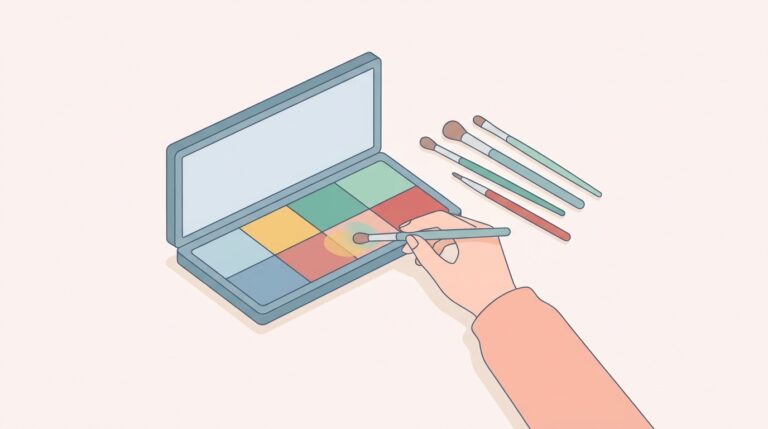
Phase 1: Empathy & The K-Culture Cold Open
안녕하세요! 매일한글(Daily Hangul) 수석 에디터입니다.
유튜브에서 유명한 K-Beauty 크리에이터의 영상을 보거나, 드라마 <여신강림> 같은 메이크오버 씬을 볼 때면 이런 생각 해보신 적 없나요? 자막에는 분명히 ‘Blend it out’이라고 나오는데, 크리에이터의 입에서는 전혀 다른 외계어(?)가 쏟아집니다.
“여기 총알 브러쉬로 경계를 살살 풀어주면서 음영을 얹어줄게요. 그리고 애교살을 확 살려주는 거죠!”
Wait, what? A ‘bullet’ brush? ‘Loosening the border’? Are we doing a gorgeous K-Pop idol eye makeup look, or planning a tactical military operation? 😅
Advanced Korean learners often hit a wall when it comes to highly specialized daily vocabulary, and K-Beauty is the ultimate boss fight. In the textbook, you learn ‘화장하다’ (to put on makeup) and ‘색을 섞다’ (to mix colors). But walk into any Olive Young flagship store in Gangnam, and that textbook Korean won’t help you find the exact eye blending brush you need.
Today, we’re going to dive into the real, highly sophisticated Korean expressions used for eye makeup and brushes. Knowing these won’t just help you shop—it’ll grant you ultimate insider status among Korean beauty enthusiasts. Let’s get glowing! ✨
Phase 2: Core Expressions Deep Dive
Let’s break down the C1-level beauty vocabulary that will make you sound like a native K-Beauty guru.
1. 경계를 풀어주다
- Pronunciation: [gyeonggye-reul pureojuda]
- Meaning: Literal = To loosen/untie the boundary. Real nuance = To blend out harsh lines seamlessly.
- K-Culture Moment: You’ll hear this in almost every single Korean makeup tutorial. When applying eyeshadow, Koreans hate harsh, unblended cut-creases. The goal is always a soft, watercolor-like gradient (수채화 메이크업).
- Editor’s Insight: The verb ‘풀어주다’ (to loosen, to relieve, to untangle) gives a feeling of softening something that is stiff or harsh. It’s the exact sensation of taking a fluffy blending brush and gently sweeping away the edges of a dark shadow.
- Situation Spectrum:
- Casual with friends: ✅
- Beauty store staff (Semi-formal): ✅
- Formal/Business: ⚠️ (Only if you work in the beauty industry!)
- 🤔 Think About It: The concept of ‘풀어주다’ is also used for muscles (근육을 풀어주다) or stress (스트레스를 풀어주다). What does this tell us about how Koreans view harsh edges in makeup? Perhaps it’s seen as something ‘tense’ that needs to be relaxed?
2. 음영을 넣다
- Pronunciation: [eumyeong-eul neota]
- Meaning: Literal = To put in shade/shadow. Real nuance = To contour the eyes, adding depth and dimension.
- K-Culture Moment: Think of the classic, moody ‘Fall makeup’ look of a K-Drama female lead. It’s never about slapping on bright colors; it’s about subtle ‘음영’ to make the eyes look naturally deep and melancholic.
- Editor’s Insight: While ‘컨투어링’ (contouring) is used for the jawline, ‘음영’ is the poetic, preferred term for the eyes. It sounds elegant and subtle.
- Situation Spectrum:
- Casual with friends: ✅
- Beauty store staff (Semi-formal): ✅
- Formal/Business: 🚫 (Not a general conversation topic)
- 🤔 Think About It: The word 음 (陰, dark) and 영 (影, shadow) comes from Hanja. Why do you think beauty terminology in Korea blends English loanwords (like ‘브러쉬’) with deep, poetic Hanja words?
3. 애교살을 살리다
- Pronunciation: [aegyosar-eul sallida]
- Meaning: Literal = To revive/save the aegyo-sal. Real nuance = To highlight and emphasize the under-eye fat for a youthful look.
- K-Culture Moment: Watching a K-Pop girl group fan-cam. Even under blinding stage lights, their eyes pop and look smiling and innocent. That’s the power of ‘살려낸’ (revived) aegyo-sal using a tiny precision brush.
- Editor’s Insight: ‘살리다’ is an incredibly versatile C1 verb. You can revive a dying plant, save a life, or… save a dead makeup look by adding some glitter under the eye. It means ‘to bring out the best feature of something.’
- Situation Spectrum:
- Casual with friends: ✅
- Beauty store staff (Semi-formal): ✅
- Formal/Business: 🚫
Phase 3: Textbook vs. Real Korean
[Describing Blending]
* 📖 Textbook Korean: 색을 자연스럽게 섞으세요. (Mix the colors naturally.)
* 🗣️ Real Korean: 브러쉬로 경계를 싹 풀어주세요. (Seamlessly blend out the edges with a brush.)
* 💡 Why the difference?: ‘섞다’ implies physically mixing two pigments together (like paint). ‘풀어주다’ accurately describes the action of softening the edge of the makeup already on the skin.
[Describing Pigmentation]
* 📖 Textbook Korean: 이 아이섀도우는 색이 아주 진하게 나옵니다. (This eyeshadow’s color comes out very dark.)
* 🗣️ Real Korean: 이거 완전 발색 미쳤어요! / 발색력이 짱짱해요. (The color payoff on this is insane!)
* 💡 Why the difference?: ‘발색’ (color manifestation) is the standard beauty jargon. Adding ‘미쳤어요’ (crazy) or ‘짱짱해요’ (sturdy/strong) is the ultimate Gen Z seal of approval.
[Describing the Brush]
* 📖 Textbook Korean: 작고 끝이 둥근 붓을 사용하세요. (Use a small brush with a round tip.)
* 🗣️ Real Korean: 총알 브러쉬로 포인트 섀도우를 얹어주세요. (Place the point shadow with a bullet brush.)
* 💡 Why the difference?: Koreans love descriptive, visual naming. ‘총알’ (bullet) perfectly describes the dense, tapered shape of a pencil/crease brush.
Phase 4: Cultural Context — K-Culture Deep Dive
4-1. The Non-verbal Language of K-Beauty
When you hear terms like “살살” (gently/lightly) or “톡톡” (tap-tap), it comes with a specific hand gesture. Korean makeup emphasizes minimal friction on the skin to prevent aging. So when you use an eye brush to ‘음영을 넣다’, you never drag it aggressively. You tap it off on the back of your hand first (양 조절 – portion control) to show you have the Nunchi (눈치) not to ruin the base makeup.
4-2. The K-Pop Connection: Stage vs. Street
In K-Pop fandoms, a common compliment for idol makeup artists is “오늘 샵 원장님 누구시냐, 애교살 폼 미쳤다” (Who is the salon director today, the aegyo-sal game is crazy). K-Pop makeup requires heavy, highly pigmented (발색이 강한) glitter and deep shading to survive the camera flashes.
However, Critical Viewpoint: What you see on K-Pop idols is not everyday Korean makeup. If you walk onto the Seoul subway with heavy cut-crease and chunky glitter, you will get stares. Daily Korean makeup is all about “꾸안꾸” (꾸민 듯 안 꾸민 듯 – Effortlessly chic). That’s why the concept of blending out harsh lines (경계를 풀어주다) is practically a religion for the everyday Korean woman.
Phase 5: Interactive Roleplay Scenario
Setting: A bustling Olive Young flagship store in Gangnam on a Friday evening. K-Pop is playing loudly. You’re holding a gorgeous new eyeshadow palette, but you realize you need the right tools.
Characters:
* YOU (The Reader): An advanced Korean learner who knows exactly what look they want, but needs help finding the right brush.
* Jieun (25, Staff): Friendly, wears a trendy oversized blazer, and has flawlessly blended eye makeup.
[Dialogue Begins]
YOU: 저기요, 아이 메이크업 브러쉬 좀 보려고 하는데요.
(jeogiyo, ai meikeueop beureoswi jom boryeogo haneundeyo.)
[Excuse me, I’m looking to see some eye makeup brushes.]
(🎭 Stage Direction: You hold up the eyeshadow palette you just picked out)
Jieun: 아, 네 고객님! 어떤 용도로 찾으세요? 베이스용 아니면 포인트용이요?
(A, ne gogaengnim! Eotteon yongdoro chajeuseyo? Beiseuyong animyeon pointeuyong-iyo?)
[Ah, yes customer! What purpose are you looking for? Base or point?]
YOU: 음영 넣고 경계 풀어줄 때 쓸 만한 총알 브러쉬 있나요?
(Eumyeong neoko gyeonggye pureojul ttae sseul manhan chong-al beureoswi innayo?)
[Do you have a bullet brush good for adding depth and blending out the harsh lines?]
Jieun: 아~ 블렌딩 잘 되는 거 찾으시는구나! 이쪽으로 오세요. (Walks over to the brush aisle) 이 제품이 요즘 제일 잘 나가요. 모질이 부드러워서 섀도우 뭉침 없이 싹 풀어주거든요.
(A~ beullending jal doeneun geo chajeusineunguna! Ijjogeuro oseyo. I jepumi yojeum jeil jal nagayo. Mojiri budeureowoseo syaedou mungchim eopsi ssak pureojugeodeunyo.)
[Ah~ you’re looking for one that blends well! Come this way. This product sells the best these days. The bristles are soft so it blends out the shadow without clumping.]
YOU: 오, 발색도 잘 되나요?
(O, balsaekdo jal doenayo?)
[Oh, is the color payoff good too?]
Jieun: 그럼요! 고객님 혹시 애교살에도 같이 쓰실 건가요?
(Geureomyo! Gogaengnim hoksi aegyosaredo gachi sseusil geongayo?)
[Of course! Customer, are you perhaps going to use it for your aegyo-sal too?]
🔀 Your Turn! How do you reply?
* A) “네, 애교살을 살리고 싶어요!” (Yes, I want to emphasize my aegyo-sal!)
* B) “아니요, 저는 아이돌처럼 진하게 섞을 거예요.” (No, I will mix it darkly like an idol.)
* C) “애교살이 뭐예요? 먹는 건가요?” (What is aegyo-sal? Is it food?)✅ Best Choice: A — Using “살리고 싶어요” sounds incredibly natural and exactly like how a native would describe wanting to make that feature pop.
⚠️ Choice B Analysis: Using ‘섞다’ (mix) here sounds clunky. And ‘진하게’ isn’t wrong, but ‘음영을 깊게 넣을 거예요’ (I’ll add deep shading) sounds much more advanced (C1).
YOU (Choosing A): 네, 펄 얹어서 애교살을 좀 살리고 싶어서요.
(Ne, peol eonjeoseo aegyosareul jom salligo sipeoseoyo.)
[Yes, I want to add some pearl/glitter and emphasize my aegyo-sal.]
Jieun: 그럼 이 브러쉬가 딱이에요. 끝이 모여있어서 디테일하게 펄 얹기 진짜 좋거든요!
(Geureom i beureoswiga ttagieyo. Kkeuchi moyeoisseoseo diteilhage peol eon-gi jinjja jokeodeunyo!)
[Then this brush is perfect. The tip is tapered so it’s really good for applying pearl with detail!]
YOU: 대박, 이걸로 할게요. 감사합니다!
(Daebak, igeollo halgeyo. Gamsahamnida!)
[Awesome, I’ll take this one. Thank you!]
Jieun: 네, 카운터에서 결제 도와드릴게요~ 💖
(Ne, kaunteo-eseo gyeolje dowadeurilgeyo~)
[Yes, I’ll help you with the checkout at the counter~]
Phase 6: 10-Second Shadowing Drill
Let’s practice the flow and intonation. Remember to pause at the slashes!
😊 총알 브러쉬로 / 경계를 / 살살~ / 풀어주세요.
(chong-al beureoswiro / gyeonggye-reul / salsal~ / pureojuseyo.)
Tone: Sweet, instructive, like a beauty YouTuber sharing a secret.
Pronunciation tip: ‘살살’ sounds like a soft, whispering breeze. Drag out the first ‘살~’ a bit!
😲 우와, / 이거 완전 / 발색 / 미쳤다!
(Uwa, / igeo wanjeon / balsaek / micheotda!)
Tone: Genuinely impressed, wide-eyed.
Phase 7: K-Culture Mini Dictionary
| 한국어 | Romanization | English | Cultural Context |
|---|---|---|---|
| 꾸안꾸 | kku-an-kku | Effortlessly chic | Short for 꾸민 듯 안 꾸민 듯 (Like you dressed up, but didn’t). The ultimate goal of daily K-Beauty. |
| 곰손 / 똥손 | gomson / ttongson | Bear hands / Poop hands | Slang for someone who is terrible at doing things with their hands (like makeup). The opposite is 금손 (Gold hands). |
| 양 조절 | yang jojeol | Portion control | Tapping off excess powder from a brush. Essential for avoiding looking like a clown. |
| 퍼스널 컬러 | peoseuneol keolleo | Personal Color | A massive trend in Korea. Getting professionally analyzed to see if you are ‘Warm Spring’, ‘Cool Summer’, etc. |
Phase 8: Travel Survival Kit (Beauty Haul Edition)
Navigating Olive Young or a road-shop brand requires quick, survival-level phrases.
🆘 Survival Phrases TOP 3
1. 🇰🇷 “이거 테스터 있나요?” (igeo teseuteo innayo?)
– 🗣️ Meaning: Do you have a tester for this?
– 📍 Usage: When you find a gorgeous palette but the sample is missing.
2. 🇰🇷 “이 브러쉬 인조모인가요, 천연모인가요?” (i beureoswi injomo-ingayo, cheonyeonmo-ingayo?)
– 🗣️ Meaning: Is this brush synthetic hair or natural hair?
– 📍 Usage: Crucial for advanced makeup users or vegans!
3. 🇰🇷 “요즘 제일 잘 나가는 게 뭐예요?” (yojeum jeil jal naganeun ge mwoyeyo?)
– 🗣️ Meaning: What sells the best these days? / What’s the bestseller?
– 📍 Usage: When you are overwhelmed by 50 different blending brushes.📌 Editor’s Travel Note
– Tax-Free: Many large Olive Young stores offer Immediate Tax Refund (즉시 환급) at the counter. Always bring your physical passport!
– “1+1” Culture: In Korea, “원플러스원” (One plus one) is everywhere. If a brush says 1+1, make sure you bring two to the counter, otherwise the cashier will make you run back and get the second one!
Phase 9: Critical Thinking — “One Step Deeper”
🧠 Think Deeper: Language & The “Effortless” Ideal
Have you noticed how many Korean beauty terms revolve around softening, blurring, and making things look natural? Words like 풀어주다 (to loosen/diffuse), 스머징 (smudging), and 수채화 발색 (watercolor pigmentation) dominate the market. This deeply reflects the Korean societal pressure to look flawless, yet seemingly without effort (꾸안꾸).
While Western beauty trends often celebrate bold self-expression—sharp cut creases, dramatic contouring, and striking colors—mainstream Korean beauty language reflects a desire for harmony, gentleness, and an almost invisible perfection that doesn’t “disrupt” the natural face. The language we use to describe our brushes literally shapes how we view beauty.
💬 Your Turn: Does your culture’s makeup terminology lean more toward “bold transformation” (like contouring and baking) or “subtle enhancement”? Share your thoughts in the comments!
Phase 10: FAQ & Common Mistakes
Q: Can I use “경계를 풀어주다” in situations other than makeup?
A: Yes! You can use it abstractly, like “두 부서 간의 경계를 풀어주다” (to loosen the boundaries between two departments at work), though it’s less common than the makeup context.
Q: If I’m a guy looking for male grooming tools, do I use the same words?
A: Absolutely. Male grooming is huge in Korea. You’d use the exact same terms for blending out a brow pencil or adding subtle shading.
❌ Common Mistake #1: Confusing 브러쉬 (beureoswi – Brush) with 블러셔 (beulleosyeo – Blush/Rouge).
✅ How to fix it: Pronunciation is key. Brush ends with an ‘ee’ sound (쉬). Blush ends with an ‘eo’ sound (셔). “블러셔 바르는 브러쉬 주세요” (Please give me a brush to apply blush) is a great tongue twister!
Phase 11: Summary & Action Items
- One-Liner Summary: Ditch the textbook ‘섞다’ and elevate your C1 K-Beauty Korean by using ‘경계를 풀어주다’ (blending boundaries), ‘음영’ (shading), and mastering the ‘총알 브러쉬’ (bullet brush)!
🔥 Action Mission:
* 🥉 Bronze (Solo): Look at your own makeup brushes in the mirror and identify your “총알 브러쉬” out loud in Korean.
* 🥈 Silver (Online): Find a Korean makeup tutorial on YouTube (search: 애교살 메이크업) and listen for the word “풀어주다” or “음영”. Drop a comment on the video using what you learned!
* 🥇 Gold (Real-world): Next time you are in Korea (or at a local K-beauty store), point to an eyeshadow and ask the staff: “이거 발색 잘 되나요?” (Does this have good color payoff?)
Phase 12: K-Beauty Interactive Quiz
Test your new C1-level knowledge!
1. Situation Judgment: You applied a dark brown shadow to your outer eye, but the line looks way too harsh and blocky. What should you tell yourself in the mirror?
* A) “색을 더 많이 섞어야겠다.”
* B) “총알 브러쉬로 음영을 다 지워야겠다.”
* C) “브러쉬로 경계를 살살 풀어줘야겠다.”
2. True or False – K-Culture Edition:
* “In Korean beauty stores, ‘퍼스널 컬러’ (Personal Color) is an outdated trend nobody talks about anymore.” (T/F)
3. Fill in the Blank:
* “아이돌처럼 눈 밑을 반짝이게 하려면, 글리터로 ______을(를) 살려야 해요.”
(Answers: 1. C – You need to diffuse the boundary! 2. False – It is still massively popular and dictates product marketing! 3. 애교살)
Frequently Asked Questions (FAQ)
Q: What does "경계를 풀어주다" mean in Korean and how do you pronounce it?
A: In Korean, "경계를 풀어주다" is pronounced [gyeonggye-reul pureojuda] and means: Literal = To loosen/untie the boundary. Real nuance = To blend out harsh lines seamlessly.
Q: What does "음영을 넣다" mean in Korean and how do you pronounce it?
A: In Korean, "음영을 넣다" is pronounced [eumyeong-eul neota] and means: Literal = To put in shade/shadow. Real nuance = To contour the eyes, adding depth and dimension.
Q: What does "애교살을 살리다" mean in Korean and how do you pronounce it?
A: In Korean, "애교살을 살리다" is pronounced [aegyosar-eul sallida] and means: Literal = To revive/save the aegyo-sal. Real nuance = To highlight and emphasize the under-eye fat for a youthful look.






