

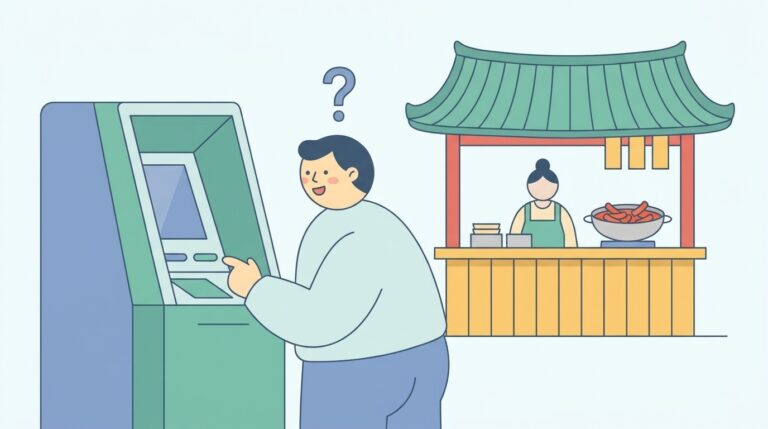
Phase 1: The Panic at the Myeongdong Street Food Stall
Hello! I am the Lead Editor of Daily Hangul.
Picture this: You are wandering the vibrant streets of Myeongdong. The air is thick with the sweet, buttery smell of Hotteok (Korean sweet pancakes) and the spicy aroma of Tteokbokki. Your mouth is watering, you order an extra-large portion, and confidently pull out your credit card.
Suddenly, the vendor crosses their arms, making an ‘X’ shape, and says: “현금만 돼요” (Cash only).
Panic sets in. You run to the nearest convenience store ATM. But the screen is filled with an overwhelming amount of Hangul. Where is the ‘English’ button? What do all these boxes mean?
If you’ve watched a K-Drama, you’ve probably seen that iconic scene where a rich mother slides a thick envelope across a cafe table, demanding the protagonist to “take this cash and leave my son.” While you might not be getting a dramatic envelope of hush money, knowing how to withdraw cash in Korea is an absolute survival skill. Korea is famously a “card heaven,” but for street food, traditional markets, and topping up your T-money transit card, cash is king.
Don’t worry! This guide is based on real SOS messages from our beginner students. Let’s learn exactly how to get your money out so you can get back to eating!
Phase 2: Core Expressions Deep Dive
To survive the Korean ATM or bank counter, you only need to recognize and say a few key things.
1. 출금 (Withdrawal)
- Pronunciation: chul-geum
- Sound-alike guide: ‘chul’ sounds like the start of chill but with a ‘u’ as in pull. ‘geum’ starts with a ‘g’, followed by the ‘eu’ sound (like the disgusted sound you make when you step in gum: eugh!), ending in ‘m’.
- Meaning: Withdrawal (Literal: to take money out)
- K-Culture Moment: You won’t hear this spoken often, but you will see it everywhere. On every Korean ATM screen, the biggest button is usually 출금 (Withdrawal) or 예금출금 (Deposit Withdrawal). If you want cash for those K-Pop concert unofficial goods (sold by fans outside the venue), you need to press this button!
- Editor’s Insight: Think of this as a “visual password.” You don’t need to pronounce it perfectly right now, but memorize the shape of these two blocks. 출 looks like a little tree with a hat, and 금 is gold/money!
- Situation Spectrum:
- ATM Screen (Visual): ✅
- Speaking to a friend: ⚠️ (Too formal, sounds like a banker)
- Speaking to a bank teller: 🚫 (They usually ask you first)
- 🤔 Think About It: Why do Korean ATMs have so many complex buttons on the home screen compared to Western ATMs? It’s because Koreans use ATMs for everything from paying utility bills to sending money to friends instantly. How are ATMs different in your country?
2. 돈 좀 찾으려고요 (I want to withdraw some money)
- Pronunciation: don jom cha-jeu-ryeo-go-yo
- Meaning: I intend to find some money (Real nuance: I’d like to withdraw cash)
- K-Culture Moment: If you step inside a physical bank to talk to a human teller (maybe your card isn’t working in the machine), this is your magic phrase.
- Editor’s Insight: Notice the verb 찾다 (chat-da), which literally means “to find” or “to look for.” In Korean, we don’t say “I want to take out money.” We say “I want to find my money.” Isn’t that poetic? Your money is resting in the bank, and you are simply going to find it!
- Situation Spectrum:
- To a bank teller (Semi-formal): ✅
- To a friend (Casual – drop the ‘yo’): ✅
- Boss/Elders: 🚫 (Not applicable, you wouldn’t say this to a boss)
- 🤔 Think About It: Does your language use a specific verb for withdrawing money, or do you use a general verb like “take” or “get”?
3. 비밀번호 (PIN / Password)
- Pronunciation: bi-mil-beon-ho
- Sound-alike guide: bee-meal-bun-ho
- Meaning: Secret number (PIN or password)
- K-Culture Moment: You’ll hear this everywhere in Korea! From entering your Airbnb, unlocking your smartphone, to using the ATM. In K-Dramas, there’s always a tense moment where a character tries to guess the villain’s bimilbeonho to unlock their phone.
- Editor’s Insight: When the ATM machine suddenly speaks to you with a polite robotic voice, listen for this word. It means it’s time to type your 4-digit PIN!
- Situation Spectrum:
- Everywhere: ✅
Phase 3: Textbook vs. Real Korean
Let’s see how you actually sound compared to a textbook when you visit a bank.
[Situation 1: Telling the bank clerk you need cash]
* 📖 Textbook Korean: 현금을 인출하고 싶습니다. (I would like to withdraw cash.)
* 🗣️ Real Korean: 돈 좀 찾으려고요. (I’m trying to get some money.)
* 💡 Why the difference?: “인출” (withdrawal) is a formal Hanja (Chinese-root) word. Native Koreans prefer using pure Korean verbs like “찾다” (to find) in everyday speech to sound softer and more natural.
[Situation 2: Asking for the ATM]
* 📖 Textbook Korean: 현금 자동 입출금기가 어디에 있습니까? (Where is the Automated Teller Machine?)
* 🗣️ Real Korean: ATM(에이티엠) 어디 있어요? (Where is the ATM?)
* 💡 Why the difference?: Efficiency! Koreans love abbreviations. Everyone just says “ATM” (pronounced eh-ee-tee-em).
Bottom Note: As an A1 learner, don’t worry about long, polite sentences. Using “[Noun] + 어디 있어요?” (Where is [Noun]?) is perfectly polite and gets the job done instantly!
Phase 4: Cultural Context — K-Culture Deep Dive
4-1. Non-verbal Cue: The Two-Handed Rule
If you are handing your bank card or passport to a bank teller, always use two hands, or support your right arm with your left hand. In Korean culture, handing something to a professional or an elder with one hand (especially your left hand) is considered rude. Doing the “two-handed pass” will instantly earn you the teller’s respect!
4-2. K-Food Connection: The Cash Paradox
Korea is the most cashless society in the world. You can pay for a $1 coffee with a credit card. However, the K-Food street culture is the exception. When you visit Gwangjang Market for Bindaetteok (mung bean pancakes) or buy late-night fish cakes (Eomuk), the vendors operate on tight margins. They prefer cash or domestic bank transfers (계좌이체 – gye-jwa-i-che). Since tourists can’t easily do Korean bank transfers, carrying about 30,000 to 50,000 KRW in cash is your ultimate food survival kit!
Phase 5: Real-world Roleplay Scenario
Setting: It’s 2 PM on a Tuesday at a busy bank branch near Hongdae. You tried to use the ATM to get cash for a street food tour, but your foreign card didn’t work. You are now sitting in front of a friendly bank teller.
Characters:
– YOU: A hungry traveler desperately needing cash for Tteokbokki.
– Teller (Jiyoung, 28): A polite bank employee who deals with confused tourists every day.
Dialogue:
Jiyoung: 안녕하세요! 어떻게 오셨어요? 😊
(an-nyeong-ha-se-yo! eo-tteo-ke o-syeot-seo-yo?)
[Hello! How can I help you today? / Lit: How did you come here?]
YOU: 안녕하세요. 저…
(an-nyeong-ha-se-yo. jeo…)
[Hello. Um…]
🔀 Your Turn! How should you reply?
– A) “출금!” (Withdrawal!)
– B) “현금을 인출하고 싶습니다.” (I would like to withdraw cash.)
– C) “돈 좀 찾으려고요.” (I’d like to find/withdraw some money.)✅ Best Choice: C — It sounds incredibly natural and polite without being overly stiff.
⚠️ Choice A Analysis: Shouting “Withdrawal!” like a robot might startle poor Jiyoung. It’s too blunt.
⚠️ Choice B Analysis: Correct, but sounds like you are reading from a 1990s language textbook.
(Assuming you chose C)
YOU: 돈 좀 찾으려고요. 💵
(don jom cha-jeu-ryeo-go-yo.)
[I’d like to withdraw some money.]
Jiyoung: 네, 카드나 여권 주시겠어요?
(ne, ka-deu-na yeo-gwon ju-si-get-seo-yo?)
[Yes, could you give me your card or passport?]
(🎭 Stage Direction: You hand your foreign card over using BOTH hands! 🙌)
Jiyoung: (Smiling at your manners) 비밀번호 입력해 주세요.
(bi-mil-beon-ho im-nyeok-hae ju-se-yo.)
[Please enter your PIN.]
YOU: 네. (Types PIN into the keypad)
(ne.)
[Okay.]
Jiyoung: 현금 여기 있습니다. 감사합니다!
(hyeon-geum yeo-gi it-seum-ni-da. gam-sa-ham-ni-da!)
[Here is your cash. Thank you!]
Phase 6: 10-Second Shadowing Drill
Repeat after me! Pay attention to the pauses (/) and the emotion tags.
When you sit down at the bank counter:
😊 돈 좀 / 찾으려고요~
(don jom / cha-jeu-ryeo-go-yo~)
Say it softly and kindly, stretching the ‘yo’ slightly at the end for a friendly vibe.
When you don’t know where the machine is:
🥺 ATM / 어디 있어요?
(A-T-M / eo-di it-seo-yo?)
Look slightly confused and point around.
Phase 7: K-Culture Mini Dictionary
| Korean | Romanization | English | Context |
|---|---|---|---|
| 현금 | hyeon-geum | Cash | What you need for street food! |
| 카드 | ka-deu | Card | Usually accepted 99% of the time in Korea. |
| 수수료 | su-su-ryo | Fee | The pesky ATM withdrawal fee you want to avoid. |
| 영수증 | yeong-su-jeung | Receipt | Cashiers will always ask if you want this. |
| 계좌이체 | gye-jwa-i-che | Bank Transfer | The Korean locals’ preferred way to pay at markets. |
Phase 8: Traveler’s Survival Kit
Getting cash in Korea as a traveler can be tricky because not all ATMs accept foreign cards.
🆘 Survival Phrases at the Bank/ATM
– 🇰🇷 “글로벌 ATM 어디 있어요?” (geul-lo-beol A-T-M eo-di it-seo-yo?)
– 🗣️ Meaning: Where is the Global ATM?
– 📍 Where to use: Inside a bank or subway station.
– 💡 Pro Tip: Look for ATMs with a “Global ATM” sign. Regular ATMs might spit your foreign card right back out with an angry beep!📌 Editor’s Travel Note
– Convenience Stores are Lifesavers: If you can’t find a bank, go to a GS25, CU, or 7-Eleven. Their ATMs usually accept foreign cards (though the fee 수수료 might be around 3,600 KRW).
– The T-Money Trap: You CANNOT top up your T-Money subway card with a credit card at the subway station machines. You absolutely must have cash for this!
Phase 9: Critical Thinking — “One Step Deeper”
🧠 Think Deeper: Global Era & K-Travel (The Cashless Irony)
Korea is rushing towards a completely cashless society. In Seoul, there are even “cashless buses” where you cannot pay with coins anymore. Yet, for foreign travelers, experiencing traditional Korean culture—like eating at a bustling night market, buying cheap socks in Myeongdong, or using the subway card—still heavily relies on physical paper money. This creates a unique “traveler’s bubble” where tourists interact with Korean currency far more often than local young Koreans do!
💬 Your Turn:
Is your country mostly cashless now, or is physical money still a daily necessity? Tell us in the comments how it compares to Korea!
Phase 10: FAQ & Avoiding Mistakes
Q: The ATM asked for a 6-digit PIN, but mine is 4 digits. What do I do?
If the Korean ATM asks for a 6-digit 비밀번호 (PIN), usually you just enter your 4-digit PIN and press the confirm button. If it forces 6 digits, try adding ’00’ to the end of your PIN (e.g., 123400).
Q: Can I just say “PIN number” to the teller?
Many Koreans won’t recognize the English word “PIN.” Always use 비밀번호 (bi-mil-beon-ho) instead.
❌ Common Mistake #1: Yanking your card out of the ATM too early.
✅ Do this instead: Korean ATMs will usually return your card FIRST, beep loudly, and then dispense your cash. Wait for the machine to give you your money! Don’t walk away after grabbing your card.
Phase 11: Summary & Action Items
✨ One-Liner Summary: To get your street food cash, look for the 출금 (Withdrawal) button, or kindly tell the teller “돈 좀 찾으려고요.”
🎯 Action Mission 3 Steps:
– 🥉 Bronze (Solo): Look at your own bank card and say “비밀번호” out loud 3 times.
– 🥈 Silver (Online): Change your phone’s language setting to Korean for 5 minutes and try to find the word “비밀번호” on your lock screen.
– 🥇 Gold (Real World): Next time you pass an ATM in your town, pretend it’s a Korean machine and mentally say “돈 좀 찾으려고요!”
🍜 K-Culture Mission:
Search YouTube for “Gwangjang Market Street Food.” Watch how many locals hand over physical cash (현금) versus paying with their phones.
Phase 12: Quiz — Interactive Challenge
1. You are at an ATM. Which Korean word must you press to get cash OUT of the machine?
A) 비밀번호
B) 출금
C) 영수증
2. True or False — K-Culture Edition:
“You can top up your Korean T-money transit card using an international credit card at the subway station.”
3. Fill in the Blank:
You walk up to the bank teller and say: “돈 좀 ___________.” (I’d like to withdraw some money).
(Answers below!)
Click here for Answers!
- B (출금) – This is the “Withdrawal” button. (A is PIN, C is Receipt).
- False! You must use cash to recharge T-money cards at the subway machines.
- 찾으려고요 (cha-jeu-ryeo-go-yo) – Meaning “I intend to find/withdraw.”
Frequently Asked Questions (FAQ)
Q: What does "출금 (Withdrawal)" mean in Korean and how do you pronounce it?
A: In Korean, "출금 (Withdrawal)" is pronounced [chul-geum] and means: a key conversational Korean expression covered in this lesson.
Q: What does "돈 좀 찾으려고요 (I want to withdraw some money)" mean in Korean and how do you pronounce it?
A: In Korean, "돈 좀 찾으려고요 (I want to withdraw some money)" is pronounced [don jom cha-jeu-ryeo-go-yo] and means: I intend to find some money (Real nuance: I'd like to withdraw cash)
Q: What does "비밀번호 (PIN / Password)" mean in Korean and how do you pronounce it?
A: In Korean, "비밀번호 (PIN / Password)" is pronounced [bi-mil-beon-ho] and means: a key conversational Korean expression covered in this lesson.







