

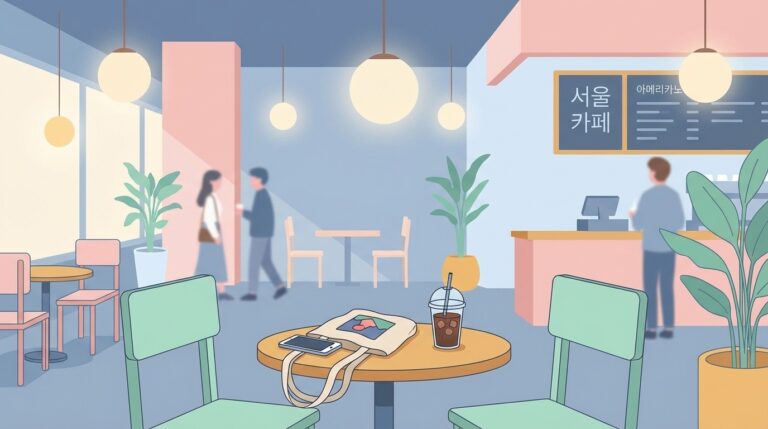
Phase 1: The ‘Cafe Nunchi’ Game
Hello! Daily Hangul Editor here.
Imagine this: You walk into a stunning, trendy cafe in Seongsu-dong, Seoul. The smell of freshly roasted espresso fills the air. You look around—it’s packed. But wait! Over in the corner, there’s an empty table. You rush over, feeling like you just won the lottery, only to find… a single iPhone and a lip balm sitting on the table. No human in sight.
Your first thought might be, “Did someone lose their phone?”
Nope. In Korea, that phone is a fortress. It means, “This seat is mine. I am ordering my Iced Americano.”
Welcome to the intense, yet highly trusting world of Korean cafe culture! If you don’t know the unwritten rules of 자리 잡기 (grabbing a seat), you might end up standing awkwardly with a hot coffee in your hands, or worse, accidentally stealing someone’s claimed table.
Don’t worry. This guide is based on real struggles from my expat students who learned the hard way. Today, I’ll teach you how to secure your spot like a true local!
Phase 2: Core Expressions Deep Dive
Here are the absolute must-know survival phrases for claiming your territory in a Korean cafe.
1. 여기 자리 있어요? (Is this seat taken?)
- Pronunciation: [yeo-gi ja-ri i-sseo-yo?] (Sound guide: ‘yeo-gi’ sounds like Yogi Bear, ‘ja-ri’ rhymes with safari, and ‘i-sseo-yo’ sounds like ‘ee-so-yo’.)
- Meaning: Literal: “Is there a seat here?” / Real nuance: “Is this seat taken?”
- K-Culture Moment: You spot a table with a jacket draped over the chair, but you aren’t 100% sure if someone is sitting there. You catch the eye of the person at the next table and ask this phrase.
- Editor’s Insight: This phrase is pure magic. It is polite, direct, and universally understood. You are basically asking, “Does this space belong to anyone right now?”
- Situation Spectrum:
- Casual (Strangers your age): ✅
- Semi-formal (Staff or older strangers): ✅
- Formal: ✅ (It’s perfectly fine to use with anyone!)
- 🤔 Think About It: Notice how Koreans don’t say “Are you sitting here?” to the person nearby. They ask if the seat itself has an owner. How do you ask this in your native language?
2. 자리 좀 맡아줄래? (Can you save a seat?)
- Pronunciation: [ja-ri jom ma-ta-jul-lae?] (‘ma-ta’ sounds like Hakuna Matata!)
- Meaning: Literal: “Will you hold the seat?” / Real nuance: “Watch our table while I go order.”
- K-Culture Moment: You and your Korean friend walk into a busy cafe. Your friend spots an empty table, throws their bag on it, and says this to you before sprinting to the bathroom.
- Editor’s Insight: ‘맡다’ means to take charge of or keep something. You are giving your friend the serious mission of guarding the table!
- Situation Spectrum:
- Casual (Friends): ✅
- Semi-formal (Colleagues): ⚠️ (Use ‘맡아주세요’ [ma-ta-ju-se-yo] instead)
- Formal (Boss): 🚫 (Let your boss sit; YOU should be the one finding the seat!)
- 🤔 Think About It: Why do Koreans split up the tasks of ‘ordering’ and ‘saving a seat’ instead of doing it together? (Hint: Efficiency is key in Korea!)
3. 가방 두고 올게요. (I’ll leave my bag and come back.)
- Pronunciation: [ga-bang du-go ol-ge-yo]
- Meaning: “I’ll leave my bag (at the table) and come (to the counter).”
- K-Culture Moment: You are standing in line to order, but you suddenly realize you haven’t secured a table. You tell your friend this phrase, run to a table, drop your $2,000 laptop, and casually walk back to order a $4 coffee.
- Editor’s Insight: This is the ultimate “flex” of Korea’s high-trust society. ‘두다’ means to place or leave.
- Situation Spectrum:
- Casual / Semi-formal / Formal: ✅ (Just adjust the politeness ending: 친구에게는 “가방 두고 올게!”)
Phase 3: Textbook vs. Real Korean
Let’s see how textbooks teach it versus how you’ll actually hear it on the streets of Hongdae.
[Situation 1: Asking if a table is free]
* 📖 Textbook Korean: 이 자리에 앉아도 됩니까? (May I sit in this seat?)
* 🗣️ Real Korean: 여기 자리 있어요? (Is there a seat here?)
* 💡 Why the difference?: The textbook version sounds like you are formally asking permission from a king to sit on a throne. The real version is quick, efficient, and natural.
[Situation 2: Saving a seat for a friend]
* 📖 Textbook Korean: 제 자리를 지켜주시겠어요? (Would you protect my seat?)
* 🗣️ Real Korean: 자리 좀 봐줘. / 나 가방 놓고 올게. (Watch my seat / I’ll go drop my bag.)
* 💡 Why the difference?: ‘지키다’ (to protect) makes it sound like you expect a ninja attack. ‘봐주다’ (to keep an eye on) is the natural, casual way to ask for a small favor.
Bottom Note: For A2 learners, sticking to “여기 자리 있어요?” and “가방 두고 올게요” will make you sound 100% fluent and completely natural.
Phase 4: Cultural Context — K-Culture Deep Dive
4-1. The Non-Verbal “Nunchi” of Finding a Seat
In Korea, securing a cafe seat requires serious Nunchi (눈치 – the subtle art of reading the room). When you walk into a full cafe, don’t just stand at the door. You must do the “Nunchi Walk”—slowly patrolling the aisles, looking for people who are putting on their coats or packing up their laptops.
When asking “여기 자리 있어요?”, make sure to point with an open hand towards the table, not with a single finger, which can seem rude.
4-2. The “K-Drama Study Session” Trope
Have you noticed in K-Dramas, characters always seem to have deeply emotional conversations or intense study sessions in beautiful, well-lit cafes? In reality, cafes in Korea are often extensions of people’s living rooms and offices.
This birthed the 카공족 (Kagongjok)—the “Cafe Study Tribe.” Because people spend hours studying or working in cafes, finding a seat with a 콘센트 (power outlet) is a highly competitive sport. Leaving a laptop unattended while going to the restroom is a testament to Korea’s incredibly low petty crime rate.
Phase 5: Interactive Roleplay Scenario
Setting: Saturday afternoon, 2:00 PM. A massive, aesthetic cafe in Yeonnam-dong. The place is packed. You are with your Korean friend, Minji.
Characters:
– YOU: An expat who desperately needs an iced coffee.
– Minji (28): Your Korean friend, a veteran at cafe seating.
Minji: 와, 사람 진짜 많다. 우리 자리부터 잡자!
(Wa, saram jinjja manta. Uri jaributeo japja!)
[Wow, there are so many people. Let’s grab a seat first!]
(🎭 Stage Direction: Minji scans the room like a hawk)
YOU: 저기 창가 쪽에 빈자리 있는 것 같아!
(Jeogi changga jjoge binjari inneun geot gata!)
[I think there’s an empty seat by the window over there!]
Minji: 오, 나이스! 빨리 가보자.
(O, naiseu! Ppal-li gaboja.)
[Oh, nice! Let’s go quickly.]
(🎭 Stage Direction: You both walk over, but there is a scarf draped over one of the chairs, though no one is around.)
Minji: 아… 이거 누가 자리 맡아둔 건가?
(A… igeo nuga jari matadun geonga?)
[Ah… did someone save this seat?]
🔀 Your Turn! What should you do?
– A) Just sit down. A scarf doesn’t pay rent!
– B) Ask the person at the next table: “저기요, 여기 자리 있어요?”
– C) Move the scarf to the floor.✅ Best Choice: B. Asking the neighbor is the standard Korean protocol.
⚠️ Why not A or C?: In Korea, personal belongings on a table are a legally binding social contract! Moving them will cause a very awkward confrontation when the owner returns with their coffee.
(Assuming you chose B)
YOU: (To the neighbor) 저기요, 여기 자리 있어요?
(Jeogiyo, yeogi jari isseoyo?)
[Excuse me, is this seat taken?]
Neighbor: 아, 제 친구 자리예요. 화장실 갔어요.
(A, je chingu jariyeyo. Hwajangsil gasseoyo.)
[Ah, it’s my friend’s seat. They went to the restroom.]
YOU: 아, 네. 감사합니다.
(A, ne. gamsahamnida.)
[Ah, okay. Thank you.]
(Mission failed, but handled politely! Time to keep looking.)
Phase 6: 10-Second Shadowing Drill
Let’s practice! Speak out loud, paying attention to the pauses (/) and the emotion tags.
- 🥺 (Politely asking) 저기요, / 여기 / 자리 있어요?
(jeogiyo, / yeogi / jari isseoyo?) - 😊 (Happily to a friend) 저기 / 빈자리 있다! / 내가 / 먼저 갈게!
(jeogi / binjari itda! / naega / meonjeo galge!) - 🏃 (In a rush at the counter) 잠시만요, / 가방 좀 / 두고 올게요!
(jamsimanyo, / gabang jom / dugo olgeyo!)
Phase 7: K-Culture Mini Dictionary
| Korean | Romanization | English | Context |
|---|---|---|---|
| 자리 | jari | Seat / Space | Used for physical seats, but also means “place” or “position”. |
| 카공족 | kagongjok | Cafe Study Tribe | People who study/work in cafes. (카페 + 공부 + 족) |
| 만석 | manseok | Fully Booked / No Seats | You will often see a “만석” sign on popular cafe doors. |
| 콘센트 | konsenteu | Power Outlet | Konglish from “concentric plug”. Crucial for laptop users! |
| 눈치 게임 | nunchi geim | Nunchi Game | The mental battle of waiting for someone to leave so you can take their seat. |
Phase 8: Traveler Survival Kit
If you are traveling to Korea, cafes are your sanctuaries. Here are the top phrases you need:
🆘 Survival Phrases for K-Cafes
– 🇰🇷 “콘센트 있는 자리 있어요?” (konsenteu inneun jari isseoyo?)
– 🗣️ Meaning: Are there any seats with power outlets?
– 🇰🇷 “여기 와이파이 비밀번호가 뭐예요?” (yeogi waipai bimilbeonhoga mwoyeyo?)
– 🗣️ Meaning: What is the Wi-Fi password here?
– 🇰🇷 “만석이에요?” (manseogieyo?)
– 🗣️ Meaning: Are there no seats left? (Ask staff if you aren’t sure).📌 Editor’s Travel Note
– Order of Operations: In busy Seoul cafes (especially in areas like Hannam or Seongsu), DO NOT ORDER FIRST. Always secure your seat first, leave your coat/bag, and then go to the counter to order. Staff will sometimes ask you: “자리 먼저 잡으셨나요?” (Did you grab a seat first?).
– The Wi-Fi Secret: The Wi-Fi password is almost always printed at the very bottom of your paper receipt!
Phase 9: Critical Thinking Corner — “One Step Deeper”
🧠 Think Deeper: Society & Trust (Why Koreans leave their phones on tables)
One of the biggest culture shocks for foreigners in Korea is seeing laptops, wallets, and the latest iPhones left completely unattended on cafe tables to “reserve” a seat. How is this possible? It stems from a combination of factors: a generally high-trust society regarding personal property, strict laws, and the fact that Korea is blanketed with CCTV cameras.
Leaving a bag isn’t just about convenience; it reflects a communal agreement that personal space, once claimed, is respected. It’s a fascinating contrast: Koreans might bump shoulders with you on a crowded subway without apologizing, but they will defend the sanctity of your unattended laptop with their lives.
💬 Your Turn: Would you feel safe leaving your phone on a cafe table in your home country to save a seat? Share your thoughts in the comments!
Phase 10: FAQ & Mistake Prevention
Q: Can I use “여기 자리 있어요?” to an older person?
Yes! It is perfectly polite. Just make sure to use the ‘-요’ (yo) at the end.
Q: If there’s an empty chair at someone else’s table, can I just take it?
No, always ask first! Say: “의자 좀 써도 될까요?” (May I use this chair?). Most Koreans will gladly nod and let you take it.
Q: What if I move someone’s stuff because I thought they left?
Avoid doing this at all costs. If a half-empty cup or a scarf is there, the table is taken. Wait for the staff to clear it if you suspect it’s actually abandoned.
❌ Common Mistake #1: Pointing at a person and asking “Are you sitting here?”
✅ Do this instead: Point at the empty chair/table and ask “여기 자리 있어요?” (Is this seat taken?). In Korean, we ask about the status of the seat, not the action of the person!
Phase 11: Summary & Action Items
✨ One-Liner Summary: In Korea, secure your table before ordering coffee, and use “여기 자리 있어요?” to navigate the busy cafe scene like a pro.
🎯 Action Missions:
– 🥉 Bronze (Solo): Say “가방 두고 올게요” (I’ll leave my bag and come back) in front of the mirror 3 times.
– 🥈 Silver (Online): Leave a comment below answering our Think Deeper question about leaving phones on tables!
– 🥇 Gold (Real World): Next time you visit a Korean cafe, confidently leave your bag (or a less valuable item like a jacket) at the table before ordering!
🎧 K-Culture Mission:
Watch any modern K-Drama on Netflix. Pay close attention to cafe scenes. Can you spot what items the characters leave on the table to claim their spots before they go to the counter?
Phase 12: Quiz — Interactive Challenge
Let’s test your Cafe Nunchi!
1. You find a great table, but there is a single umbrella resting on the chair. What does this mean?
A) Free umbrella!
B) The seat is taken. Do not sit.
C) The staff put it there to dry.
2. Fill in the blank: You want to ask the person nearby if the empty table next to them is taken.
“저기요, 여기 ( ) 있어요?”
3. True or False: You should always order your coffee first, and then walk around the cafe looking for a seat with your heavy tray.
(Scroll down or highlight to see answers!)
Click to reveal answers
1. B) The seat is taken. That umbrella is a placeholder!
2. 자리 (jari). The full phrase is “여기 자리 있어요?”
3. False. Always grab a seat first, especially in busy cafes!
Frequently Asked Questions (FAQ)
Q: What does "여기 자리 있어요? (Is this seat taken?)" mean in Korean and how do you pronounce it?
A: In Korean, "여기 자리 있어요? (Is this seat taken?)" is pronounced [yeo-gi ja-ri i-sseo-yo?] and means: Literal: "Is there a seat here?" / Real nuance: "Is this seat taken?"
Q: What does "자리 좀 맡아줄래? (Can you save a seat?)" mean in Korean and how do you pronounce it?
A: In Korean, "자리 좀 맡아줄래? (Can you save a seat?)" is pronounced [ja-ri jom ma-ta-jul-lae?] and means: Literal: "Will you hold the seat?" / Real nuance: "Watch our table while I go order."
Q: What does "가방 두고 올게요. (I'll leave my bag and come back.)" mean in Korean and how do you pronounce it?
A: In Korean, "가방 두고 올게요. (I'll leave my bag and come back.)" is pronounced [ga-bang du-go ol-ge-yo] and means: "I'll leave my bag (at the table) and come (to the counter)."






