

Phase 1: Empathy (The K-Culture Cold Open)
Hello! I’m your Senior Editor at Daily Hangul.
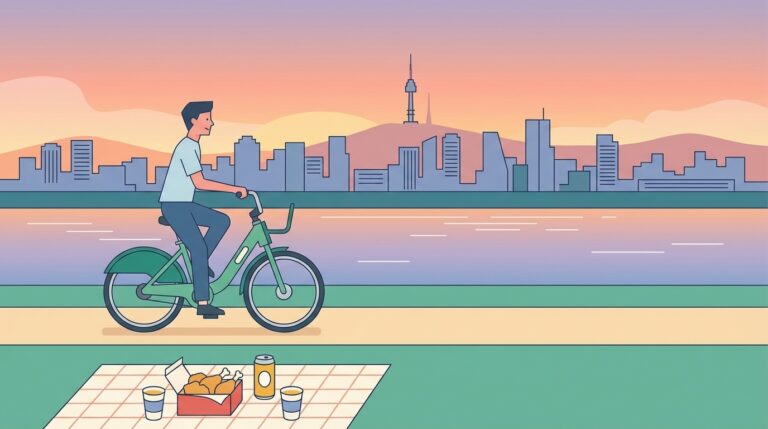
Picture this: You’re watching your favorite K-Drama. The main characters have just survived a grueling week at work. What do they do? They don’t go to a fancy restaurant. Instead, they find themselves sitting on a picnic mat by the Han River (Hangang), the evening breeze blowing in their hair, two bicycles parked behind them, and a box of crispy fried chicken between them. The subtitle just says, “It’s nice here.” But the vibe? It screams ultimate healing.
Now, you’re finally in Seoul. The weather is perfect. You want to live out your own Hangang fantasy with your Korean friends. But how do you naturally suggest renting a bike? How do you smoothly transition from sweating on a bicycle to ordering delivery chicken to a park that has no specific address?
If you use textbook Korean here, you might sound like a news anchor reporting on park activities. To get that real “Insider (인싸)” treatment, you need the language of the locals. This guide is based on real questions from my intermediate students who wanted to stop sounding like a textbook and start sounding like a true Seoulite!
Phase 2: Deep Dive into Core Expressions
Here are the top phrases you need to master your Han River outing at a B2 level.
1. 한강 가서 따릉이 탈래?
- Pronunciation: [hangang gaseo ttareung-i tallae?] (The ‘tt’ in 따 sounds like the sharp, tense ‘t’ in the word ‘stop’.)
- Meaning: Literal: Do you want to go to Hangang and ride Ttareungi? / Real nuance: Let’s grab some public bikes at the river and chill.
- K-Culture Moment: “따릉이 (Ttareungi)” is Seoul’s official public bicycle system. Locals rarely say “자전거 (bicycle)” when talking about riding at the Han River; they almost exclusively refer to Ttareungi. Asking this is the ultimate casual weekend invitation.
- Editor’s Insight: The grammar
-ㄹ래?(Do you want to…? / I want to…) is a soft, casual way to ask for someone’s intention. It feels much friendlier than the rigid-ㅂ시다(Let’s).- Situation Spectrum:
- Friends (Casual): ✅
- Close Coworkers (Semi-formal): ⚠️ (Use ‘탈까요?’ instead)
- Boss/Elders (Formal): 🚫
- 🤔 Think About It: Why do Koreans love giving cute nicknames to public services? “Ttareungi” mimics the “ring-ring” sound of a bicycle bell. Does your city have a cute name for its public transport?
2. 바람 좀 쐬고 올까요?
- Pronunciation: [baram jom ssoego olkkayo?] (‘ssoe’ sounds like ‘swe’ in ‘sweat’.)
- Meaning: Literal: Shall we go get some wind and come back? / Real nuance: Shall we go get some fresh air to clear our heads?
- K-Culture Moment: You’ll hear this phrase in almost every office K-Drama when the lead is stressed. They go to the rooftop or the Han River. It implies “I need a mental break.”
- Editor’s Insight: This isn’t just about breathing oxygen; it’s about a change of scenery. Pairing this with a Han River visit shows you truly understand the Korean concept of “healing” (힐링).
- Situation Spectrum:
- Friends (Casual): ✅ (바람 쐬고 올래?)
- Close Coworkers (Semi-formal): ✅
- Boss/Elders (Formal): ⚠️ (Needs more formal context)
- 🤔 Think About It: In Korean culture, taking a break is often expressed as an active motion (“getting wind”). How does your language express the need to clear your mind?
3. 자전거 타고 먹는 치맥이 진리죠.
- Pronunciation: [jajeon-geo tago meongneun chimaegi jillijo.] (‘meong-neun’ – notice how the ‘k’ sound in 먹 assimilates to an ‘ng’ sound because of the following ‘n’.)
- Meaning: Literal: Chimaek eaten after riding a bicycle is the truth. / Real nuance: Nothing beats Chimaek after a bike ride.
- K-Culture Moment: After burning exactly 150 calories on the bike, Koreans will immediately consume 1,500 calories of Chicken and Beer (치맥 – Chimaek). It’s the law of the Han River.
- Editor’s Insight: Calling something “진리” (the truth) is a slightly dramatic, very native way to say “It’s the absolute best.” It shows you have a great sense of humor and grasp of modern slang.
- Situation Spectrum:
- Friends (Casual): ✅ (치맥이 진리지!)
- Close Coworkers (Semi-formal): ✅
- Boss/Elders (Formal): 🚫
Phase 3: Textbook vs. Real Korean
Let’s compare what you studied with what you’ll actually hear at Yeouido Hangang Park.
[Suggesting a Bike Ride]
* 📖 Textbook Korean: 한강에서 자전거를 탑시다. (Let’s ride bicycles at Hangang.)
* 🗣️ Real Korean: 우리 따릉이 빌려서 탈까? (Shall we rent and ride Ttareungi?)
* 💡 Why the difference?: Specifying the brand “따릉이” adds a layer of shared local experience. Plus, -ㅂ시다 sounds like a military command in casual settings.
[Reacting to the Good Weather]
* 📖 Textbook Korean: 날씨가 아주 맑고 좋습니다. (The weather is very clear and good.)
* 🗣️ Real Korean: 오늘 날씨 미쳤다! 완전 한강 각인데? (The weather is crazy today! Perfect vibe for Hangang, right?)
* 💡 Why the difference?: Using “미쳤다” (crazy) for something incredibly good, and “각” (angle/opportunity) to mean “the perfect condition for X” are top-tier native slangs.
Bottom Note: At a
B2 (Upper-Intermediate)level, using words like “각” or “진리” shows you can play with the language without crossing the line into overly aggressive slang.
Phase 4: Cultural Context — K-Culture Deep Dive
4-1. Non-Verbal Elements: The “Nunchi” of the Bike Lane
When you’re at the Han River, the red asphalt is strictly for bicycles. Walking on it is a massive breach of Nunchi (social awareness). Also, you will encounter the “Ahjussi Cyclists”—older men dressed in professional Tour de France gear, riding carbon-fiber bikes at top speed. Your non-verbal task? Stay out of their way. Keep to the right side of the lane, and don’t make sudden stops!
4-2. K-Food Connection: The Magic of “Delivery Zones”
How do you order food to a massive riverbank with no address? Welcome to the magic of the “배달존” (Baedal Zone / Delivery Zone). Hangang Parks have designated pick-up spots marked with huge numbers (e.g., 배달존 2).
In dramas, they make it look like the delivery driver somehow magically finds the main character sitting on the grass. Critical View: In reality, you have to walk to the designated Delivery Zone, stand with 20 other hungry people, and listen carefully as the driver shouts the last 4 digits of your phone number!
Phase 5: Real-Life Roleplay Scenario
Setting: Saturday afternoon, 5:00 PM. Yeouido Hangang Park. The weather is crisp. You and your Korean language exchange partner have just finished a one-hour ride on the green Ttareungi bikes. You’re catching your breath.
Characters:
– YOU: An expat living in Seoul, proud of your B2 Korean skills, and very hungry.
– Jihoon (28): Your Korean language exchange partner. Energetic and loves food.
Dialogue:
Jihoon: 아, 오랜만에 자전거 타니까 다리 아프네요.
(a, oraenmane jajeon-geo tanikka dari apeuneyo.)
[Ah, my legs hurt since it’s been a while since I rode a bike.]
YOU: 저도요! 그래도 바람 쐬니까 너무 좋죠?
(jeodoyo! geuraedo baram ssoenikka neomu jochyo?)
[Me too! But it’s so nice getting some fresh air, right?]
Jihoon: 맞아요. 역시 스트레스 풀 때는 한강이 진리예요. 자, 이제 운동했으니까 칼로리 채워야죠? 뭐 먹을래요?
(majayo. yeoksi seuteureseu pul ttaeneun hangang-i jilliyeyo. ja, ije undonghaesseunikka kallori chaewoyajo? mwo meogeullaeyo?)
[Exactly. Hangang is the absolute best for relieving stress. Well, since we exercised, we need to fill up our calories. What do you want to eat?]
🔀 Your Turn! How do you answer?
– A) 저는 샌드위치를 먹고 싶습니다. (I would like to eat a sandwich.)
– B) 자전거 타고 먹는 치맥 어때요? 제가 쏠게요! (How about Chimaek after riding bikes? It’s on me!)
– C) 한강 국물 마셔볼까요? (Shall we drink Han River soup?)✅ Best Choice: B — Suggesting Chimaek while referencing the bike ride is the most culturally accurate response. Plus, offering to treat (“내가 쏜다”) earns you massive affection points.
⚠️ Choice C Analysis: Wait, Han River soup? No! Unless you fell into the river, do not drink it!
(Continuing with Choice B)
Jihoon: 오, 치맥! 완전 좋죠! 근데 한강에서는 라면도 필수인 거 알죠?
(o, chimaek! wanjeon jochyo! geunde hangang-eseoneun ramyeondo pilsuin geo aljo?)
[Oh, Chimaek! Totally! But you know Ramyeon is also a must at Hangang, right?]
YOU: 당연하죠. 그럼 지훈 씨가 편의점에서 라면 끓여 오세요. 저는 치킨 배달시킬게요.
(dang-yeonhajo. geureom jihun ssiga pyeon-uijeomeseo ramyeon kkeuryeo oseyo. jeoneun chikin baedalsikilgeyo.)
[Of course. Then Jihoon, you go boil the Ramyeon at the convenience store. I’ll order the chicken delivery.]
Jihoon: 완벽한 역할 분담이네요! 배달존 2번에서 만나요!
(wanbyeokan yeokal bundamineyo! baedaljon ibeoneseo mannayo!)
[Perfect division of labor! Let’s meet at Delivery Zone 2!]
Phase 6: 10-Second Shadowing Drill
Practice this sentence to sound like a native. Pay attention to the pauses (/) and the emotion tags!
😊 오늘 / 날씨도 좋은데 / 한강 가서 / 따릉이 탈까요?
(oneul / nalssido joeunde / hangang gaseo / ttareung-i talkkayo?)
Tip: Keep the tone light and raise the pitch slightly at the end of “탈까요?” to make it sound inviting and polite!
Phase 7: K-Culture Mini Dictionary
| 한국어 | Romanization | English | Context |
|---|---|---|---|
| 따릉이 | ttareung-i | Seoul Public Bike | The green bikes you see everywhere. You need an app to unlock them. |
| 치맥 | chimaek | Chicken & Beer | The holy grail of Korean food pairings. |
| 배달존 | baedal-jon | Delivery Zone | Numbered meeting spots at the Han River where delivery drivers hand off food. |
| 물멍 | mul-meong | Spacing out by the water | A popular way to heal. Just staring blankly at the river to empty your mind. |
| 돗자리 | dotjari | Picnic Mat | Essential for Han River lounging. You can rent them near the park entrances. |
Phase 8: Traveler’s Survival Kit
Are you planning to hit the Han River? You absolutely need these phrases and tips.
🆘 Survival Phrases for Hangang
– 🇰🇷 “배달존 2번이 어디예요?” (baedaljon ibeoni eodiyeyo?)
– 🗣️ Meaning: Where is Delivery Zone 2?
– 📍 Where to use: Asking passersby when your delivery driver is calling you and you’re lost.
- 🇰🇷 “돗자리 하나 대여할게요.” (dotjari hana daeyeohalgeyo.)
- 🗣️ Meaning: I’d like to rent one picnic mat.
- 📍 Where to use: At the small vendors near the subway exits.
📌 Editor’s Travel Note
– The Ttareungi App: As a tourist, you don’t need a Korean phone number to use Ttareungi! Download the official app, select “Foreigner” at the bottom, and you can buy a daily pass using an international credit card or the Discover Seoul Pass.
– Ramyeon Machines: Bought a packet of Ramyeon at the Han River convenience store? Don’t leave! Use the self-service boiling machines outside. Just place the foil bowl, press the button, and let the machine do the work. Do NOT put the flavor powder in before the water starts pouring, or it might burn!
Phase 9: Critical Thinking Corner — “One Step Deeper”
Food & Identity: Why does everything taste better outdoors in Korea?
🧠 Think Deeper:
Have you noticed how much effort Koreans put into eating well outdoors? While a simple sandwich suffices in many cultures, Koreans will go to great lengths to boil hot Ramyeon, order freshly fried chicken, and share multiple side dishes on a tiny picnic mat by the river. This reflects the deep-rooted culture of “Jeong” (정) and the belief that eating a proper, hot meal together (식구 – meaning ‘mouths that eat together’) is what solidifies a relationship. The Han River isn’t just a park; it’s a massive, communal dining room where the entire city comes to bond.💬 Your Turn: Does your culture have a specific outdoor food tradition that brings people together? How is it different from the Han River Chimaek culture? Share in the comments!
Phase 10: FAQ & Common Mistakes
Q: Can I ride my bike anywhere in the Han River Park?
No! There are strict lanes. The red or dark-colored asphalt is for bikes only. The lighter, urethane paths are for pedestrians. Walking in the bike lane is highly frowned upon and dangerous.
Q: Do I need to clean up my food delivery trash?
Absolutely! You cannot just leave your chicken bones on the grass. You must sort your trash into recycling (재활용) and general waste (일반쓰레기) at the massive garbage stations located throughout the park.
❌ Common Mistake #1: Saying “강물 마실까요?” (Shall we drink river water?) instead of “바람 쐴까요?” (Shall we get fresh air?).
✅ How to fix: Always remember “바람을 쐬다” (to be exposed to the wind/air) is the idiom for taking a break!
Phase 11: Summary & Action Items
One-Liner Summary: Suggesting a ride on Ttareungi and offering to buy Chimaek is the ultimate way to show your B2 Korean fluency and cultural savvy!
Action Mission 3 Steps:
– 🥉 Bronze (Solo): Say “우리 한강 가서 따릉이 탈까?” out loud 3 times looking out your window.
– 🥈 Silver (Online): Comment your favorite Korean delivery food on a YouTube vlog about the Han River.
– 🥇 Gold (Real-world): Text your Korean friend right now and set up a date: “이번 주말에 한강에서 치맥 어때요?”
K-Culture Mission: Watch an episode of a modern K-Drama (like Hospital Playlist or Queen of Tears). Keep your eyes peeled for the Han River scenes. Can you spot the Ramyeon machines or the Ttareungi?
Phase 12: Quiz — Interactive Challenge
Test your Hangang knowledge!
1. Situational Judgment: Your boss looks very stressed after a long meeting. You want to suggest taking a quick break outside. What do you say?
– A) 한강 가서 치맥 할까요? (Shall we go to Han River for Chimaek?)
– B) 부장님, 잠깐 나가서 바람 좀 쐬고 오실까요? (Boss, shall we go out and get some fresh air for a moment?)
– C) 따릉이 타러 갈래? (Wanna go ride Ttareungi?)
(Answer: B. A is too casual/time-consuming for work hours. C is missing honorifics completely!)
2. True or False: If you order delivery to the Han River, the driver will find your exact picnic mat using GPS.
(Answer: False! You must meet them at the designated 배달존 – Delivery Zone.)
3. Fill in the Blank:
“자전거 타고 먹는 치맥이 ______죠!” (Nothing beats Chimaek after a bike ride!)
(Answer: 진리 (The truth/The best))
Great job! You are now officially ready to conquer the Han River like a local. Until next time, keep riding and keep studying! 🚲🍗
Frequently Asked Questions (FAQ)
Q: What does "한강 가서 따릉이 탈래?" mean in Korean and how do you pronounce it?
A: In Korean, "한강 가서 따릉이 탈래?" is pronounced [hangang gaseo ttareung-i tallae?] and means: Literal: Do you want to go to Hangang and ride Ttareungi? / Real nuance: Let's grab some public bikes at the river and chill.
Q: What does "바람 좀 쐬고 올까요?" mean in Korean and how do you pronounce it?
A: In Korean, "바람 좀 쐬고 올까요?" is pronounced [baram jom ssoego olkkayo?] and means: Literal: Shall we go get some wind and come back? / Real nuance: Shall we go get some fresh air to clear our heads?
Q: What does "자전거 타고 먹는 치맥이 진리죠." mean in Korean and how do you pronounce it?
A: In Korean, "자전거 타고 먹는 치맥이 진리죠." is pronounced [jajeon-geo tago meongneun chimaegi jillijo.] and means: Literal: Chimaek eaten after riding a bicycle is the truth. / Real nuance: Nothing beats Chimaek after a bike ride.







