

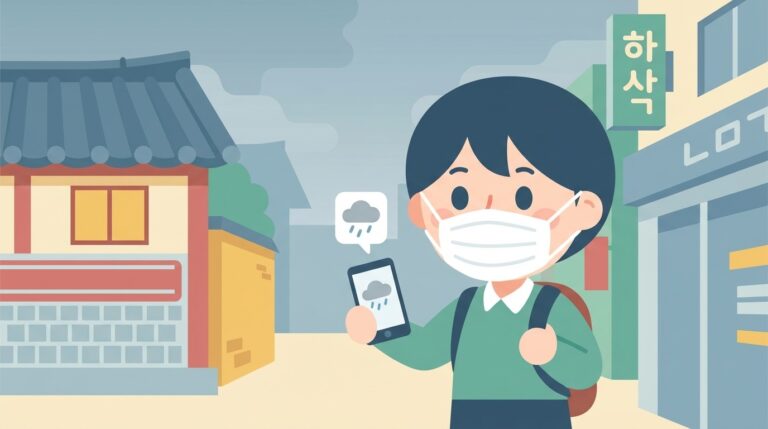
Surviving Korea’s Fine Dust Season! The Only Phrases You Need When the Sky Turns Grey
Phase 1: Empathy & The K-Culture Cold Open
Hello! This is your editor at Daily Hangul.
Imagine this: You step out of Incheon Airport, ready to start your dream trip in Korea. You look up at the sky, expecting the bright, clear blue you saw in your favorite K-Dramas like Crash Landing on You or Queen of Tears. But instead… it looks like someone put a grey, hazy filter over the city.
“Is it foggy?” you ask your Korean friend.
They sigh, pull out two white masks from their pocket, hand you one, and say, “No… it’s Mise-meonji (fine dust).”
If you visit Korea during spring or winter, you will absolutely encounter 미세먼지 (Fine Dust) and its stealthier, more dangerous cousin, 초미세먼지 (Ultrafine Dust). Knowing how to talk about it isn’t just about making small talk—it’s actual survival! Today, we are going to learn how to navigate the hazy days like a true local, even if you are an absolute beginner (A1).
Everything in this guide is based on real questions from expats who once coughed their way through Seoul. Let’s clear the air!
Phase 2: Core Expressions Deep Dive
Let’s learn the top 3 essential phrases you need on a dusty day in Korea.
1. 초미세먼지 심해요 (The ultrafine dust is bad)
- Pronunciation: Cho-mi-se-meon-ji sim-hae-yo
- Sound-alike guide: “Cho” (like choke) + “me-say” + “mon-jee” + “sheem-hay-yo”
- Meaning: Literal: Ultrafine dust is severe. / Real nuance: The air quality is absolutely terrible today.
- K-Culture Moment: You’ll hear this on subway trains. Two office workers checking their phones: “Ah, cho-mi-se-meon-ji simhaeyo.” It’s the ultimate conversation starter in Korea, replacing “nice weather, right?”
- Editor’s Insight: 미세먼지 is regular fine dust, but adding 초 (Cho-) makes it “super” or “ultra.” When it’s cho-mi-se-meon-ji, Koreans don’t mess around—they cancel picnics.
- Situation Spectrum:
- Casual with friends: ✅ (Drop the ‘yo’ -> 초미세먼지 심해!)
- Coworkers: ✅
- Boss/Elders: ✅
- 🤔 Think About It: Why do Koreans talk about the air quality as much as the weather? How does your culture handle bad weather days?
2. 마스크 있어요? (Do you have a mask?)
- Pronunciation: Ma-seu-keu i-sseo-yo?
- Sound-alike guide: Mah-suh-koo / ee-so-yo?
- Meaning: Literal: Mask exists? / Real nuance: Do you have a mask? (Can be used to ask a friend for one, or ask a store clerk if they sell them).
- K-Culture Moment: You walk into a GS25 convenience store because your throat is scratching. You look at the clerk and ask this. It’s the most powerful survival sentence you can learn!
- Editor’s Insight: Korean doesn’t always need “I” or “You.” Just saying “Mask exists?” with a rising tone works perfectly in any situation.
- Situation Spectrum:
- Casual with friends: ✅ (Drop the ‘yo’ -> 마스크 있어?)
- Coworkers: ✅
- Boss/Elders: ⚠️ (Better to say: 마스크 있으세요? – i-sseu-se-yo)
- 🤔 Think About It: Notice how we drop the subject (I/You)? Korean is a “high-context” language. We rely on the situation to fill in the blanks!
3. 삼겹살 먹으러 가요! (Let’s go eat pork belly!)
- Pronunciation: Sam-gyeop-sal meo-geu-reo ga-yo!
- Sound-alike guide: Sahm-gyup-sahl / muh-goo-ro / gah-yo!
- Meaning: Literal: Let’s go to eat pork belly. / Real nuance: The air is dusty, so let’s use it as an excuse to eat K-BBQ!
- K-Culture Moment: It’s 6 PM. The sky is grey. Your manager claps their hands and says this. It’s an old Korean myth that the fat from the pork belly washes the fine dust out of your throat.
- Editor’s Insight: Medical doctors say this is completely false. Do Koreans care? Not at all. It’s simply the best cultural excuse to eat K-BBQ!
- Situation Spectrum:
- Casual with friends: ✅ (Drop the ‘yo’ -> 가!)
- Coworkers: ✅
- Boss/Elders: ⚠️ (Let them suggest it first!)
- 🤔 Think About It: Food is often used as a remedy or a social glue in Korea. Is there a comfort food in your country linked to specific weather?
Phase 3: Textbook vs. Real Korean
Here is how language evolves from the textbook to the streets of Hongdae!
[Checking the Air Quality]
* 📖 Textbook Korean: 오늘 미세먼지 농도가 매우 높습니다. (Today, the fine dust concentration is very high.)
* 🗣️ Real Korean: 오늘 공기 최악. (Today’s air is the worst.) / 앱 빨간색이야. (The app is red.)
* 💡 Why is it different?: Koreans use a famous app called ‘미세미세 (MiseMise)’. It uses colors and faces to show air quality. “Red” means extremely bad!
[Telling someone to wear a mask]
* 📖 Textbook Korean: 외출할 때 마스크를 착용하세요. (Please wear a mask when going out.)
* 🗣️ Real Korean: 마스크 꼭 써! (Make sure to wear a mask!)
* 💡 Why is it different?: “착용하다” (to wear/equip) is formal Hanja (Chinese-root) vocabulary. In daily life, we just use the easy verb “쓰다” (to put on/use).
Bottom Note: As an A1 beginner, don’t worry about long, formal announcements. Stick to the “Real Korean” short phrases—they sound much more natural!
Phase 4: Cultural Context — K-Culture Deep Dive
4-1. Non-Verbal Cues (The ‘Nunchi’ of Fine Dust)
If someone offers you a mask on a dusty day, accept it with two hands and a slight bow. Even if you don’t want to wear it, putting it in your pocket shows you appreciate their care. Rejecting it with a casual “Nah, I’m good” can seem careless about your health, which might worry them!
4-2. K-Food Connection: The Great Samgyeopsal Myth 🥩
Let’s dive deeper into the pork belly myth! In the past, Korean coal miners used to eat greasy pork belly after a long day in the mines, believing the slippery fat would coat their throats and “wash down” the coal dust into their stomachs.
Today, modern office workers apply this exact same logic to Cho-mi-se-meon-ji! On days when the air quality index (AQI) hits dangerous levels, you will notice long lines outside K-BBQ restaurants.
* Critical View: Does it actually work? Scientifically, no. The dust goes to your lungs, and the pork goes to your stomach. But culturally? It’s a brilliant coping mechanism. It turns a depressing, gloomy day into a reason for a festive community dinner!
Phase 5: Real-Life Roleplay Scenario
Setting: It’s a hazy Thursday evening in Seoul. You are a beginner Korean student hanging out near the Han River. The sky suddenly turns a yellowish-grey. You are coughing a bit. Your Korean friend, Minji, looks at her phone with a worried face.
Characters:
– YOU: An absolute beginner trying your best to survive the dust.
– Minji: (25, your friendly language exchange partner, always checks the weather app).
Dialogue:
Minji: 헉! 지금 미세미세 앱 봤어요?
(Heok! ji-geum mi-se-mi-se aep bwas-seo-yo?)
[Gasp! Did you see the MiseMise app just now?]
YOU: 아니요. 왜요? 비 와요?
(A-ni-yo. Wae-yo? Bi wa-yo?)
[No. Why? Is it raining?]
Minji: 비 아니에요. 초미세먼지 최악이에요.
(Bi a-ni-e-yo. Cho-mi-se-meon-ji choe-a-gi-e-yo.)
[It’s not rain. The ultrafine dust is the worst.]
(🎭 Stage Direction: Minji shows you her phone screen. There is an angry black demon face on the app.)
YOU: 헐… 진짜요?
(Heol… jin-jja-yo?)
[OMG… really?]
Minji: 네. 마스크 있어요?
(Ne. Ma-seu-keu i-sseo-yo?)
[Yes. Do you have a mask?]
🔀 Your Turn! How do you answer?
– A) 아니요, 없어요. (A-ni-yo, eop-seo-yo) – “No, I don’t have one.”
– B) 나 마스크 싫어해요. (Na ma-seu-keu si-reo-hae-yo) – “I hate masks.”
– C) 마스크 맛있어요. (Ma-seu-keu ma-si-sseo-yo) – “Masks are delicious.”✅ Best Choice: A! It perfectly answers her question in polite A1 Korean.
⚠️ Choice B Analysis: While honest, this might make Minji panic about your health.
❌ Choice C Analysis: Delicious?! Unless your mask is made of candy, this is a hilarious beginner mistake!
(Assuming you chose A)
Minji: 그럼 편의점 가요. 제가 하나 살게요.
(Geu-reom pyeon-ui-jeom ga-yo. Je-ga ha-na sal-ge-yo.)
[Then let’s go to the convenience store. I’ll buy one.]
YOU: 아, 감사합니다!
(Ah, gam-sa-ham-ni-da!)
[Ah, thank you!]
Phase 6: 10-Second Shadowing Drill
Let’s practice speaking like a local! Follow the slashes (/) to pause, and pay attention to the emotion tags!
- 🤧 (Coughing slightly) 쿨럭! / 오늘 / 초미세먼지가 / 너~~무 심해요.
(Kul-leok! / o-neul / cho-mi-se-meon-ji-ga / neo~~mu sim-hae-yo.)
“Cough! Today the ultrafine dust is wwaaaay too bad.” -
🥺 (Pleading) 혹시 / 마스크 / 있어요?
(Hok-si / ma-seu-keu / i-sseo-yo?)
“By any chance, do you have a mask?”
Phase 7: K-Culture Mini Dictionary
| 한국어 (Korean) | Romanization | English | Context |
|---|---|---|---|
| 미세먼지 | mi-se-meon-ji | Fine Dust | Particles in the air, usually worse in Spring. |
| 초미세먼지 | cho-mi-se-meon-ji | Ultrafine Dust | PM2.5 particles. The invisible, dangerous ones! |
| 황사 | hwang-sa | Yellow Dust | Sandstorms blowing over from deserts in spring. |
| 미세미세 | mi-se-mi-se | MiseMise | The #1 must-download weather app in Korea. |
| 삼겹살 | sam-gyeop-sal | Pork Belly | The legendary (but unscientific) cure for a dusty throat. |
Phase 8: Traveler’s Survival Kit
If you are traveling in Korea, you must know how to buy the right mask at a convenience store!
🆘 Survival Phrases at the Convenience Store
– 🇰🇷 “마스크 어디 있어요?” (Ma-seu-keu eo-di i-sseo-yo?)
– 🗣️ English Guide: Where are the masks?
– 📍 Where to use: CU, GS25, 7-Eleven, Olive Young.
- 🇰🇷 “이거 얼마예요?” (I-geo eol-ma-ye-yo?)
- 🗣️ English Guide: How much is this?
- 💡 Pro Tip: If you don’t know Korean numbers yet, just show the clerk this phrase and point to your phone’s calculator app!
📌 Editor’s Travel Note
– The KF Rating: When buying a mask for fine dust, look for KF80 or KF94 on the package. KF stands for “Korean Filter.” Do not buy a regular “dental mask” (덴탈 마스크) for fine dust; they don’t filter the tiny particles!
– Essential App: Download the “MiseMise (미세미세)” app. If the app shows a demon wearing a gas mask, do not go hiking at Bukhansan! Go to an indoor mall like COEX instead.
Phase 9: Critical Thinking Corner — “One Step Deeper”
Media vs. Reality (미디어와 현실)
🧠 Think Deeper:
If you watch K-Dramas, Seoul always looks vibrant, with crystal clear skies and perfectly lit romantic walks along the Han River. But the reality of living in Seoul during the spring is quite different. The K-Drama industry specifically schedules outdoor shoots on “good air days” or uses heavy color-grading in post-production to erase the grey haze. This creates a beautifully idealized version of Korea for the global audience. It’s fascinating how media constructs a “perfect” reality, while actual Seoulites are busy checking their AQI apps and buying KF94 masks!💬 Your Turn: Does the media in your country hide certain weather realities? Have you ever visited a place that looked totally different from the movies? Let us know in the comments!
Phase 10: FAQ & Avoiding Misunderstandings
Q: Can I tell my boss “초미세먼지 심해 (Cho-mi-se-meon-ji sim-hae)”?
No! That’s casual language (Banmal). You must add “~요 (yo)” at the end for anyone older than you or in the workplace: “심해요 (sim-hae-yo)”.
Q: In a restaurant, can I ask them to turn on the air purifier?
Yes! You can point to it and say: “저거 틀어주세요” (Jeo-geo teu-reo-ju-se-yo / Please turn that on). Most places run them automatically, though.
❌ Common Mistake #1: Going on a picnic without checking the air!
✅ Do this instead: Always check the weather app in the morning. If it says “나쁨” (Bad) or “최악” (Worst), change your plans to an indoor café!
Phase 11: Summary & Action Items
- One-Liner Summary: When the sky turns grey, check the MiseMise app, grab a KF94 mask, and use it as the perfect excuse to eat Samgyeopsal!
Action Mission 3 Steps:
– 🥉 Bronze (Solo): Look in the mirror and practice saying “마스크 있어요?” (Do you have a mask?) 3 times.
– 🥈 Silver (Online): Check the current air quality in Seoul online and write it in the comments! (e.g., “Seoul air is 좋음/나쁨 today!”)
– 🥇 Gold (Real World): The next time you go to a Korean market or convenience store, ask “이거 얼마예요?” (How much is this?) out loud!
K-Culture Mission:
Search for a “Korean BBQ ASMR” video on YouTube. Listen to the sizzling pork belly and imagine you are escaping the fine dust outside!
Phase 12: Quiz — Interactive Challenge
1. Situational Judgment:
You walk out of your hotel, and the sky is incredibly foggy and yellowish. What should you do first?
– A) Take a deep breath of fresh morning air!
– B) Open your phone and check the fine dust levels.
– C) Put on sunglasses.
(Answer: B. It’s probably not morning mist, it’s fine dust!)
2. Fill in the Blank:
At the convenience store:
YOU: 혹시 KF94 ___________ 있어요?
(A) 초미세먼지
(B) 마스크
(C) 삼겹살
(Answer: B. 마스크. You are looking for a mask!)
3. True or False – K-Culture Edition:
“Koreans believe eating spicy Tteokbokki washes the fine dust from your throat.” (T/F)
(Answer: False! It’s not Tteokbokki, it’s greasy Samgyeopsal!)
4. Roleplay Application:
If you say “마스크 있어?” (Ma-seu-keu i-sseo?) without the “yo” at the end to an older Korean store clerk, what might happen?
(Answer: They will understand you, but they might think you are a bit rude or lack manners since you didn’t use the polite form. Always add “~yo”!)
Frequently Asked Questions (FAQ)
Q: What does "초미세먼지 심해요 (The ultrafine dust is bad)" mean in Korean and how do you pronounce it?
A: In Korean, "초미세먼지 심해요 (The ultrafine dust is bad)" is pronounced [Cho-mi-se-meon-ji sim-hae-yo] and means: Literal: Ultrafine dust is severe. / Real nuance: The air quality is absolutely terrible today.
Q: What does "마스크 있어요? (Do you have a mask?)" mean in Korean and how do you pronounce it?
A: In Korean, "마스크 있어요? (Do you have a mask?)" is pronounced [Ma-seu-keu i-sseo-yo?] and means: Literal: Mask exists? / Real nuance: Do you have a mask? (Can be used to ask a friend for one, or ask a store clerk if they sell them).
Q: What does "삼겹살 먹으러 가요! (Let's go eat pork belly!)" mean in Korean and how do you pronounce it?
A: In Korean, "삼겹살 먹으러 가요! (Let's go eat pork belly!)" is pronounced [Sam-gyeop-sal meo-geu-reo ga-yo!] and means: Literal: Let's go to eat pork belly. / Real nuance: The air is dusty, so let's use it as an excuse to eat K-BBQ!







