

Phase 1: Empathy & K-Culture Cold Open
Hello there! I’m the Lead Editor at Daily Hangul.
Picture this: You are watching a critically acclaimed K-Drama like My Liberation Notes (나의 해방일지). The protagonist is staring blankly out the window of a late-night subway, crossing the Han River. They utter a line that the subtitles translate simply as, “I’m thinking about my life.” But somehow, the vibe feels much heavier, almost poetic. It doesn’t feel like a casual thought; it feels like they are staring directly into their soul.
Or perhaps you’re listening to RM’s solo album Indigo, reading the translated lyrics, and wondering, “How do Koreans express this profound sense of self-reflection and existential questioning so beautifully?”
As advanced (C1) learners, you already know how to order food, navigate the subway, and hold a conversation. But when you want to discuss literature, poetry, or your inner feelings with a Korean friend over a quiet cup of drip coffee, standard textbook phrases like “생각합니다” (I think) just don’t cut it.
Today, we are going to dive deep into literary criticism and self-reflection in modern Korean poetry. Knowing these expressions will elevate your Korean from “fluent” to “culturally resonant,” allowing you to connect with locals on a genuinely profound level. This guide is built on the real moments when my advanced students finally realized how to articulate their deepest thoughts in Korean.
Phase 2: Deep Dive into Core Expressions
Let’s explore the top expressions used when analyzing poetry or expressing deep introspection.
1. 자아 성찰 (Self-reflection / Introspection)
- Pronunciation: ja-a seong-chal (Think of ‘ja-a’ like saying “Jah-ah”, ‘seong’ rhymes with ‘song’, and ‘chal’ sounds like the start of ‘Charlie’)
- Meaning: Literal: Ego reflection. Real nuance: A profound, philosophical introspection into one’s own life, actions, and identity.
- K-Culture Moment: You often see this word in K-Pop artist interviews when they release a “deep” album, or in K-Drama monologues where a character retreats to the countryside to “find themselves.”
- Editor’s Insight: This is an elegant, highly educated term. You wouldn’t use this when deciding what to eat for dinner. It’s reserved for big life changes or discussing themes in a literary masterpiece.
- Situation Spectrum:
- Close Friends (Casual): ⚠️ (Might sound a bit pretentious unless joking or having a serious late-night talk)
- Colleagues (Semi-formal): ✅ (Great for discussing a book or movie)
- Boss/Elders (Formal): ✅ (Highly respectful and articulate)
- 🤔 Think About It: Why is “자아” (Ego/Self) such a prominent theme in modern Korean literature? In a society deeply rooted in collectivism and Nunchi (reading the room), modern poetry often serves as the only safe sanctuary to explore the pure “Self” without societal expectations.
2. 나 자신을 돌아보다 (To look back at oneself)
- Pronunciation: na ja-sin-eul do-ra-bo-da (do-ra-bo-da sounds like ‘dora-boda’)
- Meaning: Literal: To look back at myself. Real nuance: To reflect on one’s past actions, usually with a sense of growth, regret, or realization.
- K-Culture Moment: During an end-of-year award speech, a Korean actor might say, “This role gave me a chance to look back at myself” (이 역할을 통해 나 자신을 돌아보게 되었습니다).
- Editor’s Insight: This is the most natural, universally used phrase for self-reflection in conversational Korean. It carries a warm, humble tone.
- Situation Spectrum:
- Close Friends (Casual): ✅
- Colleagues (Semi-formal): ✅
- Boss/Elders (Formal): ✅
- 🤔 Think About It: Notice the physical metaphor of “looking backward” (돌아보다). Does your native language use spatial metaphors for mental reflection?
3. 현타가 오다 (To experience a reality check / Existential crisis)
- Pronunciation: hyeon-ta-ga o-da (hyeon sounds like ‘hyun’ in Hyundai, ta like ‘tah’)
- Meaning: Literal: Reality time comes. Real nuance: A sudden, sobering realization of reality, often leading to a mini existential crisis or a feeling of emptiness.
- K-Culture Moment: You studied Korean for 5 hours, then watched a K-Drama without subtitles and understood nothing. That feeling? 현타가 왔다.
- Editor’s Insight: While the previous two expressions are literary and formal, 현타 is modern slang. It’s the modern, cynical youth’s version of “자아 성찰.” When reality hits you so hard that you are forced to re-evaluate your life choices.
- Situation Spectrum:
- Close Friends (Casual): ✅
- Colleagues (Semi-formal): ⚠️ (Only with close colleagues)
- Boss/Elders (Formal): 🚫 (Too informal and slangy)
- 🤔 Think About It: Why did this slang become so popular among Korean youth? It reflects the exhaustion of hyper-competition, where poetic ideals constantly clash with harsh realities.
Phase 3: Textbook vs. Real Korean
When reading a poem and discussing it, how you express your feelings drastically changes depending on who you are talking to.
[Expressing that a poem made you think about your life]
* 📖 Textbook Korean: 이 시는 자아 탐구에 관한 내용입니다. (This poem is about the exploration of the ego.)
* 🗣️ Real Korean: 이 시 읽으니까 갑자기 내 인생 돌아보게 되네. (Reading this poem suddenly makes me look back on my life.)
* 💡 Why the difference?: Textbook Korean uses abstract Hanja (Sino-Korean) words. Real Korean uses native verbs (돌아보다) to make the emotion feel personal and grounded.
[Admitting you feel lost in life]
* 📖 Textbook Korean: 저는 자아 정체성에 혼란을 겪고 있습니다. (I am experiencing confusion in my ego identity.)
* 🗣️ Real Korean: 아, 요즘 진짜 내가 뭘 위해 사는지 모르겠어. 완전 현타 와. (Ah, lately I really don’t know what I’m living for. Total reality check.)
* 💡 Why the difference?: Modern youth express psychological distress not through clinical terms, but through visceral, relatable slang that invites empathy from peers.
Bottom Note: At the C1 level, balancing elegant vocabulary (자아 성찰) with authentic conversational phrases (돌아보게 되다) is the key to sounding like a highly educated, yet approachable native speaker.
Phase 4: Cultural Context — K-Culture Deep Dive
4-1. Non-verbal Nuances: The Heavy Sigh and the Gaze
When discussing deep, reflective poetry in Korea, non-verbal cues are just as important as the words. You don’t say “나 자신을 돌아보게 되네요” with a bright, popping smile. You often precede it with a soft, audible sigh (a reflection of Han – 한) and look slightly away, perhaps into your coffee cup or out the window. Direct eye contact during vulnerable self-reflection can feel too intense or confrontational in Korean culture. Looking away signals that you are peering inward.
4-2. The K-Culture Link: RM & The Indie Bookstore Movement
If you want to see modern “자아 성찰” in action, look no further than K-Pop lyricism, especially artists like BTS’s RM. His lyrics frequently blur the lines between modern poetry and hip-hop, constantly questioning the “Self” (자아) against the idol persona.
Furthermore, this thirst for introspection has birthed a massive trend in Seoul: 독립서점 (Independent Bookstores). Tucked away in neighborhoods like Mangwon-dong or Haebangchon, these quiet spaces are where Korean youth go to escape the “Pali-Pali” (hurry hurry) culture. They sit, read poetry, and engage in the very self-reflection we are studying today.
Phase 5: Real-life Roleplay Scenario
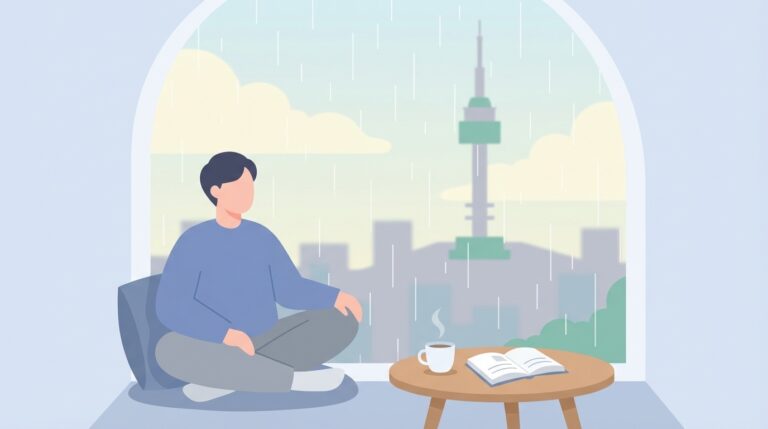
Setting: Saturday afternoon. A quiet independent bookstore with a small cafe corner in Hapjeong-dong. Rain is gently tapping against the window. You and Min-su (30, your Korean friend who loves literature) have just finished reading a modern Korean poetry collection by Yun Dong-ju.
Characters:
– YOU: An expat working in Seoul, feeling a bit burned out lately.
– Min-su: A thoughtful, slightly introverted Korean friend who enjoys deep conversations.
Dialogue:
Min-su: 방금 읽은 윤동주 시인의 시, 어땠어요? ☕️
(banggeum ilgeun yun dong-ju si-in-ui si, eottaesseoyo?)
[Translation: How was the poem by Yun Dong-ju you just read?]
(🎭 Stage Direction: Min-su takes a slow sip of his drip coffee, looking at you expectantly.)
YOU: 단어들이 참 아름답네요. 뭔가 마음이 차분해져요.
(dan-eo-deul-i cham a-reum-dam-ne-yo. mwon-ga ma-eum-i cha-bun-hae-jyeo-yo.)
[Translation: The words are truly beautiful. Somehow, my mind feels calm.]
Min-su: 맞아요. 저는 이 시를 읽을 때마다… 뭐랄까, 바쁘게만 살던 일상을 멈추게 돼요.
(ma-ja-yo. jeo-neun i si-reul il-geul ttae-ma-da… mwo-ral-kka, ba-ppeu-ge-man sal-deon il-sang-eul meom-chu-ge dwae-yo.)
[Translation: Right. Whenever I read this poem… how should I say it, it makes me stop my constantly busy daily life.]
YOU: 공감해요. 한국에서의 생활이 가끔 너무 빠르다고 느껴지거든요.
(gong-gam-hae-yo. han-guk-eo-seo-ui saeng-hwal-i ga-kkeum neo-mu ppa-reu-da-go neu-kkyeo-ji-geo-deun-yo.)
[Translation: I empathize with that. Life in Korea sometimes feels too fast.]
Min-su: 그럴 땐 이런 문학 작품이 정말 큰 위로가 되죠. 스스로에게 질문을 던지게 하니까요.
(geu-reol ttaen i-reon mun-hak jak-pum-i jeong-mal keun wi-ro-ga doe-jyo. seu-seu-ro-e-ge jil-mun-eul deon-ji-ge ha-ni-kka-yo.)
[Translation: At times like that, these literary works are a great comfort. Because they make you ask questions to yourself.]
🔀 Your Turn! How should you respond to show you deeply relate?
– A) 네, 저도 집에 가서 잘 거예요. (Yes, I’m going to go home and sleep too.)
– B) 맞아요. 이 시 덕분에 오랜만에 나 자신을 돌아보게 되더라고요.
– C) 아~ 완전 현타 오네요! 진짜 대박!✅ Best Choice: B — “You’re right. Thanks to this poem, I was able to look back at myself for the first time in a while.” This perfectly matches the calm, reflective mood of the conversation.
⚠️ Choice C Analysis: While “현타 오네요” means you’re hit by reality, using it here with “대박!” ruins the poetic, melancholic atmosphere. It’s too slangy and energetic for a quiet book cafe discussion.
Min-su: ‘나 자신을 돌아보다’… 한국어를 정말 깊이 있게 하시네요. 감동받았어요.
(na ja-sin-eul do-ra-bo-da… han-guk-eo-reul jeong-mal gi-pi it-ge ha-si-ne-yo. gam-dong-ba-da-sseo-yo.)
[Translation: ‘Looking back at yourself’… You speak Korean with such depth. I’m touched.]
(🎭 Stage Direction: Min-su gives a warm, impressed smile.)
Phase 6: 10-Second Shadowing Drill
Let’s practice delivering this reflective thought with the correct pacing and emotional weight.
😌 이 시를 / 읽으니까 // 오랜만에 / 나 자신을 / 돌아보게 되더라고요.
(i si-reul / il-geu-ni-kka // o-raen-ma-ne / na ja-sin-eul / do-ra-bo-ge doe-deo-ra-go-yo.)
Editor’s Tip: Pause slightly at the double slash (//). Lower your pitch at the end (되더라고요) to sound thoughtful and grounded, not excited.
Phase 7: K-Culture Mini Dictionary
Here are some essential keywords for discussing poetry and self-reflection:
| Korean | Romanization | English | Contextual Meaning |
|---|---|---|---|
| 공감하다 | gong-gam-ha-da | To empathize | Essential for literary reviews. “I deeply empathized with the protagonist.” |
| 여운이 남다 | yeo-un-i nam-da | Lingering feeling | The emotional resonance left after reading a great poem or watching a movie. |
| 위로를 받다 | wi-ro-reul bat-da | To receive comfort | Often used when art or poetry heals a weary heart. |
| 정체성 | jeong-che-seong | Identity | A core theme in modern literature (e.g., 자아 정체성 – ego identity). |
| 감수성 | gam-su-seong | Sensibility | “감수성이 풍부하다” means someone is emotionally sensitive/artistic. |
Phase 8: Traveler’s Survival Kit
If this lesson inspired you to visit a beautiful independent bookstore or the Yun Dong-ju Literature Museum in Seoul, here are your survival phrases!
🆘 Survival Phrases for the Bookstore
– 🇰🇷 “가장 사랑받는 시집 하나 추천해 주실 수 있나요?” (ga-jang sa-rang-ban-neun si-jip ha-na chu-cheon-hae ju-sil su in-na-yo?)
– 🗣️ Meaning: Can you recommend a most beloved poetry book?
– 📍 Where to use: Independent bookstores (독립서점) or Kyobo Bookstore.
- 🇰🇷 “이 시집, 선물용으로 포장해 주시겠어요?” (i si-jip, seon-mul-yong-eu-ro po-jang-hae ju-si-ge-sseo-yo?)
- 🗣️ Meaning: Could you gift-wrap this poetry book?
- 📍 Where to use: At the checkout counter.
🇰🇷 “조용히 책 읽기 좋은 자리가 있을까요?” (jo-yong-hi chaek il-gi jo-eun ja-ri-ga i-sseul-kka-yo?)
- 🗣️ Meaning: Is there a good seat to read quietly?
- 📍 Where to use: Book cafes.
📌 Editor’s Travel Note
– Etiquette: In Korean independent bookstores, taking photos of the inside pages of books is heavily frowned upon due to copyright. Always ask “사진 찍어도 되나요?” (Can I take pictures?) before snapping your aesthetic Instagram shots!
Phase 9: Critical Thinking Corner — “Going One Step Deeper”
Language & Power vs. The Poetic Self
🧠 Think Deeper:
Korean is a highly relational language. Words change based on who is older, who has a higher rank, and how close you are. This means that every time a Korean person speaks, they must first acknowledge their “social position” relative to the listener. However, modern poetry strips all this away. In a poem, the speaker is just “나” (I), communicating directly with the universe or their inner self. This is why learning terms like “자아 성찰” is so powerful—it represents a rare linguistic escape from Korea’s strict hierarchical structure, offering a space where pure individuality breathes freely.💬 Your Turn: Does your native language require you to constantly define your social relationship with the listener? How do people in your culture express deep, personal introspection? Share your thoughts in the comments!
Phase 10: FAQ & Avoiding Common Mistakes
Q: Can I tell my boss “저 요즘 현타가 왔어요” (I’m having an existential crisis lately)?
No! Even if you are close, it sounds unprofessional. Instead, use a softer, formal approach: “요즘 제 커리어에 대해 고민이 많습니다” (I have many deep thoughts about my career lately).
Q: What’s the difference between 성찰 (Seong-chal) and 반성 (Ban-seong)?
This is a massive point of confusion for C1 learners!
❌ Common Mistake #1: Saying “저는 제 인생을 반성합니다” when you mean you are reflecting on your life.
✅ How to fix it:
– 반성 (Ban-seong): Means repentance or admitting a mistake. You use this when you did something wrong and are sorry (e.g., “I regret fighting with my mom”).
– 성찰 (Seong-chal): Means introspection/reflection. You use this to analyze your life objectively without necessarily feeling guilty.
Phase 11: Summary & Action Items
One-Liner Summary: To connect with the Korean soul, move beyond “I think” and use “나 자신을 돌아보다” (to look back at myself) to express profound self-reflection.
Action Mission:
– 🥉 Bronze (Solo): Stand in front of a mirror, let out a soft sigh, and practice saying “요즘 나 자신을 돌아보게 되네” with deep emotion.
– 🥈 Silver (Online): Find a Korean poem translation online (like Yun Dong-ju or Kim So-wol). Leave a comment in Korean saying: “이 시는 큰 여운을 남기네요.” (This poem leaves a great lingering emotion.)
– 🥇 Gold (Real World): Visit a quiet cafe or a bookstore. Post a picture of your coffee or book with the hashtag #자아성찰 (Self-reflection).
K-Culture Mission:
Listen to RM’s Indigo album or watch an episode of My Liberation Notes. Try to spot the moments where the characters or lyrics shift their gaze inward to “reflect on themselves.”
Did today’s lesson make you look back on your language journey? Let me know below! 👇
Phase 12: Interactive Quiz
Q1. Situational Judgment: You just watched a heartbreakingly beautiful indie film with your Korean language partner. You want to say the movie made you reflect on your life. What is the most natural, C1-level phrase to use?
1) 영화 주인공을 반성합니다.
2) 자아 정체성이 붕괴되었습니다.
3) 영화를 보고 나 자신을 많이 돌아보게 됐어요.
4) 현타가 와서 짜증 나요.
(Toggle for Answer)
Answer: 3. It perfectly conveys the natural, emotional reflection. #1 means you are repenting for the protagonist (incorrect). #2 sounds like a psychology textbook. #4 is too aggressive and slangy for a beautiful indie film.
Q2. True or False – K-Culture Edition:
“In Korean independent bookstores, it is completely fine to take photos of the pages of poetry books to post on Instagram.”
(Toggle for Answer)
Answer: False. Copyright and respect for authors are highly emphasized in indie bookstores. Taking pictures of the cover is usually fine, but snapping the inside pages is considered rude.
Q3. Fill in the Blank:
요즘 너무 바쁘게 살아서, 조용한 카페에서 ( _______ )을/를 하는 시간이 필요해요.
(Hint: A philosophical term for looking into your ego)
(Toggle for Answer)
Answer: 자아 성찰
Frequently Asked Questions (FAQ)
Q: What does "자아 성찰 (Self-reflection / Introspection)" mean in Korean and how do you pronounce it?
A: In Korean, "자아 성찰 (Self-reflection / Introspection)" is pronounced [ja-a seong-chal (Think of 'ja-a' like saying "Jah-ah", 'seong' rhymes with 'song', and 'chal' sounds like the start of 'Charlie'] and means: Literal: Ego reflection. Real nuance: A profound, philosophical introspection into one's own life, actions, and identity.
Q: What does "나 자신을 돌아보다 (To look back at oneself)" mean in Korean and how do you pronounce it?
A: In Korean, "나 자신을 돌아보다 (To look back at oneself)" is pronounced [na ja-sin-eul do-ra-bo-da (do-ra-bo-da sounds like 'dora-boda'] and means: Literal: To look back at myself. Real nuance: To reflect on one's past actions, usually with a sense of growth, regret, or realization.
Q: What does "현타가 오다 (To experience a reality check / Existential crisis)" mean in Korean and how do you pronounce it?
A: In Korean, "현타가 오다 (To experience a reality check / Existential crisis)" is pronounced [hyeon-ta-ga o-da (hyeon sounds like 'hyun' in Hyundai, ta like 'tah'] and means: Literal: Reality time comes. Real nuance: A sudden, sobering realization of reality, often leading to a mini existential crisis or a feeling of emptiness.







