

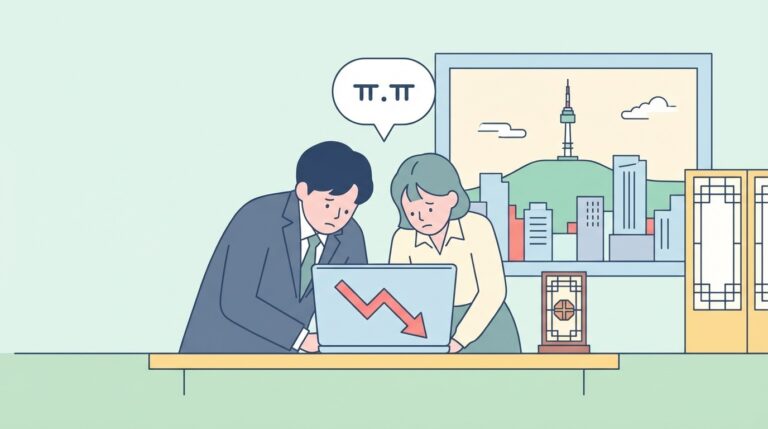
Phase 1: Empathy (The K-Drama Office Reality)
Hello! I’m your Editor from Daily Hangul.
Picture this: You are watching a Korean office drama like Misaeng or Start-Up. The camera zooms in on a tense meeting room. The team is staring at an Excel spreadsheet with a glaring red number at the bottom. The director lets out a heavy sigh, adjusting his glasses, and asks, “Why did we spend so much this month?” The background music stops. The dreaded “budget overrun” meeting has begun.
If you’re working in Korea or dealing with Korean partners, analyzing a budget overrun (예산 초과) is a high-stakes game of Nunchi (눈치). The subtitles might just say, “We went over budget because of X,” but the actual Korean being spoken is a delicate dance of honorifics, passive voice, and corporate diplomacy.
As someone who has navigated the Seoul corporate world for over a decade, I’m here to tell you: your textbook won’t save you in that meeting room. But this guide will. Let’s learn how to explain a financial deficit like a true K-Corporate insider.
Phase 2: Core Expressions Deep Dive
Here are the 3 most crucial expressions you need to survive a budget analysis meeting.
1. 예상보다 예산이 많이 초과되었습니다.
- Pronunciation: [yesangboda yesani mani chogwadoeeotseumnida]
Sound-alike guide: yeh-sang-boh-dah / yeh-sah-nee / mah-nee / cho-gwah-dweh-oht-seum-nee-dah. (Tip: ‘gwah’ sounds like ‘gw’ in ‘Gwen’ + ‘ah’).- Meaning: Literal: “The budget has been exceeded much more than expected.” / Real nuance: “We spent way too much, but it wasn’t entirely our fault, the situation exceeded our expectations.”
- K-Culture Moment: You’ll hear this exactly 15 minutes into an episode of a workplace K-Drama, usually delivered by a nervous junior manager looking down at their tablet, avoiding direct eye contact with the boss.
- Editor’s Insight: Notice the passive voice (
초과되었습니다). In Korean corporate culture, it’s safer to say “the budget was exceeded” rather than “I/We spent too much money.” It softens the blame.- Situation Spectrum:
- Casual with friends: 🚫 (Too formal)
- Co-workers (Semi-formal): ✅
- Boss/Clients (Formal): ✅
- 🤔 Think About It: Why does business Korean rely so heavily on the passive voice when discussing mistakes? Does your native language also use passive structures to avoid direct blame?
2. 주요 원인은 물가 상승으로 파악됩니다.
- Pronunciation: [juyo wonineun mulga sangseungeuro paakdoemnida]
Sound-alike guide: joo-yo / won-in-eun / mool-gah / sang-seung-eu-ro / pah-ak-dwem-nee-dah. (‘eu’ sounds like the disgusted sound you make when stepping in gum).- Meaning: Literal: “The main cause is grasped as rising prices.” / Real nuance: “We analyzed the data, and inflation is the main culprit.”
- K-Culture Moment: This is the “shield” expression. When the boss asks why, you immediately pivot to external factors (물가 상승 – inflation, 환율 – exchange rate, 인건비 – labor costs).
- Editor’s Insight:
파악됩니다(is identified/grasped) makes you sound incredibly analytical and objective. It shows you didn’t just guess; you did your research.- Situation Spectrum:
- Casual with friends: 🚫
- Co-workers (Semi-formal): ⚠️ (A bit stiff for close colleagues)
- Boss/Clients (Formal): ✅
- 🤔 Think About It: In Korea, appearing objective and data-driven is highly valued to maintain harmony. How do you present bad news in your culture without sounding defensive?
3. 다음 분기 예산을 재조정하겠습니다.
- Pronunciation: [daeum bungi yesaneul jaejojonghagetseumnida]
Sound-alike guide: dah-eum / boon-gee / yeh-san-eul / jae-jo-jong-hah-get-seum-nee-dah.- Meaning: Literal: “I will readjust the budget for the next quarter.” / Real nuance: “I’ve already thought of a solution so please don’t fire me.”
- K-Culture Moment: In a K-Drama, after the boss yells, the competent lead character calmly steps forward and drops this line, instantly changing the mood of the room and earning a nod of approval.
- Editor’s Insight: You can’t just report a problem; you must offer a solution.
재조정(readjustment) implies you are taking proactive steps.- Situation Spectrum:
- Casual with friends: 🚫
- Co-workers (Semi-formal): ✅
- Boss/Clients (Formal): ✅
Phase 3: Textbook vs. Real Korean
[Admitting the Overrun]
* 📖 Textbook: 예산을 넘었습니다. (We passed the budget.)
* 🗣️ Real Korean: 예산이 오바됐어요. (The budget went ‘over’.)
* 💡 Why the difference?: Koreans love using Konglish (English words adapted into Korean) in the office. “오바되다” (from “over”) is widely used to mean exceeding a limit, though it’s best kept to semi-formal meetings, not the CEO.
[Explaining the Financial Hit]
* 📖 Textbook: 돈을 많이 썼습니다. (We spent a lot of money.)
* 🗣️ Real Korean: 이번에 타격이 좀 컸습니다. (The hit was quite big this time.)
* 💡 Why the difference?: 타격 means “a blow” or “impact.” Describing an unexpected expense as a “big hit” shifts the nuance from “we were careless” to “we faced a tough challenge.”
Bottom Note: At the B2 level, avoid overly casual slang like “돈이 증발했어요” (the money evaporated) during formal reports, but definitely use “오바됐어요” with your peers to sound like a local!
Phase 4: Cultural Context — K-Culture Deep Dive
4-1. Non-Verbal Cues (The Art of Corporate Nunchi)
When delivering bad financial news in Korea, your body language is just as important as your vocabulary. Do not make intense, unwavering eye contact—this can be seen as defiant. Instead, look at the report or screen, occasionally glancing at the boss. Keep your posture slightly bowed, reflecting a respectful, apologetic attitude.
4-2. The K-Drama Corporate Trope & Hoesik
If you’ve watched any office K-Drama, you know what happens immediately after a stressful budget meeting: a 회식 (Hoesik – Company Dinner). The team heads to a smoky Samgyeopsal (pork belly) restaurant to drink Soju and vent.
* Critical View: Dramas often show the junior employee drunkenly confronting the boss about the budget constraints. In reality, do not do this. Hoesik is for team bonding and gently smoothing over the day’s friction, not for debating the Q3 marketing spend!
Phase 5: Practical Role-play Scenario
Setting: Friday afternoon, 4 PM. A glass-walled meeting room in a Gangnam startup. You are presenting the quarterly financial report.
Characters:
– YOU: A foreign project manager. You need to explain why the marketing campaign cost 20% more than planned.
– Director Choi (45): Your stern but fair Korean boss.
Dialogue:
Director Choi: (Flipping through the report) 이번 마케팅 캠페인, 왜 이렇게 예산이 초과된 거죠?
(ibeon maketing kaempein, wae ireoke yesani chogwadoen geojyo?)
[Why was the budget so overshot for this marketing campaign?]
(🎭 Stage Direction: Director Choi takes off his glasses and looks at you expectantly.)
YOU: 아, 그 부분은… 예상보다 예산이 많이 초과되었습니다.
(a, geu bubuneun… yesangboda yesani mani chogwadoeeotseumnida.)
[Ah, regarding that part… the budget was exceeded much more than expected.]
Director Choi: 초과된 건 숫자로 나와 있으니까 알고요. 이유가 뭡니까?
(chogwadoen geon sutjaro nawa isseunikka algoyo. iyuga mwomnikka?)
[I know it’s exceeded because the numbers show it. What is the reason?]
🔀 Your Turn! How should you respond?
– A) “제가 계산을 잘못했습니다. 죄송합니다.” (I calculated wrong. Sorry.)
– B) “주요 원인은 광고 단가 상승으로 파악됩니다. 다음 분기 예산을 재조정하겠습니다.” (The main cause is identified as the rise in ad rates. I will readjust the next quarter’s budget.)
– C) “마케팅 팀이 돈을 너무 많이 썼어요.” (The marketing team spent too much money.)✅ Best Choice: B — Reason: It’s objective, uses professional vocabulary (파악됩니다), and immediately offers a solution (재조정).
⚠️ Choice A & C Analysis: Choice A takes too much personal blame without offering an analytical reason. Choice C sounds like you are throwing another team under the bus, which breaks the “team harmony” rule in Korean corporate culture.
(Assuming you chose B)
Director Choi: (Nods slowly) 알겠습니다. 그럼 다음 주까지 수정된 예산안 올려주세요.
(algetseumnida. geureom daeum jukkaji sujeongdoen yesanan ollyeojuseyo.)
[Understood. Then submit the revised budget proposal by next week.]
Bonus K-Culture Scenario: The Aftermath
(Later that evening at the Samgyeopsal place)
Min-su (Your Colleague): 오늘 최 이사님 질문 공격 장난 아니었죠? 고생했어요. 맥주 한잔해요!
(oneul choe isanim jilmun gonggyeok jangnan anieotjyo? gosaenghaesseoyo. maekju hanjanhaeyo!)
[Director Choi’s question attack was no joke today, right? You worked hard. Let’s have a beer!]
YOU: 진짜 진땀 뺐어요. 예산 오바된 거 수습하느라… 짠!
(jinjja jinttam ppaesseoyo. yesan obadoen geo suseupaneura… jjan!)
[I really sweat bullets. Trying to fix the budget overrun… Cheers!]
Phase 6: 10-Second Shadowing Drill
Practice this sentence to sound like a calm, collected professional. Pay attention to the pauses!
😤 단호하고 프로페셔널하게 (Firm and Professional):
주요 원인은 / 광고 단가 상승으로 / 파악됩니다. / 대안을 / 마련하겠습니다.
(juyo wonineun / gwanggo danga sangseungeuro / paakdoemnida. / daeaneul / maryeonhagetseumnida.)
Phase 7: K-Culture Mini Dictionary
| Korean | Romanization | English | Cultural Context |
|---|---|---|---|
| 눈치 | nunchi | Social tact / reading the room | Crucial in business to gauge the boss’s mood before delivering bad financial news. |
| 회식 | hoesik | Company dinner | The unofficial extension of the office where tension from budget meetings is resolved over food. |
| 법카 | beop-ka | Corporate card | Short for 법인카드. Going over the ‘beop-ka’ limit is a common cause for HR warnings! |
| 수습하다 | suseupada | To handle/resolve a mess | When a budget overrun happens, your job is to “suseup” the situation. |
| 빵꾸나다 | ppanggkunada | To have a deficit/hole | Office slang. “예산 빵꾸났어” means “There’s a hole in our budget (we’re out of money).” |
Phase 8: Traveler’s Survival Kit
Wait, what if you aren’t in a corporate office, but you’re a traveler on a business trip (출장) who just realized you went way over your daily budget?
🆘 Survival Expressions for the Over-Budget Traveler
– 🇰🇷 “영수증 꼭 챙겨주세요.” (yeongsujeung kkok chaenggyeojuseyo.)
– 🗣️ Sound-alike: young-soo-jeung kkok cheng-gyeo-joo-seh-yo.
– 📍 Where to use: Taxis, restaurants, cafes.
– 💡 Pro Tip: If you are traveling on a company budget, you must have the physical or digital receipt to prove your expenses and avoid budget discrepancies!📌 Editor’s Travel Note
– Splitting the bill: If you’re out of budget, ask “따로 결제할게요” (I’ll pay separately) when dining with others. It’s very common in modern Korea!
– Installments: If you made a huge purchase in Korea with a Korean credit card and went over budget, you can ask “할부 되나요?” (Can I pay in installments?).
Phase 9: Critical Thinking — “One Step Deeper”
Language & Power (Hierarchy in Corporate Korea)
In Korean business culture, the language used for reporting finances is heavily influenced by hierarchy. You’ll notice we used 파악됩니다 (it is identified) instead of 제가 찾았습니다 (I found it). By removing the “I” (주어 생략 – subject omission) and using passive, formal endings (-습니다), the speaker shifts the focus from personal action to objective facts. It’s a linguistic buffer. It shows respect to the superiors by presenting the data humbly, allowing the boss to be the ultimate judge of the situation rather than the employee boldly claiming authority over the facts.
💬 Your Turn: How does your work culture handle reporting mistakes or budget deficits? Do you use direct language (“I messed up”) or diplomatic language? Share in the comments!
Phase 10: FAQ & Avoiding Misunderstandings
Q: Can I use “예산 오바됐어요” to my boss?
A: NO. Unless you work in a highly casual startup where everyone uses English names and informal language, “오바되다” is too slangy for reporting to higher-ups. Stick to “초과되었습니다.”
Q: Should I bow when apologizing for the budget?
A: A slight head bow, yes. You don’t need to do a full 90-degree bow like in historical dramas. A seated, slight bow of the head (about 15-30 degrees) while saying “죄송합니다” (I’m sorry) is sufficient.
❌ Common Mistake #1: Saying “제 잘못입니다” (It’s my fault) too eagerly.
✅ Do this instead: In corporate Korea, while accountability is good, taking all the blame abruptly can make you look incompetent. Say “저희 팀의 착오가 있었습니다” (There was an error on our team’s part) or focus on the external causes first.
Phase 11: Summary & Action Items
- One-Liner Summary: When explaining a budget overrun, use objective, passive vocabulary (
초과되었습니다,파악됩니다) and always offer a readjustment plan (재조정). -
Action Mission 3 Steps:
- 🥉 Bronze (Solo): Look in the mirror, adjust imaginary glasses, and say “예상보다 예산이 초과되었습니다” 3 times with a serious face.
- 🥈 Silver (Online): Write a comment below using the word ‘법카’ (Corporate card) in a sentence!
- 🥇 Gold (Real World): Next time you spend too much on online shopping, dramatically tell your friend, “이번 달 지출 원인은 물가 상승으로 파악됩니다.”
- K-Culture Mission:
Find an office K-Drama (like Misaeng, Search: WWW, or Start-Up) on Netflix. Watch for the inevitable meeting room scene. Can you spot the moment they look at the budget? Listen closely to the formal verb endings they use!
Phase 12: Quiz — Interactive Challenge
1. Situational Judgment: Your boss asks why the team dinner cost $500. What is the most professional B2-level response?
a) 우리가 소고기를 너무 많이 먹었어요. (We ate too much beef.)
b) 회식 예산이 예상보다 초과되었습니다. (The company dinner budget was exceeded more than expected.)
c) 돈이 빵꾸났어요. (The money has a hole in it.)
2. Fill in the Blank:
주요 원인은 물가 상승으로 (_______).
(The main cause is identified as inflation.)
a) 파악됩니다
b) 오바됐어요
c) 수습해요
3. True or False – K-Culture Edition:
In a Korean corporate setting, it is considered highly professional to aggressively make eye contact with your boss while explaining a financial mistake to show your confidence. (T/F)
(Answers: 1: b, 2: a, 3: False – softening eye contact shows respect and contrition in this context.)
Frequently Asked Questions (FAQ)
Q: What does "예상보다 예산이 많이 초과되었습니다." mean in Korean and how do you pronounce it?
A: In Korean, "예상보다 예산이 많이 초과되었습니다." is pronounced [yesangboda yesani mani chogwadoeeotseumnida] and means: Literal: "The budget has been exceeded much more than expected." / Real nuance: "We spent way too much, but it wasn't entirely our fault, the situation exceeded our expectations."
Q: What does "주요 원인은 물가 상승으로 파악됩니다." mean in Korean and how do you pronounce it?
A: In Korean, "주요 원인은 물가 상승으로 파악됩니다." is pronounced [juyo wonineun mulga sangseungeuro paakdoemnida] and means: Literal: "The main cause is grasped as rising prices." / Real nuance: "We analyzed the data, and inflation is the main culprit."
Q: What does "다음 분기 예산을 재조정하겠습니다." mean in Korean and how do you pronounce it?
A: In Korean, "다음 분기 예산을 재조정하겠습니다." is pronounced [daeum bungi yesaneul jaejojonghagetseumnida] and means: Literal: "I will readjust the budget for the next quarter." / Real nuance: "I've already thought of a solution so please don't fire me."







