

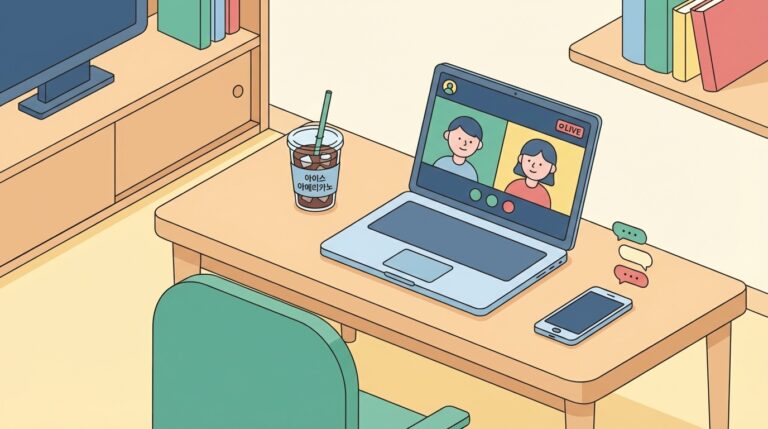
Phase 1: Empathy (The Immersive Open)
Hello! I’m the Lead Editor of Daily Hangul.
Picture this: You are watching a modern K-Drama like Start-Up or Search: WWW. The main characters aren’t just working in sleek offices; they are typing furiously on their laptops at home, navigating video calls, and responding to endless pinging sounds from work messengers. You might think, “Work from home (WFH) is the same everywhere, right?”
Well… not exactly. In Korea, the transition to ‘스마트 워크’ (Smart Work) and ‘재택 근무’ (WFH) brought along an unspoken set of digital rules. Suddenly, the traditional Korean office hierarchy and the delicate art of nunchi (reading the room) had to be translated into Slack messages, Zoom backgrounds, and response times. Have you ever wondered why your Korean colleague adds a little “~” (tilde) at the end of their message, or why everyone says “You’ve worked hard” before logging off?
If you’re at a C1 level, you already know the grammar. But if you want to navigate a Korean remote workspace with the finesse of a native—and get that “insider” respect—you need to master the nuance of digital nunchi. This guide is built directly from the real-life struggles of expats and digital nomads working with Korean teams.
Phase 2: Deep Dive into Core Expressions
Let’s break down the most crucial phrases you need to survive and thrive in a Korean remote work setting.
1. 마이크가 음소거되어 있습니다.
- Pronunciation: Maikeuga eum-sogeo-doeeo itseumnida. [Mah-ee-keu-gah oom-so-guh-dway-uh it-sum-nee-da]
- Sound-alike guide: ‘으’ sounds like the disgusted sound you make when stepping in gum (uh).
- Meaning: (Literal) The microphone has been muted. (Real nuance) “You’re on mute!”
- K-Culture Moment: The classic Zoom blunder. In Korean business culture, directly saying “You forgot to turn on your mic” to a boss can feel a bit abrasive. Using the passive voice (“is muted”) softens the blow entirely.
- Editor’s Insight: This phrase is a lifesaver. It removes the blame from the person and places it on the technology. It’s the ultimate polite save.
- Situation Spectrum:
- Casual (Peers): ⚠️ (A bit too formal; use “마이크 꺼졌어요” instead)
- Semi-formal (Colleagues): ✅
- Formal (Boss/Clients): ✅
- 🤔 Think About It: Why does Korean rely so heavily on passive voice in polite situations? How does taking the “subject” out of the sentence reflect the cultural value of preserving harmony and “saving face”?
2. 슬랙(메신저)으로 공유해 드렸습니다.
- Pronunciation: Seullaeg-euro gongyuhae deuryeotseumnida. [Sull-lag-eu-ro gong-yoo-hae du-ryeot-sum-nee-da]
- Meaning: (Literal) I shared it via Slack for you. (Real nuance) “I sent it on Slack.”
- K-Culture Moment: You’ve finished your part of the project while WFH. You don’t just quietly upload it; you announce it. In Korea, visible communication is key to showing you are actively working.
- Editor’s Insight: Notice the “~해 드렸습니다” (did it for you). This structure elevates your sentence from just stating a fact to offering a service. It’s a hallmark of professional Korean business etiquette.
- Situation Spectrum:
- Casual: 🚫
- Semi-formal: ✅
- Formal: ✅
- 🤔 Think About It: In English, “I sent it” is neutral. Why do you think Korean requires acknowledging the receiver’s benefit even for routine tasks?
3. 먼저 로그아웃하겠습니다. 수고하셨습니다!
- Pronunciation: Meonjeo logeu-aut-hagetseumnida. Sugohasyeotseumnida! [Mun-juh lo-gu-out-ha-get-sum-nee-da. Soo-go-ha-shut-sum-nee-da!]
- Meaning: (Literal) I will log out first. You worked hard! (Real nuance) “I’m logging off for the day. Great job everyone!”
- K-Culture Moment: It’s 6:00 PM. In a physical office, you’d stand up, bow slightly, and say “먼저 들어가겠습니다” (I’ll be leaving first). In the remote era, you type this into the team group chat before your green dot turns grey.
- Editor’s Insight: Never just disappear offline. The remote “clock-out” ritual is sacred. Adding “수고하셨습니다” acknowledges the collective effort, which is deeply rooted in Korean community values.
- Situation Spectrum:
- Casual: ✅
- Semi-formal: ✅
- Formal: ✅
- 🤔 Think About It: Does your culture have a specific phrase to acknowledge everyone’s hard work at the end of the day, or do people just say “bye”?
Phase 3: Textbook vs. Real Korean
How does textbook Korean hold up against the fast-paced, efficiency-driven reality of Korean Slack channels?
[Status Updates]
* 📖 Textbook Korean: 저는 지금 화장실에 갑니다. 잠시 자리를 비웁니다. (I am going to the restroom now. I am stepping away for a moment.)
* 🗣️ Real Korean: 잠시 자리 비웁니다. / (Setting status to: ☕️ 자비)
* 💡 Why the difference?: WFH demands brevity. “자비” is short for 자리 비움 (Away From Keyboard/Desk). No one needs to know exactly where you are going, just that you’re AFK.
[Acknowledging a Message]
* 📖 Textbook Korean: 네, 알겠습니다. 메시지를 잘 받았습니다. (Yes, I understand. I received the message well.)
* 🗣️ Real Korean: 넵! / 넹 / 확인했습니다~
* 💡 Why the difference?: A simple “네” (Yes) can sound too cold or robotic in text. Adding a ‘ㅂ’ (넵) adds a brisk, energetic, and professional tone. The tilde (~) softens the message, functioning like a friendly smile!
Bottom Note for C1 Learners: While “넵” is a staple, don’t overdo the slang with senior management. Stick to “확인했습니다” (Confirmed/Noted) when talking to directors or clients.
Phase 4: Cultural Context — K-Culture Deep Dive
4-1. The Non-Verbal Game: Digital Nunchi (디지털 눈치)
In a physical office, nunchi means noticing when your boss’s coffee is empty or realizing the mood in the room is tense. In the WFH era, nunchi has evolved.
* Response Time: If a message drops in the team chat, the speed at which the “1” (unread counter on Kakaotalk) disappears or a Slack emoji reaction appears is a measure of your work ethic.
* The Zoom Nod: In Korean meetings, active listening is crucial. On Zoom, since audio overlap is messy, Koreans will nod enthusiastically to show they are engaged.
4-2. The K-Drama Connection: The “Start-Up” Hustle
If you’ve watched K-Dramas featuring tech companies (like Start-Up), you’ve seen the intense collaborative energy. Even when working remotely, that “pali-pali” (hurry up) culture remains. However, unlike dramas where juniors confidently argue with CEOs, real-world remote work still heavily relies on honorifics and gentle phrasing. In reality, a junior wouldn’t say “That’s wrong!” on a call; they would say “그 부분은 다시 한번 확인이 필요할 것 같습니다” (I think that part needs to be checked one more time).
Phase 5: Real-Life Roleplay Scenario
Setting: Friday, 3:00 PM. You are working remotely from a beautiful cafe in Jeju Island (a popular “workcation” spot). You are on a weekly Zoom sync with your Korean team back in Seoul.
Characters:
– YOU: An expat digital marketer. You want to show you are highly engaged despite the scenic background.
– Min-su (32): Your friendly project manager who usually leads the meetings.
– Team Leader Lee (45): Your boss, observing quietly but expecting clear updates.
The Dialogue:
Min-su: 자, 다들 들어오셨나요? 그럼 주간 회의 시작하겠습니다.
(Ja, dadeul deureo-osyeonnayo? Geureom jugan hoe-i sijakhagetseumnida.)
[Translation: Alright, is everyone here? Let’s start the weekly meeting.]
(🎭 Stage Direction: Min-su shares his screen, showing an Excel spreadsheet)
YOU: 네, 잘 들립니다.
(Ne, jal deullimnida.)
[Translation: Yes, I can hear you well.]
Min-su: 먼저 마케팅팀 이번 주 진행 상황 공유 부탁드립니다. 화면 띄워주시겠어요?
(Meonjeo maketing-tim ibeon ju jinhaeng sanghwang gongyu butakdeurimnida. Hwamyeon ttiwo-jusigetseoyo?)
[Translation: First, please share the marketing team’s progress for this week. Could you pull up your screen?]
YOU: 넵, 잠시만요. 화면 공유하겠습니다.
(Nep, jamsimanyo. Hwamyeon gongyuhagetseumnida.)
[Translation: Yep, just a moment. I’ll share my screen.]
(🎭 Stage Direction: You click ‘Share Screen’ but nothing happens)
Min-su: 어… 화면이 아직 안 보이는데요?
(Eo… hwamyeoni ajik an boineundeyo?)
[Translation: Uh… I can’t see the screen yet.]
YOU: 앗, 죄송합니다. 인터넷 연결이 조금 불안정한 것 같습니다. 다시 해보겠습니다.
(At, joesonghamnida. Inteonet yeongyeori jogeum buranjeonghan geot gatseumnida. Dasi haebogetseumnida.)
[Translation: Ah, sorry. I think the internet connection is a bit unstable. Let me try again.]
Team Leader Lee: (Frowning slightly) 거긴 제주도라 그런가? 와이파이 괜찮아요?
(Geogin Jeju-do-ra geureon-ga? Wa-i-pa-i gwaenchannayo?)
[Translation: Is it because you are in Jeju? Is the Wi-Fi okay?]
🔀 Your Turn! How should you respond to the boss?
– A) “아니요, 와이파이 최악이에요. 짜증나네요.” (No, the Wi-Fi is the worst. It’s annoying.)
– B) “네, 괜찮습니다. 핫스팟으로 바로 연결해서 화면 띄우겠습니다!” (Yes, it’s fine. I’ll connect to my hotspot immediately and pull up the screen!)
– C) “제주도가 원래 이래요. 하하.” (Jeju is just like this. Haha.)✅ Best Choice: B — Reason: In a Korean professional setting, offering an immediate, proactive solution (using a hotspot) demonstrates efficiency and “센스” (sense/competence). It reassures the boss instantly.
⚠️ Choice A & C Analysis: Complaining or making a joke at the expense of efficiency during a formal update will make you seem unprofessional to a Korean manager.
YOU: 네, 괜찮습니다. 핫스팟으로 바로 연결해서 화면 띄우겠습니다!
(Ne, gwaenchansumnida. Hat-seu-pat-euro baro yeongyeol-haeseo hwamyeon ttiu-getseumnida!)
[Translation: Yes, it’s fine. I’ll connect to my hotspot immediately and pull up the screen!]
Team Leader Lee: (Nodding in approval) 네, 알겠습니다. 진행하세요.
(Ne, algetseumnida. Jinhaenghaseyo.)
[Translation: Yes, understood. Please proceed.]
Phase 6: 10-Second Shadowing Drill
Practice saving your colleague from speaking into the void! Pay attention to the intonation.
😊 민수 대리님! / 마이크가 / 음소거~되어 / 있습니다! (Min-su daerinim! / maikeuga / eum-sogeo~doeeo / itseumnida!)
- Tip: Slightly elongate the “거~” to sound friendly rather than accusatory.
Phase 7: K-Culture Mini Dictionary
| 한국어 (Korean) | Romanization | English | Context |
|---|---|---|---|
| 랜선 회식 | ransen hoesik | Virtual team dinner | “LAN cable team dinner.” People order delivery to their homes and drink together over Zoom. A pandemic invention that stuck around! |
| 화상 회의 | hwasang hoe-i | Video conference | The formal term for a Zoom/Meet call. |
| 재택 | jaetaek | WFH | Short for 재택 근무 (Working from home). |
| 노션/슬랙 | Nosyeon/Seullaek | Notion/Slack | The holy grail tools of modern Korean startups. |
| 자비 | jabi | AFK | Slang abbreviation for 자리 비움 (stepping away from the desk). |
Phase 8: Traveler / Digital Nomad Survival Kit
For C1 learners, you might be working remotely from a trendy cafe in Seongsu-dong. Here is your survival kit for working from Korean cafes.
🆘 Survival Phrases for the Digital Nomad
– 🇰🇷 “혹시 콘센트 있는 자리 있나요?” (Hoksi konsenteu inneun jari innayo?)
– 🗣️ Guide: [Hok-shee con-sen-teu in-neun ja-ree in-na-yo?]
– 📍 Where to use: Entering a cafe looking to charge your laptop.
– 💡 Pro Tip: In Korea, you can leave your laptop and wallet on the table to go to the restroom. No one will steal them. However, they will steal your umbrella if it rains!📌 Editor’s Travel Note
– Wi-Fi: Almost every cafe in Korea has blazing fast, free Wi-Fi. The password is usually printed on the receipt (영수증 하단 확인).
– Duration: It is perfectly acceptable to work in a franchise cafe (like Starbucks) for hours. However, in small, independent cafes, buying another drink after 2-3 hours is considered good nunchi.
Phase 9: Critical Thinking Corner — “Going Deeper”
Language & Power in the Digital Workspace
Korean is inherently a hierarchical language, heavily reliant on honorifics (높임말) to establish social distance and respect. But how does this translate to a platform like Slack, which was designed in Silicon Valley to promote flat, casual communication?
In Korea, companies adopted Slack for efficiency but culturally adapted its features. For example, instead of typing a formal reply to a boss, an employee might use a custom emoji of a bowing character that says “확인했습니다” (Noted). The technology is Western, but the application is entirely Korean. It highlights an interesting phenomenon: technology doesn’t overwrite culture; culture molds the technology to fit its existing social structures.
💬 Your Turn: Does remote work make hierarchical relationships feel flatter in your culture, or do new digital rules emerge to maintain them? Share your thoughts below!
Phase 10: FAQ & Avoiding Mistakes
Q: Can I use emojis with my Korean boss on Slack?
A: Yes, but with caution. Stick to standard positive emojis (👍, 🙏, 😊). Avoid overly casual or dramatic emojis, and never use just an emoji to reply to an important directive. Always pair it with text like “네, 알겠습니다!”
Q: Is it okay to eat during a virtual meeting?
A: Generally, no. Unless it is specifically designated as a ‘랜선 회식’ (virtual dinner) or a casual brown-bag session, eating during a formal ‘화상 회의’ is considered highly unprofessional in Korea. Stick to coffee or water.
❌ Common Mistake: Saying “수고하세요” (Work hard) to your boss when logging off.
✅ Do this instead: “수고하세요” is a command directed at equals or juniors. To seniors, you must say “수고하셨습니다” (You have worked hard / Good job today) or “먼저 들어가보겠습니다” (I will take my leave).
Phase 11: Summary & Action Items
One-Liner Summary: Mastering Korean remote work is about blending high-efficiency digital tools with traditional politeness and quick nunchi.
Your Action Missions:
– 🥉 Bronze (Solo): Change your computer or phone’s language setting to Korean for one hour and navigate your workflow.
– 🥈 Silver (Online): Write your next “away from keyboard” status message in Korean on your private study group chat: “잠시 자리 비웁니다~”
– 🥇 Gold (Real World): The next time you are on a call with Korean colleagues, use the phrase “화면 띄워주시겠어요?” to ask them to share their screen.
– 🎬 K-Culture Mission: Watch an episode of a modern office K-Drama (Start-Up, Agency) and count how many times they say “확인했습니다” or “수고하셨습니다”!
Phase 12: Quiz — Interactive Challenge
Test your digital nunchi!
1. Fill in the blank: Your Korean colleague asks you to check a file on the company messenger. You want to reply cheerfully but professionally.
“네, 슬랙 확인________!”
(A) 했어
(B) 했습니다~
(C) 해라
2. True or False — K-Culture Edition:
If you work remotely from a cafe in Seoul, you must take your laptop with you when you go to the bathroom to prevent theft. (T/F)
3. Situational Judgment:
Your mic was muted for the last 2 minutes while you were giving an update. Min-su points it out. What is the most natural Korean response?
(A) 당신이 내 마이크를 껐나요? (Did you turn off my mic?)
(B) 앗, 죄송합니다. 마이크가 꺼져 있었네요. 다시 말씀드리겠습니다. (Ah, sorry. The mic was off. I will say it again.)
(C) 왜 아무도 말을 안 해줬어요? (Why didn’t anyone tell me?)
🗝️ Click here for answers
1. (B) 했습니다~ (Adding the tilde softens the formal ending, making it perfect for office messenger etiquette).
2. False (Korea is famous for its high level of trust in cafes. You can leave your belongings on the table!).
3. (B) (Acknowledge the mistake lightly and offer to repeat. Avoid blaming others!).
Frequently Asked Questions (FAQ)
Q: What does "마이크가 음소거되어 있습니다." mean in Korean and how do you pronounce it?
A: In Korean, "마이크가 음소거되어 있습니다." is pronounced [Maikeuga eum-sogeo-doeeo itseumnida. [Mah-ee-keu-gah oom-so-guh-dway-uh it-sum-nee-da] and means: (Literal) The microphone has been muted. (Real nuance) "You're on mute!"
Q: What does "슬랙(메신저)으로 공유해 드렸습니다." mean in Korean and how do you pronounce it?
A: In Korean, "슬랙(메신저)으로 공유해 드렸습니다." is pronounced [Seullaeg-euro gongyuhae deuryeotseumnida. [Sull-lag-eu-ro gong-yoo-hae du-ryeot-sum-nee-da] and means: (Literal) I shared it via Slack for you. (Real nuance) "I sent it on Slack."
Q: What does "먼저 로그아웃하겠습니다. 수고하셨습니다!" mean in Korean and how do you pronounce it?
A: In Korean, "먼저 로그아웃하겠습니다. 수고하셨습니다!" is pronounced [Meonjeo logeu-aut-hagetseumnida. Sugohasyeotseumnida! [Mun-juh lo-gu-out-ha-get-sum-nee-da. Soo-go-ha-shut-sum-nee-da!] and means: (Literal) I will log out first. You worked hard! (Real nuance) "I'm logging off for the day. Great job everyone!"







