

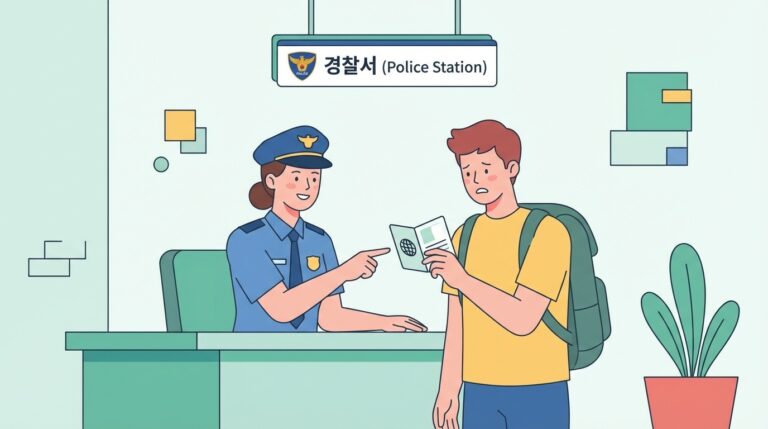
Phase 1: Empathy (Immersive Open)
Hello! Daily Hangul Editor here.
Imagine this: You are at Incheon International Airport, or maybe you just finished an amazing late-night shopping spree in Myeongdong. Your favorite K-Pop group’s song is playing in the background from a nearby cosmetics shop. You reach into your bag to grab your wallet and… your passport is gone. Your heart drops to your stomach.
In K-Dramas, this is usually the moment when a handsome stranger picks it up and hands it back to you in slow motion. But in reality? You need to find a police station or a Lost and Found center, fast.
Losing your passport in a foreign country is terrifying. I’ve had panicked students KakaoTalk me at 2 AM because they left their bag on the subway. The good news? Korea has one of the best lost-and-found systems in the world. Knowing just a few key phrases can turn a major crisis into a minor hiccup—and maybe even a good travel story.
Let’s learn exactly what to say so you can get back to enjoying your trip!
Phase 2: Deep Dive into Core Expressions
Here are the top 3 survival phrases you need when you’ve lost your passport.
1. 여권 잃어버렸어요. (I lost my passport.)
- Pronunciation: [yeogwon ileobeoryeosseoyo] (yeo-gwon / eel-o-bo-ryos-so-yo)
- Meaning: Literal: (I) lost (my) passport. / Real nuance: Help, I lost my passport!
- K-Culture Moment: You walk into a brightly lit Pachulso (파출소, local police box). The police officer looks up, and you deliver this line. It’s direct, polite, and immediately tells them the severity of the situation.
- Editor’s Insight: The verb ‘잃어버리다’ (to lose) sounds a bit long, but the ‘어요’ (eoyo) ending makes it perfectly polite for A2 beginners to use with strangers or officials.
- Situation Spectrum:
- Friends (Casual): ✅ (Drop the ‘요’ -> 여권 잃어버렸어!)
- Strangers/Staff (Semi-formal): ✅
- Police Officers/Elders (Formal): ✅ (Or use ‘잃어버렸습니다’ for extra formality)
- 🤔 Think About It: In Korean, we often omit the subject ‘I’ (저는) and the possessive ‘my’ (제). Why do you think Korean relies so heavily on context instead of specifying “I lost my passport”?
2. 분실물 센터가 어디예요? (Where is the Lost and Found?)
- Pronunciation: [bunsilmul senteoga eodiyeyo?] (boon-shil-mool / sen-to-ga / o-dee-ye-yo?)
- Meaning: Where is the Lost and Found center?
- K-Culture Moment: You are in a massive subway station like Gangnam or Hongdae. You realize you left your bag on the train. You run to the station office and ask this question.
- Editor’s Insight: Notice how Koreans use the English word ‘center’ (센터). Many modern facilities in Korea blend traditional vocabulary (분실물 – lost items) with English loanwords.
- Situation Spectrum:
- Friends (Casual): 🚫 (You wouldn’t ask a friend this unless they work there)
- Strangers/Staff (Semi-formal): ✅
- Police Officers/Elders (Formal): ✅
- 🤔 Think About It: “어디예요?” (Where is it?) is a magic phrase. You can put anything before it. 화장실(Bathroom), 출구(Exit), 경찰서(Police station). What’s the first place you’d search for using this phrase?
3. 도와주세요. (Please help me.)
- Pronunciation: [dowajuseyo] (do-wa-joo-se-yo)
- Meaning: Please help me.
- K-Culture Moment: This is the ultimate K-Drama survival phrase. Whether the protagonist is running from the villains or just locked out of their apartment, “도와주세요” is the go-to cry for help.
- Editor’s Insight: It sounds dramatic, but in a passport-loss situation, it effectively conveys urgency without being rude.
- Situation Spectrum:
- Friends (Casual): ✅ (도와줘! – dowajwo!)
- Strangers/Staff (Semi-formal): ✅
- Police Officers/Elders (Formal): ✅
Phase 3: Textbook vs. Real Korean
[Situation 1: Reporting the loss to the police]
* 📖 Textbook Korean: 제 여권을 분실하였습니다. (I have lost my passport. – Very stiff and formal)
* 🗣️ Real Korean: 저… 여권 잃어버렸어요. (Um… I lost my passport.)
* 💡 Why the difference?: Textbooks often teach formal written Korean (분실하다), but in spoken daily life, native speakers prefer the descriptive verb ‘잃어버리다’.
[Situation 2: Asking for the location]
* 📖 Textbook Korean: 분실물 취급소가 어디에 있습니까? (Where is the lost item handling office located?)
* 🗣️ Real Korean: 분실물 센터 어디예요? (Where’s the Lost and Found?)
* 💡 Why the difference?: Efficiency! Koreans love shortening phrases, and “어디예요?” is much faster to say than “어디에 있습니까?”
Bottom Note: As an A2 learner, keeping it simple and adding ‘요’ at the end of your verbs is your safest and most natural bet!
Phase 4: Cultural Context — K-Culture Deep Dive
4-1. Non-Verbal Communication (Nunchi in an Emergency)
When you approach a police officer or a station clerk, body language matters.
* Approach them with a slightly bowed head to show respect and urgency.
* When handing over any documents (like another ID or a form), use two hands. This is a core rule of Korean etiquette.
* Nunchi (눈치) tip: If the officer is dealing with a loud drunk person (a common Friday night scene!), wait patiently on the side until they make eye contact with you.
4-2. The “Safe Korea” Phenomenon & CCTV
Have you ever seen a TikTok video of someone leaving their laptop and wallet on a cafe table in Seoul to go to the restroom? It’s true—Korea is incredibly safe regarding personal belongings.
However, if your passport is gone, it usually means it fell out somewhere, rather than being stolen. Korea has an unbelievable network of CCTVs. When you report a lost item to the police, they will often check the CCTV of the area you last remember being in. So, try to remember the exact time and place!
Phase 5: Real-Life Roleplay Scenario
Setting: It’s 10:00 PM on a Friday. You are at the Itaewon Police Box (이태원 파출소). The neon lights are flashing outside, but inside, it’s quiet. Officer Kim is typing on his computer.
Characters:
* YOU (The Reader): An A2-level Korean learner, panicking because your flight is in two days.
* Officer Kim (35, Male): A friendly but tired local police officer who speaks a little English but appreciates your Korean.
Dialogue:
YOU: 저기요… 도와주세요.
(jeogiyo… dowajuseyo.)
[Excuse me… please help me.]
(🎭 Stage Direction: You walk up to the desk, looking worried.)
Officer Kim: 네, 무슨 일이세요? 👮♂️
(ne, museun iriseyo?)
[Yes, what’s the matter?]
YOU: 제 가방을 잃어버렸어요.
(je gabangeul ileobeoryeosseoyo.)
[I lost my bag.]
Officer Kim: 아이고, 어디서 잃어버리셨어요?
(aigo, eodiseo ileobeorysyeosseoyo?)
[Oh no, where did you lose it?]
YOU: 이태원역 지하철이요.
(itaewonyeok jihacheoriyo.)
[At Itaewon subway station.]
Officer Kim: 가방 안에 중요한 물건이 있었나요?
(gabang ane jungyohan mulgeoni isseonnayo?)
[Were there important items in the bag?]
🔀 Your Turn! How should you respond?
* A) “여권 잃어버렸어요.” (Simple and clear!)
* B) “제 여권을 분실하였습니다.” (Too robotic)
* C) “대박! 여권 없어!” (Way too casual, he is a police officer!)✅ Best Choice: A. It’s the most natural, urgent, and polite way to state the problem to an officer for your level.
YOU: 네… 여권 잃어버렸어요. 😭
(ne… yeogwon ileobeoryeosseoyo.)
[Yes… I lost my passport.]
Officer Kim: 여권이요? 알겠습니다. 신고서 써 주세요.
(yeogwoniyo? algetseumnida. singoseo sseo juseyo.)
[Your passport? Understood. Please write a report form.]
YOU: 네, 감사합니다.
(ne, gamsahamnida.)
[Yes, thank you.]
Officer Kim: 파파고 번역기 있으세요? 영어로 쓰셔도 됩니다.
(papago beonyeokgi isseuseyo? yeongeoro sseusyeodo doemnida.)
[Do you have the Papago translator? You can write in English.]
Phase 6: 10-Second Shadowing Drill
Read these out loud! Pay attention to the slashes for pauses and the emotion tags.
- 🥺 Desperate: 저기요… / 도와주세요! (jeogiyo… / dowajuseyo!)
- 😢 Worried: 제 여권을 / 잃어버렸어요. (je yeogwoneul / ileobeoryeosseoyo.)
- 🤔 Inquiring: 분실물 센터가 / 어디예요? (bunsilmul senteoga / eodiyeyo?)
Phase 7: K-Culture Mini Dictionary
| Korean | Romanization | English | Context |
|---|---|---|---|
| 파출소 | pachulso | Police Box | Small, local police stations found in every neighborhood. Your first stop for lost items. |
| 신분증 | sinbunjeung | ID Card | You will need another form of ID if you lose your passport. |
| 대사관 | daesagwan | Embassy | Where you must go to get an emergency passport. |
| 분실물 | bunsilmul | Lost Item | Often seen on signs in subway stations. |
| 눈치 | nunchi | Nunchi | The ability to read the room. Crucial when deciding who to ask for help. |
Phase 8: Traveler Survival Kit
🆘 Survival Phrase #1
* 🇰🇷 “대사관이 어디예요?” (daesagwani eodiyeyo?)
* 🗣️ Pronunciation: dae-sa-gwan-ee / o-dee-ye-yo?
* 📍 Where to use: Taxi, asking for directions on the street.
* 💡 Meaning: “Where is the embassy?” You will definitely need this to get a temporary passport!📌 Editor’s Travel Note
* Helpful Apps: Download Papago (for translation) and Naver Map or KakaoMap (Google Maps doesn’t work well for walking directions in Korea).
* Emergency Number: Call 112 for the police. For tourist help in English, call 1330 (Korea Travel Helpline – they are lifesavers!).
* Lost & Found Portal: Korea has a centralized police lost and found website called LOST112. Police officers will upload found items there!
Phase 9: Critical Thinking — “One Step Deeper”
🧠 Media vs. Reality (The K-Drama Illusion)
In K-Dramas, losing a valuable item often leads to a romantic encounter or a dramatic chase scene. In reality, Korea is famous for its “High-Trust Society” regarding personal belongings. You will see people leaving expensive iPhones on tables to reserve seats at cafes.
However, a passport is a highly sensitive government document. While a Korean citizen might ignore a dropped wallet, a passport requires official police intervention due to identity theft concerns. The juxtaposition of a society that doesn’t lock its bicycles but has a highly rigid bureaucratic system for official documents is a fascinating aspect of modern Korea.
💬 Your Turn: Does your country have a high-trust culture regarding lost items? What usually happens if you leave your bag in a cafe in your hometown? Let us know in the comments!
Phase 10: FAQ & Avoiding Mistakes
- Q: Can I just speak English to the police?
- A: Yes, somewhat! Most young officers know basic English or will immediately pull out their phones to use a translation app. But saying “여권 잃어버렸어요” first will earn you huge respect and speed up the process.
- Q: Is there a fee to use the Lost and Found?
- A: No! It is a completely free public service.
❌ Common Mistake #1: Saying “도와줘!” (dowajwo!) to a police officer or subway staff.
✅ Do this instead: Always use the polite “요” ending: “도와주세요!” (dowajuseyo!). Dropping the ‘요’ makes it informal, which is disrespectful to officials.
Phase 11: Summary & Action Items
One-Liner Summary: When panic hits because you lost your passport, take a deep breath and say, “여권 잃어버렸어요” (I lost my passport).
Action Mission 3 Steps:
* 🥉 Bronze (Solo): Look in the mirror with a sad face and practice saying “여권 잃어버렸어요” three times.
* 🥈 Silver (Online): Write down “도와주세요” in your phone’s notepad so you can point to it in an emergency.
* 🥇 Gold (Real Life): Next time you are at a Korean subway station, try to spot the sign that says “분실물 센터” (Lost and Found)!
K-Culture Mission:
Go to YouTube and search for “Korean Police CCTV lost item.” You’ll find heartwarming (and real!) news clips of Korean police tracking down lost bags for tourists using their amazing camera network.
Phase 12: Quiz — Interactive Challenge
1. Situational Judgment: You are at a cafe and realize your wallet is missing. You approach the cafe staff. What is the most natural thing to say?
* A) 지갑 잃어버렸어요. (jigap ileobeoryeosseoyo)
* B) 제 지갑을 분실하였습니다. (je jigabeul bunsilhayeotseumnida)
* C) 지갑이 어디예요? (jigabi eodiyeyo?)
(Answer: A. B is too formal, C means “Where is the wallet?” which implies the staff knows where it is!)
2. True or False — K-Culture Edition:
If you lose an item on the Korean subway, it is gone forever.
(Answer: False! The subway lost and found centers in Seoul are incredibly efficient and recover thousands of items daily.)
3. Fill in the Blank:
Where is the lost and found center?
분실물 센터가 ( _______ )?
(Answer: 어디예요 – eodiyeyo)
Frequently Asked Questions (FAQ)
Q: What does "여권 잃어버렸어요. (I lost my passport.)" mean in Korean and how do you pronounce it?
A: In Korean, "여권 잃어버렸어요. (I lost my passport.)" is pronounced [yeogwon ileobeoryeosseoyo] and means: Literal: (I) lost (my) passport. / Real nuance: Help, I lost my passport!
Q: What does "분실물 센터가 어디예요? (Where is the Lost and Found?)" mean in Korean and how do you pronounce it?
A: In Korean, "분실물 센터가 어디예요? (Where is the Lost and Found?)" is pronounced [bunsilmul senteoga eodiyeyo?] and means: Where is the Lost and Found center?
Q: What does "도와주세요. (Please help me.)" mean in Korean and how do you pronounce it?
A: In Korean, "도와주세요. (Please help me.)" is pronounced [dowajuseyo] and means: Please help me.







