

Phase 1: Empathy (The K-Culture Cold Open)
Hello! I’m the lead editor at Daily Hangul.
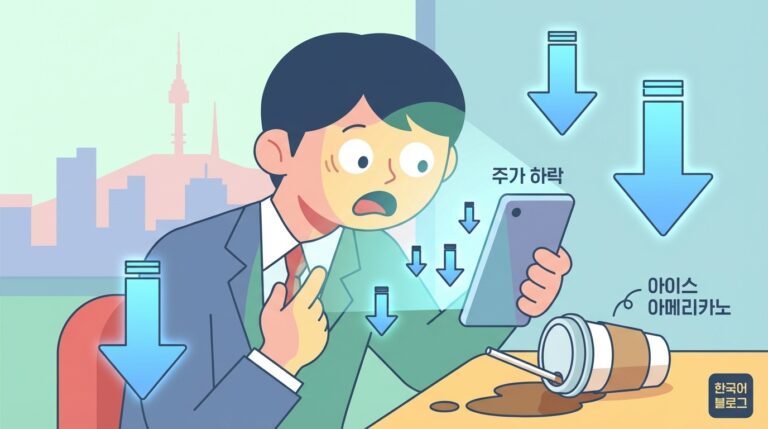
Picture this: You are sitting in a bustling cafe in Yeouido (the Wall Street of Seoul). At the table next to you, a young office worker in a crisp suit is staring blankly at his smartphone. He lets out a deep, soul-crushing sigh, muttering something under his breath. You glance at his screen and see it’s completely covered in blue.
Wait, blue? If you’re from the US or Europe, you might think, “Blue is good, right? Or maybe green?” Nope. Welcome to the Korean stock market, where red means profit (up) and blue means loss (down). That poor guy’s portfolio is currently bleeding out in blue.
Investing has become a massive part of modern Korean culture, especially for the MZ generation trying to navigate a challenging economy. But the vocabulary they use isn’t taught in standard textbooks. If you tell a Korean friend, “My stocks decreased in value,” you’ll sound like a news anchor. But if you know how to use the real survival slang of the Korean stock market, they’ll instantly treat you like a true insider—a fellow survivor of the financial battlefield.
Let’s dive into the highly emotional, incredibly witty Korean expressions used to cope with market volatility!
Phase 2: Core Expressions Deep Dive
Here are the top 3 expressions Koreans actually use when the market goes crazy.
1. 떡락 (Tteok-rak)
- Pronunciation: [Tteok-rak] (The double ‘ㄸ’ sounds like a sharp, tense ‘d’ sound, like the ‘t’ in “stop”.)
- Meaning: (Literal) Rice cake fall vs. (Real nuance) A massive market crash; plummeting.
- K-Culture Moment: You open your brokerage app on a Monday morning after bad global news. The chart is a straight line down. You take a screenshot, send it to your group chat, and just type: “와… 오늘 테슬라 개떡락…” (Wow… Tesla completely crashed today…)
- Editor’s Insight: The opposite is 떡상 (Tteok-sang – skyrocketing). The origin is debated, but many believe ‘떡’ (rice cake) is used as an intensifier here, meaning “extremely” or “suddenly.” It captures that heavy, dramatic feeling of a drop.
- Situation Spectrum:
- Friends (Casual): ✅
- Close Coworkers (Semi-formal): ⚠️ (Okay if they invest too)
- Boss/Elders (Formal): 🚫
- 🤔 Think About It: Why do Koreans use food-related prefixes like ‘떡’ (rice cake) to emphasize sudden, extreme changes? Does your language have a similar physical metaphor for a stock crash?
2. 존버 (Jon-beo)
- Pronunciation: [Jon-beo] (Sounds like ‘John Bough’)
- Meaning: (Literal) F*cking holding out vs. (Real nuance) HODL (Holding On for Dear Life); refusing to sell at a loss.
- K-Culture Moment: A character in a K-Drama is drinking soju alone at a Pojangmacha (tent bar). His friend tells him to sell his failing crypto. He slams his glass down and yells, “안 팔아! 무조건 존버야!” (I’m not selling! I’m HODLing no matter what!)
- Editor’s Insight: This is an abbreviation of “존나 버티다” (Holding out fiercely). Note that “존나” is a slang/profanity (similar to fcking). While “존버” has become mainstream and is even used in broadcasting with captions, you should *never use it in professional settings.
- Situation Spectrum:
- Friends (Casual): ✅
- Close Coworkers (Semi-formal): ⚠️
- Boss/Elders (Formal): 🚫
- 🤔 Think About It: “존버” reflects the desperation of retail investors. What does it say about the emotional toll of investing that the most popular term for “waiting” includes a curse word?
3. 물타기 (Mul-ta-gi)
- Pronunciation: [Mul-ta-gi] (Sounds like ‘Mool-tah-gee’)
- Meaning: (Literal) Riding the water / Adding water vs. (Real nuance) Averaging down (buying more shares of a losing stock to lower the average cost).
- K-Culture Moment: You’re having lunch with colleagues. One says his Samsung stock is down 20%. The other colleague casually slurps his spicy stew and advises, “지금 쌀 때 물타기 해.” (Average down now while it’s cheap.)
- Editor’s Insight: Imagine you have a soup that’s way too salty. What do you do? You add water (물타기) to dilute it. Koreans use this exact metaphor for diluting your financial losses by buying the dip. It’s brilliant and incredibly visual!
- Situation Spectrum:
- Friends (Casual): ✅
- Close Coworkers (Semi-formal): ✅
- Boss/Elders (Formal): ⚠️ (Better to use “추가 매수” – additional purchase)
- 🤔 Think About It: The concept of “adding water” to soften a blow is deeply embedded in Korean daily life. Have you ever tried to “average down” in a real-life situation outside of stocks?
Phase 3: Textbook vs. Real Korean
Let’s see how a C1-level learner can upgrade their textbook phrases into native-level slang.
[Situation 1: Describing a painful portfolio]
* 📖 Textbook Korean: 제 주식 가치가 많이 하락했습니다. (The value of my stocks has declined significantly.)
* 🗣️ Real Korean: 내 계좌 완전 파란불이야… 녹고 있어. (My account is totally a blue light… it’s melting.)
* 💡 Why the difference?: Koreans love visual and sensory metaphors. “Melting” (녹다) perfectly describes the helpless feeling of watching your money disappear daily.
[Situation 2: Deciding what to do during a crash]
* 📖 Textbook Korean: 손실이 크지만 계속 보유하겠습니다. (The loss is large, but I will continue to hold.)
* 🗣️ Real Korean: 어차피 마이너스라 팔지도 못해. 강제 존버야. (It’s in the minus anyway so I can’t even sell. It’s a forced HODL.)
* 💡 Why the difference?: “강제” (forced) is often added to words to show a lack of agency, humorously deflecting the blame from one’s own bad investment choices.
Phase 4: Cultural Context — K-Culture Deep Dive
4-1. Non-Verbal Cues (The “Nunchi” of Investing)
When the market is highly volatile, the office atmosphere changes. If you see your Korean colleagues aggressively swiping down on their phones (refreshing the brokerage app) and sighing quietly, use your Nunchi (눈치). This is not the time to brag about your recent crypto gains. Keep a straight face and perhaps quietly hand them an iced americano.
4-2. K-Culture Link: The “Donghak Ant Movement”
In 2020, during the global pandemic crash, Korean retail investors banded together to buy domestic stocks, preventing the market from collapsing. The media dubbed this the 동학개미운동 (Donghak Ant Movement), a clever historical pun on an 1894 peasant revolution.
In Korea, retail investors are called 개미 (ants). Why? Because like ants, they are small, work extremely hard, and often get crushed by foreign institutions or whales. But together, they are a force of nature. If you understand the “Ant” identity, you understand the soul of the Korean working class.
Phase 5: Real-life Roleplay Scenario
Setting: It’s Friday, 6:00 PM. The Korean stock market just closed after a brutal week. You are at a smoky Samgyeopsal (pork belly) restaurant in Gangnam with your Korean coworker, Minsu. Soju glasses are filled. The vibe is heavy.
Characters:
– YOU: An expat working in Seoul, an intermediate-advanced Korean speaker.
– Minsu (32): Your friendly coworker who invests heavily in tech stocks.
Dialogue:
Minsu: 하아… (한숨) 오늘 진짜 술 당긴다. 짠하자.
(Haa… oneul jinjja sul dang-ginda. Jjanhaja.)
[English: Sigh I really crave alcohol today. Let’s cheers.]
(🎭 Stage Direction: Minsu downs his soju in one shot and stares into the empty glass.)
YOU: 민수 씨, 표정이 왜 그래요? 무슨 일 있어요?
(Minsu ssi, pyojeong-i wae geuraeyo? Museun il isseoyo?)
[English: Minsu, why the long face? Is something wrong?]
Minsu: 내 주식 계좌 봤어? 완전 새파랗게 질렸어. 떡락도 이런 떡락이 없네.
(Nae jusik gyejwa bwasseo? Wanjeon saeparahge jillyeosseo. Tteongnakdo ireon tteongnagi eomne.)
[English: Did you see my stock account? It turned completely blue. I’ve never seen a crash like this.]
YOU: 헐, 테슬라 많이 떨어졌던데. 어떡해요?
(Heol, teseulla mani tteoreojyeotdeonde. Eotteokaeyo?)
[English: OMG, I saw Tesla dropped a lot. What are you gonna do?]
Minsu: 몰라, 지금 팔면 손해가 너무 커. 그냥 앱 지우고 존버하려고.
(Molla, jigeum palmyeon sonhaega neomu keo. Geunyang aep jiugo jonbeoharyeogo.)
[English: I don’t know, if I sell now the loss is too huge. I’m just gonna delete the app and HODL.]
🔀 Your Turn! How should you respond?
– A) “빨리 손절하는 게 낫지 않을까요?” (Wouldn’t it be better to cut your losses quickly?)
– B) “맞아요, 이럴 땐 강제 존버가 답이죠. 제가 고기 쏠게요!” (You’re right, forced HODL is the answer right now. I’ll pay for the meat!)
– C) “아싸! 저는 수익 났는데!” (Yay! I made a profit though!)✅ Best Choice: B. Empathy is everything in Korean culture. Agreeing with his “forced HODL” and offering to buy dinner (고기 쏜다) will earn you a friend for life.
⚠️ Choice A Analysis: “손절” (cutting losses) is logical, but offering unsolicited financial advice to an emotional investor lacks nunchi.
🚫 Choice C Analysis: Do you want to be left alone at the restaurant? Never flex when someone is bleeding blue!
Phase 6: 10-Second Shadowing Drill
Practice this sentence to sound like a true Seoulite who just checked their portfolio. Pay attention to the deep sigh at the start.
😩 하아… / 내 계좌 / 완전 파란불이네. / 지금 / 물타기 해야 하나?
(Haa… / nae gyejwa / wanjeon paranburine. / jigeum / multagi haeya hana?)
Sigh… my account is totally blue. Should I average down right now?
Phase 7: K-Culture Mini Dictionary (Investing Slang Edition)
| Korean | Romanization | English | Cultural Context |
|---|---|---|---|
| 개미 | gaemi | Ants (Retail Investors) | Represents individual investors. Foreign/institutional investors are usually the “predators.” |
| 파란불 | paranbul | Blue light | A stock chart showing a decrease in price. (Opposite of the US market) |
| 빨간불 | ppalganbul | Red light | A stock chart showing an increase in price. Red = Passion/Wealth in Asian markets. |
| 멘붕 | men-bung | Mental Breakdown | Abbreviation of 멘탈 붕괴. Used when the market crashes unexpectedly. |
| 손절 | son-jeol | Cutting losses | Originally investing slang, now used in daily life for “cutting toxic people out of your life.” |
Phase 8: Traveler Survival Kit
Even if you aren’t trading stocks while traveling, market volatility affects exchange rates (환율), which affects your trip!
🆘 Survival Phrases for the Volatile Economy
– 🇰🇷 “환율이 많이 올랐네요.” (Hwanyuri mani ollanneyo.)
– 🗣️ English Guide: The exchange rate has gone up a lot.
– 📍 Where to use: Banks, currency exchange booths in Myeongdong, or when chatting with local merchants.
– 💡 Pro Tip: A “high exchange rate” (high USD/KRW) is actually great for travelers bringing US Dollars or Euros, but bad for Koreans buying imported goods!📌 Editor’s Travel Note
– Card Heaven: Korea is practically a cashless society. You don’t need to exchange massive amounts of cash unless you’re buying street food at Gwangjang Market.
– News on the Subway: If you look at the screens on the Seoul Metro, you’ll see running tickers with stock numbers. Remember: ▲ in Red is GOOD, ▼ in Blue is BAD.
Phase 9: Critical Thinking — “One Step Deeper”
Society & Economy: Why is Everyone an “Ant”?
If you watch recent K-Dramas or reality shows, you’ll notice an obsession with investing among young people in their 20s and 30s. This isn’t just a fun hobby; it’s a survival tactic. Due to historically high housing prices in Seoul and stagnant wages, many young Koreans feel that saving money the traditional way (putting it in a bank) will never allow them to buy a home or achieve financial freedom.
Therefore, they turn to the stock market or cryptocurrency as their only “ladder” for class mobility. When a Korean friend says they are “HODLing” (존버), it carries a deeper socio-economic weight—it’s a reflection of a generation holding onto the hope of a better future despite systemic hurdles.
💬 Your Turn: How does your generation in your home country view investing? Is it seen as a careful retirement strategy, or a desperate attempt to build wealth? Share your thoughts in the comments!
Phase 10: FAQ & Avoiding Misunderstandings
Q: Can I use “존버 (Jonbeo)” with my boss?
NO. Even though it’s used casually on the internet, the root of the word contains profanity. If your boss asks about your project, don’t say “존버하겠습니다” (I will f*cking hold on). Instead, say “끝까지 버텨보겠습니다” (I will persevere until the end).
Q: Wait, why is RED good and BLUE bad?
In Western markets (like Wall Street), red implies debt or blood, while green is money. However, in East Asian cultures (Korea, China, Japan), Red is a highly auspicious color representing prosperity, fire, and rising energy. Blue represents coldness, water, and falling temperatures.
❌ Common Mistake #1: Saying “My account is in the red” to mean you lost money. If you literally translate that to “빨간불이야”, a Korean will congratulate you for getting rich!
✅ Do this instead: To say you lost money, always say “파란불이야” (It’s a blue light) or “마이너스야” (It’s in the minus).
Phase 11: Summary & Action Items
🎯 One-Liner Summary: To survive the Korean stock market conversations, remember that red is good, blue is bad, and when things crash (떡락), the only answer is to average down (물타기) or hold on for dear life (존버)!
🚀 Action Mission:
– 🥉 Bronze (Solo): Say “하… 완전 파란불이네, 강제 존버야.” out loud 3 times with a dramatic sigh.
– 🥈 Silver (Online): Go to Naver Finance (네이버 금융), click on any major stock, and look at the color of the numbers. Red or blue?
– 🥇 Gold (Real World): The next time you are having a tough time with a difficult task (like studying Korean!), tell your study partner: “우리 포기하지 말고 존버합시다!” (Let’s not give up and HODL!)
🔎 K-Culture Mission:
Check out the “종목토론실” (Stock Discussion Board) on Naver Finance for a famous stock like Samsung Electronics. You don’t need to understand everything—just count how many times you see the words 떡상, 떡락, and 존버.
Did you learn something new today? What’s your favorite slang term from this list? Let me know in the comments below! 👇
Phase 12: Quiz — Interactive Challenge
1. Situational Judgment: Your Korean friend texts you a screenshot of their stock portfolio. Every single number is highlighted in BLUE. What should you reply?
– A) 우와! 축하해! 떡상했네! (Wow! Congrats! It skyrocketed!)
– B) 파란불이네… 물타기 할 돈은 있어? (It’s blue… do you have money to average down?)
– C) 나도 빨간불인데 기분 좋다! (Mine is red too, I feel great!)
2. True or False – K-Culture Edition:
In Korea, retail investors (ordinary people trading stocks) are called “Spiders” (거미) because they weave complex webs of trades.
3. Fill in the Blank:
When a stock price drops dramatically out of nowhere, you can say: “주식이 갑자기 ______ 했어!”
– A) 떡상 (Tteoksang)
– B) 존버 (Jonbeo)
– C) 떡락 (Tteokrak)
🚨 Click here for the answers!
1. B – Blue means loss in Korea. Congratulating them (A) or bragging about your red portfolio (C) will end your friendship!
2. False – They are called “Ants” (개미 – Gaemi) because they are hardworking and numerous.
3. C – 떡락 (Tteokrak) means a sudden crash or plummet.
Frequently Asked Questions (FAQ)
Q: What does "떡락 (Tteok-rak)" mean in Korean and how do you pronounce it?
A: In Korean, "떡락 (Tteok-rak)" is pronounced [Tteok-rak] and means: (Literal) Rice cake fall vs. (Real nuance) A massive market crash; plummeting.
Q: What does "존버 (Jon-beo)" mean in Korean and how do you pronounce it?
A: In Korean, "존버 (Jon-beo)" is pronounced [Jon-beo] and means: (Literal) F*cking holding out vs. (Real nuance) HODL (Holding On for Dear Life); refusing to sell at a loss.
Q: What does "물타기 (Mul-ta-gi)" mean in Korean and how do you pronounce it?
A: In Korean, "물타기 (Mul-ta-gi)" is pronounced [Mul-ta-gi] and means: (Literal) Riding the water / Adding water vs. (Real nuance) Averaging down (buying more shares of a losing stock to lower the average cost).







