Phase 1: Empathy & Hook (Welcome to the Real Korea!)
Hello! I’m your lead editor at Daily Hangul.
Let’s set the scene: You’ve just arrived in Korea. You’re sitting in your cute Airbnb or new officetel, and you’ve just experienced the magic of Korean delivery (배달 – baedal). You devoured a massive bowl of spicy Tteokbokki and crispy fried chicken. Life is good.
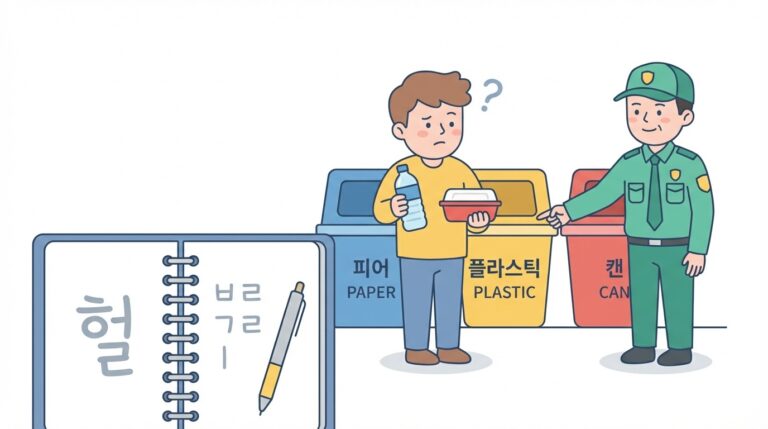
But then, you look at the mountain of plastic containers left on your table. You pack them into a bag, walk down to the basement, and suddenly… you freeze.
You are standing in front of the 분리수거장 (Bun-li-su-geo-jang – Recycling Area). There are 10 different bins. A friendly but stern-looking Ahjussi (the building security guard) is watching you. You freeze. In K-Dramas, the handsome lead never has to wash the red chili oil out of a plastic delivery box. But in reality? Korea has one of the strictest recycling systems in the world!
If you don’t know the basics of Korean Garbage Disposal (쓰레기 배출), you might get scolded, or worse—fined! But don’t worry. As your local culture navigator, I’m here to give you the exact A1-level survival phrases you need to conquer the Korean trash system like a true insider. Let’s dive in!
Phase 2: Deep Dive into Core Expressions
1. 재활용 (Recycling)
- Pronunciation: [jae-hwal-yong] / Sounds like: “Jay-hwal-yong” (Imagine a guy named Jay playing ping-pong!)
- Meaning: Recycling (Literal: Re-use)
- K-Culture Moment: You’re carrying a pile of empty banana milk bottles and soju bottles. Your Korean roommate sees you and says, “Wait, that’s jae-hwal-yong!”
- Editor’s Insight: This is the golden word. If you hold up an item and say this with a questioning look, Koreans will immediately point you to the right bin.
- Situation Spectrum:
- Casual with friends: ✅
- Semi-formal (Convenience store worker): ✅
- Formal (Building Manager/Security Guard): ✅
- 🤔 Think About It: Korea recycles over 80% of its waste. Why do you think a country with such a fast-paced “Pali-Pali” (hurry up) culture takes so much time to meticulously separate trash?
2. 일반 쓰레기 (General Waste)
- Pronunciation: [il-ban sseu-le-gi] / Sounds like: “Eel-bahn soo-reh-gee” (Make a slightly disgusted face when saying ‘sseu’)
- Meaning: General trash (Non-recyclable)
- K-Culture Moment: You try to throw away a greasy, unwashed pizza box into the paper bin. The building manager runs over waving his hands: “No, no! Il-ban sseuregi!”
- Editor’s Insight: In Korea, general trash CANNOT be thrown in random black bags. You MUST buy a specific standardized bag from the government (more on that later!).
- Situation Spectrum:
- Casual with friends: ✅
- Semi-formal: ✅
- Formal: ✅
- 🤔 Think About It: Food waste (음식물 쓰레기) is completely separate from general waste in Korea. How is food waste handled in your home country?
3. 쓰레기 봉투 주세요 (Please give me a garbage bag)
- Pronunciation: [sseu-le-gi bong-tu ju-se-yo] / Sounds like: “Soo-reh-gee bong-too joo-say-yo”
- Meaning: Please give me a trash bag.
- K-Culture Moment: It’s 11 PM. You walk into a brightly lit GS25 convenience store. You need the magical, government-issued plastic bag to throw away your room’s trash.
- Editor’s Insight: This is an absolute survival phrase. When you say this, the cashier will ask you what size (usually 10 liters or 20 liters) you need. Just hold up 10 or 20 on your fingers!
- Situation Spectrum:
- Casual: 🚫 (Don’t use ‘juseyo’ with close friends)
- Semi-formal (Cashier/Store owner): ✅
- Formal: ⚠️
Phase 3: Textbook vs. Real Korean
[Situation 1: Asking where to throw something away]
* 📖 Textbook Korean: 플라스틱은 어디에 버립니까? (Where do I dispose of the plastic?)
* 🗣️ Real Korean: 이거 플라스틱이에요? (Is this plastic?) OR 여기 버려요? (Do I throw it here?)
* 💡 Why the difference?: Everyday Korean relies heavily on context and pointing. You don’t need a full grammatical sentence; holding the item and asking “Here?” (여기? – yeogi?) with the polite ending “~요 (~yo)” is highly efficient.
[Situation 2: Buying the specific trash bag]
* 📖 Textbook Korean: 종량제 봉투 20리터 한 장 주십시오. (Please give me one 20-liter volume-based waste fee system bag.)
* 🗣️ Real Korean: 쓰레기 봉투 20리터 주세요. (20-liter trash bag, please.)
* 💡 Why the difference?: “종량제” (jong-lyang-je) is the official, legal term, but it’s hard to pronounce even for Koreans! Everyone just calls it a “trash bag” (쓰레기 봉투).
Phase 4: Cultural Context — K-Culture Deep Dive
4-1. Non-verbal Element: The Power of Nunchi at the Bins
When you enter the recycling area, don’t just toss your bag. Engage your 눈치 (Nunchi – situational awareness). Look at what your neighbors are doing. Are they taking the labels off water bottles? Yes, they are. In Korea, you must remove the plastic label from PET bottles and crush them before recycling. If you just stand there looking confused, often a kind (or frustrated) neighbor will step in to help you.
4-2. K-Food Connection: The “Delivery Wash”
Korea’s delivery app culture (Baemin, Yogiyo) is world-class. You can get hot soup delivered in a plastic bowl. But here is the critical K-Food rule: Stained plastic cannot be recycled.
If you order spicy Maratang or Jjamppong, the red chili oil will stain the white plastic bowl. You must wash it with dish soap! If it’s still red, it is no longer Jae-hwalyong (Recycling)—it becomes Il-ban sseuregi (General waste). Drama characters never do the dishes, but we mortals must!
Phase 5: Real-life Roleplay Scenario
Setting: A local convenience store (CU) at 9 PM. You just moved into your new officetel and realized you have nowhere to put your trash. You approach the counter where a part-time worker is standing.
Characters:
* YOU: An absolute beginner in Korean, armed with today’s lesson.
* Min-ji (21, Cashier): Friendly, but wants to get back to watching a K-Drama on her phone.
Dialogue:
YOU: 안녕하세요! (an-nyeong-ha-se-yo!)
[Hello!]
Min-ji: 네, 어서오세요. (ne, eo-seo-o-se-yo.)
[Yes, welcome.]
YOU: 저기… 쓰레기 봉투 주세요. (jeo-gi… sseu-le-gi bong-tu ju-se-yo.)
[Excuse me… Garbage bag, please.]
Min-ji: (Pulls out a drawer) 몇 리터 드릴까요? (myeot li-teo deu-lil-kka-yo?)
[How many liters should I give you?]
YOU: (Holding up 10 fingers) 10… 10리터 주세요. (sip li-teo ju-se-yo.)
[10… 10 liters, please.]
Min-ji: 일반이요? 음식물이요? (il-ban-i-yo? eum-sik-mul-i-yo?)
[General or Food waste?]
(🎭 Stage Direction: Min-ji holds up a white bag and a yellow bag.)
🔀 It’s your turn! How do you answer?
* A) “일반 쓰레기 주세요.” (General waste, please.)
* B) “재활용 주세요.” (Recycling, please.)
* C) “김치 주세요.” (Kimchi, please.)✅ Best Choice: A — You need the general trash bag for your tissues and wrappers!
⚠️ Choice B Analysis: You don’t put recycling in a purchased bag! You put recycling directly into the bins downstairs or in clear/translucent plastic bags.
Min-ji: 네, 350원입니다. 봉투 필요하세요? (ne, sam-baek-o-sib-won-im-ni-da. bong-tu pi-lyo-ha-se-yo?)
[Okay, that’s 350 won. Do you need a plastic shopping bag?]
YOU: 아뇨, 괜찮아요. 감사합니다! (a-nyo, gwaen-chan-a-yo. gam-sa-ham-ni-da!)
[No, it’s okay. Thank you!]
Phase 6: 10-Second Shadowing Drill
Let’s practice the most important question when you are confused holding a piece of trash!
Listen to the rhythm and try to match it.
🥺 이거 / 재활용 / 맞아요? (i-geo / jae-hwal-yong / ma-ja-yo?)
(Is this recycling?)
- Intonation Tip: Raise your pitch at the very end on “요? (yo?)” to make it a question. Put a little helpless emotion (🥺) into it, and Koreans will gladly help you!
Phase 7: K-Culture Mini Dictionary
| Korean | Romanization | English | Context |
|---|---|---|---|
| 눈치 | nunchi | Situational awareness | The essential Korean social skill of “reading the room.” Crucial at the recycling bins! |
| 배달 | baedal | Delivery | Korea’s massive food delivery culture. Creates a lot of plastic waste. |
| 분리수거 | bun-li-su-geo | Separating trash | The act of sorting recycling. You will see this word on signs everywhere. |
| 음식물 쓰레기 | eum-sik-mul sseu-le-gi | Food waste | Must be separated completely! You usually buy a small yellow or green bag specifically for this. |
Phase 8: Traveler Survival Kit
Even if you’re just visiting Korea and staying in a hotel or walking around Myeongdong, garbage disposal affects you! Here is why: There are almost NO public trash cans on the street!
🆘 Survival Phrases for Travelers
* 🇰🇷 “쓰레기통 어디예요?” (sseu-le-gi-tong eo-di-ye-yo?)
* 🗣️ Pronunciation: Soo-reh-gee-tong uh-dee-yay-yo?
* 📍 Where to use: Convenience stores, cafes, subway stations.
* 💡 Pro Tip: If you buy a street food skewer, give the empty stick back to the vendor! They will throw it away for you.📌 Editor’s Travel Note
* Cafes: If you drink coffee inside a cafe, you MUST separate your leftover ice/drink, plastic cup, and paper sleeve into different slots at the cafe’s return station.
* Restrooms: In some older subway stations or traditional markets, you might see signs asking you to throw toilet paper in the trash can, NOT the toilet. (Though modern places allow flushing!). Always check the signs!
Phase 9: Critical Thinking — “One Step Deeper”
Global Era & Environmental Identity
Korea is a country of paradoxes. On one hand, we have the “Pali-Pali” (hurry up) culture where anything from iced coffee to a full Korean BBQ meal can be delivered to your door in 20 minutes, wrapped in layers of plastic. On the other hand, we have a highly collective, community-driven culture that demands every citizen wash their plastics, remove bottle labels, and buy specific bags to fund local waste management. The recycling room is where modern convenience meets traditional collective responsibility. If you don’t recycle, you aren’t just harming the earth; you are breaking the “rules of the village.”
💬 Your Turn: How is recycling viewed in your culture? Is it an individual choice or a strict community rule? Let us know in the comments!
Phase 10: FAQ & Avoiding Common Mistakes
Q: Can I use a regular plastic bag from the supermarket as my trash bag?
No! This is illegal for general waste. You must use the officially purchased “종량제 봉투” (Standardized bag). However, you can use regular clear bags for recycling.
Q: Are chicken bones considered food waste?
No! This shocks many foreigners. Hard things that animals cannot digest (chicken bones, onion skins, eggshells, tea bags) are actually 일반 쓰레기 (General Waste)!
❌ Common Mistake #1: Throwing leftover soup into the sink or regular trash.
✅ Do this instead: Strain the solids into your food waste bag (음식물 쓰레기), and pour only the liquid down the drain.
Phase 11: Summary & Action Items
One-Liner Summary: To survive Korean trash disposal, remember to separate Jae-hwalyong (Recycling), wash your plastic delivery bowls, and buy your Sseuregi bongtu (Trash bags) at the convenience store!
Action Mission 3-Step Challenge:
* 🥉 Bronze (Solo): Look at your current trash can. Point to a plastic bottle and say “재활용 (Jae-hwal-yong)” out loud.
* 🥈 Silver (Online): Look up the specific color of the standardized trash bag for your Seoul district (e.g., Gangnam is different from Mapo!) and share it in our community.
* 🥇 Gold (Real Life): Go to a Korean convenience store and successfully buy a 10-liter trash bag using “쓰레기 봉투 10리터 주세요.”
K-Culture Mission:
The next time you watch a K-Drama, look closely at the background when characters are walking outside at night. You will almost always see designated piles of colorful garbage bags leaning against a street pole. Spot them!
Phase 12: Quiz — Interactive Challenge
1. Fill in the Blank:
You are at the convenience store. You need a bag for your general trash.
“저기요, 일반 ______ 봉투 주세요.”
(Hint: The Korean word for trash)
2. True or False — K-Culture Edition:
Pork bones and clam shells should be put into the Food Waste (음식물 쓰레기) bag. (T / F)
3. Situational Judgment:
You are holding a greasy pizza box with melted cheese stuck to the cardboard. Where does it go?
* A) 재활용 (Paper Recycling)
* B) 일반 쓰레기 (General Waste)
* C) 음식물 쓰레기 (Food Waste)
(Answers: 1. 쓰레기, 2. False! Bones and shells are General Waste, 3. B! Greasy paper cannot be recycled.)
Did you get them all right? You are now ready to take out the trash in Korea like a local! See you in the next lesson! 👋
Frequently Asked Questions (FAQ)
Q: What does "재활용 (Recycling)" mean in Korean and how do you pronounce it?
A: In Korean, "재활용 (Recycling)" is pronounced [jae-hwal-yong] and means: Recycling (Literal: Re-use)
Q: What does "일반 쓰레기 (General Waste)" mean in Korean and how do you pronounce it?
A: In Korean, "일반 쓰레기 (General Waste)" is pronounced [il-ban sseu-le-gi] and means: General trash (Non-recyclable)
Q: What does "쓰레기 봉투 주세요 (Please give me a garbage bag)" mean in Korean and how do you pronounce it?
A: In Korean, "쓰레기 봉투 주세요 (Please give me a garbage bag)" is pronounced [sseu-le-gi bong-tu ju-se-yo] and means: Please give me a trash bag.