

Phase 1: Empathy (The K-Culture Cold Open)
Hello! I am the Senior Editor at Daily Hangul.
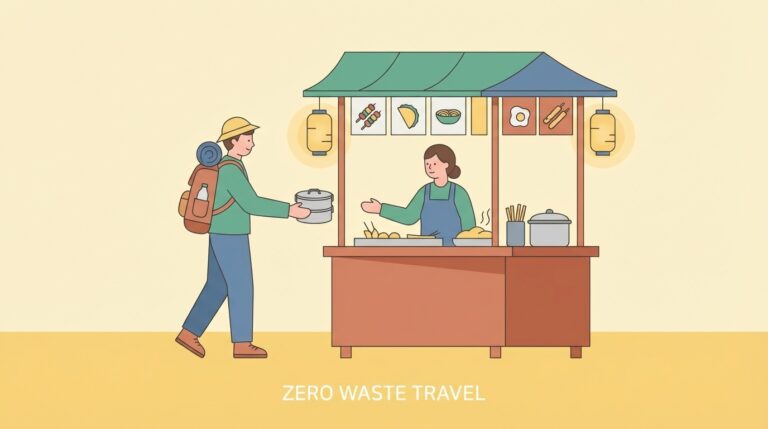
Picture this: You are standing in front of a bustling street food stall in Myeongdong. The heavenly scent of spicy Tteokbokki fills the air. The Ajumma (stall owner) is moving at lightning speed—the legendary Korean Pali-pali (hurry-hurry) pace. She grabs a plastic bag, ready to scoop your food into it. You brought your own glass container to practice ‘Zero Waste,’ but suddenly, the sheer pressure of the line behind you and her rapid-fire movements make your mind go blank.
How do you stop this highly efficient, plastic-heavy assembly line without sounding rude or causing a bottleneck?
In Korea, there’s a brilliant eco-movement called the Yonggi-nae (용기내) Campaign. It is a genius pun: Yonggi means both ‘courage’ and ‘container.’ It literally asks you to ‘take courage’ to bring your ‘container.’ At the C2 level, fluency isn’t just about flawless grammar; it is about having the sociolinguistic finesse—the Nunchi—to ask for a favor that disrupts the collective flow. Today, we’re going to master the high-level art of polite disruption for the planet.
Phase 2: Core Expressions Deep Dive
Let’s look at the sophisticated ways to negotiate Zero Waste in Korea without stepping on anyone’s toes.
1. 사장님, 번거로우시겠지만 이 용기에 담아 주실 수 있나요?
- Pronunciation: sajangnim, beongeorousigetjiman i yonggie dama jusil su innayo?
- Sound-alike guide: sah-jang-nim, bun-guh-row-woo-she-get-jee-mahn ee yong-gee-eh dahm-ah joo-shil soo in-nah-yo?
- Meaning: (Literal) Boss, though it might be cumbersome, could you put it in this container? -> (Real nuance) I know this breaks your routine and I’m sorry for the hassle, but could you please use my personal container?
- K-Culture Moment: This is the ultimate ‘Nunchi-saver’ sentence. In a busy Gukbap (soup and rice) restaurant, handing over a Tupperware instead of taking the standard takeout packaging disrupts the owner’s workflow. The word 번거로우시겠지만 (although it is a hassle for you) is a magical phrase that instantly softens the other person’s heart.
- Editor’s Insight: The key here is the pre-apology. By acknowledging that you are causing an inconvenience, you show high emotional intelligence.
- Situation Spectrum:
- Casual (Friends): 🚫 (Too formal)
- Semi-formal (Café staff): ✅
- Formal (Busy restaurant owners, elders): ✅
- 🤔 Think About It: Korean culture heavily values group harmony over individual disruption. Why is acknowledging someone else’s ‘hassle’ (번거로움) considered a prerequisite for making a special request? Does your native language have a similar softening buffer?
2. 저, 일회용품 줄이기 하고 있어서요. 봉투는 괜찮습니다.
- Pronunciation: jeo, ilhoeyongpum juligi hago isseoseoyo. bongtuneun gwaenchanseumnida.
- Sound-alike guide: juh, eel-hweh-yong-poom jool-ee-gee ha-go iss-uh-suh-yo. bong-too-neun gwaen-chan-seum-nee-dah.
- Meaning: (Literal) I am doing disposable item reduction. The bag is okay. -> (Real nuance) I’m trying to reduce plastic waste, so I won’t need a plastic bag, thank you.
- K-Culture Moment: You are at an olive young or a convenience store. The cashier automatically starts bagging your items. Saying this calmly not only stops the process but provides a valid, socially acceptable excuse for why you are rejecting their standard service.
- Editor’s Insight: Using ~하고 있어서요 (because I am doing ~) provides a gentle justification. In Korea, flatly saying ‘No’ can feel abrupt. Giving a brief reason makes the refusal polite and understandable.
- Situation Spectrum:
- Casual: ⚠️ (Slightly stiff, you’d just say ‘봉투 안 줘도 돼’)
- Semi-formal/Formal: ✅
- 🤔 Think About It: Notice the use of ‘괜찮습니다’ (It’s okay) to mean ‘No, thank you.’ How does the concept of ‘okay’ change its meaning depending on the context in Korean?
3. 남은 반찬은 제가 챙겨 온 통에 싸 가도 될까요?
- Pronunciation: nameun banchaneun jega chaenggyeo on tonge ssa gado doelkkayo?
- Sound-alike guide: nahm-eun bahn-chan-eun jeh-gah cheng-gyuh ohn tong-eh ssah gah-do dwel-kka-yo?
- Meaning: (Literal) For the leftover side dishes, may I pack and go in the container I brought? -> (Real nuance) Do you mind if I pack these leftover side dishes in my own Tupperware to take home?
- K-Culture Moment: Korean dining involves endless Banchan (side dishes). Often, a lot is left over. Taking leftovers home from a restaurant isn’t as common in Korea as it is in the West (the ‘doggy bag’ culture), and packing banchan can feel like you’re taking advantage of the free refills. Asking politely with this phrasing makes it an eco-friendly act rather than a cheap one.
- Editor’s Insight: The verb 싸 가다 (to wrap and go / to pack up) is the perfect colloquial term for taking leftovers.
- Situation Spectrum:
- Casual/Semi-formal: ✅
- Formal (High-end dining): ⚠️ (Might be unusual for very upscale places)
- 🤔 Think About It: Why is it sometimes seen as embarrassing to pack leftover free side dishes in Korea? How does the ‘Yonggi-nae’ movement challenge this stigma?
Phase 3: Textbook vs. Real Korean
[Situation 1: Refusing plastic utensils on a delivery app]
* 📖 Textbook Korean: 일회용 수저와 포크는 주지 마십시오. (Do not give disposable spoons and forks.)
* 🗣️ Real Korean: (배달 앱 요청사항) 일회용 수저/포크 빼주세요! 🌍 (Delivery app request: Please leave out disposable spoons/forks!)
* 💡 Why the difference?: In written requests, especially on apps, Koreans prefer short, direct, but polite verbs like 빼주세요 (exclude it) rather than formal negative imperatives.
[Situation 2: Asking for a tumbler discount at a café]
* 📖 Textbook Korean: 제 개인 컵을 사용하면 할인을 받을 수 있습니까? (Can I receive a discount if I use my personal cup?)
* 🗣️ Real Korean: 텀블러 할인 되나요? 이거 씻어온 거예요. (Is the tumbler discount available? I washed this.)
* 💡 Why the difference?: Efficiency. Plus, café workers legally/hygienically need to ensure the cup is clean. Proactively saying ‘이거 씻어온 거예요’ (I brought this washed) shows high-level local etiquette.
Phase 4: Cultural Context — K-Culture Deep Dive
4-1. The Non-Verbal ‘Nunchi’ of Zero Waste
Language is only half the battle. When doing the Yonggi-nae challenge, timing is everything. Do not shove your container at the staff when there is a line of 10 people behind you. Wait for a slight lull, make eye contact, smile apologetically, and hold the container with two hands with the lid already taken off. Taking the lid off beforehand is a masterclass in Korean Pali-pali empathy—you are saving them 2 seconds of work.
4-2. K-Food Connection: The Delivery Plastic Paradox
If you’ve watched K-Dramas like Hospital Playlist or Let’s Eat, you know how central delivery food is. Black bean noodles (Jajangmyeon), fried chicken, and Jokbal arrive at your door in 20 minutes. But here is the dark side: the sheer mountain of plastic containers, tightly sealed in plastic wrap, accompanied by tiny plastic cups of sauces.
Because Korean food has so many liquid components (soups, stews, fermented sauces), completely going ‘Zero Waste’ is incredibly difficult. That’s why the Yonggi-nae movement is considered a true ‘challenge’ in Korea. By participating, you aren’t just being green; you are actively pushing back against a deeply ingrained system of hyper-convenience.
Phase 5: Real-Life Roleplay Scenario
Setting: A bustling, incredibly popular Malatang (spicy hot pot) restaurant near Hongdae. It is 6:30 PM on a Friday. The line is out the door. You are standing at the counter, holding a large stainless-steel bowl you brought from your Airbnb.
Characters:
– YOU: A highly competent, eco-conscious foreign resident.
– 사장님 (Owner): A fast-talking, efficient woman in her 50s. Friendly but stressed.
Dialogue:
사장님: 다음 분! 포장이세요, 드시고 가세요?
(da-eum bun! pojangiseyo, deusigo gaseyo?)
[Next! Is it for takeout or for here?]
(🎭 Stage Direction: She has her hand hovering over a stack of massive plastic takeout bowls)
YOU: 포장할 건데요. 사장님, 많이 바쁘시죠?
(pojanghal geondeyo. sajangnim, mani bappeusijyo?)
[Takeout. Boss, you’re really busy right now, aren’t you?]
사장님: 네, 지금 주문이 좀 밀렸어요. 맵기는 몇 단계로 해 드려요?
(ne, jigeum jumuni jom millyeosseoyo. maepgineun myeot danggyero hae deuryeoyo?)
[Yes, orders are a bit backed up. What spice level would you like?]
YOU: 2단계로 해주세요. 그리고… 번거로우시겠지만 이 용기에 담아 주실 수 있나요?
(idanggyero haejuseyo. geurigo… beongeorousigetjiman i yonggie dama jusil su innayo?)
[Level 2, please. And… I know it’s a hassle, but could you put it in this container?]
(🎭 Stage Direction: You hand over your open stainless-steel bowl with both hands)
사장님: 어머, 그릇을 가져오셨네? 아이고, 근데 이거 국물 넘칠 것 같은데…
(eomeo, geureuseul gajyeoosyeonne? aigo, geunde igeo gungmul neomchil geot gateunde…)
[Oh my, you brought your own bowl? Oh dear, but I think the soup might overflow here…]
🔀 Your Turn! How should you handle this Nunchi test?
– A) “무조건 여기에 넣어주세요!” (Put it in here no matter what!)
– B) “아, 그럼 국물을 조금만 덜 주셔도 괜찮아요! 제가 플라스틱 줄이기 하고 있어서요.”
– C) “아… 네, 그럼 그냥 플라스틱에 주세요.”✅ Best Choice: B — “Ah, then it’s okay to give me a little less soup! I’m trying to reduce plastic.” This is the ultimate C2 response. You compromise (accepting less food), state your eco-friendly reason gently, and relieve her anxiety about the food spilling.
⚠️ Choice A Analysis: Way too aggressive. You will sound entitled.
⚠️ Choice C Analysis: You lose your ‘Yonggi’ (courage)!
사장님: (Smiling) 그래요? 그럼 내가 건더기를 좀 더 많이 넣어줄게.
(geuraeyo? geureom naega geondeogireul jom deo mani neoeojulge.)
[Is that so? Then I’ll put in a bit more solid ingredients for you.]
YOU: 우와, 감사합니다! 영수증은 버려주셔도 돼요!
(uwa, gamsahamnida! yeongsujeungeun beoryeojusyeodo dwaeyo!)
[Wow, thank you! You can throw away the receipt!]
Phase 6: 10-Second Shadowing Drill
Time to practice your rhythm and intonation!
🥺 사장님, / 😅 번거로우시겠지만 / 😊 이 용기에 / 담아 주실 수 있나요?
(sa-jang-nim, / beon-geo-ro-u-si-get-ji-man / i yong-gi-e / da-ma ju-sil su in-na-yo?)
Pro-tip: Pause slightly after ‘사장님’ to get their attention, and use a slightly higher, softer pitch on ‘번거로우시겠지만’ to emphasize your apologetic tone.
Phase 7: K-Culture Mini Dictionary
| 한국어 | Romanization | English | Cultural Context |
|---|---|---|---|
| 용기내 | yonggi-nae | Take courage / Bring a container | A clever pun driving the Korean Zero Waste movement. |
| 일회용품 | ilhoeyongpum | Disposable items | Literally “one-time use items.” A major issue in Korea’s delivery culture. |
| 텀블러 | teombeulleo | Tumbler / Reusable cup | Koreans use the loanword ‘tumbler’ for almost all reusable cups/thermoses. |
| 배달의 민족 | baedal-ui minjok | Delivery Nation (Baemin) | The #1 food delivery app in Korea. They recently added an option to default to “No disposable utensils.” |
| 눈치 | nunchi | Social situational awareness | Essential when practicing eco-action so as not to inconvenience busy workers. |
Phase 8: Traveler Survival Kit
Even if you are just visiting Seoul for a week, you can practice eco-tourism! Here is your quick survival kit.
🆘 Eco-Traveler Expressions TOP 3
– 🇰🇷 “봉투 괜찮습니다.” (bongtu gwaenchanseumnida.)
– 📍 Where to use: Convenience stores (CU, GS25), Olive Young, grocery stores.
– 💡 Meaning: “I don’t need a bag.” Say this proactively before they scan your last item!
– 🇰🇷 “영수증 버려주세요.” (yeongsujeung beoryeojuseyo.)
– 📍 Where to use: Cafés, restaurants, ticket counters.
– 💡 Meaning: “Please throw away the receipt.” Korea is trying to reduce thermal paper waste.
– 🇰🇷 “여기(텀블러)에 담아주세요.” (yeogi(teombeulleo)e damajuseyo.)
– 📍 Where to use: Starbucks, local indie cafés.
– 💡 Meaning: “Please put it in here (my tumbler).”📌 Editor’s Travel Note
– Reusable Cup Systems: Many trendy cafés in Seoul (especially around Jeju Island and certain Seoul districts) use a returnable cup system (다회용기). You pay a 1,000 KRW deposit, which you get back when you return the cup to a kiosk!
– Recycling (분리수거): Korea has one of the strictest recycling systems in the world. If you stay in an Airbnb, you must separate food waste, plastics, paper, and general waste.
Phase 9: Critical Thinking Corner — “Going One Step Deeper”
Language & Power: The Weight of “Collective Flow” in Korea
🧠 Think Deeper:
Have you noticed that advocating for the environment in Korea requires expressions of apology? Phrases like “번거로우시겠지만” (It must be a hassle, but…) or “죄송하지만” (I am sorry, but…) are essential. This reflects a profound aspect of Korean society: the collective system’s efficiency is highly prioritized over individual preference. Breaking the Pali-pali flow—even for a noble cause like saving the Earth—is seen as an imposition on the worker’s time. The “Yonggi-nae” movement isn’t just about environmentalism; it is a fascinating sociological shift where individuals are learning to disrupt the collective rhythm respectfully, and society is slowly learning to accommodate these individual ethical choices.💬 Your Turn: Does being eco-friendly in your home country require you to be apologetic or “courageous”? How do people react to personal containers at a busy fast-food place where you live? Tell us in the comments!
Phase 10: FAQ & Mistake Prevention
Q: Can I bring my own container to high-end fine dining restaurants to pack leftovers?
Editor’s Answer: Generally, yes, but it is less common. Fine dining places might insist on wrapping it beautifully for you due to their brand standards. It’s safer to use this at casual dining (Gogi-jib, Gukbap, Tteokbokki places).
Q: Will café staff get angry if my tumbler is dirty?
Editor’s Answer: Yes! Due to strict hygiene laws, Korean café staff are not allowed to wash your cup for you. If it’s dirty, they might refuse to use it. Always rinse it first.
❌ Common Mistake: Demanding rather than requesting.
– Don’t say: “플라스틱 주지 마세요!” (Don’t give me plastic!)
– Why: It sounds like an activist scolding a worker.
– ✅ Do say: “플라스틱 안 주셔도 괜찮아요.” (It’s okay not to give me plastic.) Soft, indirect, and polite.
Phase 11: Summary & Action Items
One-Liner Summary: To master the Korean Zero Waste movement, combine your environmental passion with the sociolinguistic finesse of apologizing for the inconvenience (번거로우시겠지만).
Take Action:
– 🥉 Bronze (Solo): Stand in front of a mirror with a Tupperware container and practice saying “사장님, 여기에 담아 주실 수 있나요?” naturally.
– 🥈 Silver (Online): Open a Korean delivery app (if you are in Korea) or a food app, and find the setting that says “일회용 수저 빼주세요” (Exclude disposable utensils).
– 🥇 Gold (Real Life): Take your tumbler to a Korean café (or any local café) tomorrow and ask them to use it instead of a paper cup in Korean!
K-Culture Mission:
The next time you watch a K-Drama set in an office, look closely at the desks! You’ll notice that almost every character now has a massive tumbler instead of disposable cups—a huge shift in Korean media over the last 5 years.
Phase 12: Quiz — Interactive Challenge
1. Situational Judgment:
You are at a busy street food stall. You want to buy Mandu (dumplings) in your own container. The owner is looking stressed. What is the BEST opening line?
– A) 만두 1인분 여기에 담아주세요. (Put 1 serving of dumplings in here.)
– B) 사장님, 많이 바쁘시죠? 죄송한데 이 통에 담아주실 수 있나요? (Boss, you’re busy right? I’m sorry, but could you put it in this container?)
– C) 일회용품 쓰면 안 돼요! (You shouldn’t use disposables!)
2. True or False – K-Culture Edition:
– “In Korea, if you ask a café worker to wash your tumbler before putting coffee in it, they will happily do it as part of their excellent customer service.” (T/F)
(Answers: 1: B – perfect use of Nunchi and empathy. 2: False – Hygiene regulations prevent them from washing personal items; you must bring it clean!)
Frequently Asked Questions (FAQ)
Q: What does "사장님, 번거로우시겠지만 이 용기에 담아 주실 수 있나요?" mean in Korean and how do you pronounce it?
A: In Korean, "사장님, 번거로우시겠지만 이 용기에 담아 주실 수 있나요?" is pronounced [sajangnim, beongeorousigetjiman i yonggie dama jusil su innayo?] and means: (Literal) Boss, though it might be cumbersome, could you put it in this container? -> (Real nuance) I know this breaks your routine and I'm sorry for the hassle, but could you please use my personal container?
Q: What does "저, 일회용품 줄이기 하고 있어서요. 봉투는 괜찮습니다." mean in Korean and how do you pronounce it?
A: In Korean, "저, 일회용품 줄이기 하고 있어서요. 봉투는 괜찮습니다." is pronounced [jeo, ilhoeyongpum juligi hago isseoseoyo. bongtuneun gwaenchanseumnida.] and means: (Literal) I am doing disposable item reduction. The bag is okay. -> (Real nuance) I'm trying to reduce plastic waste, so I won't need a plastic bag, thank you.
Q: What does "남은 반찬은 제가 챙겨 온 통에 싸 가도 될까요?" mean in Korean and how do you pronounce it?
A: In Korean, "남은 반찬은 제가 챙겨 온 통에 싸 가도 될까요?" is pronounced [nameun banchaneun jega chaenggyeo on tonge ssa gado doelkkayo?] and means: (Literal) For the leftover side dishes, may I pack and go in the container I brought? -> (Real nuance) Do you mind if I pack these leftover side dishes in my own Tupperware to take home?







