

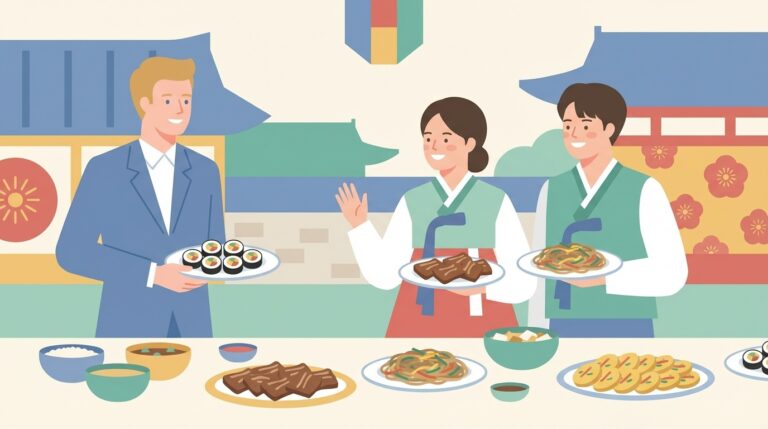
Surviving a Korean Wedding Buffet: The Ultimate A1 Guide
Greeting: Hello! I’m your Daily Hangul Editor.
Imagine this: You’ve just attended a beautiful, tear-jerking Korean wedding. The couple has kissed, the photos are done, and suddenly, the crowd moves like a swift river toward one destination—the legendary Korean Wedding Buffet (뷔페). You sit down with a mountain of Galbi (short ribs) and sushi on your plate. Your Korean coworker looks at you, smiles, and says, “많이 드세요!” (Eat a lot!)
Do you just nod awkwardly? Or do you reply with the perfect, polite phrase that instantly makes you part of the Korean Sik-gu (family)?
In Korean culture, the wedding buffet is serious business. In fact, guests often judge the entire wedding based on how good the buffet is! Knowing a few simple, magical phrases here will not only show your good manners but will also earn you some major “Insider” points. This guide is built from the real, slightly panicked questions of my beginner students who suddenly found themselves holding a plate at a Gangnam wedding hall.
Ready to eat? Let’s dig in!
Phase 2: Core Expressions Deep Dive
1. 잘 먹겠습니다 (I will eat well)
- Pronunciation: jal meok-get-seum-ni-da [jal sounds like the ‘jal’ in jalapeño, meok sounds like ‘muck’ in a puddle]
- Meaning: Literal: I will eat well. / Real nuance: Thank you for the meal; I look forward to it.
- K-Culture Moment: Before taking the very first bite of your buffet food, you say this. You’ve probably seen K-Pop idols clap their hands together and say this before devouring a late-night snack on a live stream!
- Editor’s Insight: This isn’t just about the food. It’s an announcement. You are acknowledging the effort of the hosts (the bride and groom) who provided this feast.
- Situation Spectrum:
- Casual with friends: ✅ (You can just say “잘 먹을게!” – jal meogeulge)
- Semi-formal (coworkers): ✅
- Formal (elders, boss): ✅
- 🤔 Think About It: Why do Koreans announce they are going to eat before every single meal? Does your native language have a phrase you must say before eating?
2. 맛있어요 (It is delicious)
- Pronunciation: ma-si-sseo-yo [ma-she-saw-yo]
- Meaning: It’s delicious / It tastes good.
- K-Culture Moment: In K-Dramas, whenever someone tries the main character’s cooking, the camera zooms in on their face. The golden response? Eyes widening, nodding enthusiastically, and saying “와, 맛있어요!”
- Editor’s Insight: Korean food culture relies heavily on reactions. If you eat silently, Koreans might worry you hate the food. Saying “맛있어요” is the best compliment to the atmosphere!
- Situation Spectrum:
- Casual with friends: ✅ (Drop the ‘yo’: 맛있어! – masisseo!)
- Semi-formal (coworkers): ✅
- Formal (elders, boss): ✅
- 🤔 Think About It: In many cultures, nodding is enough. Why is verbalizing your enjoyment so crucial in Korean dining culture?
3. 배불러요 (I’m full)
- Pronunciation: bae-bul-leo-yo [bae (like your bae) – bull (like the animal) – uh – yo]
- Meaning: Literal: My stomach is calling out. / Real nuance: I am full.
- K-Culture Moment: The host or an older coworker will inevitably tell you to “eat more!” (더 드세요 – deo deuseyo). This phrase is your polite, smiling shield to gracefully decline a fourth plate of food.
- Editor’s Insight: Say it with a slight sigh of happy exhaustion, perhaps gently patting your stomach. It shows you thoroughly enjoyed the meal but physically cannot continue.
- Situation Spectrum:
- Casual with friends: ✅ (배불러 – baebulleo)
- Semi-formal (coworkers): ✅
- Formal (elders, boss): ⚠️ (Better to say: 정말 잘 먹었습니다 – I really ate well.)
- 🤔 Think About It: Why do Korean hosts repeatedly offer more food even when you say you are full? Is it a test, or a sign of affection?
Phase 3: Textbook vs. Real Korean
[Situation 1: Praising the wedding food]
* 📖 Textbook Korean: 이 음식은 아주 맛있습니다. (This food is very delicious. – Sounds like a robot food critic.)
* 🗣️ Real Korean: 와, 진짜 맛있어요! (Wa, jinjja masisseoyo! – Wow, really delicious!)
* 💡 Why the difference?: Adding “진짜” (jinjja – really) and showing emotion makes you sound human and appreciative, not like an AI reading a script.
[Situation 2: When you finish your meal]
* 📖 Textbook Korean: 저는 식사를 마쳤습니다. (I have finished my meal. – Sounds like a military report.)
* 🗣️ Real Korean: 아유, 배불러요! 잘 먹었습니다. (Ayu, baebulleoyo! Jal meogeotseumnida. – Oh, I’m full! I ate well.)
* 💡 Why the difference?: Acknowledging you are full (“배불러요”) before thanking them for the meal (“잘 먹었습니다”) is the ultimate sign that the host did a great job.
Bottom Note: As an A1 (Beginner) learner, don’t worry about complex grammar. Just nailing “진짜 맛있어요” with a big smile will win over any Korean table!
Phase 4: Cultural Context — K-Culture Deep Dive
4-1. Non-Verbal Cues & “Nunchi” at the Buffet
When you say “잘 먹겠습니다” (I will eat well), give a slight nod of your head. Don’t just stare blankly! Also, use your Nunchi (social sense) at the buffet table. In Korea, buffet staff are incredibly fast at clearing empty plates. If you leave your plate empty, it might vanish when you look away! Keep your chopsticks or fork resting on your plate if you aren’t done yet.
4-2. The K-Food Connection: The Legendary “Meal Ticket”
Have you ever noticed in K-Dramas that when someone gives congratulatory money (축의금 – chuguigeum) at a wedding reception desk, they receive a little piece of paper in return? That is the 식권 (sikgwon – meal ticket)!
Without this ticket, you cannot enter the buffet. The wedding buffet is a vibrant mix of traditional Korean food (like Japchae and Yukhoe), sushi, and Western dishes. Koreans often joke that a wedding’s success is 20% the dress and 80% how good the buffet was!
Phase 5: Real-Life Roleplay Scenario
Setting: Saturday, 1:00 PM. A grand wedding hall in Gangnam. You’ve handed in your meal ticket and are now sitting at a large round table with your Korean coworker, Min-su. The table is overflowing with plates.
Characters:
– YOU: An expat attending your first Korean wedding.
– Min-su (32, friendly Korean coworker): Loves food, very generous, treating you like a VIP guest.
Dialogue:
Min-su: 많이 드세요! 뷔페 진짜 크죠? 🍣
(Mani deuseyo! Bwipe jinjja keujyo?)
[Eat a lot! The buffet is really big, right?]
YOU: 네, 너무 좋아요!
(Ne, neomu joayo!)
[Yes, I love it!]
(🎭 Stage Direction: You are about to take your first bite of the sushi.)
YOU: ______________!
(Hint: I will eat well!) -> 잘 먹겠습니다! (Jal meokgetseumnida!)
Min-su: 육회(beef tartare) 어때요? 입에 맞아요?
(Yukhoe eottaeyo? Ibe majayo?)
[How is the beef tartare? Does it suit your taste?]
YOU: 와, 이거 진짜 맛있어요!
(Wa, igeo jinjja masisseoyo!)
[Wow, this is really delicious!]
(🎭 Stage Direction: 30 minutes later. You are holding your stomach. Min-su points to the dessert section.)
Min-su: 케이크 좀 더 가져올까요?
(Keikeu jom deo gajyeoolkkayo?)
[Shall I bring some more cake?]
🔀 YOUR TURN! How do you reply?
– A) 아니요. 싫어요. (Aniyo. sireoyo. – No. I hate it.)
– B) 아, 저는 배불러요. 진짜 잘 먹었습니다! (Ah, jeoneun baebulleoyo. Jinjja jal meogeotseumnida! – Ah, I’m full. I really ate well!)
– C) 케이크? 대박! (Keikeu? Daebak! – Cake? Awesome!)✅ Best Choice: B — You politely state you are full and follow up with gratitude for the meal.
⚠️ Choice A Analysis: “싫어요” is way too direct and sounds aggressive. Never use this to decline food politely!
Phase 6: 10-Second Shadowing Drill
Read these out loud! Pay attention to the pauses (/) and the emotion.
😊 Before eating:
잘 / 먹겠습니다!
(jal / meok-get-seum-ni-da!)
Say it brightly and with anticipation!
🤩 While eating:
와 / 이거 / 진~짜 / 맛있어요!
(wa / i-geo / jin~jja / ma-si-sseo-yo!)
Emphasize ‘jin~jja’ (really) to sound authentic!
🥺 After eating:
아유 / 저는 / 배불러요. / 잘 먹었습니다!
(a-yu / jeo-neun / bae-bul-leo-yo. / jal meo-geot-seum-ni-da!)
Pat your stomach gently and smile warmly.
Phase 7: K-Culture Mini Dictionary
| Korean | Romanization | English | Context |
|---|---|---|---|
| 뷔페 | bwi-pe | Buffet | Pronounced with a ‘p’ sound, not an ‘f’. |
| 식권 | sik-gwon | Meal ticket | You get this after giving your wedding gift money. Don’t lose it! |
| 축의금 | chu-gui-geum | Congratulatory money | The cash gift given at Korean weddings. |
| 육회 | yuk-hoe | Beef tartare | A staple premium dish at Korean wedding buffets. |
| 하객 | ha-gaek | Wedding guest | The people attending the wedding. |
Phase 8: Traveler Survival Kit
Even if you’re not at a wedding, you will likely eat at a buffet (like a hotel breakfast) while traveling in Korea. Here are your survival phrases!
🆘 Survival Phrases: The Buffet Edition
– 🇰🇷 “식당이 몇 층이에요?” (Sikdangi myeot chung-ieyo?)
– 🗣️ Meaning: What floor is the dining hall/restaurant?
– 📍 Where to use: Hotel lobbies, Wedding hall elevators.
- 🇰🇷 “화장실이 어디예요?” (Hwajangsiri eodiyeyo?)
- 🗣️ Meaning: Where is the restroom?
- 📍 Where to use: Everywhere! Crucial after a big buffet meal.
📌 Editor’s Travel Note
– Tipping: There is absolutely NO tipping in Korea! Even at luxury hotel buffets. Leaving cash on the table will just confuse the staff; they might chase you down to return it!
– Chopsticks vs. Forks: Most buffets have forks and knives in the Western food section. If you can’t use chopsticks, don’t panic! Just ask: “포크 있어요?” (Pokeu isseoyo? – Do you have a fork?).
Phase 9: Critical Thinking Corner — “One Step Deeper”
Food & Identity: The Concept of “Sik-gu” (식구)
🧠 Think Deeper:
In Korean, the word for family is Gajok (가족), but there is another very common word: Sik-gu (식구). It literally translates to “mouths that eat together.” In Korea, sharing a meal is the ultimate way of breaking the ice and forming a bond. That is why hosts at weddings spend a fortune on the buffet, and why elders constantly tell you to “eat more.” It’s not just about nutrition; it’s the Korean way of saying, “I care about you; you are part of my community now.”💬 Your Turn: Does your culture have a strong connection between sharing food and showing affection? How do you say “eat a lot” in your language? Share in the comments!
Phase 10: FAQ & Mistake Prevention
Q: “Can I take leftover buffet food home in a box?”
A: No! Unlike some Western cultures where “doggy bags” are common, taking food out of a buffet in Korea is strictly prohibited and considered very rude.
Q: “Do I say 잘 먹었습니다 (Past tense) before I eat?”
A: Big NO!
– Before eating = 잘 먹겠습니다 (Future/Will do)
– After eating = 잘 먹었습니다 (Past/Did do)
Mixing these up is cute, but very confusing for Koreans!
❌ Common Mistake #1: Saying “맛있어요” (It’s delicious) with a completely flat, expressionless face.
✅ Do this instead: In Korea, food reactions are a performance! Open your eyes a bit wider, nod, and add a “Wow!”
Phase 11: Summary & Action Items
One-Liner Summary: At a Korean wedding buffet, show your appreciation by saying 잘 먹겠습니다 (I will eat well) before you eat, 맛있어요 (It’s delicious) during the meal, and 배불러요 (I’m full) when you can’t eat another bite!
Your Action Missions:
– 🥉 Bronze (Solo): Stand in front of your mirror and practice saying “잘 먹겠습니다” with a bright smile 3 times.
– 🥈 Silver (Online): Go to YouTube, search for a Korean food vlog (Mukbang), and write “진짜 맛있어요!” in the comments.
– 🥇 Gold (Real World): Next time you eat at a Korean restaurant (or any restaurant with Korean friends), use “잘 먹겠습니다” before you pick up your chopsticks!
K-Culture Mission: Watch a K-Drama eating scene today. Try to catch the exact moment the characters say “잘 먹겠습니다” before they dig into their food. You’ll hear it everywhere now!
What is your favorite Korean food? Let me know in the comments below! 👇
Phase 12: Interactive Quiz
Q1. You are about to eat your first plate at the wedding buffet. Your Korean friend looks at you. What do you say?
A) 배불러요 (Baebulleoyo)
B) 잘 먹겠습니다 (Jal meokgetseumnida)
C) 잘 먹었습니다 (Jal meogeotseumnida)
Q2. True or False: If the food at the buffet is excellent, you should leave a 10% tip on the table.
True / False
Q3. Fill in the blank: “와, 진짜 _______!” (Wow, it’s really delicious!)
A) 맛있어요 (Masisseoyo)
B) 싫어요 (Sireoyo)
Click to see the answers!
Q1. B – 잘 먹겠습니다 is said BEFORE you eat. ‘C’ is said AFTER you finish.
Q2. False – Tipping is not a part of Korean culture. In fact, leaving money on a buffet table will cause confusion!
Q3. A – 맛있어요 means delicious. ‘싫어요’ means ‘I hate it/I don’t want to’!
Frequently Asked Questions (FAQ)
Q: What does "잘 먹겠습니다 (I will eat well)" mean in Korean and how do you pronounce it?
A: In Korean, "잘 먹겠습니다 (I will eat well)" is pronounced [jal meok-get-seum-ni-da [jal sounds like the 'jal' in jalapeño, meok sounds like 'muck' in a puddle] and means: Literal: I will eat well. / Real nuance: Thank you for the meal; I look forward to it.
Q: What does "맛있어요 (It is delicious)" mean in Korean and how do you pronounce it?
A: In Korean, "맛있어요 (It is delicious)" is pronounced [ma-si-sseo-yo [ma-she-saw-yo] and means: It's delicious / It tastes good.
Q: What does "배불러요 (I'm full)" mean in Korean and how do you pronounce it?
A: In Korean, "배불러요 (I'm full)" is pronounced [bae-bul-leo-yo [bae (like your bae] and means: Literal: My stomach is calling out. / Real nuance: I am full.







