

Phase 1: Empathy & K-Culture Cold Open
Hello, learners! I’m the Lead Editor at Daily Hangul, your veteran tutor and local cultural navigator.
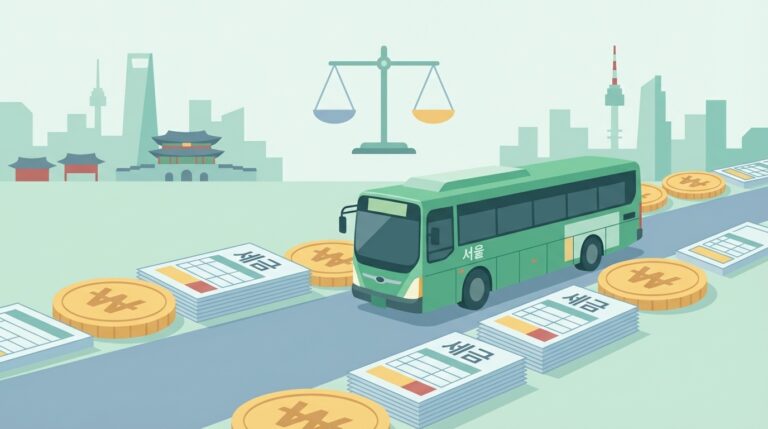
Imagine this: You are sitting by the window of a pristine, air-conditioned green bus in Seoul, crossing the Han River while listening to your favorite K-Indie track. The bus arrives exactly to the minute, just as your map app predicted. As a foreigner, you might be thinking, “Wow, Korea’s public transport is a utopian dream!”
But wait. If you turn on the Korean morning news, you won’t hear praises. Instead, you’ll hear serious anchors tossing around heavy words like “재정 적자 (financial deficit)” and “혈세 (taxpayer money)” regarding this very system.
Why? Because behind this flawless commute lies the complex reality of the 버스 준공영제 (Bus Semi-public Management System). For C2-level learners, mastering conversational Korean isn’t just about ordering coffee anymore. It’s about sitting in a company breakroom and holding your own when your Korean colleagues start debating socio-economic policies, taxes, and government efficiency.
This guide is crafted from real discussions advanced expats have in Seoul. Let’s peel back the curtain on the “perfect commute” and learn how to critique society like a true intellectual local!
Phase 2: Deep Dive into Core Expressions
To discuss this topic, you need high-level, journalistic vocabulary that Koreans use daily when complaining about politics or the economy.
1. 준공영제
- Pronunciation: [jun-gong-yeong-je] (Sounds like: joon-gong-young-jeh)
- Meaning: Semi-public management system (Literal: Semi-public operation system)
- K-Culture Moment: You’ll hear this term constantly on the news when bus drivers threaten a strike (파업). The local government manages the routes to ensure coverage, but private companies operate the buses.
- Editor’s Insight: This word immediately signals that you are highly educated in Korean affairs. It shows you understand the unique hybrid system where the city covers the private bus companies’ financial losses.
- Situation Spectrum:
- Casual with friends: ✅ (If discussing news)
- Co-workers (Semi-formal): ✅
- Formal Debates/Bosses: ✅
- 🤔 Think About It: Why did Seoul adopt a “semi-public” system instead of fully nationalizing the buses? What does this say about the balance between capitalism and public welfare in modern Korea?
2. 혈세가 줄줄 샌다
- Pronunciation: [hyeol-se-ga jul-jul saen-da] (Sounds like: hyul-seh-gah jool-jool sen-dah)
- Meaning: Taxpayer money is being wasted (Literal: Blood tax is leaking drip by drip)
- K-Culture Moment: Picture an angry middle-aged man at a gukbap (soup and rice) restaurant pointing his spoon at the TV screen during a news segment about government bailouts.
- Editor’s Insight: 혈세 (blood tax) is a dramatic but incredibly common term for “taxes.” It emphasizes how hard citizens worked to earn that money. “줄줄 새다” paints a vivid picture of a leaky pipe.
- Situation Spectrum:
- Casual with friends: ✅
- Co-workers (Semi-formal): ✅
- Formal Debates/Bosses: ⚠️ (A bit too emotional for an academic paper, but perfect for a passionate opinion in a meeting)
- 🤔 Think About It: “Blood tax.” Why do Koreans attach the word “blood” to taxes? It reflects the intense work culture and the collective feeling that public funds must be treated sacredly.
3. 도덕적 해이
- Pronunciation: [do-deok-jeok hae-i] (Sounds like: doh-duck-juck heh-ee)
- Meaning: Moral hazard
- K-Culture Moment: This is the buzzword of K-Drama corporate thrillers. When executives of private bus companies give themselves massive bonuses while their companies lose money (knowing the government will bail them out), citizens scream “도덕적 해이!”
- Editor’s Insight: Using this phrase takes you from “good at Korean” to “fluent local intellectual.”
- Situation Spectrum:
- Casual with friends: ⚠️ (Might sound a bit pretentious at a pub)
- Co-workers (Semi-formal): ✅
- Formal Debates/Bosses: ✅
- 🤔 Think About It: Does your native language have a direct translation for “Moral Hazard”? In Korea, public outrage toward corporate greed is fierce, making this a highly triggering term.
Phase 3: Textbook vs. Real Korean
Let’s upgrade your vocabulary from TOPIK textbooks to real-world socio-economic discussions.
[Expressing Wasted Money]
* 📖 Textbook Korean: 세금을 낭비하고 있습니다. (They are wasting taxes.)
* 🗣️ Real Korean: 내 피 같은 세금이 밑빠진 독에 물 붓기예요. (My blood-like taxes are pouring water into a bottomless jug.)
* 💡 Why the difference?: Koreans love using idioms (사자성어/속담). “밑빠진 독에 물 붓기” perfectly captures the frustration of infinitely subsidizing private bus companies.
[Discussing Efficiency]
* 📖 Textbook Korean: 버스 노선을 더 좋게 만들어야 합니다. (We need to make bus routes better.)
* 🗣️ Real Korean: 노선 효율성을 제고하고 중복 노선을 통폐합해야죠. (We must improve route efficiency and consolidate overlapping routes.)
* 💡 Why the difference?: In a C2 professional or news context, Sino-Korean words (Hanja) like 제고하다 (improve/enhance) and 통폐합하다 (consolidate/merge) carry authority and precision.
Phase 4: Cultural Context — K-Culture Deep Dive
4-1. Non-Verbal Elements: The “Sigh” of the Citizen
When discussing taxes and government deficits, the delivery is crucial. You don’t say “혈세가 샌다” with a bright smile. It is usually accompanied by a heavy sigh (한숨) or a click of the tongue (쯧쯧). In Korean Nunchi culture, expressing shared frustration over economic burdens is a way to bond with your colleagues.
4-2. K-Culture Connection: “시민의 발” (Feet of the Citizens)
In K-Dramas like My Mister (나의 아저씨) or any slice-of-life show, the bus is a sanctuary for the weary worker. In news media, public transport is always referred to as 시민의 발 (the citizens’ feet).
Because buses are the “feet” of the people, the government cannot let them stop running. This gives private bus unions immense leverage to threaten strikes (파업). The Semi-public system was born out of Korea’s “Pali-pali” (hurry up) culture—the economy cannot afford for the “feet” to stop moving, so the government steps in with cash to keep the wheels turning, leading to the current financial dilemma.
Phase 5: Real-Life Roleplay Scenario
Setting: Tuesday morning, 8:45 AM. You are in the company pantry getting an Americano. The TV on the wall is broadcasting news about a potential bus strike and the massive deficit of the Seoul bus system.
Characters:
– YOU: A foreign expat working in a Korean marketing firm. You take the 741 bus to work every day.
– Ji-hoon (34, Male): Your outspoken Korean senior colleague who drives to work.
Dialogue:
Ji-hoon: 아휴, 또 파업한다고 난리네.
(Ahyu, tto paeopandago nalline.)
[Sigh, they are making a fuss about going on strike again.]
(🎭 Stage Direction: Ji-hoon shakes his head while stirring his coffee.)
YOU: 그러게요. 저도 출근할 때 버스 타는데 파업하면 큰일이에요.
(Geureogeyo. Jeodo chulgeunhal ttae beoseu taneunde paeophamyeon keunirieyo.)
[Tell me about it. I take the bus to work too, so if they strike, it’s a disaster.]
Ji-hoon: 00씨, 버스 준공영제 때문에 서울시 적자가 얼만지 알아요? 작년에만 8천억이 넘었대요.
(00-ssi, beoseu jun-gong-yeong-je ttaemune seoulsi jeokjaga eolmanji arayo? Jangnyeoneman pal-cheon-eogi neomeotdaeyo.)
[Do you know how much Seoul’s deficit is because of the semi-public bus system? They say it was over 800 billion won last year alone.]
YOU: 8천억이요? 와, 그 정도인 줄은 몰랐네요.
(Pal-cheon-eogiyo? Wa, geu jeongdoin jureun mollatneyo.)
[800 billion? Wow, I didn’t realize it was that much.]
Ji-hoon: 버스 회사 임원들은 성과급 잔치하면서, 적자는 우리 세금으로 메우고 있잖아요. 완전 도덕적 해이죠.
(Beoseu hoesa imwondeureun seonggwageup janchihamyeonseo, jeokjaneun uri segeumeuro meugo itjanayo. Wanjeon do-deok-jeok hae-ijyo.)
[The bus company executives are throwing bonus parties, while covering the deficit with our taxes. It’s a total moral hazard.]
🔀 Your Turn! How do you respond?
– A) “세금을 낭비하면 안 됩니다!” (Too robotic and textbook.)
– B) “맞아요. 노선 효율성을 제고해서 혈세가 새는 걸 막아야 할 텐데요.” (Agreeing using high-level vocabulary, showing deep empathy and intellect.)
– C) “그래도 대중교통은 복지니까 세금 좀 쓸 수도 있죠!” (Playing devil’s advocate—risky but leads to good debate!)✅ Best Choice: B — Reason: In Korean workplace culture, bonding over shared societal frustrations (especially regarding taxes) builds strong camaraderie. Using terms like “효율성 제고” will impress Ji-hoon.
YOU: 맞아요. 노선 효율성을 제고해서 혈세가 새는 걸 막아야 할 텐데요.
(Majayo. Noseon hyoyulseong-eul jego-haeseo hyeolse-ga saeneun geol magaya hal tendeyo.)
[You’re right. They need to improve route efficiency and stop taxpayer money from leaking.]
Ji-hoon: 오, 00씨! ‘혈세’라는 말도 알아요? 완전 한국인 다 됐네요!
(O, 00-ssi! ‘Hyeolse’raneun maldo arayo? Wanjeon hangugin da dwaenneyo!)
[Oh! You even know the word ‘blood tax’? You’ve become completely Korean!]
YOU: 하하, 뉴스에서 많이 들었거든요. 근데 빈 차로 다니는 외곽 노선들은 진짜 문제긴 하더라고요.
(Haha, nyuseueseo mani deureotgeodeunyo. Geunde bin charo danineun oegwak noseondeureun jinjja munjegin hadeoragoyo.)
[Haha, I heard it a lot on the news. But those suburban routes running empty really do seem like a problem.]
Ji-hoon: 내 말이! 어휴, 일이나 합시다. 우리 혈세 벌러 가야죠.
(Nae mari! Eohyu, irina hapsida. Uri hyeolse beolleo gayajyo.)
[My point exactly! Phew, let’s get to work. We need to go earn our ‘blood tax’.]
Phase 6: 10-Second Shadowing Drill
Speak like a prime-time news anchor!
😤 시민의 발인 / 대중교통을 볼모로 / 파업을 하는 것은 / 무책임합니다!
(simin-ui barin / daejung-gyotong-eul bolmoro / paeobeul haneun geoseun / muchaegimhamnida!)
“Holding public transport, the feet of the citizens, hostage to go on strike is irresponsible!”
Phase 7: K-Culture Mini Dictionary
| 한국어 | Romanization | English | Context |
|---|---|---|---|
| 시민의 발 | simin-ui bal | Feet of the citizens | A common metaphor for public transport, emphasizing its necessity for the working class. |
| 밥그릇 싸움 | bapgeureut ssaum | Rice bowl fight | A turf war over resources/profits. Used when unions and companies fight over subsidies. |
| 성과급 잔치 | seonggwageup janchi | Bonus party | Used sarcastically when failing companies give their executives massive bonuses. |
| 볼모로 잡다 | bolmoro japda | To hold hostage | Used when strikes inconvenience citizens to pressure the government. |
Phase 8: Traveler/Resident Survival Kit
As a C2 resident, you aren’t just taking the subway to Myeongdong; you are navigating commuter life during potential strikes!
🆘 Survival Phrases for Transit Disruptions
– 🇰🇷 “오늘 버스 파업한다던데, 정상 운행 하나요?” (oneul beoseu paeophandadeonde, jeongsang unhaeng hanayo?)
– 🗣️ “I heard there’s a bus strike today, are they running normally?”
– 🇰🇷 “이 버스 우회해서 가나요?” (i beoseu uhoehaeseo ganayo?)
– 🗣️ “Is this bus taking a detour?” (Useful during city protests affecting routes).📌 Editor’s Transit Note
– Apps like KakaoBus or Naver Map will show red alert banners (공지사항) if a strike or route cancellation occurs. Always check these apps on rainy days or during election/protest seasons in Gwanghwamun!
Phase 9: Critical Thinking Corner — “One Step Deeper”
1. 언어와 권력 (Language & Power): The Framing of “혈세” (Blood Tax)
🧠 Think Deeper:
Notice how the media frames government spending as “blood tax” (혈세) rather than just “public funds” (공공 자금). This emotionally charged language shapes public opinion, making citizens feel personally robbed by inefficiencies in the bus system. On the flip side, unions frame their strikes around “생존권” (the right to survive). The battle over the bus semi-public system isn’t just about accounting; it’s a linguistic war for public sympathy. In Korea, where capitalist efficiency is worshipped, public welfare programs must constantly justify their existence to avoid being labeled as “bottomless jugs.”💬 Your Turn: In your home country, how is public transport funded? Is government subsidization viewed as an essential “public good” or a “waste of taxes”? Share your perspective in the comments!
Phase 10: FAQ & Avoiding Misunderstandings
- Q: Can I use “혈세 (blood tax)” when complaining about something small, like buying a bad cup of coffee?
- A: NO. It is strictly reserved for government taxes. If you use it for personal spending, you will sound very strange. For personal money, use “내 피 같은 돈 (my blood-like money).”
- Q: Is it okay to criticize government policies with Korean colleagues?
- A: YES, but read the room (눈치). General complaints about “wasted taxes” or “inefficiency” are universal safe grounds for bonding. However, avoid taking hard political party sides unless you know them very well.
❌ Common Mistake #1:
Using “제고하다 (improve/enhance)” in casual contexts.
(e.g., “내 한국어 실력을 제고하고 싶어” – Sounds like a robot.)
✅ Do this instead:
Use “제고하다” ONLY for abstract, systemic things like 효율성 (efficiency), 이미지 (image), or 가치 (value). For personal skills, use “향상시키다” or simply “늘리다”.
Phase 11: Summary & Action Items
- One-Liner Summary: The “flawless” Seoul bus system is maintained by the Semi-Public System (준공영제), sparking fierce debates over route efficiency (효율성 제고) and taxpayer burdens (혈세 낭비).
-
Action Mission 3 Steps:
- 🥉 Bronze (Solo): Read a Korean news headline containing the word “파업” or “준공영제” and translate it.
- 🥈 Silver (Online): Go to a Korean news YouTube video about public transport and leave a comment using “효율성 제고.”
- 🥇 Gold (Real Life): Bring up the topic of bus routes and taxes during your next lunch or coffee break with a Korean colleague using the roleplay script!
- K-Culture Mission:
- Next time you ride a Seoul bus, look at the driver’s name tag and company name at the front. Remember that while the city colors it green or blue, a private company is running the numbers behind the scenes!
- Engagement: Have you ever experienced a transit strike in Korea? How did you handle the commute? Let me know below!
Phase 12: Quiz — Interactive Challenge
1. Fill in the Blank:
“버스 회사의 적자를 메우기 위해 시민의 _____(이/가) 투입되고 있습니다.”
A) 발 (Feet)
B) 성과급 (Bonus)
C) 혈세 (Blood tax)
2. Situational Judgment:
Your Korean boss says, “요즘 시내버스 노선이 너무 중복되는 것 같아.” (I feel like city bus routes overlap too much these days.) What is the most C2-level appropriate response?
A) 네, 버스가 너무 많아요.
B) 맞습니다. 노선 통폐합을 통해 효율성을 제고할 필요가 있습니다.
C) 세금이 줄줄 새네요! 파업해야 합니다!
3. True or False – K-Culture Edition:
The term “시민의 발” (Feet of the citizens) is used by the government to refer to expensive taxis.
(Answers: 1. C / 2. B / 3. False, it refers strictly to mass public transport like buses and subways.)
Frequently Asked Questions (FAQ)
Q: What does "준공영제" mean in Korean and how do you pronounce it?
A: In Korean, "준공영제" is pronounced [jun-gong-yeong-je] and means: Semi-public management system (Literal: Semi-public operation system)
Q: What does "혈세가 줄줄 샌다" mean in Korean and how do you pronounce it?
A: In Korean, "혈세가 줄줄 샌다" is pronounced [hyeol-se-ga jul-jul saen-da] and means: Taxpayer money is being wasted (Literal: Blood tax is leaking drip by drip)
Q: What does "도덕적 해이" mean in Korean and how do you pronounce it?
A: In Korean, "도덕적 해이" is pronounced [do-deok-jeok hae-i] and means: Moral hazard







