

Phase 1: Empathy (The Deep Dive)
Hello, learners! I’m the Senior Editor of Daily Hangul.
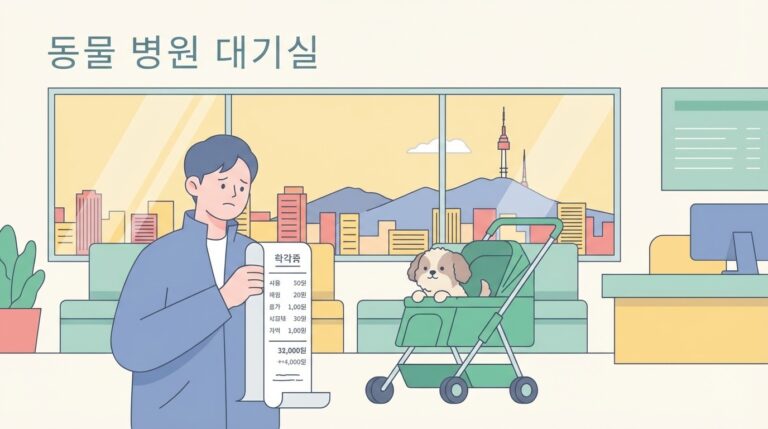
Imagine this: You’re at a trendy dog cafe in Yeonnam-dong. There are more dogs in high-end strollers (개모차) than babies in the entire neighborhood. A woman next to you is feeding her poodle an organic, freeze-dried venison treat. But then, she looks at a piece of paper and lets out a deep, exhausted sigh. It’s a vet bill. She mutters to her friend, “I knew I should have gotten pet insurance, but the coverage is so terrible… the system is completely broken.”
Welcome to the paradox of Korea’s modern pet culture. While the “pet-fam” (펫팸족, pet + family) population has exploded past 15 million, the systemic support—specifically pet insurance (펫보험)—lags drastically behind. As a C2 level learner, you’re no longer just learning how to say “What a cute dog!” You need the linguistic tools to engage in deep, socio-economic debates that Koreans are actually having right now.
Today, we aren’t just looking at vocabulary; we are examining the clash between a booming cultural trend and the institutional growing pains trying to catch up. Let’s dive in.
Phase 2: Core Expressions Deep Dive
To discuss pet insurance policies like a native intellectual or news panelist, you need these power phrases.
1. 제도적 보완이 시급하다
- Pronunciation: [Je-do-jeok bo-wa-ni si-geu-pa-da]
Sound analogy: ‘je’ sounds like the start of ‘jelly’, ‘bo-wan’ rhymes with ‘bow’ and ‘one’.- Meaning: Urgent need for institutional improvement/supplementation.
- K-Culture Moment: Turn on any late-night current affairs debate (100분 토론). When discussing why pet abandonment is rising or why vet bills bankrupt families, experts inevitably use this phrase to point the finger at the government’s lack of action.
- Editor’s Insight: This phrase carries a heavy, intellectual weight. It shifts the blame from individual responsibility to structural flaws. It’s the ultimate “polite but critical” mic-drop in a serious conversation.
- Situation Spectrum:
- Casual with close friends: ⚠️ (A bit too stiff, sounds like you’re reading the news)
- Professional/Semi-formal debate: ✅
- Formal written essays/News: ✅
- 🤔 Think About It: Why does Korean discourse frequently rely on the word “제도” (institution/system)? Korea developed rapidly through state-led initiatives. Therefore, Koreans naturally look to the government to standardize and solve market chaos—including the pet industry.
2. 진료비 표준 수가제
- Pronunciation: [Jin-ryo-bi pyo-jun su-ga-je]
Sound analogy: ‘pyo-jun’ sounds like ‘pew-June’.- Meaning: Standardized medical fee system.
- K-Culture Moment: In a KakaoTalk group chat for local dog owners, someone complains that a simple blood test cost 50,000 won at one clinic and 150,000 won at another. The immediate response? “This is exactly why we need a pyojun sugaje!”
- Editor’s Insight: This is the holy grail of the Korean pet owner’s demands. Because human healthcare in Korea is universally standardized and incredibly cheap thanks to the National Health Insurance, the “Wild West” pricing of veterinary medicine feels especially jarring and unfair to Koreans.
- Situation Spectrum:
- Casual: ✅ (Commonly used by frustrated pet owners)
- Semi-formal: ✅
- Formal: ✅
- 🤔 Think About It: How does your home country handle veterinary costs? Does the contrast between excellent human healthcare and expensive pet healthcare exist there, too?
3. 가입 문턱을 낮추다
- Pronunciation: [Ga-ip mun-teo-geul nat-chu-da]
Sound analogy: ‘mun-teok’ sounds like ‘moon-tuck’.- Meaning: To lower the barrier to entry (literally: lower the threshold for enrollment).
- K-Culture Moment: Startup CEOs pitching new pet-tech platforms or insurance companies launching new policies always use this phrase. “We have lowered the threshold so even senior dogs can get insured.”
- Editor’s Insight: “문턱” (door threshold) is a fantastic metaphor in Korean. High thresholds mean something is exclusive, expensive, or hard to get into. Lowering it implies democratization and accessibility.
- Situation Spectrum:
- Casual: ✅
- Semi-formal: ✅
- Formal: ✅
Phase 3: Textbook vs. Real Korean
Let’s see how policy debates actually sound on the streets versus in your advanced textbook.
[Describing Unpredictable Vet Bills]
* 📖 Textbook Korean: 동물 병원비가 명확하지 않아서 문제입니다. (It is a problem that veterinary bills are not clear.)
* 🗣️ Real Korean: 동물병원 진료비는 완전 부르는 게 값이에요. (Vet bills are literally ‘whatever they ask for’.)
* 💡 Why the difference?: “부르는 게 값이다” is a widespread idiom criticizing merchants or services that have no set price tags, reflecting a deep cultural frustration with lack of transparency.
[Describing Unhelpful Insurance Policies]
* 📖 Textbook Korean: 펫보험은 아직 보장 범위가 좁습니다. (Pet insurance still has a narrow coverage scope.)
* 🗣️ Real Korean: 펫보험 들어봤자 혜택이 쥐꼬리만 해서 완전 계륵이에요. (Even if you get pet insurance, the benefits are like a mouse’s tail, so it’s a chicken rib.)
* 💡 Why the difference?: “계륵” (chicken rib – not much meat to eat, but a waste to throw away) perfectly captures the C2-level dilemma of modern Korean consumers holding onto sub-par insurance just in case.
Phase 4: Cultural Context — K-Culture Deep Dive
4-1. The Non-Verbal “Nunchi” of Pet Bills
When discussing financial burdens like vet bills in Korea, direct questions are a faux pas. You never ask, “How much did your dog’s surgery cost?” directly. Instead, you use Nunchi. You might sigh and say, “My dog just got a basic checkup and it was 300,000 won… the bills are no joke lately.” By offering your own vulnerability first, you create a safe space for the other person to vent about their own financial frustrations with their pet’s healthcare.
4-2. Media vs. Reality: The “Gucci Dog” Illusion
If you watch K-Dramas or follow K-Pop idols, their pets are royalty. You see idols booking out entire luxury pet resorts or buying designer dog clothes. This media portrayal creates a “premiumization” (프리미엄화) of pet culture. However, the dark underbelly of this boom is the reality of average citizens. They buy into the culture, but when the pet gets sick, the lack of institutional safety nets (like standardized disease codes and mandatory insurance) leads to devastating financial strain or, tragically, pet abandonment.
Phase 5: Real-Life Roleplay Scenario
Setting: Friday evening at an upscale “Pet-Friendly” cafe in Apgujeong. You are sitting with Min-ji (34, a passionate Pomeranian owner who is highly active in pet civic groups). Your dog recently had to get knee surgery (슬개골 탈구 – incredibly common in Korea).
Min-ji: (Looking at your dog) 다리는 이제 좀 괜찮아요? 수술비 장난 아니었죠?
(Romanization) Darineun ije jom gwaenchannayo? Susulbi jangnan anieotjyo?
(English) Is his leg okay now? The surgery cost must have been no joke, right?
YOU: 네, 통장이 텅장이 됐어요. 펫보험도 없어서 100% 자비로 냈거든요.
(Romanization) Ne, tongjangi teongjangi dwaesseoyo. Petboheomdo eopseoseo baek-peo-sen-teu jabiro naetgeodeunyo.
(English) Yeah, my bank account became an empty account (teong-jang). I didn’t have pet insurance, so I paid 100% out of pocket.
Min-ji: 그러니까요! 우리나라 펫보험은 진짜 제도적 보완이 시급해요.
(Romanization) Geureonilkkayo! Urinara petboheomeun jinjja jedojeok bowani sigeupaeyo.
(English) Exactly! Our country’s pet insurance urgently needs institutional improvement.
Min-ji: 아니, 병원마다 질병 코드도 다르고, 표준 수가제도 없는데 보험사가 어떻게 상품을 제대로 만들겠어요?
(Romanization) Ani, byeongwonmada jilbyeong kodeudo dareugo, pyojun sugajedo eomneunde boheomsaga eotteoke sangpumeul jedaero mandeulgesseoyo?
(English) I mean, every clinic has different disease codes, and there’s no standardized fee system, so how can insurance companies even create proper products?
🔀 Your Turn! How do you respond to Min-ji’s frustration?
– A) “맞아요. 정부가 빨리 동물병원 진료비를 통제해야 해요.” (Agree completely, pushing for government control.)
– B) “그래도 수의사들 입장도 이해는 가요. 장비가 다 다르잖아요.” (Play devil’s advocate, defending the vets.)
– C) “대박! 진짜 짜증나겠네요.” (Too casual for the depth of the conversation.)✅ Best Choice: B or a nuanced version of A. At a C2 level, a simple “I agree” isn’t enough. A great response would be: “맞아요, 기본 질병에 대한 가이드라인은 필요하죠. 그래야 보험 가입 문턱도 낮아질 테니까요.” (Right, we need guidelines for basic diseases. That’s the only way the threshold for insurance enrollment will be lowered.) This shows empathy while using advanced policy vocabulary.
Phase 6: 10-Second Shadowing Drill
Time to practice your policy-debater tone. Speak with conviction and slight frustration!
😤 펫보험 / 가입률을 높이려면, / 무엇보다 / 표준 수가제 도입이 / 시급합니다!
(Pet-boheom / ga-imnyureul nopyeoryeomyeon, / mu-eotboda / pyojun sugaje do-ibi / sigeupamnida!)
[To increase the pet insurance enrollment rate, above all, the introduction of a standardized fee system is urgent!]
Phase 7: K-Culture Mini Dictionary
Master these terms to understand the socio-economics of Korean pet ownership.
| 한국어 | Romanization | English | Context |
|---|---|---|---|
| 펫팸족 | pet-paem-jok | Pet-fam tribe | People who treat their pets as equal family members. The driving force behind the premium pet market. |
| 개모차 | gae-mo-cha | Dog stroller | A portmanteau of 개 (dog) + 유모차 (baby stroller). Symbolizes Korea’s demographic shift. |
| 텅장 | teong-jang | Empty account | Slang combining 텅 (empty sound) + 통장 (bank account). Often the result of vet bills. |
| 슬개골 탈구 | seul-gae-gol tal-gu | Patellar luxation | A knee joint issue incredibly common in Korea due to the preference for small, purebred indoor dogs living on slippery apartments floors. The #1 cause of massive vet bills. |
Phase 8: Expat/Traveler Survival Kit
Even if you are just visiting or living in Korea temporarily, if you have a pet, you will interact with the veterinary system. Navigating clinics without insurance requires specific phrasing.
🆘 Survival Phrases for the Vet Clinic
– 🇰🇷 “보험 청구용 진료비 세부 내역서 떼주세요.” (Boheom cheongguyong jinryobi sebu naeyeokseo ttejuseyo.)
– 🗣️ Meaning: Please issue an itemized medical bill for my insurance claim.
– 📍 Where to use: At the vet reception desk after payment.
– 💡 Pro Tip: Even if you have foreign pet insurance, you need a “세부 내역서” (itemized statement), not just a credit card receipt. Korean clinics will provide this if asked.📌 Editor’s Note on Korean Vets
– 24/7 Clinics (24시 동물병원): They are abundant in Seoul, which is amazing for emergencies. However, be warned: nighttime emergency surcharges (야간 할증) can be 30-50% higher.
– Pharmacies: You can actually buy some preventative pet medicines (like heartworm pills) at human pharmacies that have an “동물 약국” (Animal Pharmacy) sign, often much cheaper than at the vet.
Phase 9: Critical Thinking — “One Step Deeper”
🧠 Think Deeper: Media vs. Reality & The State’s Role
The debate over “표준 수가제” (standardized fees) for pets highlights a fascinating aspect of the Korean psyche. Koreans are accustomed to the National Health Insurance (건강보험), widely considered one of the best and most cost-controlled systems in the world. When Koreans step into a vet clinic and experience a purely capitalistic, unregulated market where prices fluctuate wildly, it feels culturally offensive. The demand for “institutional improvement” is essentially a demand for the government to step in and regulate the pet market just as it regulates human healthcare. It raises a critical question for the global era: As pets become legally and culturally recognized as ‘family’, should the state treat veterinary care as a public good or leave it as a luxury market?
💬 Your Turn: Does your home country regulate veterinary prices, or is it a completely free market? How do people in your culture handle catastrophic vet bills? Let’s debate in the comments!
Phase 10: FAQ & Avoiding Misunderstandings
Q: When talking about my pet, do I use honorifics?
A: This is a huge debate in Korea right now! You will hear over-the-top customer service workers say, “강아지님이 주사 맞으실게요” (The dog-nim will receive an injection). While “pet-fam” owners might use honorifics for their pets playfully, grammatically, it is incorrect to elevate an animal using ‘시’ or ‘님’. Stick to standard forms: “우리 강아지가 아파요” (not 아프셔요).
Q: Can I ask someone how much they bought their dog for?
A: No! This is becoming a major cultural taboo. With the rise of the “사지 말고 입양하세요” (Don’t buy, adopt) movement, treating pets like commodities with price tags is frowned upon in educated circles.
❌ Common Mistake: Using human medical insurance terms directly for pets without context.
✅ Do this instead: Remember that terms like “의료보험” usually imply the national human system. For pets, always specify “펫보험” (Pet Insurance) or “동물병원 진료비” (Vet medical expenses).
Phase 11: Summary & Action Items
One-Liner Summary: To truly grasp Korea’s pet culture, you must look past the cute “Gucci dogs” and understand the C2-level policy debates regarding standardized fees and insurance reform.
Action Mission 3 Steps:
– 🥉 Bronze (Solo): Read the shadowing sentence aloud 3 times, focusing on the serious, persuasive intonation.
– 🥈 Silver (Online): Go to Naver News, search “펫보험 표준 수가제”, and try to read the headline and the top-voted comment.
– 🥇 Gold (Real World): If you have a Korean friend with a pet, ask them: “요즘 동물병원 진료비 너무 비싸지 않아요? 펫보험은 어때요?” and see if they start venting!
K-Culture Mission:
Next time you walk through a wealthy Seoul neighborhood (like Gangnam or Hannam), count the ratio of baby strollers to dog strollers (개모차). It’s a visual representation of the social shift driving these insurance debates!
Phase 12: Quiz — Interactive Challenge
1. Situational Judgment: You are watching a news debate. A panelist argues that fewer people are buying pet insurance because it doesn’t cover genetic diseases common in Korea. What phrase will they most likely use to conclude their argument?
– A) 강아지가 너무 불쌍해요.
– B) 보험 가입 문턱을 대폭 낮춰야 합니다.
– C) 펫팸족이 늘어나고 있습니다.
2. Fill in the Blank:
“병원마다 수술비가 너무 달라서 불만이에요. 빨리 정부가 _________를 도입해야 해요.”
– (Hint: Standardized medical fee system)
3. True or False – K-Culture Edition:
In Korean veterinary medicine, the prices for basic procedures like blood tests and X-rays are strictly regulated by the government, just like human hospitals. (T / F)
🚨 Click here for Answers!
1. B (They will argue to lower the threshold/barrier to entry for insurance so it covers more).
2. 표준 수가제 (pyojun sugaje)
3. False. That is exactly why Korean pet owners are demanding institutional improvements! The vet market is currently a free market with unregulated pricing.
Frequently Asked Questions (FAQ)
Q: What does "제도적 보완이 시급하다" mean in Korean and how do you pronounce it?
A: In Korean, "제도적 보완이 시급하다" is pronounced [Je-do-jeok bo-wa-ni si-geu-pa-da] and means: Urgent need for institutional improvement/supplementation.
Q: What does "진료비 표준 수가제" mean in Korean and how do you pronounce it?
A: In Korean, "진료비 표준 수가제" is pronounced [Jin-ryo-bi pyo-jun su-ga-je] and means: Standardized medical fee system.
Q: What does "가입 문턱을 낮추다" mean in Korean and how do you pronounce it?
A: In Korean, "가입 문턱을 낮추다" is pronounced [Ga-ip mun-teo-geul nat-chu-da] and means: To lower the barrier to entry (literally: lower the threshold for enrollment).







