

Phase 1: Empathy (The K-Culture Cold Open)
Hello! Daily Hangul Editor here.
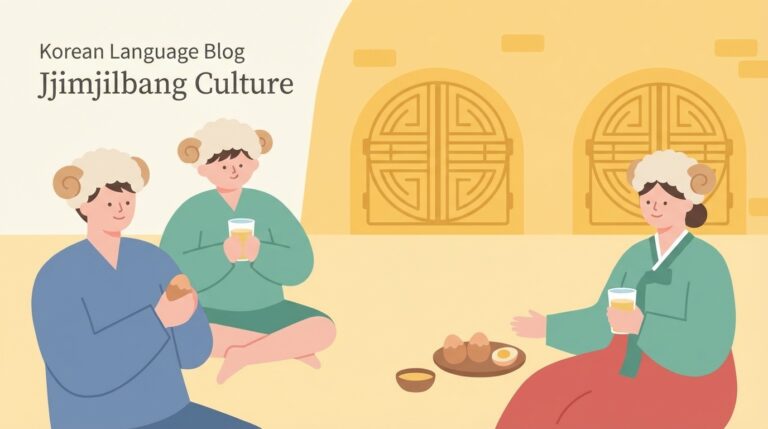
You’ve seen it in countless K-Dramas—the main characters sitting on a heated floor wearing those iconic “sheep head” towels (양머리), cracking baked eggs on each other’s heads, and sipping sweet rice punch after a long day. It looks so cozy and healing, right?
But what happens when you actually step into a Korean bathhouse (찜질방, Jjimjilbang) to spend the night? It can be surprisingly overwhelming. The locker rooms, the naked baths, the shared sleeping halls (수면실)… Where do you sleep? How do you pay for food without your wallet? What if you accidentally walk into a quiet zone crunching loudly on your snacks?
If you don’t know the unwritten rules and the essential phrases, you might end up wandering around the sleeping hall with nowhere to rest, or worse, accidentally offending an old lady (이모님).
This guide is based on real SOS messages from our students who visited a Jjimjilbang for the first time. Let’s make sure you look like a total local—an absolute ‘인싸 (Insider)’—on your next overnight spa adventure!
Phase 2: Core Expressions Deep Dive
1. 여기서 자도 돼요?
- Pronunciation: yeogiseo jado dwaeyo? [yuh-gee-suh jah-doh dway-yo?]
- Meaning: Literal: “Is it okay to sleep here?” / Real Nuance: “Is this spot taken, or can I lay my mat here?”
- K-Culture Moment: You walk into the huge communal sleeping room. It’s dimly lit, and people are scattered everywhere on thin mats. You spot a small empty corner near an outlet. Before you claim it, you quietly ask the person next to it to make sure it’s not saved for their friend.
- Editor’s Insight: This phrase is an absolute lifesaver. Korean Jjimjilbangs operate on a ‘first-come, first-served’ basis for floor space. Asking this politely shows you have basic “눈치 (Nunchi)” and respect for others’ personal boundaries in a shared space.
- Situation Spectrum:
- Casual (To a friend): 야, 여기서 잘까? ✅
- Polite (To a stranger): 여기서 자도 돼요? ✅
- Formal (To staff): 여기서 자도 됩니까? ⚠️ (A bit too stiff for a relaxing spa!)
- 🤔 Think About It: Why is asking for permission to occupy a small piece of floor so important in a public space? How does your culture handle personal space in shared public areas?
2. 식혜 하나랑 구운 계란 주세요.
- Pronunciation: sikhye hanarang guun gyeran juseyo. [shee-kyeh ha-na-rang goo-oon gyeh-ran joo-seh-yo]
- Meaning: “One Sikhye (sweet rice punch) and baked eggs, please.”
- K-Culture Moment: This is the Holy Trinity of Jjimjilbang food. In every drama, when someone runs away from home to a bathhouse, they are always eating this combo. The sweet, icy Sikhye perfectly balances the heat from the saunas, and the warm, nutty baked eggs keep you full.
- Editor’s Insight: You’ll say this at the “매점 (Maejeom)” or snack bar. You don’t need cash! You just say this phrase, and the auntie will point to a scanner where you tap your locker bracelet. Magic!
- Situation Spectrum:
- Casual: 식혜 하나랑 계란 줘. 🚫 (Don’t say this to the staff!)
- Polite: 식혜 하나랑 구운 계란 주세요. ✅
- 🤔 Think About It: Why do Koreans love eating hot food (like baked eggs or seaweed soup) while sweating in a hot room?
3. 매트 하나 더 써도 될까요?
- Pronunciation: maeteu hana deo sseodo doelkkayo? [ma-teu ha-na duh ssuh-doh dwel-kka-yo?]
- Meaning: “Can I use one more mat?”
- K-Culture Moment: The sleeping mats at a Jjimjilbang are notoriously thin. Your back might hurt if you’re not used to sleeping on the floor. You approach the staff member organizing the mats to ask if you can double up.
- Editor’s Insight: Use this phrase carefully! On crowded weekends, they might say no because mats are limited. But on a quiet Tuesday night, asking nicely with this phrase will usually get you a “Yes!”
- Situation Spectrum:
- Casual: 매트 하나 더 쓸게. 🚫
- Polite: 매트 하나 더 써도 될까요? ✅
Phase 3: Textbook vs Real Korean
[Renting a Mat / Blanket]
* 📖 Textbook Korean: 수면용 매트를 하나 빌려주시기 바랍니다. (Please lend me one sleeping mat.)
* 🗣️ Real Korean: 이모님, 저기 매트 하나 가져가도 돼요? (Auntie, can I take one mat from over there?)
* 💡 Why the difference?: Koreans use family terms like “이모님 (Auntie)” to show friendly respect to service workers, instantly breaking the ice and making the interaction warmer.
[Waking Up Your Friend in the Morning]
* 📖 Textbook Korean: 아침이 되었습니다. 이제 일어나세요. (It is morning. Please wake up now.)
* 🗣️ Real Korean: 야, 일어나. 배고파. 매점 가자. (Hey, wake up. I’m hungry. Let’s go to the snack bar.)
* 💡 Why the difference?: Close friends in Korea use very direct, short sentences. Sleepovers at a Jjimjilbang are all about casual bonding, so formal speech between friends sounds incredibly awkward.
Bottom Note: At a B1 level, you want to sound polite to strangers but natural. Stick to “~해요” or “~해도 돼요?” forms. It strikes the perfect balance between respect and casual spa vibes!
Phase 4: Cultural Context — K-Culture Deep Dive
4-1. Non-verbal Communication: The Magic Bracelet & Nunchi
At a Jjimjilbang, your locker key is attached to a coiled elastic bracelet. Never lose it! You wear it on your wrist or ankle. This isn’t just a key; it’s your credit card. When you buy food, use the massage chairs, or rent a blanket, you simply say the phrase and tap your wristband against the scanner.
Also, use your Nunchi (눈치) in the sleeping hall. Even though people are sleeping openly on the floor, you should avoid walking too closely to someone’s head. Step lightly and speak in whispers!
4-2. K-Drama Connection: The Runaway Trope
In countless K-Dramas, when the main character gets into a huge fight with their family or gets kicked out of their house, they pack a small bag and head to the Jjimjilbang to sleep.
Why? Because it’s cheap, safe, open 24 hours, and has food! In the drama Crash Landing on You or Legend of the Blue Sea, you see characters marveling at the Jjimjilbang culture.
Critical View: While dramas make it look like people sleep deeply and peacefully, the reality is that there’s often someone snoring loudly in the corner, and the TVs are usually on until late. Bring earplugs!
Phase 5: Real-Life Roleplay Scenario
Setting: 11:30 PM. The main hall of “Dragon Hill Spa” in Seoul. The heated floor is warm, the lights are dimmed, and you can hear the faint sound of a TV playing a late-night variety show. You are wearing your comfy cotton Jjimjilbang uniform (찜질복). You walk up to the snack bar.
Characters:
– YOU: A traveler ending a long day of sightseeing, craving some late-night snacks before sleeping on the floor.
– 이모님 (Auntie): The snack bar owner. Fast, efficient, but friendly.
Dialogue:
YOU: 이모님, 안녕하세요!
(imohnim, annyeonghaseyo!)
[Auntie, hello!]
이모님: 네~ 뭐 드릴까?
(ne~ mwo deurilkka?)
[Yes~ what can I get you?]
YOU: 식혜 하나랑 구운 계란 주세요.
(sikhye hanarang guun gyeran juseyo.)
[One Sikhye and baked eggs, please.]
이모님: 네, 계란 세 개짜리?
(ne, gyeran se gaejjari?)
[Yes, the three-egg pack?]
YOU: 네, 맞아요. 아, 그리고 수건 하나 더 살 수 있나요?
(ne, majayo. a, geurigo sugeon hana deo sal su innayo?)
[Yes, that’s right. Ah, and can I buy one more towel?]
이모님: 수건은 카운터 가서 말해야 돼. 팔찌 이쪽으로 대세요~
(sugeoneun kaunteo gaseo malhaeya dwae. paljji ijjogeuro daeseyo~)
[For towels, you have to tell the front counter. Tap your bracelet here~]
(🎭 Stage Direction: You tap your wristband. Beep!)
YOU: 감사합니다! 저… 매트 하나만 가져가도 돼요?
(gamsahamnida! jeo… maeteu hanaman gajyeogado dwaeyo?)
[Thank you! Um… can I take one mat?]
이모님: 저기 구석에 남은 거 하나 있네. 그거 가져가.
(jeogi guseoge nameun geo hana inne. geugeo gajyeoga.)
[There’s one left in the corner over there. Take that one.]
🔀 Your Turn! As you walk to the corner, a Korean guy also reaches for the last mat at the same time. What do you say?
– A) “이거 제 거예요!” (This is mine!)
– B) “아, 먼저 쓰세요.” (Oh, please use it first.)
– C) “같이 쓸래요?” (Wanna share?)✅ Best Choice: B — “먼저 쓰세요” (Please use it first) is the most polite and natural way to yield. Koreans highly value mutual respect. Usually, if you say this, they will feel apologetic and might insist you take it. (It’s the polite Korean push-and-pull!).
⚠️ Choice A & C Analysis: ‘이거 제 거예요’ sounds very aggressive since you hadn’t claimed it yet. ‘같이 쓸래요?’ (Wanna share a sleeping mat?) is extremely weird to say to a stranger!
Phase 6: 10-Second Shadowing Drill
Practice these lines out loud. Pay attention to the pauses (/) and the emotion tags!
- 🥺 공손하게: 여기서 / 자도 / 될까요?
(yeogiseo / jado / doelkkayo?)
“Could I possibly sleep here?” -
😊 밝게: 식혜 하나랑 / 구운 계란 / 주세요!
(sikhye hanarang / guun gyeran / juseyo!)
“One Sikhye and baked eggs, please!” -
😤 단호하게 (If someone is being too loud): 저기요, / 조금만 / 조용히 해주세요.
(jeogiyo, / jogeumman / joyonghi haejuseyo.)
“Excuse me, please keep it down a bit.”
Phase 7: K-Culture Mini Dictionary
| 한국어 | Romanization | 영어 | 맥락 설명 (Context) |
|---|---|---|---|
| 수면실 | sumyeonsil | Sleeping Room | A designated quiet room or cave-like cubicles specifically for sleeping. |
| 양머리 | yangmeori | Sheep Head | Folding a towel to look like sheep horns. A fun cultural tradition in saunas! |
| 찜질복 | jjimjilbok | Sauna Uniform | The matching T-shirt and shorts given to you at the entrance. |
| 식혜 | sikhye | Sweet Rice Punch | A traditional sweet Korean drink made of fermented malt and rice. |
| 눈치 | nunchi | Social Awareness | Reading the room. Knowing not to be loud when people are resting on the mats. |
Phase 8: Traveler’s Survival Kit
🆘 Top 3 Survival Expressions for the Jjimjilbang
1. 🇰🇷 “와이파이 비밀번호가 뭐예요?” (waipai bimilbeonhoga mwoyeyo?)
– 🗣️ Meaning: What’s the Wi-Fi password?
2. 🇰🇷 “콘센트 써도 돼요?” (konsenteu sseodo dwaeyo?)
– 🗣️ Meaning: Can I use the power outlet? (Crucial for charging your phone overnight!)
3. 🇰🇷 “남탕/여탕은 어디로 가요?” (namtang/yeotangeun eodiro gayo?)
– 🗣️ Meaning: Where is the men’s/women’s bath?📌 Editor’s Travel Note
– Shoes OFF: The moment you walk through the main entrance, take your shoes off. You’ll put them in a tiny shoe locker before heading to the main counter.
– Gender Separation: The wet saunas and baths (목욕탕) are strictly separated by gender and require you to be completely naked. The dry saunas (찜질방) and sleeping halls are co-ed, and you MUST wear your Jjimjilbok (uniform) there!
– Valuables: Don’t leave your phone or wallet loose on your sleeping mat. Keep them in your locked locker while you sleep!
Phase 9: Critical Thinking Corner — “한 발 더 깊이”
[Privacy vs. Community: Space in Korea]
Koreans generally value personal space, so why are they so comfortable sleeping on the floor next to complete strangers in a Jjimjilbang?
This reflects a unique aspect of Korean culture rooted in “정 (Jeong)” and the communal lifestyle of the past. Traditionally, Korean families slept together on heated floors (Ondol). The Jjimjilbang is an extension of this communal living room. It’s a space where social titles are literally stripped away (everyone wears the exact same uniform), creating a rare, egalitarian environment where people feel a shared sense of comfort and collective relaxation.
💬 Your Turn: Would you feel comfortable sleeping in a massive room with 50 strangers? How does your culture view communal relaxation? Let us know in the comments!
Phase 10: FAQ & Avoiding Mistakes
Q: “Can I wear a swimsuit in the wet bath areas?”
No. In the gender-separated bathhouses (목욕탕), you must be completely nude. It might feel scary at first, but nobody is looking at you. It’s a completely natural part of Korean culture!
Q: “Is it okay to sleep in the hot sauna rooms?”
It is incredibly dangerous to fall asleep in the extremely hot kilns (like the 80°C salt rooms). There are specific “수면실” (sleeping halls) or cooler areas designated for overnight sleeping.
❌ Common Mistake #1: Losing your locker bracelet while sleeping.
✅ Do this instead: Keep it securely wrapped around your ankle while you sleep. If you lose it, you might have to pay a hefty penalty fee because it’s linked to your credit card!❌ Common Mistake #2: Bringing outside food.
✅ Do this instead: Jjimjilbangs survive on their food sales. Never bring outside food in your bag. Embrace the Sikhye and baked eggs!
Phase 11: Summary & Action Items
- One-Liner Summary: A successful Jjimjilbang sleepover requires knowing how to ask for space (“여기서 자도 돼요?”) and how to order the ultimate comfort food using your magic wristband.
Action Mission 3 Steps:
– 🥉 Bronze (Solo): Look up a picture of a “Jjimjilbang” on Google and point to the floor, saying “여기서 자도 돼요?” out loud.
– 🥈 Silver (Online): Fold a towel into a “Yangmeori” (Sheep Head) using a YouTube tutorial, snap a selfie, and post it to our community!
– 🥇 Gold (Real Life): Visit a Korean spa (even if it’s a K-Town spa in your country) and order “식혜랑 구운 계란 주세요!” in person.
- K-Culture Mission: Watch an episode of a K-Drama where characters go to a sauna. Spot the “매점” (snack bar) and see how they crack the eggs on each other’s heads. (Warning: It hurts if you do it too hard!)
Phase 12: Quiz — Interactive Challenge
1. Situational Judgment: You want to buy an iced coffee (냉커피) at the Jjimjilbang snack bar. You forgot your wallet in your locker. What should you do?
– A) Run back upstairs to get cash.
– B) Tap your locker key bracelet on the scanner.
– C) Give the Auntie your ID as collateral.
(Answer: B. Everything is charged to your locker key, and you pay the total bill when you leave the facility!)
2. Fill in the Blank:
“Excuse me, can I sleep here?”
👉 저기요, 여기서 _____ 돼요?
(Answer: 자도)
3. True or False — K-Culture Edition:
“It is perfectly normal to wear the provided Jjimjilbang T-shirt and shorts into the wet bath area to take a shower.”
(Answer: FALSE. The wet baths are strictly naked zones. You take off the uniform, leave it in your locker, and walk into the bath area with just a small towel!)
Did you pass? Now you are fully ready to survive—and thrive—during an overnight stay at a Korean Jjimjilbang. Sleep well, and don’t forget your earplugs!
Frequently Asked Questions (FAQ)
Q: What does "여기서 자도 돼요?" mean in Korean and how do you pronounce it?
A: In Korean, "여기서 자도 돼요?" is pronounced [yeogiseo jado dwaeyo? [yuh-gee-suh jah-doh dway-yo?] and means: Literal: "Is it okay to sleep here?" / Real Nuance: "Is this spot taken, or can I lay my mat here?"
Q: What does "식혜 하나랑 구운 계란 주세요." mean in Korean and how do you pronounce it?
A: In Korean, "식혜 하나랑 구운 계란 주세요." is pronounced [sikhye hanarang guun gyeran juseyo. [shee-kyeh ha-na-rang goo-oon gyeh-ran joo-seh-yo] and means: "One Sikhye (sweet rice punch) and baked eggs, please."
Q: What does "매트 하나 더 써도 될까요?" mean in Korean and how do you pronounce it?
A: In Korean, "매트 하나 더 써도 될까요?" is pronounced [maeteu hana deo sseodo doelkkayo? [ma-teu ha-na duh ssuh-doh dwel-kka-yo?] and means: "Can I use one more mat?"







