

Phase 1: Empathy & Immersion
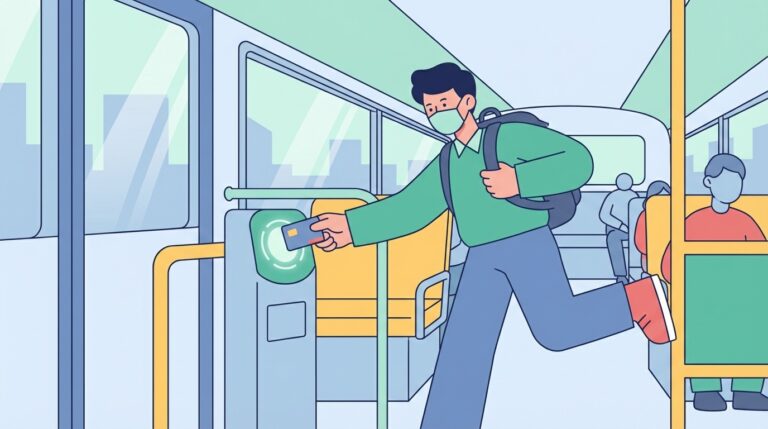
Hello! I’m your Daily Hangul Editor. Picture this: You’re watching a K-Drama. The protagonist is standing on a crowded, swaying bus, staring out the window with AirPods in, looking dramatic. But suddenly—BEEP! They tap their card, sprint to the back door, and jump off the exact second the doors fly open. Welcome to the real Korean public transit experience.
If you’ve ever ridden a bus in Seoul, you know the absolute adrenaline rush of the “tag-off.” Textbooks teach you how to ask for directions, but they rarely prepare you for the intense Ppalli-ppalli (hurry up) tempo of a Korean bus during rush hour. What if your card doesn’t work? What if the door closes before you can get off?
Today, we are diving into the C1-level nuances of bus tagging culture. Mastering these expressions won’t just save you from an awkward ride; it will make you sound like an absolute Seoulite.
Phase 2: Deep Dive into Core Expressions
1. 하차태그 하셔야 환승 할인돼요.
- Pronunciation: Hacha-taegeu hasyeoya hwanseung halin-dwaeyo. [ha-cha-tay-geu / ha-syeo-ya / hwan-seung / ha-lin-dway-yo]
- Meaning: Literal: You must do a get-off tag for the transfer discount to work. / Real nuance: You need to tap your card when you get off, or you’ll lose the transfer discount!
- K-Culture Moment: You’re with a Korean colleague. You casually try to step off the bus without tapping your card because it’s your final destination. Your colleague grabs your arm in a panic and says this. In Korea, missing the tag-off means you get hit with a penalty fare on your next ride!
- Editor’s Insight: The word ‘하차’ (getting off) combined with the English loanword ‘태그’ (tag) forms a seamless modern compound noun. Native speakers use ‘찍다’ (to stamp) or ‘태그하다’ (to tag) interchangeably.
- Situation Spectrum:
- Friends (Casual): ✅ (Simply say: “야, 내릴 때 카드 찍어.”)
- Colleagues (Semi-formal): ✅
- Boss/Elders (Formal): ⚠️ (Use: “내리실 때 카드 꼭 태그하셔야 해요.”)
- 🤔 Think About It: Why does Korea have such a strict transfer system? The ‘환승할인’ (transfer discount) is a cornerstone of Korea’s hyper-efficient welfare system, encouraging public transit use. Does your city have an integrated fare system like this?
2. 잔액이 부족합니다.
- Pronunciation: Janaegi bujok-hamnida. [ja-nay-gi / boo-jok-ham-ni-da]
- Meaning: Literal: The balance is insufficient. / Real nuance: You’re out of money, and now the whole bus knows it.
- K-Culture Moment: The bus is silent. You confidently tap your T-money card. Instead of the cheerful single BEEP (“승차입니다”), the machine loudly announces: “잔액이 부족합니다!” Heads turn. You freeze. It’s a rite of passage for anyone living in Korea.
- Editor’s Insight: This is the automated voice from the machine (단말기). As a C1 learner, you need to know how to respond to this embarrassment smoothly. Instead of freezing, you should say, “기사님, 카드로 결제할게요” (Driver, I’ll pay with a credit card) or quickly use your banking app to top up your mobile transit card.
- Situation Spectrum:
- Automated Voice: ✅
- Spoken by a human: 🚫 (We don’t usually say this in daily conversation unless joking about being broke).
- 🤔 Think About It: In Korea, machine voices are polite (using formal ~습니다). How does technology in your country communicate with users? Is it robotic, or polite like a human?
3. 기사님, 잠시만요! 내릴게요!
- Pronunciation: Gisa-nim, jamsi-manyo! Naerilgeyo! [gi-sa-nim / jam-shi-man-yo / nay-ril-ge-yo]
- Meaning: Literal: Driver, just a moment! I will get off! / Real nuance: WAIT! DON’T CLOSE THE DOOR! I’M GETTING OFF!
- K-Culture Moment: You’re stuck behind a crowd of high schoolers (만원버스 – packed bus). The doors open, but you can’t reach the exit in time. The doors start to close. This is the ultimate survival phrase you must shout across the bus to make the driver stop.
- Editor’s Insight: The term ‘기사님’ (driver) is crucial here. Never yell ‘아저씨’ (Ahjussi) if you can help it; ‘기사님’ shows much more respect. The tone should be urgent but polite.
- Situation Spectrum:
- Friends (Casual): 🚫
- Colleagues (Semi-formal): 🚫
- Bus Driver (Formal/Urgent): ✅
- 🤔 Think About It: The Ppalli-ppalli culture means bus doors close fast. Speaking up in a public space can be daunting for foreigners, but in Korea, advocating for yourself loudly but politely is sometimes necessary.
Phase 3: Textbook vs. Real Korean
[Telling someone to tap their card]
* 📖 Textbook Korean: 버스에서 내릴 때 교통카드를 단말기에 접촉하십시오. (When disembarking the bus, please contact your transit card to the terminal.)
* 🗣️ Real Korean: 내릴 때 카드 찍으세요. / 환승 찍으세요. (Tap your card when getting off / Tap for transfer.)
* 💡 Why the difference?: Koreans prioritize extreme efficiency in speech. ‘접촉하다’ (to contact) is too formal. ‘찍다’ (to stamp) visually represents the quick tap of the card.
[When your card fails]
* 📖 Textbook Korean: 제 교통카드에 돈이 없습니다. (I have no money on my transit card.)
* 🗣️ Real Korean: 헐, 잔액 없네. 잠시만요, 다른 카드로 할게요. (Whoops, no balance. Hold on, I’ll use another card.)
* 💡 Why the difference?: Acknowledging the situation with a quick exclamation (‘헐’ – OMG) and immediately offering a solution (‘다른 카드로 할게요’) fits the fast pace of boarding a bus.
Phase 4: Cultural Context — K-Culture Deep Dive
4-1. Non-Verbal Communication: The “Hover Tap” and Nunchi
In Korea, you do not wait for the bus to come to a complete stop before getting out of your seat. About one stop prior, you should stand up, navigate to the back door, and prepare your card. Notice how Koreans do the “Hover Tap”—holding their card about an inch away from the scanner, waiting for the GPS to switch to the current stop so they can tap off and jump out simultaneously. It’s an intricate dance of Nunchi (reading the room) to ensure you aren’t blocking the exit or delaying the bus.
4-2. The K-Drama Bus Trope
If you’ve watched any romantic K-Drama, you know the bus is a prime location for romance. The bus suddenly jerks, and the female lead falls perfectly into the male lead’s arms. In reality? The bus jerks because of the dynamic Seoul traffic, and you’ll likely just stumble into a pole. However, the culture of sitting by the window, listening to K-Pop on a rainy day, leaning against the glass… that aesthetic is 100% real and cherished by Koreans commuting home after a long day.
Phase 5: Interactive Role-Play Scenario
Setting: A rainy Friday evening. You are on the notorious Bus 472 heading towards Gangnam. It’s a ‘만원버스’ (fully packed bus). You are standing near the back door with your Korean friend, Ji-hoon.
Characters:
– YOU: An expat who is relatively fluent in Korean but still gets nervous on crowded buses.
– Ji-hoon (28): Your Korean friend, relaxed, a master of Seoul public transit.
Dialogue:
Ji-hoon: 우리 다음 정류장에서 내려야 돼. 카드 미리 꺼내놔.
(Woori da-eum jeongnyujang-eseo naeryeoya dwae. Kadeu miri kkeonaenwa.)
[We need to get off at the next stop. Get your card out in advance.]
(🎭 Stage Direction: Ji-hoon expertly balances without holding a handle and taps his card. BEEP!)
YOU: 알았어. 어? 근데 단말기까지 손이 안 닿아. 사람 너무 많아.
(Arasseo. Eo? Geunde danmalgi-kkaji soni an da-a. Saram neomu mana.)
[Got it. Huh? But I can’t reach the terminal. There are too many people.]
Ji-hoon: 카드 줘봐. 내가 찍어줄게.
(Kadeu jwobwa. Naega jjigeojulge.)
[Give me your card. I’ll tap it for you.]
(🎭 Stage Direction: You hand him your card. He taps it. “잔액이 부족합니다!” echoes through the bus.)
Ji-hoon: 야, 너 잔액 없대! 어떡해, 문 열리는데?
(Ya, neo janaek eopdae! Eotteokhae, mun yeollineunde?)
[Hey, it says you have no balance! What do we do, the doors are opening?]
🔀 Your Turn! How do you react?
– A) “아, 그럼 환승 포기할게. 그냥 내리자!”
– B) “잠깐만! 기사님, 저 이거 카드로 결제할게요!”
– C) “비켜주세요! 저 내려야 돼요!”✅ Best Choice for C1: A.
Wait, really? Yes! If you are getting off (하차) and your card has no balance, you only lose the transfer discount (환승할인). You don’t need to pay again to get off. The most pragmatic Seoulite move is to just get off quickly (포기할게 – I’ll give up) and reload your card at a subway station later. Choice B will delay the bus and annoy the driver. Choice C is rude.
Phase 6: 10-Second Shadowing Drill
Time to practice your pacing and tone!
😤 기사님! / 저 아직 / 안 내렸어요! / 문 좀 열어주세요!
(Gisa-nim! / jeo ajik / an naeryeosseoyo! / mun jom yeoreojuseyo!)
“Driver! / I haven’t / gotten off yet! / Please open the door!”
Pro-tip: Project your voice from your chest. Don’t be shy. The bus is loud!
Phase 7: K-Culture Mini Dictionary
| Korean | Romanization | English | Context |
|---|---|---|---|
| 환승 | hwanseung | Transfer | The holy grail of Korean transit. You can transfer between buses and subways up to 4 times for free or at a massive discount. |
| 단말기 | danmalgi | Terminal / Scanner | The machine where you tap your T-money card. |
| 만원버스 | manwon-beoseu | Packed bus | Literally ‘10,000 won bus’ (actually derived from characters meaning full capacity). A bus with no breathing room. |
| 승차감 | seungchagam | Ride comfort | Often used jokingly to describe how aggressive a bus driver’s driving style is. |
Phase 8: Traveler Survival Kit
Navigating Seoul buses can be intimidating, but these phrases will save your life.
🆘 Survival Expression #1: Multi-passenger boarding
– 🇰🇷 “기사님, 2명이요.” (Gisa-nim, du-myeong-iyo.)
– 🗣️ Pronunciation Guide: [gi-sa-nim, doo-myung-ee-yo]
– 📍 Where to use: Boarding the bus with a friend but only having one T-money card.
– 💡 Pro Tip: Tell the driver before you tap. Wait for them to adjust the machine, then tap once. When you get off, just tap normally!
📌 Editor’s Travel Note
– Useful Apps: KakaoBus (gives you real-time bus arrivals down to the second).
– Climate Card (기후동행카드): If you’re a heavy commuter in Seoul, look into this unlimited transit pass. It’s a game-changer.
– No Cash?: Seoul buses are rapidly becoming “Cashless” (현금 없는 버스). Always carry a physical card or have Apple Pay/Samsung Pay ready with a transit-enabled card.
Phase 9: Critical Thinking Corner — “A Step Deeper”
🧠 Think Deeper: Language, Power & Technology
Korea’s transit system is a marvel of big data. Every tap on and tap off feeds into a massive algorithm that adjusts bus routes and schedules in real-time. This system is completely dependent on the public’s adherence to the rules. The automated voice “하차입니다” isn’t just a receipt; it’s an auditory confirmation of a social contract. The Korean Ppalli-ppalli mindset birthed this frictionless payment system, but it also creates immense social pressure not to be the “one person who holds up the line.”
💬 Your Turn:
Does your home country prioritize public efficiency over individual relaxation? How does the language around your public transit reflect your culture’s values? Let us know in the comments!
Phase 10: FAQ & Avoiding Misunderstandings
- Q: Can I tag off immediately after boarding if the bus is crowded?
- A: No! The machine uses GPS. If you tag off too early, the machine will say “이미 처리되었습니다” (Already processed), and you won’t get your transfer discount when you actually get off later.
- Q: Do I need to say “Thank you” to the bus driver?
- A: It’s polite to give a quick nod or say “감사합니다” (Gam-sa-ham-ni-da) as you step off, but it’s not strictly required. Never stop walking to say it—say it while disembarking!
❌ Common Mistake: Yelling “Stop!” in English or “멈춰요!” (Meom-chwo-yo) when you miss your stop.
✅ Do this instead: Shout “기사님, 내릴게요!” (Driver, I’m getting off!). ‘멈춰요’ sounds like a police officer commanding a suspect to halt.
Phase 11: Summary & Action Items
- One-Liner Summary: Master the art of “Jjikda” (tapping) and survive the fast-paced Korean bus system with confidence and Nunchi!
-
Action Mission 3 Steps:
- 🥉 Bronze (Solo): Practice saying “기사님, 2명이요” loudly in front of the mirror.
- 🥈 Silver (Online): Go to a Korean learning forum and write a short paragraph about your worst/best bus experience in Korea using the word ‘단말기’.
- 🥇 Gold (Real World): Next time you take a bus in Seoul, successfully execute the “Hover Tap” right before the doors open!
- K-Culture Mission: Watch a Seoul walking vlog on YouTube. Skip to the part where they ride a bus. Close your eyes and listen specifically for the “환승입니다” or “잔액이 부족합니다” sounds!
Phase 12: Quiz — Interactive Challenge
1. Fill in the Blank:
You are getting off the bus. Your friend reminds you to tap your card.
“야, 내릴 때 꼭 카드 [ ______ ].”
2. Situational Judgment:
You are boarding the bus with a friend, and you want to pay for both of you with one T-money card. What is the correct sequence of actions?
– A) Tap the card twice very fast.
– B) Say “기사님, 2명이요”, wait for the driver to press a button, then tap once.
– C) Tap once, hand the card to your friend, and let them tap it.
3. True or False – K-Culture Edition:
If you don’t tap your card when getting off a Seoul bus, you will be arrested. (T/F)
(Answers: 1. 찍어 / 태그해, 2. B – Tapping twice will just result in an “Already processed” error! 3. False – You won’t be arrested, but you will be charged the maximum base fare on your next ride, losing your transfer discount!)
Frequently Asked Questions (FAQ)
Q: What does "하차태그 하셔야 환승 할인돼요." mean in Korean and how do you pronounce it?
A: In Korean, "하차태그 하셔야 환승 할인돼요." is pronounced [Hacha-taegeu hasyeoya hwanseung halin-dwaeyo. [ha-cha-tay-geu / ha-syeo-ya / hwan-seung / ha-lin-dway-yo] and means: Literal: You must do a get-off tag for the transfer discount to work. / Real nuance: You need to tap your card when you get off, or you'll lose the transfer discount!
Q: What does "잔액이 부족합니다." mean in Korean and how do you pronounce it?
A: In Korean, "잔액이 부족합니다." is pronounced [Janaegi bujok-hamnida. [ja-nay-gi / boo-jok-ham-ni-da] and means: Literal: The balance is insufficient. / Real nuance: You're out of money, and now the whole bus knows it.
Q: What does "기사님, 잠시만요! 내릴게요!" mean in Korean and how do you pronounce it?
A: In Korean, "기사님, 잠시만요! 내릴게요!" is pronounced [Gisa-nim, jamsi-manyo! Naerilgeyo! [gi-sa-nim / jam-shi-man-yo / nay-ril-ge-yo] and means: Literal: Driver, just a moment! I will get off! / Real nuance: WAIT! DON'T CLOSE THE DOOR! I'M GETTING OFF!







