

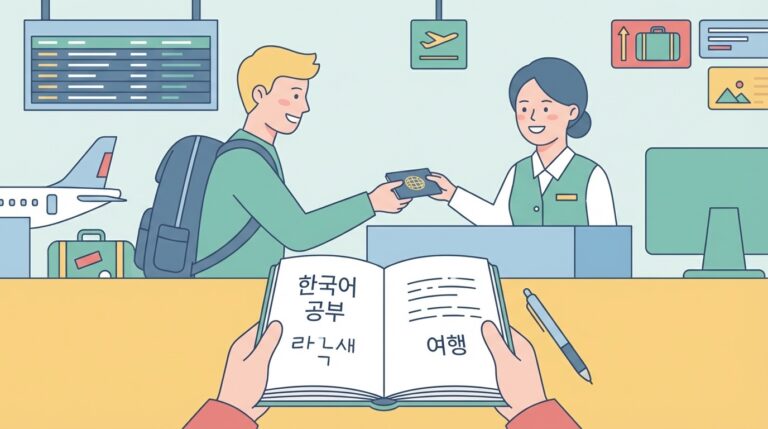
Phase 1: Empathy & The Airport Vibes
Hello! I’m your Daily Hangul Editor.
You’ve probably seen it in a K-Drama: the tense airport scene where the protagonist rushes through Incheon International Airport, passport in hand, desperately trying to catch someone before they board a flight. It’s dramatic, it’s romantic, and it’s full of tears.
But let’s be real—right now, you’re not in a dramatic romance. You just survived a long flight, or you’re about to start your epic Korean adventure, and all you want is your boarding pass so you can go eat some delicious Kimchi Jjigae in the airport lounge!
The check-in counter is usually your very first (or last) official interaction in Korea. Knowing how to confidently say “Boarding pass, please” in Korean doesn’t just get you your ticket—it shows the staff you respect their culture, and you might even get a warmer smile (or a better seat!). Don’t worry, this guide is based on real questions from beginners just like you.
Phase 2: Core Expressions – Deep Dive
1. 탑승권 주세요 (Boarding pass, please)
- Pronunciation: tapseung-gwon juseyo [tahp-seung-gwon joo-seh-yo]
- Meaning: (Literal) Give me boarding pass / (Real nuance) I would like my boarding pass, please.
- K-Culture Moment: Imagine walking up to the sleek counters of Korean Air or Asiana. The staff greets you warmly. Instead of just sliding your passport silently, saying this phrase makes you look like a seasoned traveler!
- Editor’s Insight: The word ‘주세요 (juseyo)’ is your magic wand in Korea. It means ‘please give me.’ You can attach it to absolutely any noun. Coffee? ‘Keopi juseyo.’ Water? ‘Mul juseyo.’ Boarding pass? ‘Tapseung-gwon juseyo!’
- Situation Spectrum:
- Casual (Friends): ☑️ (Without ‘yo’: tapseung-gwon jwo)
- Semi-formal (Staff/Strangers): ✅ (Perfect!)
- Formal (Boss/Elders): ⛔ (Use ‘jusipsio’ instead)
- 🤔 Think About It: In English, we often use questions like “Could I have…” to be polite. In Korean, a direct request ending in “-yo” is considered perfectly polite. Why do you think Korean favors direct, respectful statements over indirect questions?
2. 여권 여기 있어요 (Here is my passport)
- Pronunciation: yeogwon yeogi isseoyo [yuh-gwon yuh-gee eess-uh-yo]
- Meaning: (Literal) Passport exists here / (Real nuance) Here is my passport.
- K-Culture Moment: When handing over your passport, saying this softens the interaction. It’s much better than just thrusting the booklet at them!
- Editor’s Insight: Notice there is no “my” (nae) in this sentence. Koreans constantly drop pronouns like “I” or “my” when the context is obvious. We know it’s your passport!
- Situation Spectrum:
- Casual: ☑️
- Semi-formal: ✅
- Formal: ⛔
- 🤔 Think About It: Korean is a “high-context” language, meaning much of the information is understood from the situation. Does your native language require you to specify “my” or “your” every time?
3. 짐 부칠게요 (I will check my bags)
- Pronunciation: jim buchilgeyo [jeem boo-cheel-geh-yo]
- Meaning: (Literal) I will send the luggage / (Real nuance) I need to check my bags.
- K-Culture Moment: You’ve just finished a massive shopping spree in Myeongdong. Your suitcase is full of K-Beauty face masks and K-Pop albums. You definitely need to check that bag!
- Editor’s Insight: ‘짐 (jim)’ is a great all-purpose word for luggage, bags, or just ‘stuff.’ The ending ‘-lgeyo’ means ‘I will do X’ and shows your intention politely.
- Situation Spectrum:
- Casual: ☑️
- Semi-formal: ✅
- Formal: ⛔
- 🤔 Think About It: Koreans love efficiency. Saying your intention directly helps the staff move faster. Have you ever experienced Korea’s famous ‘Ppalli-ppalli’ (hurry hurry) culture?
Phase 3: Textbook vs. Real Korean
| Situation | 📖 Textbook Korean | 🗣️ Real Korean | 💡 Why the difference? |
|---|---|---|---|
| Asking for pass | 탑승권을 주시겠습니까? (Would you please give…) | 탑승권 주세요. (Boarding pass, please.) | Efficiency! ‘Juseyo’ is polite enough and gets straight to the point in a busy airport. |
| Handing passport | 나의 여권이 여기에 있습니다. (My passport is here.) | (Handing it over) 여기요. (Right here.) | Actions speak louder than words; a simple ‘Here’ paired with polite body language is best. |
| Checking bags | 제 수하물을 위탁하겠습니다. (I shall entrust my luggage.) | 짐 부칠게요. (I’ll check my bags.) | ‘Suhamul’ (luggage) is formal. ‘Jim’ (bags/stuff) is the everyday term everyone uses. |
Phase 4: K-Culture Deep Dive
4-1. Non-verbal Cue: The ‘Two-Handed Give’
When you hand your passport to the counter staff, do not use one hand while looking away! In Korea, handing things over with two hands is a basic sign of respect. If using two hands feels awkward, you can hold the passport with your right hand and lightly support your right elbow or forearm with your left hand. It immediately shows you understand Korean manners!
4-2. K-Travel Connection: The ‘Ppalli-Ppalli’ Check-in
Incheon International Airport is consistently ranked as one of the best in the world, largely because of the 빨리빨리 (Ppalli-ppalli / Hurry up) culture. Koreans value speed and efficiency. The check-in staff are trained to process you incredibly fast. By having your passport ready, handing it over with two hands, and saying “탑승권 주세요,” you are participating in this beautiful dance of efficiency. The staff will appreciate your Nunchi (social awareness) for keeping the line moving!
Phase 5: Real-Life Roleplay Scenario
Setting: Incheon Airport Terminal 1, Check-in Counter. The smell of duty-free perfume is in the air, and you can hear the hum of excited travelers. You are flying back home after an amazing 2-week trip.
Characters:
– YOU: A traveler whose suitcase is dangerously close to the weight limit.
– STAFF: Min-ji, a friendly but highly efficient airline agent.
Dialogue:
STAFF: 안녕하세요. 여권 주시겠어요? 🙂
(Annyeonghaseyo. Yeogwon jusigesseoyo?)
[Hello. Could I have your passport?]
(…You remember the two-handed rule!)
YOU: 네, 여기 있어요.
(Ne, yeogi isseoyo.)
[Yes, here it is.]
STAFF: 감사합니다. 최종 목적지가 어디신가요?
(Gamsahamnida. Choejong mokjeokjiga eodisingayo?)
[Thank you. Where is your final destination?]
YOU: 뉴욕이요. 아, 탑승권 주세요.
(Nyuyogiyo. Ah, tapseung-gwon juseyo.)
[New York. Ah, boarding pass, please.]
STAFF: 네, 짐 부치시겠어요?
(Ne, jim buchisigesseoyo?)
[Yes, would you like to check any bags?]
YOU: 네, 짐 부칠게요.
(Ne, jim buchilgeyo.)
[Yes, I’ll check my bags.]
STAFF: 가방을 저울에 올려주세요.
(Gabang-eul jeou-re ollyeojuseyo.)
[Please put your bag on the scale.]
YOU: 읏차! (Heaving sound)
(Eut-cha!)
[Heave-ho!]
STAFF: (Smiles) 수하물 표와 탑승권 여기 있습니다.
(Suhamul pyowa tapseung-gwon yeogi itseumnida.)
[Here is your luggage tag and boarding pass.]
🔀 Your Turn! The staff suddenly asks: “창가 자리로 드릴까요?” (Would you like a window seat?)
– A) “아니요.” (No.)
– B) “네, 창가 자리 주세요!” (Yes, window seat please!)
– C) “대박! 콜!” (Awesome! Deal!)✅ Best Choice: B! It perfectly uses the “Noun + Juseyo” structure we learned.
⚠️ Choice C Analysis: “대박 (Daebak)” is great for friends, but definitely too casual and a bit comical to say to the check-in staff!
🎬 Bonus Scenario: Lost in the Terminal
You got your boarding pass, but now you can’t find your gate.
YOU: 저기요… 15번 게이트 어디예요?
(Jeogiyo… sibo-beon geiteu eodiyeyo?)
[Excuse me… where is gate 15?]
STAFF: 아, 저쪽으로 쭉 가세요.
(Ah, jeojjog-euro jjuk gaseyo.)
[Ah, go straight that way.]
Phase 6: 10-Second Shadowing Drill
Read these out loud! Pay attention to the pauses (/) and the emotion tags.
- 😊 밝고 친절하게 (Bright and friendly):
여권 / 여기 / 있어요.(yeogwon / yeogi / isseoyo.) - 😊 자신감 있게 (With confidence):
탑승권 / 주세요.(tapseung-gwon / juseyo.) - 🙌 힘주어서 (With effort as you lift):
짐 / 부칠게요!(jim / buchilgeyo!)
Phase 7: K-Culture Mini Dictionary
| Korean | Romanization | English | Context |
|---|---|---|---|
| 탑승권 | tapseung-gwon | Boarding pass | The golden ticket to your flight. |
| 여권 | yeogwon | Passport | Always keep this handy. |
| 수하물 / 짐 | suhamul / jim | Luggage/Bags | ‘Suhamul’ is formal (on signs), ‘Jim’ is for speaking. |
| 눈치 | nunchi | Social awareness | Having the ‘nunchi’ to have your passport ready before reaching the counter! |
| 빨리빨리 | ppalli-ppalli | Hurry up / Fast | The core spirit of Korean airport efficiency. |
Phase 8: Traveler Survival Kit
🆘 Survival Phrases TOP 3 for the Airport
1. 🇰🇷 “화장실 어디예요?”
– 🗣️ (hwajangsil eodiyeyo?)
– 💡 Meaning: Where is the bathroom? (Crucial after a long flight!)
2. 🇰🇷 “게이트 어디예요?”
– 🗣️ (geiteu eodiyeyo?)
– 💡 Meaning: Where is the gate?
3. 🇰🇷 “이거 기내에 가지고 탈 수 있어요?”
– 🗣️ (igeo ginaee gajigo tal su isseoyo?)
– 💡 Meaning: Can I take this on the plane? (For carry-on questions).📌 Editor’s Travel Note
– Navigating: Google Maps doesn’t work well for walking in Korea, but at the airport, you just need to follow the incredible English signs!
– Duty-Free: If you buy liquid K-Beauty products at the duty-free shop after security, they will seal it in a special bag. Do NOT open it until you reach your final destination!
Phase 9: Critical Thinking Corner — “A Step Deeper”
🧠 Think Deeper: Language & Body — The Respect of Giving
In many Western cultures, handing someone an object is purely a practical action. But in Korea, the way you hand over your passport (여권) carries deep social weight. Rooted in Confucianism, using two hands to give or receive items from someone older, or from service staff, is a physical manifestation of respect. Korean isn’t just spoken with the mouth; it’s spoken with the body. When you pair “탑승권 주세요” with a two-handed gesture, you aren’t just communicating—you are showing that you value their culture.
💬 Your Turn: How do people show respect to service workers (like airport staff) in your home country? Share with us in the comments!
Phase 10: FAQ & Avoiding Mistakes
- Q: Do I need to bow to the airport staff?
- A: A slight head nod while saying “안녕하세요 (Hello)” or “감사합니다 (Thank you)” is perfect. You don’t need to do a full 90-degree bow!
- Q: Can I just say “탑승권 줘 (tapseung-gwon jwo)”?
- A: ⛔ NO! Dropping the “요 (yo)” makes it informal/casual (Banmal). Never use this with service staff unless you want to seem very rude.
❌ Common Mistake #1: Throwing or tossing your passport onto the counter.
✅ Do This Instead: Hand it directly to the staff member, ideally with both hands or a slight nod.❌ Common Mistake #2: Pointing at your luggage with one index finger.
✅ Do This Instead: Gesturing toward your bags with an open palm facing up is the polite way to point in Korea!
Phase 11: Summary & Action Items
💡 One-Liner Summary: Want your boarding pass? Just remember “Noun + Juseyo” and hand over your passport with two hands!
🎯 Action Missions:
– 🥉 Bronze (Solo): Stand in front of a mirror, hold a book like a passport, and practice saying “여권 여기 있어요” while handing it forward with two hands.
– 🥈 Silver (Online): Comment below with what kind of ‘짐’ (luggage) you usually travel with! (e.g., Backpack? Giant suitcase?)
– 🥇 Gold (Real Life): Next time you fly, politely hand your passport to the counter staff using the Korean two-handed gesture, even if they aren’t Korean!
🇰🇷 K-Culture Mission: Search for an “Incheon Airport Walking Tour” on YouTube. When they walk past the check-in counters, shout out loud: “탑승권 주세요!”
Phase 12: Interactive Quiz — Test Your Nunchi!
1. Situational Judgment: You finally reach the front of the line. The staff smiles at you. What is the BEST thing to say as you hand them your travel document?
– A) 나의 여권. (Nae yeogwon.)
– B) 여권 여기 있어요. (Yeogwon yeogi isseoyo.)
– C) 빨리빨리! (Ppalli-ppalli!)
2. Fill in the Blank: To politely ask for your ticket, you say: “탑승권 _______.”
– A) 부칠게요 (buchilgeyo)
– B) 주세요 (juseyo)
– C) 대박 (daebak)
3. True or False (K-Culture Edition):
When the staff gives you your boarding pass, you should snatch it quickly with one hand to respect their ‘Ppalli-ppalli’ time.
(Answers: 1: B, 2: B, 3: False! Always receive items with two hands to show respect, even if you are hurrying!)
Frequently Asked Questions (FAQ)
Q: What does "탑승권 주세요 (Boarding pass, please)" mean in Korean and how do you pronounce it?
A: In Korean, "탑승권 주세요 (Boarding pass, please)" is pronounced [tapseung-gwon juseyo [tahp-seung-gwon joo-seh-yo] and means: (Literal) Give me boarding pass / (Real nuance) I would like my boarding pass, please.
Q: What does "여권 여기 있어요 (Here is my passport)" mean in Korean and how do you pronounce it?
A: In Korean, "여권 여기 있어요 (Here is my passport)" is pronounced [yeogwon yeogi isseoyo [yuh-gwon yuh-gee eess-uh-yo] and means: (Literal) Passport exists here / (Real nuance) Here is my passport.
Q: What does "짐 부칠게요 (I will check my bags)" mean in Korean and how do you pronounce it?
A: In Korean, "짐 부칠게요 (I will check my bags)" is pronounced [jim buchilgeyo [jeem boo-cheel-geh-yo] and means: (Literal) I will send the luggage / (Real nuance) I need to check my bags.






