

Phase 1: Empathy (Immersion Open)
Hello! I’m your Daily Hangul editor.
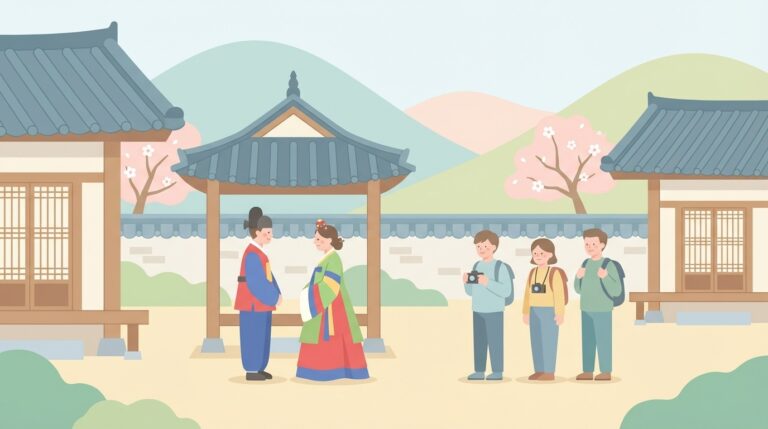
Imagine this: You are traveling in Seoul, exploring a beautiful Hanok village (traditional Korean houses) on a sunny weekend. Suddenly, you hear the lively, rhythmic sound of traditional Korean instruments. You follow the music and see colorful tents, people in stunning Hanbok, and a couple bowing to each other across a table filled with symbolic foods.
It’s a Korean traditional wedding (전통 혼례)!
If you’ve watched historical K-Dramas like The Red Sleeve or Love in the Moonlight, you’ve probably seen those grand, emotional wedding scenes. Seeing one in real life is a magical experience! But as a tourist, you might feel a bit awkward. Can I watch this? Can I take a picture? How do I say ‘she looks beautiful’ without sounding like a textbook?
Don’t worry! This guide is based on real questions from students who stumbled upon these beautiful ceremonies during their K-Travels. Let’s learn how to politely enjoy and compliment a traditional Korean wedding!
Phase 2: Core Expressions Deep Dive
1. 너무 예뻐요! / 멋있어요!
- Pronunciation: neomu yeppeoyo! / meosisseoyo!
- Sound-alike guide: nuh-moo yeh-bbuh-yo! / muh-shee-suh-yo!
- Meaning: So pretty! (Literal) / So cool/handsome! (Literal)
- K-Culture Moment: You will hear these exact words at K-Pop concerts, in K-Dramas, and everywhere in Korea! When the bride (신부) walks out in her colorful traditional dress, the crowd naturally goes, “우와, 너무 예뻐요!” (Wow, she’s so pretty!). Use “예뻐요” for the bride and “멋있어요” for the groom (신랑).
- Editor’s Insight: You don’t need complicated poetic words. A heartfelt “너무 예뻐요!” is the most natural and widely used compliment in everyday Korean.
- Situation Spectrum:
- Casual (Friends): ✅ (Drop the ‘yo’: 너무 예뻐!)
- Semi-formal (Strangers/Acquaintances): ✅
- Formal (Bosses/Elders): ⚠️ (Better to say: 정말 아름다우십니다)
- 🤔 Think About It: Why do Koreans use “멋있어요 (cool/handsome)” for so many things, from a groom’s appearance to a good deed? Does your language have a versatile compliment like this?
2. 구경해도 돼요?
- Pronunciation: gugyeonghaedo dwaeyo?
- Sound-alike guide: goo-gyung-hae-do dwae-yo?
- Meaning: Can I look around? / Can I watch?
- K-Culture Moment: You are at Namsangol Hanok Village, and you see a crowd. You are not an invited guest, but it looks like a public event. This phrase is your golden ticket! You can use it at street performances, outdoor filming sets, or open markets.
- Editor’s Insight: “구경하다” means “to look around” or “to sightsee.” Adding “~아/어도 돼요?” (Is it okay to…?) makes it a polite request.
- Situation Spectrum:
- Casual: ✅
- Semi-formal: ✅
- Formal: ⚠️
- 🤔 Think About It: Koreans love “구경” (people-watching, browsing). Window shopping is called “아이쇼핑” (eye shopping) or “구경하기.” Why is the act of “just looking” so embedded in the culture?
3. 사진 찍어도 돼요?
- Pronunciation: sajin jjigeodo dwaeyo?
- Sound-alike guide: sa-jin jjee-guh-do dwae-yo?
- Meaning: Can I take a picture?
- K-Culture Moment: You see the beautiful bride with red dots on her cheeks (연지곤지). You reach for your camera, but you want to be polite. Always ask this first! It’s also the exact phrase you use when you spot a cute dog in a park or want to photograph a cafe’s interior.
- Editor’s Insight: Even in public tourist spots, it’s polite to ask before taking close-up photos of the couple. If they smile and nod, go ahead!
- Situation Spectrum:
- Casual: ✅
- Semi-formal: ✅
- Formal: 🚫 (Use: 사진 한 장 찍어도 괜찮을까요?)
- 🤔 Think About It: Privacy is highly valued in modern Korea. How does asking for photo permission differ in your home country compared to Korea?
Phase 3: Textbook vs. Real Korean
[Situation 1: Complimenting the bride’s outfit]
* 📖 Textbook Korean: 신부의 한복이 참 아름답습니다. (The bride’s Hanbok is truly beautiful.)
* 🗣️ Real Korean: 우와, 한복 진짜 예뻐요! (Wow, the Hanbok is really pretty!)
* 💡 Why is it different?: In real life, conversational Korean relies heavily on simple intensifiers like “진짜” (really) or “너무” (too/so) rather than formal textbook adjectives.
[Situation 2: Congratulating the couple]
* 📖 Textbook Korean: 두 분의 결혼을 진심으로 축하드립니다. (I sincerely congratulate the marriage of you two.)
* 🗣️ Real Korean: 결혼 축하해요! 행복하세요~ (Happy wedding! Be happy~)
* 💡 Why is it different?: Unless you are giving an official speech, short and warm wishes with a slight bow are much more natural and friendly.
Bottom Note: For A2 beginners, stick to
~아/어/해요polite forms. They are safe to use with strangers, shop owners, and older people you meet while traveling!
Phase 4: Cultural Context — K-Culture Deep Dive
4-1. Non-Verbal Cues: The Art of the Bow
When you say “결혼 축하해요!” (Congratulations on your wedding) to someone in Korea, don’t just stand straight. Give a slight head nod or a small 15-degree bow. If you are handing over a gift or congratulatory money (축의금), always use two hands. This shows respect and good Nunchi (눈치), the Korean sense of reading the room.
4-2. K-Drama vs. Reality: The Wedding Scene
If you watch historical K-Dramas, traditional weddings are the standard. But in modern Korea, 90% of couples wear Western-style white dresses and tuxedos in bright “Wedding Halls.”
However! Traditional weddings are making a trendy comeback. Many young couples choose Hanok villages or places like “Korea House” in Seoul to have an outdoor traditional ceremony. It’s a beautiful mix of old and new. If you see one, you are witnessing a very special and proud cultural moment!
Phase 5: Real-Life Roleplay Scenario
Setting: Saturday, 1 PM. Namsangol Hanok Village in Seoul. The weather is perfect. You are exploring the traditional houses with your Korean friend.
Characters:
– YOU: A foreign traveler who loves K-Culture and has an A2 level of Korean.
– Minsu (30): Your friendly Korean local guide. He loves explaining things to you.
Dialogue:
Minsu: 어? 저기 사람 진짜 많네요. 가볼까요?
(eo? jeogi saram jinjja manneyo. gabolkkayo?)
[Oh? There are really a lot of people over there. Shall we go?]
(🎭 Stage Direction: Minsu points to a courtyard filled with colorful banners.)
YOU: 우와! 저거 뭐예요? 드라마 같아요!
(uwa! jeogeo mwoyeyo? deurama gatayo!)
[Wow! What is that? It looks like a drama!]
Minsu: 아~ 전통 혼례예요. 오늘 결혼식이 있나 봐요.
(a~ jeontong hollyeyeyo. oneul gyeollonsigi inna bwayo.)
[Ah~ It’s a traditional wedding. There must be a wedding ceremony today.]
YOU: 우리 구경해도 돼요?
(uri gugyeonghaedo dwaeyo?)
[Can we watch?]
Minsu: 네, 밖에서 보는 건 괜찮아요. 조용히 봐요.
(ne, bakkeseo boneun geon gwaenchanayo. joyonghi bwayo.)
[Yes, watching from the outside is fine. Let’s watch quietly.]
(🎭 Stage Direction: You both walk closer. You see the bride wearing a stunning red and blue robe.)
YOU: 신부 한복이 너무 예뻐요!
(sinbu hanbogi neomu yeppeoyo!)
[The bride’s Hanbok is so pretty!]
Minsu: 그쵸? 저건 ‘원삼’이라는 전통 옷이에요.
(geuchyo? jeogeon ‘wonsam’iraneun jeontong osieyo.)
[Right? That is a traditional clothes called ‘Wonsam’.]
YOU: 사진 찍어도 돼요?
(sajin jjigeodo dwaeyo?)
[Can I take a picture?]
Minsu: 네, 플래시만 안 터뜨리면 괜찮을 거예요.
(ne, peullaesiman an teotteurimyeon gwaenchanneul geoyeyo.)
[Yes, as long as you don’t use the flash, it should be fine.]
🔀 Your Turn! As the couple walks out after the ceremony, they make eye contact with the crowd. What should you say?
– A) “안녕히 계세요!” (Goodbye!)
– B) “결혼 축하해요!” (Congratulations on your wedding!)
– C) “사랑해요!” (I love you!)✅ Best Choice: B — Saying “결혼 축하해요!” with a bright smile will definitely make the couple happy. It’s polite and perfect for the occasion.
⚠️ Choice A & C Analysis: Saying “Goodbye” is a bit awkward since you aren’t leaving their house. “I love you” is definitely too much for strangers’ wedding!
YOU: 결혼 축하해요! 행복하세요! 🎉
(gyeollon chukahaeyo! haengbokaseyo!)
[Congratulations on your wedding! Be happy!]
Minsu: 와, 한국어 진짜 자연스럽네요!
(wa, hangugeo jinjja jayeonseureomneyo!)
[Wow, your Korean is really natural!]
Phase 6: 10-Second Shadowing Drill
Practice speaking naturally! Pay attention to the pauses (/) and the prolonged sound (~~~) for emphasis.
😊 우와! / 신부 한복이 / 진~~~짜 예뻐요!
(uwa! / sinbu hanbogi / jin~~~jja yeppeoyo!)
[Wow! The bride’s Hanbok is reeeeeeally pretty!]
Phase 7: K-Culture Mini Dictionary
| Korean | Romanization | English | Context |
|---|---|---|---|
| 전통 혼례 | jeontong hollye | Traditional wedding | The ceremony itself, featuring traditional outfits, bowing, and customs. |
| 한복 | hanbok | Traditional clothes | Worn during holidays, weddings, and by tourists at palaces. |
| 신랑 / 신부 | sillyang / sinbu | Groom / Bride | Essential vocabulary for any wedding context. |
| 축의금 | chuguigeum | Congratulatory money | In Korea, guests give cash in a white envelope instead of physical wedding gifts. |
| 눈치 | nunchi | Social awareness | The vital Korean skill of “reading the room” and acting appropriately. |
Phase 8: Traveler Survival Kit
Since traditional weddings usually happen at tourist spots like Hanok villages or cultural centers, here are essential survival phrases for your journey!
🆘 Survival Phrases for K-Travelers
– 🇰🇷 “여기 어떻게 가요?” (yeogi eotteoke gayo?)
– 🗣️ Meaning: How do I get here?
– 📍 Where to use: Asking someone on the street while pointing at your map app.
- 🇰🇷 “입장료 얼마예요?” (ipjangnyo eolmayeyo?)
- 🗣️ Meaning: How much is the entrance fee?
- 📍 Where to use: Ticket booths at Hanok villages or palaces.
🇰🇷 “화장실 어디 있어요?” (hwajangsil eodi isseoyo?)
- 🗣️ Meaning: Where is the restroom?
- 📍 Where to use: Everywhere!
📌 Editor’s Travel Note
– Useful Apps: Google Maps doesn’t work well for walking directions in Korea. Download Naver Map or KakaoMap!
– Attending as a tourist: You don’t need to give money (축의금) if you are just watching a public ceremony as a tourist. Just enjoy the view respectfully!
– Hanbok Rental: If you rent a Hanbok nearby, you can enter the royal palaces for free!
Phase 9: Critical Thinking Corner — “A Step Deeper”
Media vs Reality: The Illusion of Everyday Tradition
If your only exposure to Korea is through K-Dramas, you might think everyone still lives in Hanoks and gets married in Hanbok. In reality, Korea is a highly modernized, fast-paced society. Modern weddings are often 90-minute affairs in giant “Wedding Halls” resembling Western banquets.
However, the traditional wedding (전통 혼례) hasn’t disappeared. It’s preserved as a cultural heritage and chosen by couples who want a unique, culturally rich experience rather than a quick factory-style wedding. It shows how modern Koreans actively choose to keep their history alive amidst globalization.
💬 Your Turn:
Are traditional weddings still common in your culture, or have they been replaced by modern/Western styles? Share with us in the comments!
Phase 10: FAQ & Avoiding Misunderstandings
Q: Can I wear white if I am invited to a Korean wedding?
A: NO! In Korea, wearing white as a guest is considered extremely rude because white is strictly reserved for the bride so she can stand out in photos. Wear dark or muted colors. (If you are just a tourist watching from afar in a park, your outfit doesn’t matter!)
Q: Do I need to bow deeply when I say congratulations?
A: A slight 15-to-30-degree nod/bow of the head is perfect. The deep 90-degree bow is usually for highly formal apologies or specific ceremonies.
❌ Common Mistake #1: Stepping into the center aisle to take a photo.
✅ Do this instead: Professional photographers are hired to capture the day. As a tourist or guest, stay on the sidelines and use zoom!
Phase 11: Summary & Action Items
One-Liner Summary: Use “구경해도 돼요?” to politely watch, and “너무 예뻐요!” to naturally compliment the beautiful Korean traditional wedding!
Action Mission 3 Steps:
– 🥉 Bronze (Solo): Stand in front of a mirror and practice saying “사진 찍어도 돼요?” three times with a polite smile.
– 🥈 Silver (Online): Find a video of a ‘Korean traditional wedding’ on YouTube and leave a comment: “우와, 한복이 너무 예뻐요!”
– 🥇 Gold (Real Life): Next time you travel to a Hanok village in Korea, ask a staff member “구경해도 돼요?” before entering a lively courtyard!
K-Culture Mission:
Search for “Korean traditional wedding” or “전통 혼례” on Instagram. Look at the bride’s cheek makeup (연지곤지). Imagine you are there and practice saying “결혼 축하해요!”
Phase 12: Quiz — Interactive Challenge
1. Situational Judgment:
You are wandering around Namsangol Hanok Village and see a beautiful traditional ceremony. You want to take a photo of the bride. What is the most polite thing to ask someone nearby?
– A) 이거 얼마예요? (How much is this?)
– B) 사진 찍어도 돼요? (Can I take a picture?)
– C) 나이가 어떻게 되세요? (How old are you?)
(Answer: B. Always ask for photo permission to show good Nunchi!)
2. True or False — K-Culture Edition:
“If you are walking through a public park and see a traditional wedding, you must pay congratulatory money (축의금).”
(Answer: False. If you are just a tourist watching a public event, no money is expected! Just enjoy the beautiful culture.)
3. Fill in the Blank:
Bride’s outfit is gorgeous. You want to tell your Korean friend that the Hanbok is really pretty.
“우와, 한복 진~~~짜 ( _______ )!”
(Answer: 예뻐요 – yeppeoyo)
Frequently Asked Questions (FAQ)
Q: What does "너무 예뻐요! / 멋있어요!" mean in Korean and how do you pronounce it?
A: In Korean, "너무 예뻐요! / 멋있어요!" is pronounced [neomu yeppeoyo! / meosisseoyo!] and means: So pretty! (Literal) / So cool/handsome! (Literal)
Q: What does "구경해도 돼요?" mean in Korean and how do you pronounce it?
A: In Korean, "구경해도 돼요?" is pronounced [gugyeonghaedo dwaeyo?] and means: Can I look around? / Can I watch?
Q: What does "사진 찍어도 돼요?" mean in Korean and how do you pronounce it?
A: In Korean, "사진 찍어도 돼요?" is pronounced [sajin jjigeodo dwaeyo?] and means: Can I take a picture?







