

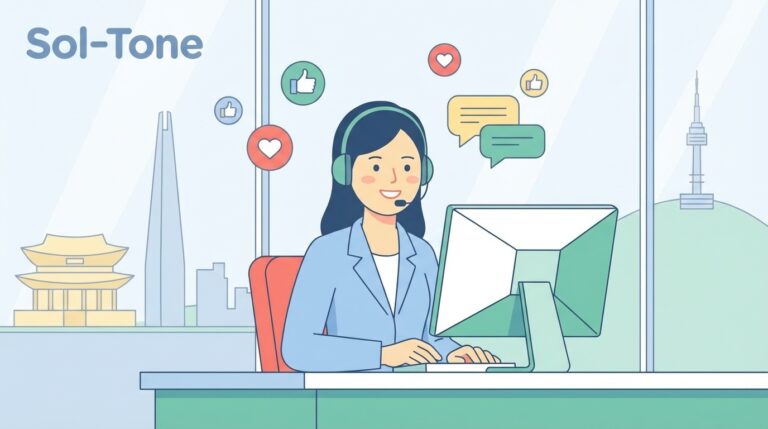
Mastering the ‘Sol-Tone’: Advanced Korean for Customer Service & Quality Assurance
Phase 1: Empathy (The K-Culture Cold Open)
Hello there! I’m your Daily Hangul Editor.
Picture this: You’re watching a K-Drama. The protagonist, struggling to make ends meet, works at a call center. Suddenly, their natural, relaxed voice disappears. They put on their headset, sit up perfectly straight, take a deep breath, and out comes a voice two octaves higher—bright, melodic, and impossibly polite. Have you ever wondered why their voice suddenly sounds like a chirping bird?
In Korea, we call this the ‘Sol-Tone’ (솔 톤)—pitching your voice to the musical note ‘G’ (Sol), which is culturally perceived as the most welcoming, friendly frequency for Customer Service (CS).
If you are working in Korea, dealing with Korean B2B clients, or even just calling a Korean airline or delivery app as a customer, understanding the ultra-polite, highly structured world of Korean CS is a game-changer. At the C1 level, it’s no longer just about knowing the word “Sorry.” It’s about mastering Quality Assurance (QA) standards, reading the customer’s Kibun (기분, mood), and using advanced linguistic softeners. If you don’t know the nuances, you might sound blunt, unprofessional, or worse—escalate a conflict. Let’s dive into the ultimate guide to Korean CS Quality Management!
Phase 2: In-Depth Core Expressions
To pass a Korean Call Center QA test with flying colors, you need phrases that act as emotional shock absorbers.
1. 불편을 드려 대단히 죄송합니다.
- Pronunciation: [Bulpyeoneul deuryeo daedanhi joesonghamnida] + [Bul-pyeon-eul / doo-ryeo / dae-dan-hee / joe-song-ham-ni-da]
- Meaning: Literal: I am extremely sorry for giving you inconvenience. / Real Nuance: I sincerely apologize for the frustration you are experiencing.
- K-Culture Moment: In K-Dramas featuring corporate crises, you’ll see the PR team or CS team bowing deeply and repeating this exact phrase. It’s the gold standard for taking accountability without immediately admitting legal fault. It soothes the customer’s Kibun first.
- Editor’s Insight: Notice we use ‘대단히’ (extremely) instead of just ‘정말’ or ‘진짜’. In QA evaluations, using casual intensifiers will cost you points. This phrase is about establishing a professional, empathetic baseline.
- Situation Spectrum:
- Casual friends: 🚫 (Too robotic!)
- Colleagues (Semi-formal): ⚠️ (Only if you made a huge professional blunder)
- Customers/VIPs (Formal): ✅ (Absolutely mandatory)
- 🤔 Think About It: Why does Korean customer service prioritize apologizing for the feeling of inconvenience before solving the technical issue? How does this reflect the Korean concept of Jeong (정) and Kibun (기분)?
2. 너른 양해 부탁드립니다.
- Pronunciation: [Neoreun yanghae butakdeurimnida] + [Neo-reun / yang-hae / boo-tak-deu-rim-ni-da]
- Meaning: Literal: We ask for your broad/generous understanding. / Real Nuance: We can’t do what you want, but please be cool about it.
- K-Culture Moment: You’ll hear this in subway announcements when a train is delayed, or read it in notices by K-Pop agencies when a concert ticket site crashes.
- Editor’s Insight: This is the ultimate “polite rejection” or “expectation management” tool. ‘너른’ means broad or generous. It appeals to the customer’s sense of magnanimity. If a QA manager hears an agent say “안 됩니다” (No, we can’t), they will deduct points. You must soften the blow with this phrase.
- Situation Spectrum:
- Casual friends: 🚫
- Colleagues (Semi-formal): ⚠️ (Okay for company-wide emails)
- Customers/VIPs (Formal): ✅
- 🤔 Think About It: In many Western cultures, giving a direct “No” is considered efficient and clear. In Korea, direct rejection is often seen as aggressive. Does your native language have a specific vocabulary set just for softening rejections?
3. 번거로우시겠지만, ~해 주시겠습니까?
- Pronunciation: [Beongeorousigetjiman, ~hae jusigetseumnikka?] + [Bun-geo-ro-woo-she-get-ji-man / ~hae / joo-she-get-seum-ni-kka?]
- Meaning: Literal: Although it may be cumbersome for you, could you please do ~? / Real Nuance: I’m sorry to make you do this extra step, but I need you to…
- K-Culture Moment: When calling a Korean bank or telecommunications company, the agent will say this right before asking you to verify your identity through a complex ARS system or app.
- Editor’s Insight: This is the “Cushion Word” (쿠션어). QA guidelines strictly mandate using cushion words before giving a customer an instruction. It acknowledges their effort and elevates their status.
- Situation Spectrum:
- Casual friends: 🚫
- Colleagues (Semi-formal): ✅ (Great for asking a favor from another department)
- Customers/VIPs (Formal): ✅
- 🤔 Think About It: “Cushion words” are the backbone of Korean business etiquette. They literally “cushion” the impact of a command. How do you soften commands in your culture?
Phase 3: Textbook vs. Real Korean QA Guidelines
Let’s compare standard textbook Korean with the highly calibrated expressions required in Real CS Quality Management.
[Situation 1: Putting a customer on hold]
* 📖 Textbook Korean: 잠시만 기다려 주세요. (Please wait a moment.)
* 🗣️ Real CS Korean: 고객님, 정보 확인을 위해 잠시 기다려 주시겠습니까? (Customer, would you mind waiting a moment while I check the information?)
* 💡 Why the difference?: A strict QA guideline: Never command the customer. Always use interrogative forms (주시겠습니까?) and state why they need to wait.
[Situation 2: When you can’t hear the customer well]
* 📖 Textbook Korean: 안 들려요. 다시 말해 주세요. (I can’t hear you. Say it again.)
* 🗣️ Real CS Korean: 고객님, 죄송하지만 통화 연결 상태가 고르지 않아 다시 한번 말씀해 주시겠습니까? (Customer, I apologize, but the connection is uneven; could you please speak one more time?)
* 💡 Why the difference?: Never blame the customer (e.g., “You’re speaking too quietly”). Blame the “connection state” (통화 연결 상태) to save their face.
[Situation 3: The Danger of “Hyper-Politeness” (과잉 존칭)]
* 📖 Textbook Korean: 주문하신 상품이 나왔습니다. (The item you ordered is out.)
* 🗣️ Real CS Korean (Bad Habit): 주문하신 상품이 나오셨습니다. (The item you ordered has honorifically come out.)
* 💡 Why the difference?: This is a huge issue in CS QA! Service workers are so pressured to be polite that they attach the honorific particle ‘-시-‘ to inanimate objects (coffee, clothes, receipts). QA managers actively train agents to stop doing this. Respect the person, not the coffee!
Phase 4: Cultural Context — K-Culture Deep Dive
4-1. Non-verbal CS Elements
- 미소 띤 목소리 (Smiling Voice): In QA evaluations, agents are graded on whether they sound like they are smiling. Many agents keep a small mirror on their desks to ensure they are physically smiling while speaking, as it changes the resonance of the voice.
- 호응어 (Backchanneling): Complete silence while the customer speaks is a QA fail. You must use active listening sounds: “아, 네~”, “그러셨군요”, “맞습니다”. This shows Nunchi and empathy.
4-2. K-Culture Connection: The Emotional Labor (감정노동) in Media vs. Reality
- K-Drama Context: Have you seen Dramas where a character is forced to kneel before an angry VIP customer (a so-called Jin-sang 진상)? While dramatized, Korea’s hyper-competitive service industry traditionally operated on the absolute “Customer is King” (손님은 왕이다) rule.
- Critical View: In recent years, reality has shifted. Because of the severe emotional toll on call center agents, the Korean government introduced laws protecting “Emotional Laborers” (감정노동자 보호법). Now, when you call a Korean CS line, an automated voice will first remind you: “Please be kind. The agent assisting you is someone’s precious family member.” (상담원도 누군가의 소중한 가족입니다.) Understanding this societal shift is crucial for an advanced Korean learner.
Phase 5: Real-Life Roleplay Scenario
Scenario A: The Escalated Call
- Setting: A bright, open-plan call center in Pangyo. You are the Senior QA Manager or Tier 2 Escalation Agent.
- Characters:
- YOU: Tier 2 Escalation Agent. Professional, calm, armed with C1 Korean skills.
- Customer (Mr. Kim, 50s): Highly agitated because his premium Hanwoo (Korean beef) gift set for the Chuseok holiday hasn’t arrived.
Dialogue:
Mr. Kim: 아니, 내일이 추석인데 아직도 고기가 안 오면 어떡합니까?! 책임질 거예요? 😠
(Ani, naeili chuseoginde ajikdo gogiga an omyeon eotteokhamnikka?! Chaegimjil geoyeyo?)
[What do you mean the meat hasn’t arrived when Chuseok is tomorrow?! Are you going to take responsibility?]
YOU: 고객님, 명절을 앞두고 많이 당황하셨죠. 먼저 불편을 드려 대단히 죄송합니다.
(Gogaengnim, myeongjeoreul apdugo mani dangwanghasyeotjyo. Meonjeo bulpyeoneul deuryeo daedanhi joesonghamnida.)
[Customer, you must be very flustered with the holiday approaching. First, I sincerely apologize for the inconvenience.]
Mr. Kim: 죄송하면 다예요? 당장 오늘 밤까지 퀵으로 보내주세요!
(Joesonghamyeon dayeyo? Dangjang oneul bamkkaji kwigeuro bonaejuseyo!)
[Is ‘sorry’ all you can say? Send it by quick delivery tonight!]
YOU: 마음 같아서는 당장 보내드리고 싶습니다만, 현재 명절 물량 폭주로 퀵 서비스 배차가 불가능한 상황입니다.
(Maeum gataseoneun dangjang bonaedeurigo sipseumnidaman, hyeonjae myeongjeol mullyang pokjuro kwik seobiseu baechaga bulganeunghan sanghwangimnida.)
[I wish I could send it to you right away, but due to the overwhelming volume of holiday orders, quick delivery dispatch is currently impossible.]
Mr. Kim: 그럼 나보고 어쩌라는 겁니까? 하 참나…
(Geureom nabogo eojjeoraneun geomnikka? Ha chamna…)
[Then what am I supposed to do? Wow, unbelievable…]
🔀 Your Turn! How do you politely manage this expectation and offer an alternative?
– A) 안 됩니다. 환불해 드릴게요. (No. I’ll give you a refund.)
– B) 번거로우시겠지만, 근처 마트에서 먼저 구매하시면 저희가 전액 보상해 드리겠습니다. 너른 양해 부탁드립니다.
– C) 기분 푸세요, 고객님. 저희도 힘들어요.✅ Best Choice: B — Reason: You use the cushion word “번거로우시겠지만” (It might be a hassle, but), offer a concrete solution (compensation for local purchase), and finish with the advanced empathetic closer “너른 양해 부탁드립니다.”
⚠️ Choice A & C Analysis: ‘A’ is way too blunt and a QA automatic fail. ‘C’ (Calm down, we are having a hard time too) is overly casual, crosses professional boundaries, and will make the customer infinitely angrier!
Scenario B: Bonus Roleplay – You as the Customer
Calling the food delivery app CS because your fried chicken arrived completely squished.
Agent: 네, 고객님. 배달의 민족 고객센터입니다. 무엇을 도와드릴까요?
(Ne, gogaengnim. Baedalui minjok gogaeksenteoimnida. Mueoseul dowadeurilkkayo?)
YOU: 안녕하세요. 방금 치킨을 받았는데, 박스가 다 찌그러져서 왔어요. 사진 확인해 주실 수 있나요?
(Annyeonghaseyo. Banggeum chikineul badanneunde, bakseuga da jjigeureojyeoseo wasseoyo. Sajin hwakinhae jusil su innayo?)
Agent: 아, 많이 속상하셨겠어요. 번거로우시겠지만 앱을 통해 사진을 등록해 주시면, 확인 후 환불 처리 도와드리겠습니다.
(Ah, mani soksanghasyeotgesseoyo. Beongeorousigetjiman aebeul tonghae sajineul deungnokhae jusimyeon, hwakin hu hwanbul cheori dowadeurigetseumnida.)
Phase 6: 10-Second Shadowing Drill
Practice your Sol-Tone! Read this aloud, following the pauses and intonation.
🥺 고객님, / 많이 당황하셨죠. / 🙇♀️ 불편을 드려 / 대단히 죄송합니다. / 🔄 제가 / 다시 한번 / 확인해 보겠습니다.
(gogaengnim, / mani dangwanghasyeotjyo. / bulpyeoneul deuryeo / daedanhi joesonghamnida. / jega / dasi hanbeon / hwakinhae bogetseumnida.)
Pro Tip: Your voice should go slightly UP on “당황하셨죠↗” (empathy) and beautifully drop with weight and sincerity on “죄송합니다↘” (apology).
Phase 7: K-Culture Mini Dictionary (CS Edition)
| Korean | Romanization | English | Context Explanation |
|---|---|---|---|
| 진상 | jin-sang | Unreasonable/Bad customer | Slang for an entitled customer who makes absurd demands. |
| 감정노동 | gamjeong-nodong | Emotional Labor | The psychological toll of having to manage one’s feelings to project a friendly corporate image. |
| 쿠션어 | kusyeon-eo | Cushion Word | Softening phrases used before a request or rejection to maintain politeness. |
| 클레임 | keulleim | Claim / Complaint | When a customer formally complains about a service or product. |
| 융통성 | yungtongseong | Flexibility/Adaptability | What customers often demand when they want you to bend the rules for them (“융통성 좀 발휘해 보세요”). |
Phase 8: Traveler Survival Kit (CS Edition)
As a traveler or expat in Korea, you will eventually need to call customer service (banks, airlines, internet providers). Use these to survive the complex ARS menus!
🆘 Survival Expression #1: Finding English Support
– 🇰🇷 “영어 가능한 상담원 연결해 주시겠어요?” (yeon-geo ganeunghan sangdamwon yeongyeolhae jusigesseoyo?)
– 🗣️ Meaning: Could you connect me to an English-speaking agent?
– 📍 Where to use: Bank CS, Immigration hotline (1345), Telecommunication companies.
– 💡 Pro Tip: Don’t panic if they say “잠시만 기다려주세요”. They are putting you on hold to find an English speaker.🆘 Survival Expression #2: Missing Deliveries
– 🇰🇷 “배송 완료라고 뜨는데, 물건을 못 받았어요.” (baesong wallyorago tteuneunde, mulgeoneul mot badasseoyo.)
– 🗣️ Meaning: It says delivery complete, but I haven’t received the item.
– 📍 Where to use: Coupang, Baemin, or post office service centers.📌 Editor’s Travel Note
– Chatbots vs. Calls: Most Korean companies heavily prefer KakaoTalk CS chatbots over phone calls now. Look for “카카오톡 상담하기” on websites. It’s easier to use a translator app via chat!
– Recording Calls: In Korea, it is legally permissible (and standard practice) for companies to record calls. You will always hear: “본 통화는 서비스 품질 향상을 위해 녹음됩니다.” (This call is recorded for quality improvement.)
Phase 9: Critical Thinking Corner — “Going Deeper”
🧠 Think Deeper: Language & Power in the Korean Service Industry
The extreme honorifics (존댓말) used in Korean Customer Service are not just about politeness; they are a direct reflection of social hierarchy and power dynamics. Historically in the modern corporate era, the paying customer was placed at the absolute top of the social pyramid, forcing agents into hyper-polite speech patterns (like apologizing for things that aren’t their fault). However, this “Language of Power” is evolving. Recent societal backlash against Gapjil (갑질, abuse of power) has led companies to revise their QA manuals. Now, manuals explicitly instruct agents on how to firmly, but politely, end a call if a customer uses abusive language. The language of Korean CS is transforming from “blind subservience” to “professional boundaries.”
💬 Your Turn: How does the customer service language in your culture reflect social power dynamics? Are “the customers always right” in your home country? Share in the comments!
Phase 10: FAQ & Avoiding Common Mistakes
Q: “Can I use ‘너른 양해 부탁드립니다’ to my boss when I miss a deadline?”
A: NO! This phrase implies, “I did something that inconveniences you, but I have a legitimate reason, so you need to be understanding.” It sounds slightly defensive or bureaucratic. To your boss, just say “죄송합니다. 앞으로 주의하겠습니다” (I apologize. I will be careful in the future.)
Q: “Why do agents keep saying ‘고객님’ in every single sentence?”
A: QA Guidelines. In many Korean call centers, using the customer’s name or title (고객님) frequently is a scored metric to build rapport.
❌ Common Mistake #1: Using the “Thing-Honorific” (사물존칭).
Saying “할인 적용 되셨습니다” (The discount has honorifically been applied).
✅ Do this instead: “할인 적용 되었습니다.” The discount is a thing, not a person. Keep the respect on the customer!
Phase 11: Summary & Action Items
- One-Liner Summary: Acing Korean CS Quality Management is about mastering the “Sol-Tone,” prioritizing empathy, and using cushion words to politely navigate boundaries.
-
Action Mission 3 Steps:
- 🥉 Bronze (Solo): Practice the “Sol-Tone” in front of a mirror using the phrase “무엇을 도와드릴까요?” while consciously smiling.
- 🥈 Silver (Online): Find a Korean customer service chatbot (like on a shopping site) and try typing a polite inquiry using a cushion word (번거로우시겠지만…).
- 🥇 Gold (Real World): The next time you call a Korean CS line or visit a bank, listen carefully to how the agent greets you and apologizes. Try to catch the phrase “양해 부탁드립니다”!
- K-Culture Mission: Watch an episode of a Korean workplace drama (like Misaeng or My Mister) and count how many times they apologize before offering a solution during a crisis.
Phase 12: Interactive Quiz
1. [Situational Judgment] A customer is complaining that the app interface is too confusing. As a top-tier CS agent, what is your FIRST response?
A) “고객님, 설명서를 다시 읽어보세요.” (Customer, read the manual again.)
B) “앱이 복잡해서 많이 불편하셨죠. 죄송합니다.” (You must have been inconvenienced because the app is complex. I apologize.)
C) “저는 개발자가 아니라서 모릅니다.” (I’m not a developer so I don’t know.)
Answer: B. Always validate the Kibun (mood) first in Korean QA standards!
2. [Fill in the Blank] To ask a customer to do something annoying (like sending an email verification), you should start with the cushion word: “[ ______________ ]시겠지만…”
Answer: 번거로우 (번거로우시겠지만 – It might be a hassle, but…)
3. [True or False – K-Culture Edition] In strict Korean CS QA evaluations, agents get bonus points for using honorifics on objects, such as “커피 나오셨습니다” (The coffee has honorifically come out), because it shows ultimate respect.
Answer: False! This is “과잉 존칭” (Hyper-politeness) and is actually penalized by modern QA managers. Respect the person, not the coffee!
How did you do? Keep practicing your Korean empathy skills, and soon you’ll sound like a true professional. Until next time, 화이팅!
Frequently Asked Questions (FAQ)
Q: What does "불편을 드려 대단히 죄송합니다." mean in Korean and how do you pronounce it?
A: In Korean, "불편을 드려 대단히 죄송합니다." is pronounced [Bulpyeoneul deuryeo daedanhi joesonghamnida] and means: Literal: I am extremely sorry for giving you inconvenience. / Real Nuance: I sincerely apologize for the frustration you are experiencing.
Q: What does "너른 양해 부탁드립니다." mean in Korean and how do you pronounce it?
A: In Korean, "너른 양해 부탁드립니다." is pronounced [Neoreun yanghae butakdeurimnida] and means: Literal: We ask for your broad/generous understanding. / Real Nuance: We can't do what you want, but please be cool about it.
Q: What does "번거로우시겠지만, ~해 주시겠습니까?" mean in Korean and how do you pronounce it?
A: In Korean, "번거로우시겠지만, ~해 주시겠습니까?" is pronounced [Beongeorousigetjiman, ~hae jusigetseumnikka?] and means: Literal: Although it may be cumbersome for you, could you please do ~? / Real Nuance: I'm sorry to make you do this extra step, but I need you to...







