

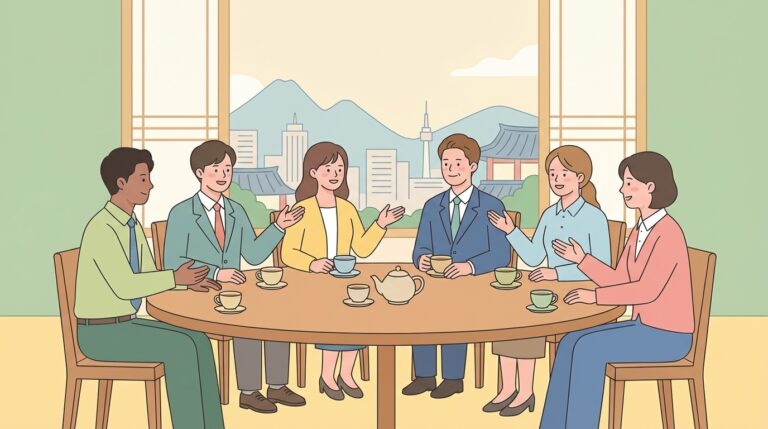
Phase 1: Empathy & K-Culture Cold Open
Hello there! It’s your Lead Editor at Daily Hangul.
Picture this: You are watching a tense episode of a K-Drama like Vincenzo or Crash Course in Romance. The local neighborhood association (맘카페 or 입주민 대표 회의) is gathered in a community center. Voices are raised, banners (플래카드) are waving, and a fierce “NIMBY” (Not In My Back Yard) protest is unfolding over a new community development plan. Then, the protagonist steps up to the mic, speaks calmly, and suddenly… the room quiets down. They didn’t just translate “Let’s compromise.” They spoke the deep, unspoken language of Gibun (기분, feelings) and Jeong (정, emotional connection).
If you’re at a C1 level, you already know how to say “I disagree” or “Let’s fix this.” But in Korean culture, directly stating facts during a heated community dispute or business conflict is like throwing water on a grease fire. You need diplomatic finesse. You need to know how to save the other person’s face while firmly standing your ground.
Whether you’re an expat navigating an Airbnb dispute, managing an overseas project, or just wanting to understand the intricate political maneuvering in your favorite K-Dramas, this guide will turn you into a master mediator. Let’s dive into the high-level art of Korean conflict resolution!
Phase 2: Core Expressions Deep Dive
Here are the top three advanced expressions used by Korean mediators to de-escalate NIMBY conflicts.
1. 입장은 충분히 이해합니다만…
- Pronunciation: ipjangeun chungbunhi ihaehamnidaman… [eep-jahng-eun choong-boon-hee ee-hae-hahm-nee-dah-mahn]
- Meaning: I fully understand your position, but… (Real nuance: “I see your feelings are valid, but we need to move to reality.”)
- K-Culture Moment: Imagine a town hall meeting. The residents are furious about a new waste facility. The mayor doesn’t start with facts; he starts with a deep sigh and this exact phrase. Acknowledging the emotional stance before dropping the “but” is a crucial defusing tactic.
- Editor’s Insight: The key here is the word ‘충분히’ (fully/sufficiently). It acts as a psychological cushion. Without it, you sound robotic; with it, you sound empathetic.
- Situation Spectrum:
- Casual friends: 🚫 (Too formal, sounds like a politician)
- Professional peers: ⚠️ (A bit heavy, but usable in serious debates)
- Formal/Stakeholders: ✅
- 🤔 Think About It: Why does Korean negotiation heavily prioritize acknowledging the other party’s feelings (기분) before addressing the logical facts? How does this compare to negotiation styles in your home country?
2. 서로 한 발씩만 양보하시죠.
- Pronunciation: seoro han balssingman yangbohasijo. [suh-roh hahn bahl-ssik-mahn yahng-boh-hah-shee-joh]
- Meaning: Let’s compromise. (Real nuance: “Let’s each take just one step back.”)
- K-Culture Moment: The classic K-Drama scene where two rival gang leaders or stubborn neighborhood grandpas are forced to make peace by a mediator. The mediator holds up their hands, pressing them to just “take one step back” to save everyone’s pride.
- Editor’s Insight: “양보하다” technically means “to yield.” By asking both sides to yield “just one step” (한 발씩만), nobody loses face. It visually framing the compromise as a shared sacrifice rather than a defeat.
- Situation Spectrum:
- Casual friends: ✅ (Playful tone)
- Professional peers: ✅
- Formal/Stakeholders: ✅ (Highly effective)
- 🤔 Think About It: Does framing a compromise as a physical “step back” make it easier for people to accept defeat in a face-saving culture?
3. 대승적인 차원에서 양해를 부탁드립니다.
- Pronunciation: daeseungjeogin cha-woneseo yanghaereul butakdeurimnida. [dae-seung-juhg-een cha-won-eh-suh yahng-hae-reul boo-tahk-deu-reem-nee-dah]
- Meaning: Please understand from a broader perspective. (Real nuance: “I am asking you to sacrifice your personal/local interest for the greater good of the community.”)
- K-Culture Moment: This is the ultimate NIMBY boss-battle phrase. When building a special needs school or a power plant, politicians use this phrase to appeal to the citizens’ sense of national or community duty.
- Editor’s Insight: “대승적” (Mahayana/Broad perspective) is an advanced, almost philosophical word. It appeals directly to the Korean collective mindset. It’s asking someone to be the bigger person for the sake of the group.
- Situation Spectrum:
- Casual friends: 🚫 (You’ll sound like you’re running for president)
- Professional peers: ⚠️ (Only in massive corporate restructuring)
- Formal/Stakeholders: ✅ (Standard PR and political jargon)
- 🤔 Think About It: What does the existence of this phrase tell us about the historical balance between individual rights and collective duties in Korean society?
Phase 3: Textbook vs. Real Korean
Let’s look at how to upgrade your textbook vocabulary to C1-level fluency in tense situations.
[Refusing a Demand]
* 📖 Textbook Korean: 그것은 절대 안 됩니다. (That is absolutely not allowed.)
* 🗣️ Real Korean: 그 부분은 현실적으로 조금 곤란합니다. (Realistically, that part is a bit difficult.)
* 💡 Why the difference?: A direct “No” destroys harmony. “곤란하다” (difficult/awkward) is the polite, face-saving way to say “Absolutely not.”
[Suggesting a Compromise]
* 📖 Textbook Korean: 우리는 타협해야 합니다. (We must compromise.)
* 🗣️ Real Korean: 원만하게 합의점을 찾았으면 좋겠습니다. (I hope we can smoothly find a point of agreement.)
* 💡 Why the difference?: “원만하다” (smooth/amicable) is the golden standard of Korean relationships. It emphasizes how the agreement is reached (without bad blood), not just the result.
[Calming Someone Down]
* 📖 Textbook Korean: 진정하세요. (Calm down.)
* 🗣️ Real Korean: 일단 앉아서 차근차근 이야기하시죠. (For now, let’s sit down and talk step by step.)
* 💡 Why the difference?: Telling an angry Korean person to “calm down” is a one-way ticket to making them angrier. Suggesting an action (sitting down, drinking coffee) deflects the tension.
Bottom Note: At the C1 level, your goal isn’t just to be understood; it’s to manage the emotional temperature of the room. Softeners like “현실적으로” (realistically) and “조금” (a bit) are your best friends.
Phase 4: Cultural Context — K-Culture Deep Dive
4-1. The Non-Verbal Art of “Nunchi” (눈치)
When mediating a local dispute, your words are only 30% of the battle. The rest is Nunchi (reading the room) and body language. When a stakeholder is shouting, you do not maintain aggressive eye contact. You lower your gaze slightly, nod slowly to show you are listening to their grievance (한, Han), and keep your voice incredibly calm and low. Offering a physical peace offering—like pouring them a paper cup of mixed coffee (믹스커피) or a yogurt drink (요구르트)—is a classic psychological reset button used in Korea.
4-2. The “Hoesik” (회식) Resolution Trope
In K-Dramas like Misaeng, you often see brutal corporate or community fights end up… at a BBQ restaurant. Why? In Korea, formal meetings are for stating positions; the actual conflict resolution happens over Samgyeopsal (삼겹살) and Soju (소주). This is where the strict hierarchical walls come down. A shared shot of Soju and the act of grilling meat for someone else is an unspoken apology and acceptance. The conflict might be NIMBY, but the solution is often found in the shared community of a dining table.
Phase 5: Real-World Roleplay Scenario
Setting: A Friday evening at the local community center in Seoul. You are the project manager for a new youth hostel, but the local apartment residents are furious, fearing it will bring noise and lower property values. The room is hot, and the residents’ representative, Mr. Kim, is slamming his hand on the table.
Characters:
– YOU: The expat project manager, trying to keep the peace.
– Mr. Kim (55): The passionate, stubborn, but deeply community-minded neighborhood representative.
Dialogue:
Mr. Kim: 우리 동네 한복판에 호스텔이라니요! 절대 용납 못 합니다!
(u-ri dong-ne han-bok-pan-e ho-seu-tel-i-ra-ni-yo! jeol-dae yong-nap mot ham-ni-da!)
[A hostel right in the middle of our neighborhood! I absolutely cannot tolerate this!]
(🎭 Stage Direction: Mr. Kim crosses his arms tightly, glaring at you)
YOU: 대표님, 입장은 충분히 이해합니다만, 이건 시청 허가를 받은 프로젝트입니다.
(dae-pyo-nim, ip-jang-eun chung-bun-hi i-hae-ham-ni-da-man, i-geon si-cheong heo-ga-reul ba-deun peu-ro-jek-teu-im-ni-da.)
[Representative, I fully understand your position, but this is a project approved by City Hall.]
Mr. Kim: 시청 허가? 그게 무슨 소용입니까! 우리 주민들 기분이 상했다고요!
(si-cheong heo-ga? geu-ge mu-seun so-yong-im-ni-kka! u-ri ju-min-deul gi-bun-i sang-haet-da-go-yo!)
[City Hall approval? What use is that! Our residents’ feelings are hurt!]
(🎭 Stage Direction: The crowd behind him murmurs in agreement)
🔀 Your Turn! How do you respond?
– A) “법적으로 아무 문제가 없습니다.” (Legally, there is no problem.)
– B) “대승적인 차원에서 양해를 부탁드립니다.” (Please understand from a broader perspective.)
– C) “그럼 저희가 어떻게 해드리면 원만한 합의점을 찾을 수 있을까요?” (Then what can we do for you to find an amicable point of agreement?)✅ Best Choice: C — Reason: It acknowledges their power and opens the floor for a face-saving negotiation.
⚠️ Choice B Analysis: While an excellent phrase, dropping “대승적인 차원” too early before calming them down might sound patronizing.
🚫 Choice A Analysis: Mentioning the law invalidates their Gibun (feelings). This will likely escalate the NIMBY protest to a full-scale rally.
(Assuming you chose C)
Mr. Kim: 흠… 방음벽을 두 배로 높이고, 주말 야간에는 통금을 정하세요.
(heum… bang-eum-byeok-eul du bae-ro nop-i-go, ju-mal ya-gan-e-neun tong-geum-eul jeong-ha-se-yo.)
[Hmm… Double the height of the soundproof walls, and set a curfew on weekend nights.]
YOU: 야간 통금은 현실적으로 조금 곤란합니다만, 방음벽은 확실히 보강하겠습니다. 서로 한 발씩만 양보하시죠.
(ya-gan tong-geum-eun hyeon-sil-jeok-eu-ro jo-geum gol-lan-ham-ni-da-man, bang-eum-byeok-eun hwak-sil-hi bo-gang-ha-get-seum-ni-da. seo-ro han bal-ssing-man yang-bo-ha-si-jo.)
[A night curfew is realistically a bit difficult, but we will definitely reinforce the soundproof walls. Let’s each yield just one step.]
Mr. Kim: …좋습니다. 일단 오늘은 여기까지 하죠.
(…jot-seum-ni-da. il-dan o-neul-eun yeo-gi-kka-ji ha-jo.)
[…Alright. Let’s stop here for today.]
Phase 6: 10-Second Shadowing Drill
Read this aloud. Pay attention to the pauses (/) to sound authoritative yet polite!
😤 Firm but Polite: 입장은 / 충분히 이해합니다만, / 원만하게 / 합의점을 찾았으면 합니다.
(ip-jang-eun / chung-bun-hi i-hae-ham-ni-da-man, / won-man-ha-ge / ha-bui-jeom-eul cha-jat-seu-myeon ham-ni-da.)
Tip: Keep your tone flat and slightly lower at the end of the sentence to project calm confidence.
Phase 7: K-Culture Mini Dictionary
| Korean | Romanization | English | Context/Explanation |
|---|---|---|---|
| 눈치 | nunchi | Social intelligence | The vital skill of reading the room and sensing tension before someone speaks. |
| 기분 | gibun | Mood / Face | A person’s emotional state and pride. Damaging someone’s gibun makes negotiation impossible. |
| 원만하다 | wonmanhada | Amicable / Smooth | The cultural ideal of resolving issues without lingering resentment or conflict. |
| 맘카페 | mam-kape | Mom Café | Local online forums run by mothers; extremely powerful in local NIMBY and community politics. |
| 님비 / 핌피 | nimbi / pimpi | NIMBY / PIMFY | Not In My Back Yard / Please In My Front Yard (fighting for lucrative facilities). |
Phase 8: Traveler/Expat Survival Kit
Even if you aren’t building a power plant, expats often face “mini-NIMBY” situations: angry landlords, noise complaints in your officetel, or disputes with local shop owners.
🆘 Survival Expressions for Local Disputes
– 🇰🇷 “제가 한국 문화를 잘 몰라서 그랬습니다. 양해 부탁드립니다.” (je-ga han-guk mun-hwa-reul jal mol-la-seo geu-raet-seum-ni-da. yang-hae bu-tak-deu-rim-ni-da.)
– 🗣️ Meaning: I did that because I am not very familiar with Korean culture. Please understand.
– 📍 Where to use: When a neighbor confronts you over trash sorting (분리수거) rules or noise.
– 💡 Pro Tip: Playing the “learning foreigner” card politely defuses 99% of neighborhood anger instantly. Korean elders will quickly switch from scolding to teaching.📌 Editor’s Travel Note
– Trash Sorting (분리수거): This is the #1 cause of expat-local conflict in Korea. Download local municipality apps to check exact disposal days.
– The Intercom: If your apartment intercom rings and it’s the security guard (경비 아저씨) complaining about noise, never argue back. A quick “죄송합니다, 주의하겠습니다” (Sorry, I’ll be careful) saves everyone a headache.
Phase 9: Critical Thinking — “One Step Deeper”
Language & Power: The Illusion of the “Greater Good”
🧠 Think Deeper:
The phrase “대승적인 차원에서” (from a broader perspective) is deeply embedded in Korea’s rapid modernization history. Following the Korean War, individuals were frequently asked to sacrifice their land, comfort, and rights for the “Miracle on the Han River” (the nation’s economic boom). Today, as Korea boasts a highly developed democracy with strong individual property rights, NIMBY conflicts are fiercer than ever. When politicians use this phrase today, it creates a fascinating clash between traditional Confucian collectivism and modern capitalist individualism. Are they genuinely appealing to community spirit, or using traditional language to silence modern complaints?💬 Your Turn: In your culture, how does the government or a corporation persuade locals to accept something they don’t want? Do they appeal to duty, or do they just offer money? Let us know in the comments!
Phase 10: FAQ & Avoiding Mistakes
- Q: If a neighbor is yelling at me, can I use informal language (반말) back to show dominance?
- A: NO! This is the worst thing you can do. Always maintain high honorifics (존댓말). Losing your temper and dropping honorifics means you lose the moral high ground in the eyes of Korean bystanders or police.
- Q: Can I just walk away from an angry neighbor?
- A: Maybe. If you feel unsafe, yes. But if it’s a structural conflict, walking away is seen as deeply disrespectful. It’s better to say, “제가 지금 바빠서 그러니, 나중에 다시 이야기하시죠” (I am busy right now, let’s talk later).
❌ Common Mistake #1: Saying “그건 당신 문제죠” (That’s your problem).
✅ Do this instead: Use “그 부분은 저희가 개입하기 어렵습니다” (It is difficult for us to intervene in that area). It sounds professional and avoids direct confrontation.
Phase 11: Summary & Action Items
- One-Liner Summary: In Korean conflict resolution, saving the other person’s Gibun (pride) through empathetic language is more important than winning the logical argument.
-
Action Mission:
- 🥉 Bronze (Solo): Stand in front of a mirror and practice saying “입장은 충분히 이해합니다만…” with a serious, empathetic nod.
- 🥈 Silver (Online): Go to a K-Drama subreddit or YouTube clip and identify a scene where characters try to find an “원만한 합의점” (amicable agreement).
- 🥇 Gold (Real Life): Next time you have a mild disagreement with a Korean friend or colleague, jokingly say, “우리 서로 한 발씩만 양보하시죠!” and watch them smile at your high-level Korean skills.
- K-Culture Mission: Watch an episode of Vincenzo (particularly the Geumga Plaza resident meetings) and spot the body language used when they argue vs. when they compromise!
Phase 12: Interactive Quiz
1. Situational Judgment: A local resident is complaining that your company’s construction site is too dusty. You need to apologize and ask them to bear with it for just one more week. What is the most C1-appropriate response?
– A) 먼지가 많아서 미안해요. 1주일만 참으세요.
– B) 불편을 드려 죄송합니다. 대승적인 차원에서 일주일만 양해를 부탁드립니다.
– C) 저희도 어쩔 수 없습니다. 곧 끝납니다.
2. True or False – K-Culture Edition: In a Korean business or community dispute, directly proving the other person is legally wrong in front of others is considered the best way to win the argument. (T/F)
👀 Click here for answers!
1. Answer: B. A is too casual and rude (“참으세요”). C is overly defensive. B acknowledges the inconvenience and politely asks for their understanding using advanced vocabulary.
2. Answer: False. Proving someone wrong in public destroys their Gibun (face). Even if you are legally right, humiliating them will make them your enemy forever. Always provide an exit strategy (a way to save face).
Frequently Asked Questions (FAQ)
Q: What does "입장은 충분히 이해합니다만..." mean in Korean and how do you pronounce it?
A: In Korean, "입장은 충분히 이해합니다만..." is pronounced [ipjangeun chungbunhi ihaehamnidaman... [eep-jahng-eun choong-boon-hee ee-hae-hahm-nee-dah-mahn] and means: I fully understand your position, but... (Real nuance: "I see your feelings are valid, but we need to move to reality.")
Q: What does "서로 한 발씩만 양보하시죠." mean in Korean and how do you pronounce it?
A: In Korean, "서로 한 발씩만 양보하시죠." is pronounced [seoro han balssingman yangbohasijo. [suh-roh hahn bahl-ssik-mahn yahng-boh-hah-shee-joh] and means: Let's compromise. (Real nuance: "Let's each take just one step back.")
Q: What does "대승적인 차원에서 양해를 부탁드립니다." mean in Korean and how do you pronounce it?
A: In Korean, "대승적인 차원에서 양해를 부탁드립니다." is pronounced [daeseungjeogin cha-woneseo yanghaereul butakdeurimnida. [dae-seung-juhg-een cha-won-eh-suh yahng-hae-reul boo-tahk-deu-reem-nee-dah] and means: Please understand from a broader perspective. (Real nuance: "I am asking you to sacrifice your personal/local interest for the greater good of the community.")






