

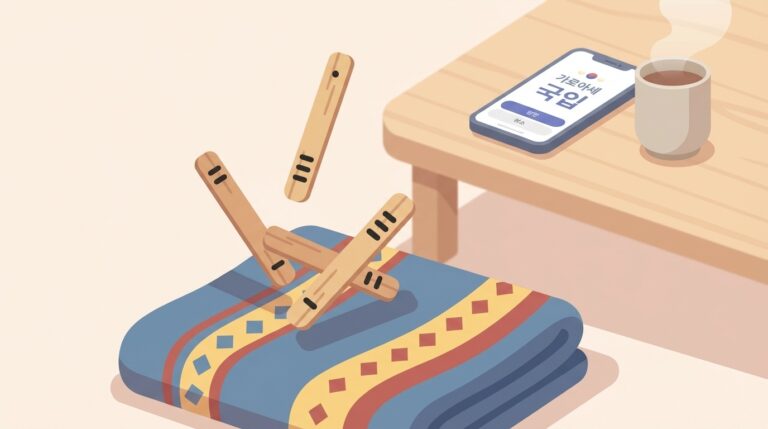
Phase 1: Empathy & The K-Culture Cold Open
Hello! This is your Daily Hangul lead editor.
Picture this: You’re watching a holiday special of your favorite K-Pop group’s variety show (think Run BTS or Going Seventeen). Suddenly, they pull out a blanket, toss four wooden sticks into the air, and absolute chaos ensues. Idols who were hugging each other five minutes ago are now screaming, betraying one another, and doing dramatic victory dances.
Welcome to Yutnori (윷놀이), the traditional Korean board game that ruins friendships and tests family bonds every Lunar New Year (Seollal) and Chuseok.
At a C1 level, you already know your standard Korean grammar. But textbooks don’t teach you the raw, unfiltered vocabulary of a fiercely competitive Korean game night. The terms used in Yutnori aren’t just for the holidays—they’ve deeply penetrated everyday Korean slang, business jargon, and casual conversations. If you don’t know what it means when your Korean colleague sighs and says, “Well, it’s mo or do now,” you’re missing out on a crucial cultural code.
This guide is built from the real-life questions of advanced learners who wanted to understand why Koreans get so incredibly passionate over four pieces of wood. Let’s dive in!
Phase 2: Core Expressions Deep Dive
Here are the top expressions born from Yutnori that you will hear in real Korean life.
1. 모 아니면 도 (Mo or Do)
- Pronunciation: [mo animyeon do] (Sounds like: “Moe ah-nee-myeon doe”)
- Meaning: Literal: “Either a Mo or a Do.” / Real nuance: “All or nothing” or “A hit or a miss.”
- K-Culture Moment: You’ll hear this constantly in K-Dramas when a CEO is making a risky investment, or when a main character is about to confess their love without a safety net. It comes from Yutnori, where Mo (moving 5 spaces) is the best outcome, and Do (moving 1 space) is the worst.
- Editor’s Insight: This phrase is the ultimate expression of taking a gamble. You use it when you are taking a leap of faith and accepting whatever extreme outcome follows.
- Situation Spectrum:
- Casual with friends: ✅
- Semi-formal (Co-workers brainstorming): ✅
- Formal (Boss/Elders): ⚠️ (Okay to use contextually to describe a situation, but sounds a bit dramatic.)
- 🤔 Think About It: Why does Korean have such a deeply ingrained idiom for “all or nothing”? Does your culture have a similar board-game-related idiom for taking huge risks?
2. 업고 가다 (To piggyback / carry)
- Pronunciation: [eopgo gada] (Sounds like: “Uhp-go ga-da”)
- Meaning: Literal: “To carry on one’s back and go.” / Real nuance: “To group pieces together” or “To carry the team.”
- K-Culture Moment: In e-sports or multiplayer gaming (like League of Legends), you’ll hear gamers say “내가 캐리할게 (I’ll carry),” but older generations and Yutnori players say “업고 가자.” In Yutnori, if your token lands on the same spot as your own token, you can stack them and move them together. High risk, high reward!
- Editor’s Insight: It implies immense trust. If you get caught by the opponent while “piggybacking,” all stacked tokens are sent back to the start. In daily life, it means taking someone under your wing or taking a collective risk.
- Situation Spectrum:
- Casual with friends: ✅
- Semi-formal (Co-workers): ✅
- Formal (Boss/Elders): 🚫 (Too informal for speaking to superiors, unless playing the game.)
- 🤔 Think About It: “Piggybacking” tokens shows a preference for collective movement over individual safety. How does this reflect the traditional Korean emphasis on community (공동체 의식)?
3. 빽도 / 백도 (Back-do)
- Pronunciation: [ppaek-do] (Sounds like: “Ppaek-doe”)
- Meaning: Literal: “Backward Do (one step back).”
- K-Culture Moment: In K-Variety shows, this is the ultimate plot twist. A player is one step away from winning, they roll the sticks, and get the one stick with a special mark—meaning they must move backwards. Cue the dramatic slow-motion replay and despair!
- Editor’s Insight: Outside the game, “빽도” is used as slang when a plan completely backfires or when you have to start over from scratch.
- Situation Spectrum:
- Casual with friends: ✅
- Semi-formal (Co-workers): ⚠️ (A bit colloquial, use “처음부터 다시” instead for professional settings.)
- Formal (Boss/Elders): 🚫
- 🤔 Think About It: The “Back-do” rule was actually added in modern times to make the game more unpredictable. What does this tell us about the Korean love for dramatic twists and dynamic situations?
Phase 3: Textbook vs. Real Korean
Let’s look at how Yutnori metaphors replace boring textbook vocabulary in advanced conversations.
[Situation 1: Describing a high-risk, high-reward choice]
* 📖 Textbook Korean: 이건 위험을 크게 감수해야 하는 일입니다. (This is a task that requires taking a big risk.)
* 🗣️ Real Korean: 이번 프로젝트는 완전 모 아니면 도예요. 가보자고! (This project is totally all or nothing. Let’s go!)
* 💡 Why the difference?: Koreans love efficiency and impactful imagery in speech. Four syllables (모 아니면 도) convey the gravity of the situation much better than a lengthy explanation.
[Situation 2: When a plan gets reversed or ruined]
* 📖 Textbook Korean: 상황이 안 좋아져서 이전 단계로 돌아갔어. (The situation worsened so we returned to the previous step.)
* 🗣️ Real Korean: 아, 완전 빽도 맞았어. 다 다시 해야 돼. (Ah, totally hit by a back-do. Gotta do it all over.)
* 💡 Why the difference?: “빽도” acts as an emotional slang term that instantly communicates frustration and the absurdity of bad luck, something native speakers relate to instantly.
Bottom Note: At the C1 level, weaving these game-based idioms into your speech shows you don’t just know the language; you know the cultural heartbeat behind it.
Phase 4: Cultural Context — K-Culture Deep Dive
4-1. Non-verbal Elements: The Art of the Throw
Yutnori isn’t just about language; it’s about the physical drama. When you throw the Yutgarak (the four sticks), you don’t just drop them gently. You must yell, put your whole body into it, and slam them onto the blanket (담요). But beware: if a stick bounces off the blanket, it’s called 낙 (Nak), meaning it’s invalid and you lose your turn.
Also, Nunchi (눈치) is crucial here. If you catch your grandfather’s token (sending him back to start), you must feign a little bit of apologetic shock before celebrating. Too much gloating might mean you get less allowance (세뱃돈)!
4-2. The Variety Show Trope: Yutnori Chaos
If you watch K-Pop idol content, Yutnori is a staple variety show trope. Why? Because it requires zero athletic ability but generates maximum emotional volatility.
* The Strategy vs. Luck dynamic: The game requires moving tokens on a board (말판 쓰기). The person moving the tokens (the “brain”) is often yelled at by the person throwing the sticks (the “brawn”).
* Real-life application: You will see captions like “배신 (Betrayal)” and “극대노 (Extreme rage)” floating on the screen. Understanding Yutnori means you suddenly understand 50% of the inside jokes during holiday broadcasts.
Phase 5: Real-World Roleplay Scenario
Setting: It’s Lunar New Year (Seollal). You’ve been invited to your Korean friend’s house. The living room is cleared, a colorful blanket is spread on the floor, and the air is thick with tension. You are teaming up with your friend against their highly competitive uncle.
Characters:
– YOU: A C1 Korean learner who is ready to show off some local slang.
– Ji-hoon (지훈): Your friend, the strategist moving the tokens.
– Uncle (삼촌): The fierce opponent who takes no prisoners.
Dialogue:
Uncle: (Throws the sticks aggressively) 윷이요! 아싸, 한 번 더!
(Yuchiyo! Assa, han beon deo!)
[A Yut! Yes, one more turn!]
(🎭 Stage Direction: The Uncle dances a little shoulder dance.)
Ji-hoon: 아, 삼촌! 살살 좀 해요. 저희 말 잡힌 거 아니죠?
(A, samchon! Salsal jom haeyo. Jeo-hui mal japin geo anijo?)
[Ah, Uncle! Take it easy. Our token didn’t get caught, right?]
Uncle: 무슨 소리! 싹 다 잡았지. 너네 처음부터 다시 출발해라!
(Museun sori! Ssak da jabatji. Neone cheoeumbuteo dasi chulbalhaera!)
[What are you talking about! I caught them all. You guys start from the beginning!]
YOU: 와, 진짜 너무하시네요! 저희 아까 두 개 업고 가고 있었는데…
(Wa, jinjja neomuhasineyo! Jeo-hui akka du gae eopgo gago isseonneunde…)
[Wow, you’re really too much! We were piggybacking two tokens earlier…]
Ji-hoon: 내 차례야. (Throws the sticks) 앗… 개(Gae) 나왔다.
(Nae charyeya. […] At… gae nawatda.)
[My turn. […] Oops… I got a Gae (move 2 spaces).]
Uncle: 킬킬, 너네 그거 움직이면 다음 턴에 내가 또 잡는다?
(Kilkil, neone geugeo umjigimyeon da-eum teone naega tto jamneunda?)
[Hehehe, if you move that one, I’ll catch you again on my next turn.]
🔀 Your Turn! As the co-strategist, Ji-hoon asks you what to do. What is your response?
– A) “안전하게 다른 말을 새로 출발시킬까요?” (Shall we safely start a new token?)
– B) “에라 모르겠다, 그냥 가요! 모 아니면 도잖아요!” (Ah, whatever, let’s just go! It’s all or nothing!)
– C) “삼촌, 한 번만 봐주세요~” (Uncle, please let us off just this once~)✅ Best Choice for a Fun Game: B — Reason: Yutnori is all about taking risks and creating drama. Shouting “모 아니면 도” will make the Uncle laugh and impress everyone with your natural grasp of Korean vibes.
⚠️ Choice C Analysis: Pleading is cute and works well in Korean Nunchi culture, but it won’t earn you the ultimate victory!
Phase 6: 10-Second Shadowing Drill
Practice these dramatic outcries to sound exactly like a native speaker during game night.
- 😤 단호하게 (Firmly): 이번 판은 / 모 아니면 도야! / 무조건 잡으러 가!
(ibeon paneun / mo animyeon doya! / mujogeon jabeureo ga!) - 😢 아쉽게 (Regretfully): 아 / 완전 망했다. / 이거 / 빽도 아니야?
(a / wanjeon manghaetda. / igeo / ppaekdo aniya?) - 😊 밝게 (Brightly): 우리 / 이거 두 개 / 업고 가자! / 빨리 끝내게!
(uri / igeo du gae / eopgo gaja! / ppalli kkeunnaege!)
Phase 7: K-Culture Mini Dictionary
| 한국어 | Romanization | English | Cultural Context |
|---|---|---|---|
| 윷가락 | yutgarak | Yut sticks | The 4 wooden sticks used as dice. One flat side, one round side. |
| 말판 | malpan | The game board | The map where you move your tokens. Strategizing here is half the game. |
| 낙 | nak | Out of bounds | When a stick falls off the blanket. You lose your turn. Absolute despair. |
| 잡다 | japda | To catch | Landing on an opponent’s token, sending them back to the start. |
| 명절 | myeongjeol | Traditional holiday | Like Seollal or Chuseok, the prime time for Yutnori arguments. |
Phase 8: Traveler Survival Kit
You might think, “I’m just visiting Korea, will I ever play Yutnori?” Yes! Many guesthouses (게스트하우스) hold traditional game nights for foreigners and locals to mingle.
🆘 Survival Expressions for Guesthouse Game Nights
– 🇰🇷 “저도 같이 해도 돼요?” (jeodo gachi haedo dwaeyo?)
– 🗣️ English Guide: Can I join in too?
– 📍 Where to use: Guesthouse lounges, pub events.
– 💡 Pro Tip: Koreans love it when foreigners show interest in traditional games. Just say this, and they will gladly explain the rules to you!📌 Editor’s Travel Note
– Game Penalties (벌칙): In Korea, games usually end with a penalty for the loser. Expect to drink a shot (if at a bar) or get a light flick on the wrist/forehead (인디안밥 / 딱밤).
– Team Dynamics: Always ask “우리 같은 편이에요?” (Are we on the same team?). Koreans bond incredibly fast once they share a team.
Phase 9: Critical Thinking — “One Step Deeper”
🧠 Think Deeper: Language & Identity – The Duality of “Catching” and “Carrying”
Have you noticed the two main strategies in Yutnori? You either carry your own team (업고 가다) or catch/destroy your opponent (상대방 말을 잡다). This beautifully mirrors the duality of modern Korean society. On one hand, there is a deep-rooted “Jeong (정)” and collective mindset where you carry your people with you, sharing the risks and rewards. On the other hand, Korea is a hyper-competitive society (think university entrance exams or corporate promotions) where “catching” the person ahead of you is the only way to survive. Yutnori isn’t just a game; it’s a microcosm of the Korean social survival instinct disguised as holiday fun.
💬 Your Turn: Does your culture have a traditional game that perfectly reflects your society’s underlying psychology? Share it in the comments!
Phase 10: FAQ & Avoiding Misunderstandings
- Q: Can I use “모 아니면 도” in a professional business meeting?
- Yes! It is widely accepted even in corporate settings to describe high-stakes situations. It shows you have a sophisticated grasp of Korean idioms.
- Q: If I don’t know the rules of Yutnori, is it rude to refuse to play?
- Not rude, but a missed opportunity. Koreans are very eager to teach foreigners. Just saying “배워보고 싶어요 (I want to learn)” will earn you massive Nunchi points.
❌ Common Mistake #1: Throwing the Yut sticks directly onto a hard floor.
✅ Do this instead: Always use the designated blanket (담요). Throwing them on a hard floor can damage the wood and is considered poor game etiquette.
Phase 11: Summary & Action Items
One-Liner Summary: Yutnori is more than a holiday board game; it’s a cultural blueprint that gave modern Korean phrases like “All or nothing (모 아니면 도)” and “Backfire (빽도)” their emotional weight.
Action Mission:
– 🥉 Bronze: Say “이건 모 아니면 도야!” out loud 3 times with dramatic flair.
– 🥈 Silver: Leave a comment in Korean on this post using the word “빽도” to describe a time your plans were ruined.
– 🥇 Gold: Next time you are faced with a 50/50 choice in Korea (e.g., trying a super spicy street food), turn to your friend and boldly declare, “모 아니면 도지!”
K-Culture Mission: Go to YouTube and search “아이돌 윷놀이 벌칙” (Idol Yutnori penalties). Watch just 5 minutes and see if you can spot the exact moment someone rolls a “Back-do” (빽도) and the room erupts into chaos!
Phase 12: Quiz — Interactive Challenge
1. Situational Judgment: Your team is working on a new marketing campaign. It’s highly unconventional. It might go viral, or it might completely fail. What is the best phrase to describe this?
* A) 우리 업고 가요.
* B) 이건 모 아니면 도예요.
* C) 완전 빽도네요.
2. Fill in the Blank:
You are playing a board game. You want to group your two pieces together to move faster, even though it’s risky.
“우리 이 말 두 개 ( _____ ) 가자!”
3. True or False – K-Culture Edition:
In Korean games, it is customary to politely shake hands after a game without any penalties. (T/F)
👀 Click here for Answers
- B (It’s an ‘all or nothing’ risk. ‘A’ means to carry a teammate, ‘C’ means moving backward/failing.)
- 업고 (eopgo – to piggyback/carry).
- False (Koreans love game penalties, or ‘벌칙’, like flicking the forehead or doing a funny dance!)
Frequently Asked Questions (FAQ)
Q: What does "모 아니면 도 (Mo or Do)" mean in Korean and how do you pronounce it?
A: In Korean, "모 아니면 도 (Mo or Do)" is pronounced [mo animyeon do] and means: Literal: "Either a Mo or a Do." / Real nuance: "All or nothing" or "A hit or a miss."
Q: What does "업고 가다 (To piggyback / carry)" mean in Korean and how do you pronounce it?
A: In Korean, "업고 가다 (To piggyback / carry)" is pronounced [eopgo gada] and means: Literal: "To carry on one's back and go." / Real nuance: "To group pieces together" or "To carry the team."
Q: What does "빽도 / 백도 (Back-do)" mean in Korean and how do you pronounce it?
A: In Korean, "빽도 / 백도 (Back-do)" is pronounced [ppaek-do] and means: Literal: "Backward Do (one step back)."







