

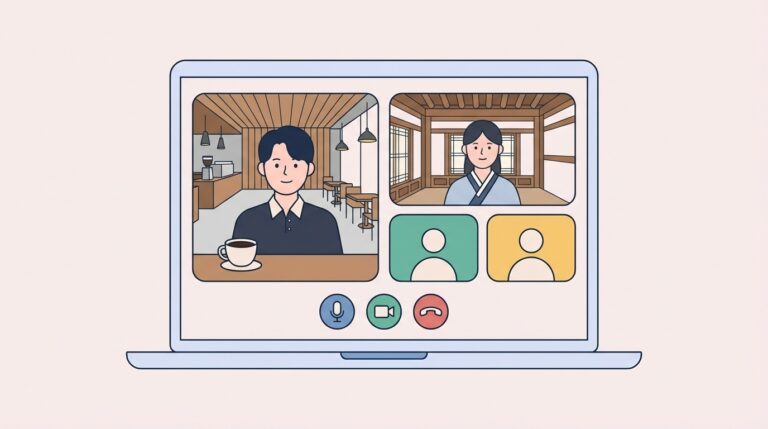
Phase 1: Empathy (Welcome to the Virtual Nunchi Game)
Hello! I’m your Daily Hangul Editor.
Imagine this: You are tuning into your first major cross-border virtual meeting with your Seoul-based team. You’ve seen enough K-Dramas like Search: WWW or Start-Up to know that Korean office culture can be fast-paced and highly respectful. But here you are on Teams, and your Korean manager is passionately presenting… on mute. The awkward silence stretches. You want to say, “Hey, you’re on mute!” but your brain freezes. Is it rude to point it out directly? How do you interrupt an executive in Korean without losing face?
Navigating Smart Work and video conferencing tools (Zoom, Teams, Google Meet) in Korean requires an entirely different set of vocabulary than what you learn in standard textbooks. At the C1 level, you don’t just need to know how to communicate; you need to master indirectness and politeness—the core of virtual Nunchi (눈치).
In this guide, based on real panics and triumphs of my advanced students, we will dissect the exact phrases Korean professionals use to navigate technical glitches, screen sharing, and graceful exits. Let’s make you sound like a true Seoul insider!
Phase 2: Deep Dive into Core Expressions
1. 마이크가 꺼져 있는 것 같습니다. (maikeuga kkeojyeo inneun geot gatseumnida)
- Pronunciation: [ma-i-keu-ga kkeo-jyeo in-neun geot gat-seum-ni-da]
(Think of ‘eu’ like the disgusted sound you make stepping in gum, and smoothly connect ‘geot’ and ‘gat’ like a subtle beatbox.) - Meaning:
- Literal: It seems like the microphone is turned off.
- Real nuance: You’re on mute, but I’m giving you a polite out by blaming the technology, not you.
- K-Culture Moment: In a typical Korean virtual meeting, direct confrontation is avoided. If a boss is on mute, saying “마이크 켜세요 (Turn on your mic)” sounds like an order. Using “~것 같습니다” (It seems like) cushions the blow. It’s the linguistic equivalent of handing someone a tissue instead of telling them their nose is running.
- Editor’s Insight: This phrase is your golden shield. Whenever technology fails, use “~것 같습니다” to point it out gently.
- Situation Spectrum:
- Close colleagues (Casual): ⚠️ (Too formal, just use “마이크 꺼졌어요”)
- Co-workers (Semi-formal): ✅
- Boss/Clients (Formal): ✅
- 🤔 Think About It: Why does Korean rely so heavily on presumptive phrasing like “It seems like” (~은/는 것 같다) in business? How does your native language handle polite corrections during a virtual meeting?
2. 화면 공유 권한 좀 주시겠어요? (hwamyeon gongyu gwonhan jom jusigesseoyo?)
- Pronunciation: [hwa-myeon gong-yu gwon-han jom ju-si-get-seo-yo?]
- Meaning:
- Literal: Could you please give me the screen sharing authority?
- Real nuance: Can you make me a co-host so I can share my screen?
- K-Culture Moment: The word 권한 (authority/permission) sounds very formal in English, but it’s standard tech-jargon in Korean corporate life. You’ll hear it constantly in IT and start-up environments when negotiating access to drives, docs, and screen sharing.
- Editor’s Insight: Notice the little word “좀” (a little). It doesn’t mean “a little bit of permission.” It acts as a politeness softener, turning a demand into a gentle request.
- Situation Spectrum:
- Close colleagues (Casual): ✅ (Drop the ‘요’: 권한 좀 줘)
- Co-workers (Semi-formal): ✅
- Boss/Clients (Formal): ✅ (Or upgrade to 주시겠습니까?)
- 🤔 Think About It: The word “공유” (sharing) is used for screens, documents, and even emotions in modern Korean. What does the evolution of this word tell us about collaborative work culture?
3. 오디오가 겹치네요. 먼저 말씀하세요. (odioga gyeopchineyo. meonjeo malsseumhaseyo.)
- Pronunciation: [o-di-o-ga gyeop-chi-ne-yo. meon-jeo mal-sseum-ha-se-yo.]
- Meaning:
- Literal: The audio is overlapping. Please speak first.
- Real nuance: We’re talking over each other. You go ahead.
- K-Culture Moment: Korean hierarchy dictates that seniors speak first. If you accidentally talk over a senior manager due to lag, quickly retreating with “먼저 말씀하세요” (Please speak first, using the honorific for ‘speak’) shows impeccable manners.
- Editor’s Insight: Instead of saying “우리가 동시에 말했네요” (We spoke at the same time), Koreans blame the “audio” (오디오가 겹치다). It removes personal fault and focuses on the technical medium!
- Situation Spectrum:
- Close colleagues (Casual): ✅ (오디오 겹친다. 먼저 해)
- Co-workers (Semi-formal): ✅
- Boss/Clients (Formal): ✅ (먼저 말씀하십시오)
- 🤔 Think About It: Deferring to the other person when overlapping is common globally. However, how does the Korean use of honorifics (말씀) elevate this basic courtesy into an act of social respect?
Phase 3: Textbook vs. Real Korean
| Situation | 📖 Textbook Korean | 🗣️ Real Office Korean | 💡 Why is it different? |
|---|---|---|---|
| Audio lag | 목소리가 잘 안 들립니다. (I cannot hear your voice well.) | 인터넷이 좀 끊기는 것 같아요. (The internet seems to be lagging.) | Real Korean avoids blaming the speaker and blames the internet connection (끊기다) instead. |
| Wrapping up the call | 이만 회의를 종료하겠습니다. (I will now terminate the meeting.) | 그럼 이것으로 랩업(wrap-up) 할까요? / 마무리하겠습니다. | Modern WFH culture frequently blends English corporate jargon (랩업) with softer closing verbs (마무리하다). |
| Waiting for others to join | 다른 사람들이 올 때까지 기다립시다. (Let’s wait until others come.) | 참석자 분들 다 들어오시면 시작하겠습니다. (We will start once all attendees have entered.) | Treat virtual rooms like physical ones; people “enter” (들어오다), and we use the polite “attendees” (참석자). |
Phase 4: Cultural Context — K-Culture Deep Dive
4-1. The Non-Verbal “Untact” Nunchi
In a physical Korean office, Nunchi involves reading the room, checking the boss’s mood, and knowing when to speak. On Zoom, “비대면 눈치” (untact/virtual nunchi) translates to exaggerated physical reactions. Because audio delays make verbal affirmations difficult, Korean professionals often nod much more emphatically than their Western counterparts or use the “thumbs up” emoji aggressively. Also, turning off your camera when the boss is speaking without prior notice? A major faux pas.
4-2. K-Drama & The WFH Reality
If you watch recent office dramas, you might notice that while work-from-home (재택근무) became a reality during the pandemic, K-Dramas still prefer the physical office for dramatic tension (think of the explosive confrontations in the breakroom). However, one phenomenon that did cross over is the “랜선 회식” (LAN-cable Hoesik / Virtual drinking party). Instead of gathering at a BBQ joint, everyone orders delivery food (배달음식) to their own homes, logs onto Zoom, and raises a glass of Soju to the webcam. If you’re invited to one, remember: you still wait for the senior to “clink” their glass to the camera first!
Phase 5: Real-world Roleplay Scenario
Setting: It’s 10:00 AM on a Tuesday. You are on a crucial MS Teams call with your Seoul marketing team. Your department head, Park Bu-jang (Manager Park), is presenting the quarterly results. Suddenly, his screen freezes, and his audio drops entirely, but he keeps presenting enthusiastically.
Characters:
– YOU: The competent international team member (C1 level Korean).
– Jimin: Your peer, sending you frantic private messages.
– Manager Park (Park Bu-jang): The passionate but slightly tech-challenged boss.
Dialogue:
Jimin (DM): 아… 부장님 또 화면 멈추셨네요. 😅
(a… bujangnim tto hwamyeon meomchusyeonneyo.)
[Translation] Ah… Manager Park’s screen is frozen again. 😅
YOU (DM): 제가 말씀드릴까요?
(jega malsseumdeurilkkayo?)
[Translation] Should I tell him?
Jimin (DM): 네, 부탁드려요! 저번에도 혼자 10분 동안 말씀하셨거든요 ㅠㅠ
(ne, butakdeuryeoyo! jeobeonedo honja sipbun dongan malsseumhasyeotgeodeunyo tt-tt)
[Translation] Yes, please! Last time he talked to himself for 10 minutes ㅠㅠ
(You unmute yourself)
🔀 Your Turn! How do you break the news to Manager Park?
– A) “부장님, 인터넷 끊겼어요. 안 들려요!” (Manager, the internet dropped. I can’t hear you!)
– B) “부장님, 죄송하지만 화면이 멈추신 것 같습니다.” (Manager, I’m sorry but it seems your screen has frozen.)
– C) “오디오 나갔습니다. 다시 접속하세요.” (Audio is gone. Reconnect.)✅ Best Choice: B — Why? It uses the polite interjection “죄송하지만” (I’m sorry but) and the presumptive “~것 같습니다” to soften the interruption. It also uses the honorific “멈추신” for the boss’s screen!
⚠️ Choice A & C Analysis: Too direct and blunt. Using standard polite form (해요/습니다) isn’t enough; the vocabulary itself lacks the required deference for a senior manager.
Manager Park: (Reconnecting) 아, 제 목소리 들리나요? 어디까지 들으셨어요?
(a, je moksori deullinayo? eodikkaji deureusyeosseoyo?)
[Translation] Ah, can you hear my voice? Up to where did you hear?
YOU: 작년 4분기 실적 부분부터 다시 해주시면 될 것 같습니다!
(jangnyeon sabungi siljeok bubunbuteo dasi haejusimyeon doel geot gatseumnida!)
[Translation] I think it would be great if you could resume from the Q4 results part!
Phase 6: 10-Second Shadowing Drill
Time to get your mouth muscles moving. Pay attention to the pauses (/) and the mood tags!
🥺 Gently & Politely:
부장님, / 죄송하지만 / 마이크가 / 꺼져 있는 것 / 같습니다.
(bu-jang-nim, / joe-song-ha-ji-man / ma-i-keu-ga / kkeo-jyeo in-neun geot / gat-seum-ni-da.)
😊 Bright & Professional:
제 화면이 / 잘 보이시나요?
(je hwa-myeoni / jal bo-i-si-na-yo?)
Phase 7: K-Culture Mini Dictionary (Virtual Office Edition)
| Korean | Romanization | English | Context & Usage |
|---|---|---|---|
| 재택근무 | jaetaekgeunmu | Work From Home (WFH) | The formal term for remote work. Highly sought-after perk in modern Korean companies. |
| 화상 회의 | hwasang hoeui | Video Conference | Literally “image-meeting.” Refers to any Zoom, Teams, or Meet call. |
| 음소거 | eum-sogeo | Mute | From Sino-Korean roots: Sound (음) Erase (소거). “음소거 해제” is unmute. |
| 화면 공유 | hwamyeon gongyu | Screen Share | A critical technical phrase. “화면 공유하겠습니다” (I will share my screen) signals the start of a presentation. |
| 랜선 회식 | raenseon hoesik | Virtual Company Dinner | “LAN-cable” + “Company Dinner”. A cultural adaptation during remote work eras where teams drink together online. |
Phase 8: Traveler’s Survival Kit (Digital Nomad Edition)
As a C1 learner, you might find yourself “working from anywhere” in Seoul—perhaps a trendy cafe in Seongsu-dong. Video calls in public spaces require a delicate touch in Korea.
🆘 Survival Expressions for the Cafe Worker
– 🇰🇷 “여기서 잠깐 화상 회의(통화) 해도 괜찮을까요?” (yeogiseo jamkkan hwasang hoeui haedo gwaenchaneulkkayo?)
– 🗣️ Meaning: Is it okay if I have a quick video call here?
– 📍 Where to use: Small boutique cafes where loud talking might disrupt the quiet atmosphere.
– 💡 Pro Tip: In major franchises (Starbucks, Twosome Place), nobody cares. But in independent roasteries, it’s polite to ask. If you must talk, keep your voice low and always wear earphones.📌 Editor’s Travel Note
– Wi-Fi is everywhere: Korea is a digital nomad’s paradise. The Wi-Fi password (와이파이 비밀번호) is usually printed on the receipt (영수증) or a sign by the register. You don’t even need to ask!
– Leaving your laptop: Yes, the legends are true. You can leave your MacBook on a cafe table to go to the restroom in Korea. It’s an unwritten rule of the Korean cafe ecosystem.
Phase 9: Critical Thinking — “One Step Deeper”
Language & Power: The Illusion of the Flat Virtual Hierarchy
🧠 Think Deeper:
Video conferencing platforms like Zoom display everyone in equal-sized, democratic little squares. In many Western cultures, this visual leveling helped flatten corporate hierarchies. However, in Korean, language itself maintains the hierarchy regardless of the visual interface. Even if a junior employee is the “Host” of the meeting, their Korean grammar must remain deferential (using 높임말). They must manage the digital space—admitting people from the lobby, managing screen shares—with the same linguistic subservience as pouring a drink for a boss at a physical hoesik. Does the digital medium change the culture, or does the culture mold the digital medium? In Korea, language is the invisible architecture that keeps the hierarchy intact, even in the cloud.💬 Your Turn: Have you noticed video calls changing the power dynamics in your native language or workplace? Share your thoughts in the comments!
Phase 10: FAQ & Avoiding Mistakes
Q: At the end of a Zoom call, everyone shouts “수고하셨습니다!” Can I say this to my boss?
A: Proceed with caution. “수고하셨습니다” (You worked hard) is standard, but technically, evaluating someone’s “effort” is a top-down concept. Towards a senior executive, it’s safer to say “감사합니다” (Thank you) or “고생 많으셨습니다” (You’ve been through a lot of trouble – slightly more empathetic and deferential).
Q: How do I smoothly interrupt someone who is rambling online?
A: Use the “apology bridge”: “말씀 중에 죄송하지만…” (I’m sorry to interrupt your speaking, but…)
❌ Common Mistake #1: Pointing out technical flaws bluntly. Saying “부장님, 목소리 안 들려요” (Manager, I can’t hear your voice) sounds like a complaint.
✅ Do this instead: Blame the mysterious void of the internet. “연결이 좀 안 좋은 것 같습니다” (It seems the connection is a bit bad).
Phase 11: Summary & Action Items
One-Liner Summary: In Korean virtual meetings, wrap your technical corrections in polite presumption (“~것 같습니다”) and always blame the internet, not the speaker!
Action Mission 3 Steps:
– 🥉 Bronze (Solo): Look at your own face on your webcam and say “마이크가 꺼져 있는 것 같습니다” three times with a gentle smile.
– 🥈 Silver (Online): Drop a comment on a Korean YouTube tech review video using the word “화면 공유” or “음소거”.
– 🥇 Gold (Real-world): In your next language exchange or Korean business call, intentionally use “인터넷이 좀 끊기는 것 같아요, 다시 말씀해 주시겠어요?” to ask for a repetition like a pro!
K-Culture Mission: Next time you watch a modern K-Drama with an office setting, watch the background computer screens. See if you can spot the MS Teams or Zoom UI, and observe how the characters physically bow to the monitor when saying goodbye. Yes, Koreans actually bow to their webcams!
Phase 12: Interactive Quiz
1. Situational Judgment: You are presenting on Teams. A senior client says, “화면이 안 보이네요.” (I can’t see the screen.) What is the most culturally appropriate and natural response?
– A) “그래요? 제 컴퓨터는 정상인데요.” (Really? My computer is normal.)
– B) “아, 죄송합니다. 다시 화면 공유 권한을 확인해보겠습니다.” (Ah, I apologize. I will check the screen-sharing permissions again.)
– C) “당신 인터넷이 느린 것 같습니다.” (I think your internet is slow.)
2. Fill in the Blank:
“오디오가 ( _______ ). 먼저 말씀하세요.”
Hint: The word implies the audio is ‘overlapping’.
3. True or False – K-Culture Edition:
In a virtual meeting (Zoom/Teams) with Korean clients, it is perfectly fine to drink coffee from a mug while the client is speaking, just as you would in a US meeting.
(Toggle for Answers)
– 1. B is correct. Always apologize first in client relations and frame it as a technical check. A is defensive, C is rude.
– 2. 겹치네요 (gyeopchineyo).
– 3. False (Mostly). While taking a sip is natural, casually snacking or slouching with a mug while a senior client speaks can be seen as lacking Nunchi. Sip discreetly, and maintain a posture of active, respectful listening!
Frequently Asked Questions (FAQ)
Q: What does "마이크가 꺼져 있는 것 같습니다. (maikeuga kkeojyeo inneun geot gatseumnida)" mean in Korean and how do you pronounce it?
A: In Korean, "마이크가 꺼져 있는 것 같습니다. (maikeuga kkeojyeo inneun geot gatseumnida)" is pronounced [ma-i-keu-ga kkeo-jyeo in-neun geot gat-seum-ni-da] and means: Literal: It seems like the microphone is turned off.
Q: What does "화면 공유 권한 좀 주시겠어요? (hwamyeon gongyu gwonhan jom jusigesseoyo?)" mean in Korean and how do you pronounce it?
A: In Korean, "화면 공유 권한 좀 주시겠어요? (hwamyeon gongyu gwonhan jom jusigesseoyo?)" is pronounced [hwa-myeon gong-yu gwon-han jom ju-si-get-seo-yo?] and means: Literal: Could you please give me the screen sharing authority?
Q: What does "오디오가 겹치네요. 먼저 말씀하세요. (odioga gyeopchineyo. meonjeo malsseumhaseyo.)" mean in Korean and how do you pronounce it?
A: In Korean, "오디오가 겹치네요. 먼저 말씀하세요. (odioga gyeopchineyo. meonjeo malsseumhaseyo.)" is pronounced [o-di-o-ga gyeop-chi-ne-yo. meon-jeo mal-sseum-ha-se-yo.] and means: Literal: The audio is overlapping. Please speak first.






