

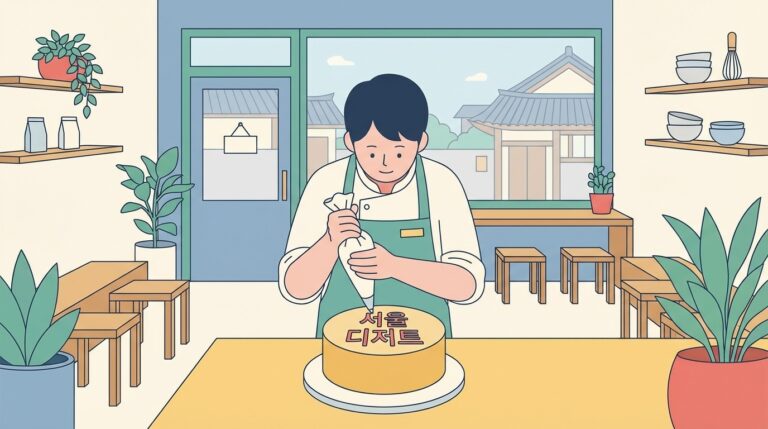
Phase 1: Empathy & The K-Culture Cold Open
Hello! Daily Hangul Editor here.
Imagine this: You are wandering through the trendy alleyways of Seongsu-dong or Yeonnam-dong in Seoul. Every dessert cafe window showcases pristine, perfectly smooth minimalist cakes with witty messages piped on top. Inspired, you sign up for a trendy Korean one-day baking class to make a customized ‘Lettering Cake’ (레터링 케이크) for your favorite K-Pop idol’s birthday or a friend’s anniversary.
The instructor hands you a spatula and says, “크림을 매끄럽게 펴 바르고 각을 살려주세요.”
Wait… Spread it smoothly and… save the angle?
If you’re at a C1 level, you already know the basics of ordering food. But when it comes to hands-on hobbies like baking, the Korean language uses highly specific, sensory-rich verbs and idiomatic expressions to describe texture, precision, and aesthetics. Mastering these won’t just help you frost a cake; it will unlock a whole new level of native-like fluency. This guide is crafted from real experiences of advanced learners who realized that textbook Korean barely scratches the surface of the professional K-Dessert scene. Let’s dive in!
Phase 2: Core Expressions Deep Dive
1. 매끄럽게 펴 바르다
- Pronunciation: [mae-kkeu-reop-ge pyeo ba-reu-da] + [Sounds like: meh-kkoo-rop-geh pyuh bah-roo-dah]
- Meaning: Literal (To spread smoothly) vs. Real nuance (To achieve a flawless, sleek finish without any bumps)
- K-Culture Moment: You’re watching a Korean cafe vlog (브이로그). The baker spends a mesmerizing 5 minutes just turning the turntable, applying frosting until the cake looks like a perfectly smooth canvas. They will subtitle this moment: “아이싱을 매끄럽게 펴 발라줍니다.”
- Editor’s Insight: For advanced learners, the distinction between 부드럽다 (soft to the touch) and 매끄럽다 (sleek, smooth without friction) is crucial. In baking, icing must be 매끄럽다.
- Situation Spectrum:
- Friends (Casual): ✅
- Colleagues (Semi-formal): ✅
- Elders/Boss (Formal): ✅ (Safe to use everywhere)
- 🤔 Think About It: Why does Korean have so many specific adjectives for textures? How does this reflect the Korean appreciation for sensory details in food and beauty?
2. 각을 살리다
- Pronunciation: [ga-geul sal-li-da] + [Sounds like: gah-geul sal-lee-dah]
- Meaning: Literal (To revive the angle) vs. Real nuance (To sharpen the edges, bringing out crisp 90-degree lines on the cake’s frosting)
- K-Culture Moment: Minimalist K-cakes are famous for their sharp, architectural edges. When the instructor tells you to “각을 살리세요,” they mean you need to hold your spatula perfectly straight to create that crisp top edge.
- Editor’s Insight: The verb 살리다 (to revive/save) is a magical, high-level Korean word. We use it to mean “bringing out the best quality” of something. You can save an angle (각을 살리다), save a vibe (분위기를 살리다), or save a flavor (맛을 살리다).
- Situation Spectrum:
- Friends (Casual): ✅
- Colleagues (Semi-formal): ✅
- Elders/Boss (Formal): ⚠️ (Slightly informal for strict business, but perfect for workshops)
- 🤔 Think About It: In English, we “sharpen” or “define” edges. In Korean, we “bring them to life” (살리다). What does this animistic approach to aesthetics tell us about the language?
3. 디테일을 잡다
- Pronunciation: [di-te-i-reul jap-da] + [Sounds like: dee-tay-ee-rool jahp-dah]
- Meaning: Literal (To catch the detail) vs. Real nuance (To nail the fine details, to refine the delicate parts)
- K-Culture Moment: When piping tiny lettering or small floral decorations on a custom cake, precision is everything. “디테일을 잡는 게 제일 어려워요” (Nailing the details is the hardest part).
- Editor’s Insight: Using English loanwords combined with native Korean verbs is a hallmark of modern conversational Korean. 잡다 (to catch/hold) is used here to mean “getting it under control” or “mastering it.”
- Situation Spectrum:
- Friends (Casual): ✅
- Colleagues (Semi-formal): ✅
- Elders/Boss (Formal): ✅
- 🤔 Think About It: Does your native language mix English terminology with local verbs as frequently as modern Korean does in specialized fields like baking or IT?
Phase 3: Textbook vs. Real Korean
| Situation | 📖 Textbook Korean | 🗣️ Real K-Dessert Korean | 💡 Why the Difference? |
|---|---|---|---|
| Putting frosting on a cake | 케이크에 크림을 바르세요. (Spread cream on the cake.) | 아이싱을 올려주세요. (Raise/place the icing.) | Pros use “올리다” (to raise/mount) to imply building layers, whereas “바르다” sounds like applying lotion. |
| Making it look nice | 예쁘게 만드세요. (Make it pretty.) | 디테일 좀 살려주세요. (Bring the details to life.) | “살리다” focuses on elevating the aesthetic quality and precision, not just generic “prettiness.” |
| The icing is too thick/clumpy | 크림이 너무 두꺼워요. (The cream is too thick.) | 크림이 떡졌어요 / 뭉쳤어요. (The cream clumped/became like rice cake.) | “떡지다” (to become like sticky rice cake) is a vivid slang used for clumpy icing, makeup, or unwashed hair. |
Bottom Note for C1 Learners: Using “떡지다” in a casual class shows incredible native-like fluency, but stick to “뭉쳤어요” (clumped) if you are speaking to an older, strict pastry chef!
Phase 4: Cultural Context — K-Culture Deep Dive
4-1. Non-verbal Elements & ‘Nunchi’ (눈치)
When icing a cake in a Korean class, watch the instructor’s Nunchi and hand pressure. Baking here is deeply tied to 손맛 (sonmat – the taste/feel of the hands). It’s not just about following the recipe perfectly; it’s about the intuitive pressure you apply with the spatula. If the instructor gently taps your wrist, it means you’re too tense. Relax your grip!
4-2. The “Lettering Cake” Phenomenon & K-Pop
In Korea, custom 레터링 케이크 (Lettering Cakes) are a massive cultural trend. They aren’t just for birthdays; they are essential for K-Pop fandoms celebrating an idol’s debut anniversary, or friends celebrating someone getting a new job.
The icing isn’t just decoration; it’s a canvas for witty puns and memes. Fans will ask bakers to pipe specific internet slang or lyrics using precise coloring. The demand for visual perfection is so high that mastering how to “각을 살리다” (sharpen edges) and “매끄럽게 펴 바르다” (smooth it out) determines a cafe’s survival on Instagram.
Critical View: While these cakes look flawless on social media, the heavy use of cream cheese and butter to maintain sharp edges often sacrifices the light, airy texture traditional Korean palates prefer.
Phase 5: Interactive Role-Play Scenario
Setting: A sunny Saturday afternoon at a popular One-Day Baking Studio in Yeonnam-dong. You are making a custom cake for your Korean friend’s birthday. The studio smells of vanilla and espresso.
Characters:
– YOU: An expat living in Seoul, trying to impress your friend with a handmade cake.
– Instructor Ji-yoon (28): A trendy, sweet but perfectionist pastry chef.
Dialogue:
Ji-yoon: 자, 이제 스패츌러로 크림을 매끄럽게 펴 발라볼게요. 손목에 힘을 빼시고요. 🎂
(Ja, ije seupaechulleoro keurimeul mae-kkeu-reop-ge pyeo bal-la-bol-ge-yo. Sonmoge himeul ppaesigoyo.)
[Alright, now let’s try spreading the cream smoothly with the spatula. Relax your wrist.]
(🎭 Stage Direction: Ji-yoon demonstrates with fluid, effortless motions)
YOU: (Struggling) 생각보다 어렵네요. 자꾸 크림이 뭉쳐요.
(Saenggakboda eoryeomneyo. Jakku keurimi mungcheoyo.)
[It’s harder than I thought. The cream keeps clumping.]
Ji-yoon: 괜찮아요! 처음엔 다 그래요. 윗부분 각을 조금만 더 살려볼까요?
(Gwaenchanayo! Cheoeumen da geuraeyo. Witbubun gageul jogeumman deo sallieobolkkayo?)
[It’s okay! Everyone is like that at first. Shall we try bringing out the top edges a bit more?]
🔀 Your Turn! How do you respond?
– A) “아, 귀찮은데 그냥 대충 할게요.” (Ah, it’s annoying, I’ll just do it roughly.)
– B) “선생님, 제가 똥손이라… 각 잡는 것 좀 도와주실 수 있나요?”
– C) “제가 알아서 완벽하게 할게요!”✅ Best Choice: B — “선생님, 제가 똥손이라… 각 잡는 것 좀 도와주실 수 있나요?” (Teacher, I have ‘poop hands’ (clumsy)… could you help me get the edges right?)
Why? Using the self-deprecating slang “똥손” (clumsy hands) in a friendly class will instantly make the instructor laugh and warm up to you. It shows high-level cultural fluency and polite reliance on their expertise.
⚠️ Choice A Analysis: This sounds extremely rude and dismissive of the instructor’s craft.
Ji-yoon: (Laughs) 에이, 똥손 아니에요! 이 정도면 훌륭하죠. 제가 조금만 다듬어 드릴게요.
(Ei, ttongson anieyo! I jeongdomyeon hullyunghajyo. Jaega jogeumman dadeumeo deurilgeyo.)
[Hey, you don’t have clumsy hands! This is great. I’ll just refine it a little bit for you.]
🎁 Bonus Scenario: Picking up a Custom Cake
You are at a bakery picking up a pre-ordered K-Pop idol cake.
Staff: 주문하신 레터링 케이크 나왔습니다. 문구 맞는지 확인해 주세요.
[Here is your lettering cake. Please check if the phrase is correct.]
YOU: 와, 글씨 디테일 진짜 잘 살려주셨네요! 너무 예뻐요.
[Wow, you really brought the lettering details to life! It’s so pretty.]
Staff: 감사합니다! 이동하실 때 모양 안 망가지게 조심하세요.
[Thank you! Please be careful not to ruin the shape while moving.]
Phase 6: 10-Second Shadowing Drill
Repeat after the guide to nail the intonation! Pay attention to the pauses (/).
- 🥺 Asking for help: 선생님, / 제가 각을 / 잘 못 살리겠어요. / 조금만 / 도와주세요!
(seonsaengnim, / jaega gageul / jal mot salligesseoyo. / jogeumman / dowajuseyo!) -
😊 Complimenting: 와! / 글씨 디테일을 / 정말 잘 / 살리셨네요!
(wa! / geulssi diteireul / jeongmal jal / sallishyeonneyo!)
Phase 7: K-Culture Mini Dictionary
| Korean | Romanization | English | Cultural Context |
|---|---|---|---|
| 레터링 케이크 | re-teo-ring ke-i-keu | Lettering Cake | Custom cakes with piped messages, central to Korean celebration culture. |
| 똥손 / 금손 | ttong-son / geum-son | Poop hands / Golden hands | Slang for someone who is clumsy (똥손) vs. highly skilled/artistic (금손). |
| 손맛 | son-mat | Taste of the hands | The idea that food tastes better based on the maker’s intuitive touch. |
| 인스타 감성 | in-seu-ta gam-seong | Insta-aesthetic | Visuals that look perfect for an Instagram feed (minimalist, clean). |
Phase 8: Traveler Survival Kit (Dessert Cafe Edition)
Even if you aren’t baking, you will definitely visit a dessert cafe in Korea!
🆘 Survival Expression #1
– 🇰🇷 “이거 달지 않고 맛있네요!”
– 🗣️ [i-geo dal-ji an-ko ma-sin-ne-yo!]
– 📍 Where to use: Eating cake with Korean friends or seniors.
– 💡 Pro Tip: In Korea, “It’s not too sweet” is the highest compliment for a dessert!🆘 Survival Expression #2
– 🇰🇷 “포장해 주실 때 보냉백 추가해 주세요.”
– 🗣️ [po-jang-hae ju-sil ttae bo-naeng-baek chu-ga-hae ju-se-yo.]
– 📍 Where to use: Buying a cake to-go.
– 💡 Pro Tip: Korean icing melts fast in summer. Always ask for a “보냉백” (cooler bag / ice pack).
📌 Editor’s Travel Note:
– Map Apps: Don’t rely on Google Maps for hidden cafes in Seongsu. Use Naver Map or KakaoMap.
– Takeout vs Dine-in: If you say “테이크아웃” (takeout), they might pack it without a fork. Always say “포크도 챙겨주세요” (Please include forks) if you need them.
Phase 9: Critical Thinking — “A Step Deeper”
🧠 Think Deeper: Food & Identity – The Ultimate Compliment: “달지 않아서 맛있다”
Why is “달지 않아서 맛있다” (It’s delicious because it’s not too sweet) considered the highest praise for desserts in Korea? In many Western cultures, a dessert’s primary goal is to provide a decadent, sugary rush. However, the Korean palate deeply values 조화 (harmony) and subtlety. This stems from a communal eating culture where desserts are often shared across generations. A dessert that is too sweet might alienate older family members. Thus, a cake that balances savory (like black sesame or mugwort) and lightly sweet flavors shows consideration for the collective over individual indulgence.
💬 Your Turn: In your culture, what is the ultimate compliment you can give to a dessert? Is extreme sweetness praised or criticized? Share your thoughts in the comments!
Phase 10: FAQ & Avoiding Misunderstandings
Q: Can I use “각을 살리다” (bring out the edge) in a business meeting?
Yes! Interestingly, this baking term works perfectly in business. If you say “이 기획안의 디테일을 좀 더 살려봅시다” (Let’s bring out the details of this proposal a bit more), you will sound like a highly competent Korean professional.
Q: Do I need to tip the instructor after a baking class?
NO. Tipping does not exist in Korea. Attempting to tip the instructor might cause awkwardness. A simple “선생님 덕분에 예쁘게 완성했어요. 감사합니다!” (Thanks to you, I finished it beautifully) with a bow of your head is the best reward.
❌ Common Mistake: Confusing 깎다 (to cut/peel) with 다듬다 (to refine/trim).
✅ Do this instead: When fixing the icing edges, don’t say “크림을 깎을까요?” (Should I peel the cream? – sounds like peeling an apple). Say “크림을 다듬을까요?” (Should I refine/smooth the cream?).
Phase 11: Summary & Action Items
One-Liner Summary: Elevate your Korean baking vocabulary by using advanced sensory verbs like “매끄럽게 펴 바르다” and “각을 살리다” to sound less like a textbook and more like a pro.
🎯 Action Missions:
– 🥉 Bronze (Solo): Stand in front of a mirror and practice saying “디테일을 정말 잘 살리셨네요!” smoothly.
– 🥈 Silver (Online): Find a Korean baking vlog on YouTube and leave a comment: “아이싱 진짜 매끄럽게 잘 하시네요!”
– 🥇 Gold (Real World): Visit a custom lettering cake shop in Korea and compliment their display cakes using today’s expressions!
🍰 K-Culture Mission:
Go to Instagram, search the hashtag #레터링케이크, and look at the aesthetic differences between Korean minimalist cakes and Western-style birthday cakes. Notice the sharp edges (각) we talked about today!
Did you try the shadowing drill? Let me know which expression felt the most natural to you in the comments below!
Phase 12: Interactive Quiz
1. Fill in the Blank:
You want the baker to make the edges of your custom cake sharp and crisp.
“사장님, 케이크 윗부분 ___ 좀 살려주세요.”
(A) 눈치
(B) 각
(C) 맛
2. True or False — K-Culture Edition:
If you want to highly praise a cake your Korean friend’s mother baked, you should tell her, “이 케이크 정말 엄청나게 달아서 최고예요!” (This cake is incredibly sweet, so it’s the best!)
3. Situational Judgment:
Your icing clumped up and looks messy. What is the most natural, C1-level way to express this to your instructor?
(A) 크림이 너무 안 예뻐요.
(B) 크림이 다 떡졌어요.
(C) 크림을 깎아주세요.
Click to reveal answers!
1. (B) 각. “각을 살리다” means to sharpen/define the edges.
2. False. Praising a cake for being too sweet might be taken as polite criticism. It’s better to say “달지 않고 맛있어요!”
3. (B) 크림이 다 떡졌어요. “떡지다” is the perfect advanced slang for clumpy textures.
Frequently Asked Questions (FAQ)
Q: What does "매끄럽게 펴 바르다" mean in Korean and how do you pronounce it?
A: In Korean, "매끄럽게 펴 바르다" is pronounced [mae-kkeu-reop-ge pyeo ba-reu-da] and means: Literal (To spread smoothly) vs. Real nuance (To achieve a flawless, sleek finish without any bumps)
Q: What does "각을 살리다" mean in Korean and how do you pronounce it?
A: In Korean, "각을 살리다" is pronounced [ga-geul sal-li-da] and means: Literal (To revive the angle) vs. Real nuance (To sharpen the edges, bringing out crisp 90-degree lines on the cake's frosting)
Q: What does "디테일을 잡다" mean in Korean and how do you pronounce it?
A: In Korean, "디테일을 잡다" is pronounced [di-te-i-reul jap-da] and means: Literal (To catch the detail) vs. Real nuance (To nail the fine details, to refine the delicate parts)







