

Phase 1: Empathy (The K-Culture Cold Open)
Hello! It’s your Daily Hangul Editor.
Picture this: You are at a 노래방 (Noraebang – Korean Karaoke) with your Korean friends. You just poured your heart and soul into singing a 3-octave K-Pop song. The neon lights are flashing, the tambourines are shaking, but… your throat is absolutely on fire.
In a K-Drama, this is the exact moment the main character aggressively hits the ‘Stop’ button, pants heavily, and downs a cup of water before confessing their feelings. But right now, you just really need a drink. You look around the small room. No water bottles. You step out to the counter, but how do you ask the owner?
If you don’t know the cultural code for “drinking water” in Korea, you might end up buying an expensive soda when water is actually free! Don’t worry. As a tutor who has seen many students lose their voices in Hongdae’s karaoke rooms, I’m going to teach you exactly how to survive and hydrate like a true local. Let’s dive in!
Phase 2: Core Phrases Deep Dive
Here are the top 3 phrases you need to save your vocal cords.
1. 물 좀 주세요 (Mul jom juseyo)
- Pronunciation: mul jom ju-se-yo (Say ‘mul’ like it rhymes with ‘pool’, and ‘ju-se-yo’ like ‘juice-ay-yo’)
- Meaning: Please give me some water. (Literal: Water a little give please)
- K-Culture Moment: This is the universal phrase in Korea. Whether you’re at a spicy Tteokbokki stand, a fancy BBQ restaurant, or a Noraebang counter, this is your magic spell for hydration.
- Editor’s Insight: The word 좀 (jom – a little) is the secret sauce here. It doesn’t mean you literally want a tiny drop of water. It’s a cultural tool to make your request sound softer and more polite.
- Situation Spectrum:
- Friends (Casual): ⚠️ (You would just say ‘물 줘’ – mul jweo)
- Staff/Noraebang Owner (Semi-formal): ✅ (Perfect!)
- Boss/Elders (Formal): ✅ (Safe and polite)
- 🤔 Think About It: Why do Koreans add “좀 (a little)” when asking for a favor? Does your language have a similar “softener” word to avoid sounding too demanding?
2. 정수기 어디 있어요? (Jeongsu-gi eodi isseoyo?)
- Pronunciation: jeong-su-gi eo-di isseo-yo? (‘gi’ sounds like ‘gee’ in ‘geese’)
- Meaning: Where is the water purifier?
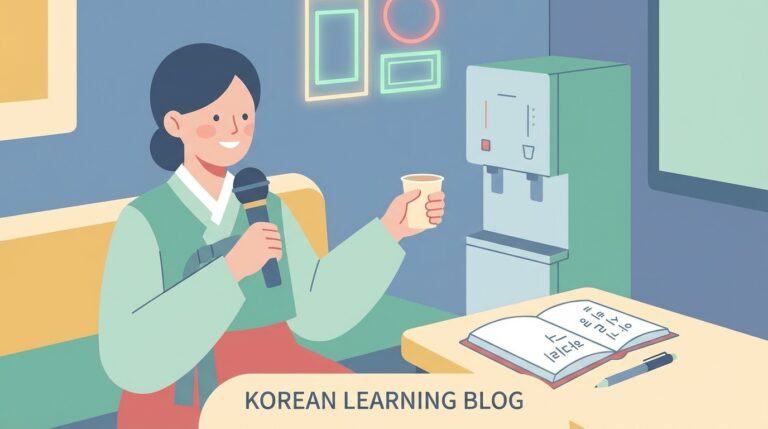
- K-Culture Moment: Have you noticed in K-Dramas, office workers always gossip around a tall machine with hot and cold water buttons? That’s a 정수기 (Water Purifier). In Korean Noraebangs, water is often free, but you have to get it yourself from this machine in the hallway!
- Editor’s Insight: Instead of asking the busy owner to bring you water, finding the ‘Jeongsu-gi’ is the ultimate insider move.
- Situation Spectrum:
- Asking friends: ✅
- Asking staff: ✅
- Asking strangers: ✅
- 🤔 Think About It: Water purifiers are everywhere in Korea—banks, pharmacies, clinics, and karaoke rooms. What does this tell you about the Korean attitude toward sharing basic necessities?
3. 물은 셀프예요? (Mureun selpeu-yeyo?)
- Pronunciation: mu-reun sel-peu-ye-yo? (‘selpeu’ is just the English word ‘self’ with a Korean accent)
- Meaning: Is water self-service?
- K-Culture Moment: You look at the restaurant wall and see a sign: “물은 셀프 (Water is Self)”. This means “Don’t wait for us to serve you, go get it yourself!” It’s a hallmark of fast-paced Korean culture.
- Editor’s Insight: Using English loanwords (Konglish) like ‘셀프’ makes you sound very natural. If you ask this, the owner will smile and point you to the water machine.
- Situation Spectrum:
- Asking staff: ✅
- Official settings: ⚠️
Phase 3: Textbook vs. Real Korean
| Situation | 📖 Textbook Korean | 🗣️ Real Korean | 💡 Why the difference? |
|---|---|---|---|
| Asking for water at the counter | 물 한 잔 주시겠습니까? (Would you please give me a glass of water?) | 사장님, 물 좀 주세요! (Boss, water please!) | Noraebangs are loud and casual. Using overly formal language sounds like a job interview. |
| Looking for cups | 종이컵은 어디에 있습니까? (Where are the paper cups located?) | 종이컵 어디 있어요? (Where’s the paper cup?) | Dropping the topic marker (은/는) makes speech much faster and more natural in real life. |
| Asking if water is free | 물은 무료입니까? (Is the water free of charge?) | 물은 셀프죠? (Water is self-service, right?) | “Self” implies it’s free but you have to do the legwork! |
Phase 4: Cultural Context — K-Culture Deep Dive
4-1. The Art of “Nunchi” (눈치) with Water
When you are at a Noraebang with older coworkers (a classic 회식/Hoesik afterparty), you shouldn’t just get water for yourself. Nunchi (reading the room) dictates that the youngest or most junior person goes to the hallway, grabs a stack of small paper cups, and brings water for everyone. If you do this as a foreigner, your Korean friends will be deeply impressed!
4-2. The “Jeongsu-gi” Paper Cup Challenge
Unlike Western restaurants that serve large glasses of iced tap water, Korean fast-casual spots and Noraebangs use a 정수기 (Water Purifier) and tiny paper cups (종이컵). These cups are about the size of an espresso shot! Why? Because it’s meant to be a quick sip to wet your throat before going back to singing.
Bonus Travel Tip: In a Coin Noraebang (코인 노래방) where there is no staff, there’s usually a vending machine inside. In this case, you have to buy a water bottle!
Phase 5: Real-Life Roleplay Scenario
Setting: Friday night, 10 PM. A loud Coin Noraebang in Hongdae. You just finished singing a BTS song, but your throat is dry. You step out to the tiny lobby and see the owner cleaning up.
Characters:
– YOU: A K-Pop fan, determined to sing 5 more songs.
– 사장님 (Boss/Owner): A friendly middle-aged man holding a mop.
Dialogue:
YOU: 헉헉… 사장님!
(heok-heok… sa-jang-nim!)
(Pant, pant… Boss!)
사장님: 아이고, 노래를 너무 열심히 불렀네요. 재미있어요?
(a-i-go, no-rae-reul neo-mu yeol-sim-hi bul-leot-ne-yo. jae-mi-it-seo-yo?)
(Oh my, you sang so hard. Is it fun?)
YOU: 네, 너무 재밌어요! 근데 목이 아파요.
(ne, neo-mu jae-mit-seo-yo! geun-de mo-gi a-pa-yo.)
(Yes, it’s so fun! But my throat hurts.)
🔀 Your Turn! How do you ask for water naturally?
– A) “물 한 잔 주시겠습니까?” (Formal textbook style)
– B) “저기요, 물 좀 주세요!” (Polite and natural)
– C) “물 줘!” (Very casual)✅ Best Choice: B. It’s polite but fits the casual vibe of a Noraebang.
⚠️ Choice A Analysis: It sounds like a robot.
🚫 Choice C Analysis: Never say this to an owner! This is only for your closest friends.
(You chose B)
YOU: 저기요, 물 좀 주세요! 🧊
(jeo-gi-yo, mul jom ju-se-yo!)
(Excuse me, please give me some water!)
사장님: 아, 물은 저기 복도 끝에 정수기 있어요. 셀프예요!
(a, mu-reun jeo-gi bok-do kkeu-te jeong-su-gi it-seo-yo. sel-peu-ye-yo!)
(Ah, the water is at the water purifier at the end of the hallway. It’s self-service!)
YOU: 아, 네! 감사합니다!
(a, ne! gam-sa-ham-ni-da!)
(Ah, okay! Thank you!)
Phase 6: 10-Second Shadowing Drill
Let’s practice the flow of real Korean! Pay attention to the pauses (/).
- 😊 사장님, / 여기 / 물 좀 / 주세요!
(sa-jang-nim, / yeo-gi / mul jom / ju-se-yo!) - 🥺 아… / 물은 / 셀프예요?
(a… / mu-reun / sel-peu-ye-yo?) - 🧐 복도에 / 정수기 / 어디 있어요?
(bok-do-e / jeong-su-gi / eo-di it-seo-yo?)
Phase 7: K-Culture Mini Dictionary
| Korean | Romanization | English | Context |
|---|---|---|---|
| 노래방 | noraebang | Karaoke | Lit. “Song room”. A staple of Korean nightlife and stress relief. |
| 정수기 | jeongsu-gi | Water Purifier | The machine that dispenses hot/cold drinking water. Ubiquitous in Korea. |
| 셀프 | selpeu | Self-service | If you see this, don’t wait! Go get the water, side dishes, or utensils yourself. |
| 사장님 | sajangnim | Boss / Owner | The safest, most polite way to call the staff or owner at a restaurant/Noraebang. |
| 종이컵 | jongikeop | Paper cup | Small disposable cups stacked next to the water purifier. |
Phase 8: Traveler’s Survival Kit 🆘
Whether you’re at a Noraebang, a spicy chicken restaurant, or a bustling market, these phrases will save you.
🆘 Survival Phrases TOP 3
1. 🇰🇷 “여기 물 좀 주세요.” (yeogi mul jom juseyo.) – Water here, please!
2. 🇰🇷 “이거 매워요?” (igeo maewoyo?) – Is this spicy? (Crucial before you need the water!)
3. 🇰🇷 “화장실 어디예요?” (hwajangsil eodiyeyo?) – Where is the bathroom? (Essential after drinking all that water!)📌 Editor’s Travel Note
– Tap Water: Koreans generally do NOT drink straight from the tap. Always look for the 정수기 (purifier) or buy bottled water (생수 – saengsu) from a convenience store.
– Ice: Free water in Korea is usually cold, but it doesn’t have ice. If you want ice, you need to go to a cafe or buy an “Ice Cup” (얼음컵) at a convenience store!
Phase 9: Think Deeper — Food, Water, and Identity
The Culture of “Insim” (인심 – Generous Hospitality)
In many Western countries, you might have to buy bottled water at a restaurant or pay a cover charge at a club. But in Korea, water and side dishes (banchan) are almost universally free. This stems from the traditional Korean concept of 인심 (Insim), which means a generous heart. Historically, refusing a thirsty traveler a cup of water was considered incredibly rude. Today, that spirit lives on in the free water purifiers found in every Noraebang, bank, and restaurant across the country.
💬 Your Turn:
Are water and side dishes free in your country’s restaurants? Does your culture have a similar concept of ‘generosity’ to strangers? Let me know in the comments!
Phase 10: FAQ & Avoiding Mistakes
Q: Can I bring my own water into a Noraebang?
It depends! Regular Noraebangs often sell drinks, so bringing outside food/drinks is frowned upon. However, Coin Noraebangs (코인 노래방) usually don’t mind if you bring in a bottle of water from the convenience store.
Q: Can I use “주세요” to an older person?
Yes! “~주세요” is a polite form (A2 level). It is perfectly safe to use with staff, owners, and older acquaintances.
❌ Common Mistake #1: Saying “물 줘” (mul jweo) to a restaurant owner.
✅ How to fix it: “줘” is casual (banmal). Only use it with your closest friends. Always add “세요” (se-yo) at the end when talking to staff: “물 주세요!”
Phase 11: Summary & Action Items
🌟 One-Liner Summary:
When your throat is dry at a Noraebang, find the Jeongsu-gi (purifier) or say “사장님, 물 좀 주세요!” (Boss, water please!).
🎯 Action Missions:
– 🥉 Bronze (Solo): Say “사장님, 물 좀 주세요!” out loud 3 times right now with a thirsty expression.
– 🥈 Silver (Online): Post a comment below telling us what your go-to Karaoke song is!
– 🥇 Gold (Real Life): Next time you visit a Korean restaurant or cafe, find the 정수기 (water purifier) and get your own water instead of asking the staff!
🎤 K-Culture Mission:
Watch a K-Drama episode tonight. I guarantee you will spot a small paper cup next to a water purifier in an office or hospital scene. When you see it, shout “Jeongsu-gi!”
Phase 12: Interactive Quiz
1. You are at a Coin Noraebang, and there is no staff. You are thirsty. What should you look for?
A) A waiter
B) 정수기 (Jeongsu-gi) or a Vending Machine
C) The bathroom tap
2. True or False: In a Korean Noraebang, it is considered rude to get your own water without asking.
– (T / F)
3. Fill in the blank:
“사장님, 물은 _____예요?” (Boss, is the water self-service?)
A) 공짜 (Free)
B) 셀프 (Self)
C) 좀 (A little)
(Answers: 1. B, 2. False – “Self” service is preferred!, 3. B)
Frequently Asked Questions (FAQ)
Q: What does "물 좀 주세요 (Mul jom juseyo)" mean in Korean and how do you pronounce it?
A: In Korean, "물 좀 주세요 (Mul jom juseyo)" is pronounced [mul jom ju-se-yo (Say 'mul' like it rhymes with 'pool', and 'ju-se-yo' like 'juice-ay-yo'] and means: Please give me some water. (Literal: Water a little give please)
Q: What does "정수기 어디 있어요? (Jeongsu-gi eodi isseoyo?)" mean in Korean and how do you pronounce it?
A: In Korean, "정수기 어디 있어요? (Jeongsu-gi eodi isseoyo?)" is pronounced [jeong-su-gi eo-di isseo-yo? ('gi' sounds like 'gee' in 'geese'] and means: Where is the water purifier?
Q: What does "물은 셀프예요? (Mureun selpeu-yeyo?)" mean in Korean and how do you pronounce it?
A: In Korean, "물은 셀프예요? (Mureun selpeu-yeyo?)" is pronounced [mu-reun sel-peu-ye-yo? ('selpeu' is just the English word 'self' with a Korean accent] and means: Is water self-service?







