

Phase 1: Empathy (Immersive Open)
Hello there! It’s your Daily Hangul Editor.
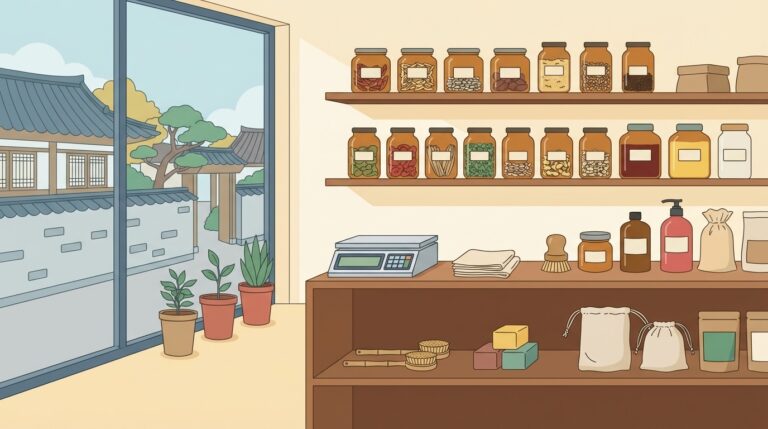
Picture this: You’re walking through the trendy, indie-vibes alleys of Mangwon-dong or Seongsu-dong. Among the aesthetic cafes and vintage boutiques, you spot a minimalist shop filled with giant dispensers, glass jars, and people carefully pumping liquids into their own bottles. Welcome to the Korean Zero Waste Shop (제로 웨이스트 샵).
Korea is a country of paradoxes. On one hand, it’s the undisputed king of Pali-pali (hurry-hurry) culture and ultra-convenient plastic-heavy delivery apps. On the other hand, the MZ generation is driving a massive eco-friendly (친환경) lifestyle revolution.
As a C2-level Korean learner, you already know how to say “봉투 필요 없어요” (I don’t need a bag). But what happens when you step into a refill station and the staff asks you to “tare the scale” or “portion out” your items? Textbooks won’t teach you these highly specific, advanced daily terms. If you don’t know them, you might end up staring blankly at a digital scale while a line forms behind you.
Don’t worry! This guide is built from the real-life experiences (and slight panics) of expats navigating Seoul’s sustainable shopping scene. Let’s dive in and shop like a true local!
Phase 2: Core Expressions Deep Dive
1. 용기 가져오셨나요?
- Pronunciation: [Yonggi gajeo-osyeotnayo?] + [Yohng-gee gah-jeo-oh-shyeot-nah-yo?]
- Meaning: Literal: “Did you bring courage?” / Real nuance: “Did you bring a container?”
- K-Culture Moment: You walk into a refill station, and the staff greets you with this. In Korean, 용기 (Yonggi) is a homonym. It means both “courage” and “container/receptacle.” The Korean eco-community cleverly turned this into the #용기내챌린지 (Yonggi-nae Challenge) on Instagram—meaning “Bring a container” AND “Take courage (to help the environment).”
- Editor’s Insight: This is a brilliant play on words! When you hear this, they aren’t questioning your bravery. They just want to know if you have your own bottle.
- Situation Spectrum:
- Casual friends: ✅ (e.g., 야, 용기 챙겼어?)
- Shop Staff to Customer: ✅
- Formal/Business: ⚠️ (Depends on the context)
- 🤔 Think About It: Puns using homonyms are incredibly common in Korean advertising and social campaigns. Can you think of any campaigns in your home country that use similar linguistic wordplay to promote a good cause?
2. 저울에 올리고 영점을 맞춰주세요.
- Pronunciation: [Jeoure olligo yeongjeomeul matchwojuseyo.] + [Jeo-ool-eh ohl-li-go young-jeom-eul mah-chwo-joo-seh-yo.]
- Meaning: Literal: “Put it on the scale and set the zero point.” / Real nuance: “Please place it on the scale and tare it.”
- K-Culture Moment: The moment of truth at any refill station. You must weigh your empty bottle before filling it, so you don’t pay for the weight of the glass. 영점 (Yeong-jeom) literally means “zero point.”
- Editor’s Insight: ‘영점을 맞추다’ is a C2-level expression you’ll also hear in science labs, military training (sighting a rifle), and now, trendy eco-shops!
- Situation Spectrum:
- Casual: ✅ (영점 맞췄어?)
- Shop Staff to Customer: ✅
- Formal/Business: ✅
- 🤔 Think About It: Notice the Sino-Korean root 零 (영/zero) and 點 (점/point). Advanced Korean heavily relies on these Hanja (Chinese character) roots for technical precision.
3. 조금씩 소분해서 담아갈 수 있어요.
- Pronunciation: [Jogeumssik sobunhaeseo damagal su isseoyo.] + [Jo-geum-shik so-boon-hae-seo dah-mah-gal soo ee-sso-yo.]
- Meaning: Literal: “You can divide into small parts and put them in.” / Real nuance: “You can portion it out in small amounts to take home.”
- K-Culture Moment: You’ll see this word everywhere—not just at zero waste shops, but when meal-prepping K-food or organizing side dishes (반찬). 소분 (Sobun) comes from 小 (small) and 分 (divide).
- Editor’s Insight: Using “소분하다” instead of “작게 나누다” instantly elevates your Korean to native-like fluency. It shows you understand domestic lifestyle vocabulary.
- Situation Spectrum:
- Casual: ✅
- Semi-formal: ✅
- Formal/Business: ✅
- 🤔 Think About It: Korean culture involves buying in bulk (like giant bags of rice or Costco runs) and dividing them up. How does the concept of ‘소분’ reflect the living situations in densely populated cities like Seoul?
Phase 3: Textbook vs. Real Korean
| Situation | 📖 Textbook Korean | 🗣️ Real Korean | 💡 Why the difference? |
|---|---|---|---|
| Agreeing to eco-friendly ways | 저는 환경을 보호합니다. (I protect the environment.) | 저 제로 웨이스트 하려고요. (I’m trying to go zero waste.) | Konglish/loanwords (제로 웨이스트, 비건, 에코) are heavily used in modern lifestyle trends. |
| Asking for a bag | 봉투 주시겠어요? (Could you give me a bag?) | 장바구니 챙겨왔어요. / 에코백 있어요. (I brought a shopping bag/eco-bag.) | ‘봉투’ implies a disposable paper/plastic bag. ‘장바구니’ is the traditional reusable bag. |
| Empty bottles | 빈 병 있어요? (Do you have an empty bottle?) | 공병 있나요? (Do you have empty/donated bottles?) | ‘공병’ (空甁) is the professional/industry term used in cosmetics and eco-shops for empty containers. |
Bottom Note for C2 Learners: Don’t be afraid to use English loanwords like “친환경 (Eco-friendly)” alongside “제로 웨이스트 (Zero Waste).” In Seoul, the English terms often carry a trendier, MZ-generation nuance.
Phase 4: Cultural Context — K-Culture Deep Dive
4-1. Non-Verbal Cues & “Nunchi” at the Scale
At a Korean refill station, the weighing area is often shared. The ultimate test of Nunchi (눈치)—the Korean art of reading the room—is being efficient at the scale. Weigh your bottle, print the barcode, fill it, and move aside quickly. In Korea’s fast-paced society, even slow-living, eco-friendly shopping has an underlying rhythm of efficiency!
4-2. The “Yonggi-nae” Challenge & Social Media
If you follow Korean celebrities or K-Pop idols on Instagram, you might have seen them posting photos of themselves picking up Tteokbokki or ordering Jjajangmyeon using their own massive pots from home. This is the #용기내챌린지 (Bring Your Container Challenge).
It started as a grassroots movement to combat the horrific amount of plastic waste generated by food delivery apps during the pandemic. Idols and actors participating in this challenge helped normalize bringing a bulky Tupperware container to your local street food vendor.
Phase 5: Real-Life Roleplay Scenario
Setting: Saturday afternoon at a popular Zero Waste Refill Station in Mangwon-dong. Sunlight streams through the window onto rows of amber glass jars. You are an expat living in Seoul, trying to buy some vegan dish soap.
Characters:
– YOU: Eco-conscious C2 Korean learner.
– Minji (28): The friendly, slightly busy shop staff member.
Dialogue:
YOU: 안녕하세요! 주방 세제 좀 리필하려고 하는데요. 🌿
(Annyeonghaseyo! Jubang seje jom ripilharyeogo haneundeyo.)
[Hello! I’d like to refill some dish soap.]
Minji: 네, 어서 오세요! 혹시 담아가실 용기 가져오셨나요?
(Ne, eoseo oseyo! Hoksi damagasil yonggi gajeo-osyeotnayo?)
[Yes, welcome! Did you happen to bring a container to put it in?]
YOU: 아, 네! 이 유리병 가져왔어요. 그런데 안이 완벽하게 마르진 않았어요. 😅
(A, ne! I yuribyeong gajeowasseoyo. Geureonde ani wanbyeokhage mareujin anasseoyo.)
[Ah, yes! I brought this glass bottle. But it’s not perfectly dry inside.]
(🎭 Stage Direction: You hand over the bottle awkwardly.)
Minji: 아고, 물기가 있으면 세제가 상할 수 있어서요.
(Ago, mulgiga isseumyeon sejega sanghal su isseoseoyo.)
[Oh dear, if there’s moisture, the soap might spoil.]
🔀 Your Turn! How should you respond?
– A) “아, 그럼 그냥 비닐봉지에 담아주세요.” (Ah, then just put it in a plastic bag.)
– B) “혹시 매장에 기증받은 공병 있나요?” (Do you happen to have any donated empty bottles in the store?)
– C) “괜찮아요. 그냥 제 병에 담아주세요.” (It’s fine. Just put it in my bottle anyway.)✅ Best Choice: B — Reason: Most zero waste shops in Korea have a sterilization station with donated ‘공병’ (Gongbyeong – empty bottles) for customers who forgot theirs or brought wet ones. It shows immense cultural fluency to ask for this!
⚠️ Choice A & C Analysis: Choice A defeats the entire purpose of the shop and will result in a polite refusal. Choice C ignores the staff’s expert advice, which goes against the communal harmony expected in Korean customer interactions.
(Assuming you chose B)
YOU: 혹시 매장에 기증받은 공병 있나요?
(Hoksi maejange gijeungbadeun gongbyeong itnayo?)
[Do you happen to have any donated empty bottles in the store?]
Minji: 네! 저쪽 소독기 안에 있는 병 중 하나 고르시면 됩니다.
(Ne! Jeojjok sodokgi ane itneun byeong jung hana goreusimyeon doemnida.)
[Yes! You can pick one of the bottles inside the sterilizer over there.]
YOU: 다행이네요. 그럼 이 병에 소분해 갈게요.
(Dahaeng-ineyo. Geureom i byeonge sobunhae galgeyo.)
[What a relief. Then I’ll portion it out into this bottle.]
Minji: 네, 내용물 담으시기 전에 저울에 올리고 영점부터 맞춰주세요!
(Ne, naeyongmul dameusigi jeone jeoure olligo yeongjeombuteo matchwojuseyo!)
[Yes, before you put the contents in, please place it on the scale and tare it first!]
YOU: 영점 버튼 누르고, 원하는 만큼 덜어가면 되는 거죠?
(Yeongjeom beoteun nureugo, wonhaneun mankeum deoreogamyeon doeneun geojyo?)
[Press the tare button, and then I just dispense as much as I want, right?]
Minji: 맞습니다! 다 하시고 바코드 출력해서 카운터로 와주세요~ 😊
(Matseumnida! Da hasigo bakodeu chullyeokhaeseo kaunteoro wajuseyo~)
[That’s correct! When you’re done, print the barcode and come to the counter~]
Phase 6: 10-Second Shadowing Drill
Master the flow and intonation like a Seoulite!
😊 저울에 / 올리고 / 영점을 / 맞춰주세요! (jeoure / olligo / yeongjeomeul / matchwojuseyo!)
* Pausing ( / ): Pause briefly after ‘올리고’ to separate the two actions (placing it, then taring it).
* Intonation: Keep it friendly and upbeat. End the ‘세요’ on a slightly higher, melodic note, which is typical for Korean customer service.
Phase 7: K-Culture Mini Dictionary
| Korean | Romanization | English | Context |
|---|---|---|---|
| 용기내 챌린지 | yonggi-nae chaellinji | Bring-your-container challenge | A social media movement encouraging people to bring pots/tupperware for takeout. |
| 소분 | sobun | Portioning / Subdividing | The act of buying in bulk and dividing into smaller containers. |
| 공병 | gongbyeong | Empty bottle | Used heavily in K-Beauty (empties recycling) and zero-waste shops. |
| 영점 | yeongjeom | Zero point (Tare) | Essential vocabulary when using digital scales in Korea. |
| 친환경 | chin-hwangyeong | Eco-friendly | “Chin” (pro/friendly) + “Hwangyeong” (environment). The standard term for green products. |
Phase 8: Traveler’s Survival Kit
Even if you’re just visiting Korea for a short trip, you might stumble into a cool sustainable pop-up in Seongsu or a vegan bakery. Keep these cards handy!
🆘 Survival Expression #1: When you need a container
– 🇰🇷 “기증받은 공병 있나요?” (gijeungbadeun gongbyeong itnayo?)
– 🗣️ Sound-alike: [Gee-jeung-bahd-eun gong-byung it-nah-yo?]
– 📍 Where to use: Refill stations, cosmetic stores taking back empties.
– 💡 Pro Tip: Many Korean shops run “Gongbyeong return programs” where returning an empty K-beauty bottle gets you store credit!📌 Editor’s Travel Note
– Useful Apps: Use KakaoMap or Naver Map and search “제로웨이스트” or “리필스테이션” (Zero Waste / Refill Station).
– Payment: Most indie shops and refill stations in Korea are heavily card-dependent or use KakaoPay. Cash is rarely used here.
– The “No Bag” Rule: By law, large supermarkets and convenience stores in Korea cannot give out free disposable bags. You must buy a government-mandated garbage bag (종량제 봉투) or bring your own!
Phase 9: Critical Thinking — “One Step Deeper”
The Paradox of “Pali-Pali” Delivery vs. The Eco-Trend
🧠 Think Deeper:
Korea is globally renowned for its hyper-efficient delivery culture. Apps like Baedal Minjok deliver everything from hot soups to iced coffees to your door in 20 minutes, generating mountains of single-use plastics. Yet, simultaneously, Korea boasts one of the highest recycling rates in the world, and the MZ generation passionately champions the “Zero Waste” movement.This creates a fascinating cultural friction. The language reflects this clash: you order delivery via an app pushing “리뷰 이벤트” (Review events requiring plastic packaging), but then log onto Instagram to participate in the “용기내 챌린지” (Container challenge). The adoption of English loanwords like “비건” (Vegan) and “제로 웨이스트” (Zero Waste) acts as a trendy lifestyle marker for the youth, pushing back against the older generation’s hyper-industrialized “growth at all costs” mindset.
💬 Your Turn: Does your country experience a similar clash between extreme convenience and environmental activism? How does your culture balance the two? Let me know in the comments!
Phase 10: FAQ & Avoiding Misunderstandings
Q: Can I use informal language (반말) when participating in online eco-challenges?
Yes and No. If you are posting on your own Instagram with hashtags, using casual endings (e.g., 오늘 용기 냈어! 🌿) is perfectly natural. However, if you are commenting on an idol’s post or a shop’s official account, stick to polite form (존댓말).
Q: Can I bring a container that still has old product in it?
No. In Korea, hygiene standards at refill stations are strict. Staff will actively check if your bottle is completely dry (물기 없음) and clean.
❌ Common Mistake #1: Confusing the homonyms of “용기”.
If you say “저는 용기가 없어요” at a refill station, it means “I don’t have a container.” If you say it at a job interview, it means “I lack courage!” Context is everything.❌ Common Mistake #2: Trying to pay without weighing the empty bottle first.
Do not just pump the liquid! Always find the scale, place the empty bottle, and “영점을 맞추다” (tare it) FIRST. Otherwise, you’ll be paying extra for the weight of your heavy glass jar.
Phase 11: Summary & Action Items
One-Liner Summary: To navigate a Korean Zero Waste Shop like a pro, remember to bring your 용기 (container), 영점 맞추기 (tare the scale), and 소분하기 (portion it out)!
Action Mission:
– 🥉 Bronze (Solo): Stand in front of a mirror and practice saying “저울에 올리고 영점을 맞춰주세요” three times smoothly.
– 🥈 Silver (Online): Find a Korean zero waste shop on Instagram (search #제로웨이스트샵) and leave a supportive comment in Korean using today’s vocabulary.
– 🥇 Gold (Real World): Visit an eco-friendly store in Korea and successfully ask, “기증받은 공병 있나요?”
K-Culture Mission:
Open Naver Map or KakaoMap right now. Search for “알맹상점” (Almeng Market) in Mangwon-dong. Look at the photo reviews (방문자 리뷰) left by Koreans. Can you spot the words “용기” or “소분” in their reviews?
Phase 12: Quiz — Interactive Challenge
1. Situational Judgment: You forgot your reusable bag at the grocery store. What is the most natural, native-like way to ask for a bag you can use again?
– A) 비닐봉지 주세요.
– B) 제로 웨이스트 할게요.
– C) 종량제 봉투 하나 주세요.
2. Fill in the Blank:
“내용물을 담기 전에 저울에 올려서 ______을 맞춰주세요.”
– A) 소분
– B) 영점
– C) 용기
3. True or False – K-Culture Edition:
“In Korea, if you order street food like Tteokbokki, it is considered rude to bring your own Tupperware from home.”
– True or False?
(Scroll down for answers!)
Click to reveal answers!
- C (종량제 봉투 – Standardized garbage bag. In Korea, if you forget an eco-bag, you usually buy a government-issued trash bag to carry groceries home, which you later use for your actual trash! A is illegal in large stores, B makes no sense here.)
- B (영점 – Zero point/Tare)
- False (It is highly encouraged! It’s part of the trendy #용기내챌린지.)
Frequently Asked Questions (FAQ)
Q: What does "용기 가져오셨나요?" mean in Korean and how do you pronounce it?
A: In Korean, "용기 가져오셨나요?" is pronounced [Yonggi gajeo-osyeotnayo?] and means: Literal: "Did you bring courage?" / Real nuance: "Did you bring a container?"
Q: What does "저울에 올리고 영점을 맞춰주세요." mean in Korean and how do you pronounce it?
A: In Korean, "저울에 올리고 영점을 맞춰주세요." is pronounced [Jeoure olligo yeongjeomeul matchwojuseyo.] and means: Literal: "Put it on the scale and set the zero point." / Real nuance: "Please place it on the scale and tare it."
Q: What does "조금씩 소분해서 담아갈 수 있어요." mean in Korean and how do you pronounce it?
A: In Korean, "조금씩 소분해서 담아갈 수 있어요." is pronounced [Jogeumssik sobunhaeseo damagal su isseoyo.] and means: Literal: "You can divide into small parts and put them in." / Real nuance: "You can portion it out in small amounts to take home."






