

안녕하세요! I am the Senior Editor at Daily Hangul, your veteran Korean tutor and local culture navigator.
Have you ever watched a K-Drama where the main characters visit a bustling traditional market or a vibrant local festival? You know the scene: energetic trot music plays in the background, steam rises from the food tents, and the protagonist playfully banters with the vendor, popping a piece of fruit into their mouth and walking away with an extra handful of food for free.
It looks incredibly natural on screen, but standing there in real life—maybe at the famous Boryeong Mud Festival or the Nonsan Strawberry Festival—can feel intimidating. How do you ask to taste something without being rude? How do you casually ask for that ‘extra’ portion like a true local?
Today, we are going to dive deep into the language and culture of Korean Local Specialty Festivals (지역 특산물 축제). This guide is based on real questions from our B2-level students who wanted to step out of the tourist bubble and interact with the locals. Let’s make you an insider!
Phase 2: Core Expressions for the Festival Insider
Here are the top three expressions you need to confidently navigate any local Korean festival.
1. “이거 시식해 봐도 돼요?”
- Pronunciation: Igeo sisikhae bwado dwaeyo? [ee-guh shee-sheek-heh bwa-doh dweh-yo?]
- Meaning: Literal: Is it okay if I do a sample tasting of this? / Real nuance: Can I try a piece?
- K-Culture Moment: You are standing in front of a giant mountain of fresh Jeju tangerines. The vendor looks busy. Instead of just pointing, you use this phrase. It shows respect but also a genuine interest in their product. In Korea, sisik (sample tasting) is a huge part of grocery shopping and festival culture!
- Editor’s Insight: The word 시식 (sisik) specifically means “tasting food.” Don’t use this for drinks (use 시음 – sieum) or trying on clothes (use 입어 보다 – ibeo boda). The tone should be polite and slightly upbeat!
- Situation Spectrum:
- Casual (To a friend): 🚫 (You wouldn’t ask your friend this, unless they are the vendor!)
- Semi-formal (To a vendor): ✅ (Perfect!)
- Formal (To a strict boss): ⚠️
- 🤔 Think About It: Why does Korean have a specific noun just for “food tasting” (시식) compared to general “trying” (해 보다)? How does this reflect the importance of food in Korean commerce?
2. “사장님, 덤 좀 더 주세요~”
- Pronunciation: Sajangnim, deom jom deo juseyo~ [sah-jahng-neem, dum johm duh joo-seh-yo~]
- Meaning: Literal: Boss, please give me a little more deom. / Real nuance: Please give me a little extra on the house!
- K-Culture Moment: You’ve just bought 2kg of strawberries. As the vendor is bagging them, you say this with a bright smile. They laugh and throw in three more massive strawberries. This is the magic of Deom (덤)—the Korean concept of giving extra as a sign of generosity and connection.
- Editor’s Insight: You cannot say this with a straight, serious face. It requires a bit of playful aegyo (charm) and a smile. If you sound too demanding, it becomes rude.
- Situation Spectrum:
- Friendly local markets/festivals: ✅
- High-end department stores: 🚫 (Never do this at a fancy mall!)
- Franchised convenience stores: 🚫
- 🤔 Think About It: In many Western cultures, asking for free extra items is considered rude or stingy. In Korea, asking for deom can actually build a friendly rapport. Why is the boundary between buyer and seller more blurred in traditional Korean settings?
3. “이거 서울로 택배 보낼 수 있어요?”
- Pronunciation: Igeo seoullo taekbae bonael su isseoyo? [ee-guh soh-ool-loh tech-bae boh-nel soo ee-suh-yo?]
- Meaning: Literal: Can I send this to Seoul by parcel delivery? / Real nuance: Can you ship this to my address in Seoul?
- K-Culture Moment: You found the best Ginseng at the Geumsan Insam Festival, but you have 3 more days of traveling. You don’t want to carry it. Luckily, Korea’s taekbae (parcel delivery) system is legendary. Vendors at festivals almost always have a shipping tent right behind their stall.
- Editor’s Insight: Taekbae is a magical word in Korea. Deliveries usually take just 1-2 days. Knowing this word saves you from lugging heavy local specialties around on the KTX.
- Situation Spectrum:
- Festival vendors/Markets: ✅
- Traveling in general: ✅
Phase 3: Textbook vs. Real Korean
Let’s see how your textbook Korean compares to what you’ll actually hear at a bustling festival.
| Situation | 📖 Textbook Korean | 🗣️ Real Korean | 💡 Why is it different? |
|---|---|---|---|
| Asking the price | 이것은 얼마입니까? (Igeoseun eolmaimnikka?) | 사장님, 이거 얼마예요? (Sajangnim, igeo eolmayeyo?) | The ‘~ㅂ니까’ form is too rigid for a festive, outdoor setting. ‘~아/어요’ is standard. |
| Asking for extra | 조금 더 주시겠습니까? (Jogeum deo jusigesseumnikka?) | 이모님~ 덤 좀 팍팍 주세요! (Imonim~ deom jom pakpak juseyo!) | ‘팍팍’ is an onomatopoeia meaning ‘generously/without hesitation’. It adds local flavor and humor! |
| Saying it tastes good | 맛이 아주 좋습니다. (Masi aju joseumnida.) | 우와, 진짜 맛있어요! (Uwa, jinjja masisseoyo!) | Emotional reactions (‘우와’, ‘진짜’) show genuine appreciation, which vendors love. |
Note for B2 Learners: Using “이모님” (Auntie) is common for older female vendors, but if you are unsure, “사장님” (Boss/Owner) is always the safest and most polite choice!
Phase 4: Cultural Context — K-Culture Deep Dive
4-1. Non-verbal Nuances at the Festival
When you hand over your credit card or cash to the vendor, use two hands, or place your left hand on your right arm/elbow as you extend your right hand. This subtle gesture of respect instantly upgrades you from “clueless tourist” to “respectful guest.” Also, when eating a sample, don’t just grab it silently. Make brief eye contact, nod politely, and say “잘 먹겠습니다” (I will eat well) before trying it.
4-2. K-Food & K-Travel Connection: The ‘Jeong’ of Street Food
If you watch K-Food documentaries or travel vlogs, you’ll notice that Korean food culture is rarely just about the calories. It is about Jeong (정 – 情), a deep emotional bond and sense of community. At local festivals, vendors will often press warm food into your hands, telling you to eat it while it’s hot. If you buy a box of peaches, they might hand you a freshly washed peach to eat right there. This isn’t just a marketing tactic; it’s Jeong. By accepting the deom (extra) and reacting with joy (“너무 맛있어요!”), you are actively participating in Korean social bonding.
Phase 5: Real-Life Roleplay Scenario
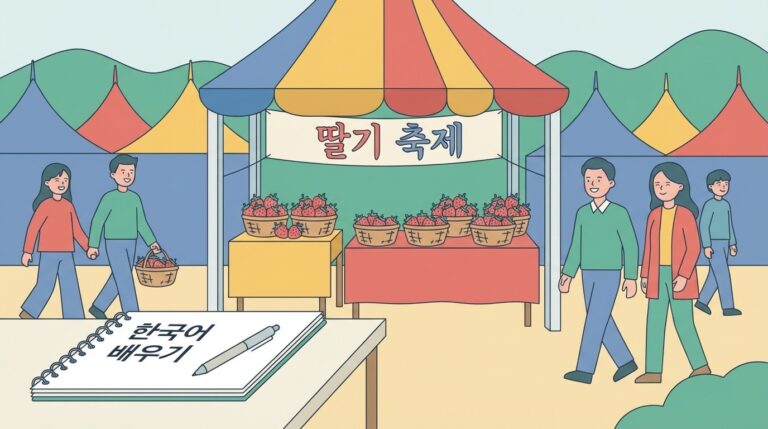
Setting: Saturday, 2 PM. You are at the famous Nonsan Strawberry Festival. The air smells sweet. Bright red strawberries are piled high on wooden tables under a large white tent. Trot music is blasting. You approach a stall run by a friendly-looking lady in her 60s.
Characters:
– YOU: An expat who loves Korean fruits but is on a budget.
– 사장님 (Vendor): A cheerful woman wearing a sun visor and a colorful floral apron.
(The conversation begins)
YOU: 우와… 딸기 진짜 크네요! 사장님, 이거 한 바구니에 얼마예요?
(Uwa… ttalgi jinjja keuneyo! Sajangnim, igeo han bagunie eolmayeyo?)
[Wow… the strawberries are really big! Boss, how much is this for one basket?]
사장님: 아이고, 학생 보는 눈이 있네! 그거 오늘 아침에 딴 거야. 한 바구니에 만 오천 원!
(Aigo, haksaeng boneun nuni inne! Geugeo oneul achime ttan geoya. Han bagunie man ocheon won!)
[Oh my, you have a good eye! I picked those this morning. 15,000 won for a basket!]
YOU: 아, 그렇구나. 저… 혹시 이거 하나 시식해 봐도 돼요?
(A, geureokguna. Jeo… hoksi igeo hana sisikhae bwado dwaeyo?)
[Ah, I see. Um… by any chance, can I try tasting one of these?]
사장님: 그럼그럼! 먹어봐. 엄청 달아. (Hands you a giant strawberry)
(Geureom geureom! Meogeobwa. Eomcheong dala.)
[Of course, of course! Try it. It’s super sweet.]
(You take a bite. It’s incredibly sweet and juicy!)
YOU: 대박… 진짜 맛있어요! 그럼 이거 한 바구니 주세요.
(Daebak… jinjja masisseoyo! Geureom igeo han baguni juseyo.)
[Wow… it’s really delicious! I’ll take one basket then.]
사장님: 그래, 예쁜 학생이니까 내가 특별히 좋은 걸로 줄게.
(Geurae, yeppeun haksaenginikka naega teukbyeolhi joeun geollo julge.)
[Okay, since you are a pretty/nice student, I’ll give you a specially good one.]
🔀 Your Turn! How do you reply as she bags the strawberries?
– A) “빨리 주세요. 감사합니다.” (Please give it to me quickly. Thank you.)
– B) “사장님, 저 혼자 먹을 건데 덤 좀 많이 주세요~ 😊” (Boss, I’m going to eat this all by myself, please give me a lot of extra!)
– C) “깎아주세요!” (Give me a discount!)✅ Best Choice: B — It uses the concept of deom playfully! Adding “I’m eating it alone” makes it conversational and friendly. She will likely laugh and throw in three more.
⚠️ Choice A & C Analysis: ‘빨리 주세요’ sounds impatient and rude. ‘깎아주세요’ (Discount please) is okay in some markets, but asking for deom (extra goods) is usually much better received at food festivals than asking for money off.
사장님: (Laughs) 알았어, 알았어! 덤으로 세 개 더 넣었어. 나중에 또 와!
(Arasseo, arasseo! Deomeuro se gae deo neoeosseo. Najunge tto wa!)
[Okay, okay! I put in three more as an extra. Come back later!]
YOU: 우와, 감사합니다! 안녕히 계세요!
(Uwa, gamsahamnida! Annyeonghi gyeseyo!)
[Wow, thank you! Goodbye!]
Phase 6: 10-Second Shadowing Drill
Let’s practice the rhythm of the market! Follow the pacing (/) and the emotion tags.
😊 밝고 애교 있게 (Bright and charmingly)
“사장님! / 이거 너무 맛있는데, / 덤 좀 / 팍팍 / 주세요~”
(Sajangnim! / igeo neomu masinneunde, / deom jom / pakpak / juseyo~)
Phase 7: K-Culture Mini Dictionary
| Korean | Romanization | English | Contextual Meaning |
|---|---|---|---|
| 시식 | sisik | Sample tasting | Specifically for food. Often found in supermarkets and festivals. |
| 덤 | deom | Extra / Bonus | Goods given free of charge to a buyer, representing Jeong. |
| 인심 | insim | Generosity | Often used as ‘인심이 좋다’ (Generous/warm-hearted), especially for rural areas or markets. |
| 특산물 | teuksanmul | Regional specialty | Local products a region is famous for (e.g., Jeju Black Pork, Icheon Rice). |
| 계좌이체 | gyejwaiche | Bank transfer | The most common way to pay at small festival stalls if you lack cash. |
Phase 8: Traveler Survival Kit 🎒
Festivals are crowded, loud, and incredibly fun. Keep these phrases in your back pocket!
🆘 Survival Phrases Top 3
– 🇰🇷 “혹시 계좌이체 돼요?” (Hoksi gyejwaiche dwaeyo?)
– 🗣️ Meaning: Do you accept bank transfers?
– 📍 Where to use: Food trucks, small stalls without card readers.
– 🇰🇷 “화장실은 어디로 가야 돼요?” (Hwajangsireun eodiro gaya dwaeyo?)
– 🗣️ Meaning: Which way should I go for the restroom?
– 📍 Where to use: Navigating massive outdoor festival grounds.
– 🇰🇷 “영수증 버려주세요.” (Yeongsujeung beoryeojuseyo.)
– 🗣️ Meaning: Please throw away the receipt.
– 📍 Where to use: When paying with a card to avoid pocket clutter.📌 Editor’s Travel Note:
Korea is a “card heaven,” but at local regional festivals, network connections for card machines can sometimes fail, or older vendors might prefer cash. Always bring about 30,000 to 50,000 won in physical cash when visiting a rural festival!
Phase 9: Critical Thinking Corner — “A Step Deeper”
🧠 Think Deeper: Food & Identity (The Philosophy of Deom)
To an outsider, giving away free produce might seem like bad business. However, in Korean culture, transactions are rarely just transactional. The concept of Deom (덤) is an economic expression of Jeong (정)—a deep-seated sense of community and affection. When a vendor gives you an extra apple, they aren’t just giving you free food; they are acknowledging a brief, human connection. It transforms you from a faceless consumer into a “guest” they want to feed. This communal approach to food is the bedrock of Korean society, where eating together and sharing generously is the ultimate expression of care.
💬 Your Turn: Does your culture have a similar concept of giving “a little extra” to customers to build relationships? Or are transactions strictly about the price tag? Share your thoughts in the comments!
Phase 10: FAQ & Avoiding Misunderstandings
Q: Can I use “사장님 (Boss)” to someone who is clearly just a part-time worker?
Yes! In Korea, calling someone “사장님” is a polite, safe, and respectful catch-all term for anyone working at a shop, restaurant, or stall, regardless of whether they actually own the business.
Q: Can I ask for deom (extra) at a modern café or convenience store?
Absolutely not. Deom is strictly for traditional markets, street food stalls, and local festivals. Asking for free extra coffee at Starbucks will only cause severe confusion!
❌ Common Mistake: Just picking up a piece of fruit and eating it without asking.
✅ Do This Instead: Always ask “시식해 봐도 돼요?” first. While samples are meant to be eaten, grabbing without asking is considered extremely rude.
Phase 11: Summary & Action Items
One-Liner Summary: Survive any Korean festival by politely asking to taste (“시식해 봐도 돼요?”) and playfully asking for a little extra local love (“덤 좀 주세요!”).
Action Mission:
– 🥉 Bronze (Solo): Stand in front of a mirror and practice asking for deom with a bright smile, three times.
– 🥈 Silver (Online): Look up a Korean festival you’d like to visit (e.g., Andong Mask Festival) and write a comment below telling us what local food you’d want to buy!
– 🥇 Gold (Real Life): Next time you visit a traditional Korean market or a local festival, use the “시식해 봐도 돼요?” phrase before buying!
K-Culture Mission: Go to YouTube and search “한국 전통시장 먹방” (Korean Traditional Market Mukbang). Watch how the YouTubers interact with the vendors. Listen closely to see if you hear the word “사장님” or “덤”!
Phase 12: Interactive Quiz
Test your festival survival skills!
1. Situational Judgment: You want to buy a box of Jeju tangerines, but you are carrying a heavy backpack and your hotel is in Seoul. What should you ask the vendor?
A) “이거 환불돼요?” (Can I refund this?)
B) “이거 서울로 택배 돼요?” (Can this be shipped to Seoul?)
C) “이거 깎아주세요.” (Please discount this.)
2. True or False – K-Culture Edition: At a local Korean festival, leaving a 10% cash tip for the street food vendor will make them very happy.
3. Fill in the Blank:
Vendor: “이거 방금 쪄서 맛있어. 먹어봐요.”
You: “우와, 혹시 하나 ______ 봐도 돼요?”
(Answers)
1. B (You want to use the taekbae parcel delivery service!)
2. False (There is NO tipping culture in Korea. The vendor will likely run down the street to return your “forgotten” change!)
3. 시식해 (sisikhae – taste/sample)
Did you enjoy this local tour? Let us know which Korean festival you’re dreaming of visiting in the comments below! 🍓
Frequently Asked Questions (FAQ)
Q: What does ""이거 시식해 봐도 돼요?"" mean in Korean and how do you pronounce it?
A: In Korean, ""이거 시식해 봐도 돼요?"" is pronounced [Igeo sisikhae bwado dwaeyo? [ee-guh shee-sheek-heh bwa-doh dweh-yo?] and means: Literal: Is it okay if I do a sample tasting of this? / Real nuance: Can I try a piece?
Q: What does ""사장님, 덤 좀 더 주세요~"" mean in Korean and how do you pronounce it?
A: In Korean, ""사장님, 덤 좀 더 주세요~"" is pronounced [Sajangnim, deom jom deo juseyo~ [sah-jahng-neem, dum johm duh joo-seh-yo~] and means: Literal: Boss, please give me a little more deom. / Real nuance: Please give me a little extra on the house!
Q: What does ""이거 서울로 택배 보낼 수 있어요?"" mean in Korean and how do you pronounce it?
A: In Korean, ""이거 서울로 택배 보낼 수 있어요?"" is pronounced [Igeo seoullo taekbae bonael su isseoyo? [ee-guh soh-ool-loh tech-bae boh-nel soo ee-suh-yo?] and means: Literal: Can I send this to Seoul by parcel delivery? / Real nuance: Can you ship this to my address in Seoul?







