

Phase 1: Empathy & The K-Culture Cold Open
Hello! Daily Hangul Editor here. 👋
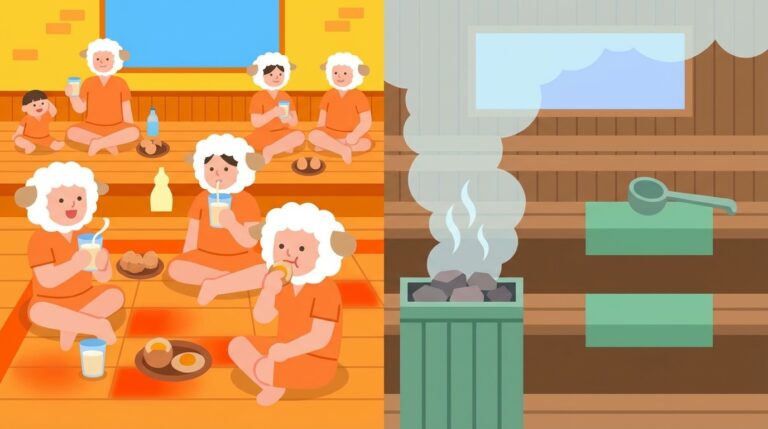
Imagine this: You’re watching a K-Drama. The main character just had a huge fight with their parents, packed a small bag, and ran away from home. But where do they go? A hotel? No. They end up sleeping on the floor of a massive, heated room, wearing matching orange T-shirts, with a towel rolled up like sheep horns on their head. Welcome to the Jjimjilbang (찜질방)—the Korean sauna.
If you’re from Finland, or familiar with the traditional Finnish sauna, you might be very confused. A Finnish sauna is a quiet, meditative space focused on the pure cycle of heat, steam (löyly), and a freezing cold plunge. It’s deeply tied to nature and solitude.
But a Korean Jjimjilbang? It’s a 24-hour indoor entertainment complex! There are TVs, restaurants, video games, sleeping areas, and people gossiping over sweet rice drinks. Knowing how to navigate this unique space—and what to say when a Korean friend invites you—will take you from a confused tourist to a true ‘Insider’ (인싸). Let’s dive in!
Phase 2: Core Expressions Deep Dive
Here are the top 3 expressions you need to survive (and enjoy) the Korean sauna.
1. 땀 좀 뺄까? (Shall we sweat a bit?)
- Pronunciation: ttam jom ppael-kka? [The ‘tt’ is tense, and ‘pp’ sounds like the ‘p’ in ‘spot’—no extra air!]
- Meaning: Literal: ‘Shall we take out some sweat?’ / Real nuance: ‘Let’s go to the Jjimjilbang and relax.’
- K-Culture Moment: You’ve been working overtime all week with your Korean coworkers. On Friday, instead of grabbing a beer, your senior rubs their neck and says, “Ah, I’m so stiff. 땀 좀 뺄까?”
- Editor’s Insight: This isn’t about working out. In Korea, sweating in a hot room is seen as ‘detoxing’ and healing. It’s an invitation to bond and relax together.
- Situation Spectrum:
- Casual (Friends): ✅ (땀 좀 빼자!)
- Semi-formal (Coworkers): ⚠️ (땀 좀 빼러 가실까요?)
- Formal (Boss/Elders): 🚫 (Wait for them to suggest it first!)
- 🤔 Think About It: Why do Koreans associate sweating with resting? In your culture, does ‘sweating’ only mean hard work or exercise?
2. 아~ 시원하다! (Ah~ so refreshing!)
- Pronunciation: a~ si-won-ha-da! [si-won sounds like ‘she-won’]
- Meaning: Literal: ‘It is cool/cold.’ / Real nuance: ‘Ah, that hits the spot!’ or ‘I feel so relieved.’
- K-Culture Moment: You sit in a 70°C (158°F) salt room. A middle-aged Korean man (Ajusshi) next to you lets out a deep breath and says, “아~ 시원하다!” Wait, it’s boiling hot in here! Why is he saying it’s cool?
- Editor’s Insight: This is the ultimate Korean paradox! “시원하다” doesn’t just mean physical temperature. It means your internal congestion (stress, muscle tension, or even a hangover) is melting away.
- Situation Spectrum:
- Casual (Friends): ✅
- Semi-formal (Coworkers): ✅
- Formal (Boss/Elders): ✅ (You can use it while getting a massage too!)
- 🤔 Think About It: Does your language have a word that means both ‘cold’ and ‘relieving hot’?
3. 식혜랑 구운 계란 주세요 (Please give me Sikhye and baked eggs)
- Pronunciation: si-kye-rang gu-un gye-ran ju-se-yo.
- Meaning: Ordering the classic Jjimjilbang snack combo.
- K-Culture Moment: You can’t go to a Jjimjilbang without eating this. Sikhye is an ice-cold sweet rice punch, and the eggs are slowly baked in the hot saunas until they turn brown and nutty.
- Editor’s Insight: The real fun is how you crack the egg—K-Drama style! You’re supposed to lightly smash it against your friend’s head. (Be gentle, though!)
- Situation Spectrum:
- To the snack bar staff: ✅
Phase 3: Textbook vs. Real Korean
| Situation | 📖 Textbook Korean | 🗣️ Real Korean | 💡 Why is it different? |
|---|---|---|---|
| Suggesting a trip | 사우나에 갑시다. (Let’s go to the sauna) | 찜질방 가서 땀 좀 빼자. (Let’s go to Jjimjilbang and sweat) | Koreans focus on the action (sweating/relaxing) rather than just the location. |
| Reacting to the heat | 이 방은 아주 덥네요. (This room is very hot) | 와, 여기 땀 장난 아니게 난다. (Wow, the sweat here is no joke) | Real conversations use exaggerations like ‘장난 아니다’ (no joke) for emphasis. |
| Feeling good in the heat | 기분이 좋습니다. (I feel good) | 아~ 시원하다! (Ah, so refreshing) | Cultural nuance: Relieving tension is described as ‘cooling down’ the inside. |
Phase 4: Cultural Context — K-Culture Deep Dive
4-1. The Non-Verbal: The ‘Yangmeori’ (Sheep Head)
If you go to a Finnish sauna, you wear a simple towel or go nude. In a Korean Jjimjilbang, everyone gets a matching T-shirt and shorts. But the crucial non-verbal cultural item is the 양머리 (Yangmeori). By folding a standard towel in three parts and rolling the ends, it looks like sheep horns. It keeps your head cool in the hot rooms and absorbs sweat.
4-2. The K-Drama Trope: The Ultimate Safe Haven
In K-Dramas, when a teenager runs away, or a couple gets locked out of their house, they always end up at the Jjimjilbang. Why? Because for around $10-$15, you get a place to shower, eat, watch TV, and sleep on the heated floor (Ondol) overnight. It’s cheap, safe, and open 24/7. However, reality check: The sleeping mats are thin, people snore loudly, and the TVs are always blaring. It’s fun, but it’s not the Four Seasons hotel!
Phase 5: Roleplay Scenario — “The Egg Crack”
Setting: A Saturday afternoon. You and your Korean friend, Minsu (30, energetic, loves K-Dramas), are sitting on the warm floor of the main Jjimjilbang hall. You both have Yangmeori towels on your heads.
Minsu: 야, 땀 빼니까 진짜 좋다. 그렇지?
(Ya, ttam ppaenikka jinjja jota. Geureotji?)
[Hey, sweating feels really good, right?]
YOU: 응, 너무 시원해!
(Eung, neomu siwonhae!)
[Yeah, it’s so refreshing!]
Minsu: 자, 찜질방에 오면 이걸 꼭 먹어야 돼. 식혜랑 구운 계란!
(Ja, jjimjilbange omyeon igeol kkok meogeoya dwae. Sikhyerang guun gyeran!)
[Here, when you come to a Jjimjilbang, you have to eat this. Sikhye and baked eggs!]
(🎭 Stage Direction: Minsu hands you a brown baked egg)
🔀 Your Turn! How do you crack the egg?
– A) Gently tap it on the floor and peel it. (Safe and normal)
– B) Smash it against Minsu’s head while shouting “시원하다!” (K-Drama style)
– C) Bite into it with the shell on. (Please don’t do this)✅ Best Choice: B — If you are close friends! Minsu will laugh and probably try to hit you back with his egg. It’s a classic bonding moment in Korea. If you chose A, it’s perfectly fine, but you miss out on the fun.
Minsu: 악! 야! 내 머리에 깨면 어떡해!
(Ak! Ya! Nae meorie kkaemyeon eotteokhae!)
[Ah! Hey! Why would you crack it on my head!]
YOU: 미안! 드라마에서 봤어. ㅋㅋㅋ
(Mian! Deurama-eseo bwasseo. lol)
[Sorry! I saw it in a drama. lol]
Phase 6: 10-Second Shadowing Drill
Channel your inner Korean Ajusshi. You just stepped into the hot tub after a long day.
😌 아~~~ / 진짜 / 시원~하다! (A~~~ / jinjja / siwon~hada!)
Tip: Drag out the ‘A~~~’ and the ‘won~’ with a deep, relieved sigh. Don’t say it sharply. It should sound like your soul is leaving your body in a good way!
Phase 7: K-Culture Mini Dictionary
| Korean | Romanization | English | Context |
|---|---|---|---|
| 찜질방 | jjimjilbang | Korean Sauna | A 24/7 public bathhouse with hot rooms, food, and sleeping areas. |
| 양머리 | yangmeori | Sheep Head | The iconic way of folding a towel to wear on your head in the sauna. |
| 때밀이 | ttaemiri | Body Scrub | The intense (and slightly painful) Korean exfoliating body scrub. |
| 불가마 | bulgama | Fire Kiln | The hottest room in the Jjimjilbang, usually shaped like a dome. |
| 온돌 | ondol | Heated Floor | Traditional Korean underfloor heating system. |
Phase 8: Traveler Survival Kit 🆘
Heading to a Jjimjilbang in Seoul? You MUST know these.
🆘 Survival Phrases
– 🇰🇷 “수면실은 어디예요?” (sumyeonsireun eodiyeyo?)
– 🗣️ English: Where is the sleeping room?
– 📍 Where to use: When you want a quiet, dark place to nap away from the loud TVs.
- 🇰🇷 “열쇠 잃어버렸어요…” (yeolsoe ileobeoryeosseoyo…)
- 🗣️ English: I lost my key…
- 📍 Where to use: Absolute panic mode! The electronic wristband is your locker key AND your credit card inside the sauna.
📌 Editor’s Travel Note
– The Wristband System: You don’t carry cash inside. You tap your locker wristband to buy food, drinks, or massages. You pay the total bill when you leave!
– Nudity: The actual wet baths (목욕탕) are strictly segregated by gender and require full nudity. But the main Jjimjilbang area (hot rooms, food court) is co-ed, and you wear the provided uniform.
Phase 9: Critical Thinking Corner — “One Step Deeper”
🧠 Think Deeper: Community & Space (공동체와 공간)
Why is the Finnish sauna so private, while the Korean Jjimjilbang is so public? The Finnish sauna often emphasizes individual connection with nature, silence, and personal endurance. In contrast, the Jjimjilbang reflects the Korean concept of Jeong (정 – deep emotional connection). Koreans historically lived in tight-knit agricultural communities, sleeping together on shared heated floors (Ondol). The Jjimjilbang is an extension of this. It’s not just a place to sweat; it’s a modern village square where families, friends, and strangers eat, sleep, and sweat shoulder-to-shoulder.
💬 Your Turn: Does your culture have a communal space where strangers relax together like this? Let us know in the comments!
Phase 10: FAQ & Avoiding Mistakes
Q: Do I have to get the ‘Ttaemiri’ (body scrub)?
A: No, it’s optional! But if you do, be prepared. They will scrub off dead skin you didn’t even know you had. You will feel like a newborn baby afterward.
Q: Can I wear my swimsuit in the bath area?
A: 🚫 No! This is a huge faux pas. In the gender-segregated wet bath areas, swimsuits trap bacteria. You must go completely naked. Don’t worry, nobody is looking at you!
❌ Common Mistake: Wearing your shoes inside.
✅ Do this instead: As soon as you enter the lobby, there are small lockers for your shoes. You take the shoe locker key, hand it to the front desk, and they give you your clothes locker key. Barefoot or socks only inside!
Phase 11: Summary & Action Items
One-Liner Summary: A Korean Jjimjilbang is a communal playground where you sweat out your stress and say “시원하다” (It’s refreshing!), unlike the quiet, private Finnish saunas.
Action Missions:
– 🥉 Bronze: Fold a towel into a ‘Yangmeori’ at home and take a selfie.
– 🥈 Silver: Search “Korean Jjimjilbang vlog” on YouTube and spot the baked eggs and Sikhye.
– 🥇 Gold: Next time you step into a hot shower, let out a loud “아~ 시원하다!”
K-Culture Mission: Watch episode 6 of the classic drama Crash Landing on You or any episode of Running Man set in a sauna. Notice how loud and chaotic it is compared to a quiet spa in your country!
Phase 12: Interactive Quiz
1. You are eating baked eggs with a Korean friend at the Jjimjilbang. You want to say, “Wow, sweating feels great!” What do you say?
A) 이 방은 덥습니다. (This room is hot.)
B) 아, 땀 좀 빼자. (Ah, let’s take out some sweat.)
C) 땀 빼니까 시원하다! (Sweating makes me feel refreshed!)
2. True or False: In a Korean Jjimjilbang, you must be naked in the co-ed heated rooms (saunas).
– True
– False
3. Fill in the blank: “_______랑 구운 계란 주세요!” (The sweet rice drink)
(Answers below)
Click to reveal answers!
1. C (A is too literal, B is a suggestion to go sweat, C perfectly captures the feeling of relief).
2. False (You only get naked in the gender-segregated wet baths. In the co-ed hot rooms, you wear the provided T-shirt and shorts!).
3. 식혜 (Sikhye)
Frequently Asked Questions (FAQ)
Q: What does "땀 좀 뺄까? (Shall we sweat a bit?)" mean in Korean and how do you pronounce it?
A: In Korean, "땀 좀 뺄까? (Shall we sweat a bit?)" is pronounced [ttam jom ppael-kka? [The 'tt' is tense, and 'pp' sounds like the 'p' in 'spot'—no extra air!] and means: Literal: 'Shall we take out some sweat?' / Real nuance: 'Let's go to the Jjimjilbang and relax.'
Q: What does "아~ 시원하다! (Ah~ so refreshing!)" mean in Korean and how do you pronounce it?
A: In Korean, "아~ 시원하다! (Ah~ so refreshing!)" is pronounced [a~ si-won-ha-da! [si-won sounds like 'she-won'] and means: Literal: 'It is cool/cold.' / Real nuance: 'Ah, that hits the spot!' or 'I feel so relieved.'
Q: What does "식혜랑 구운 계란 주세요 (Please give me Sikhye and baked eggs)" mean in Korean and how do you pronounce it?
A: In Korean, "식혜랑 구운 계란 주세요 (Please give me Sikhye and baked eggs)" is pronounced [si-kye-rang gu-un gye-ran ju-se-yo.] and means: Ordering the classic Jjimjilbang snack combo.







