

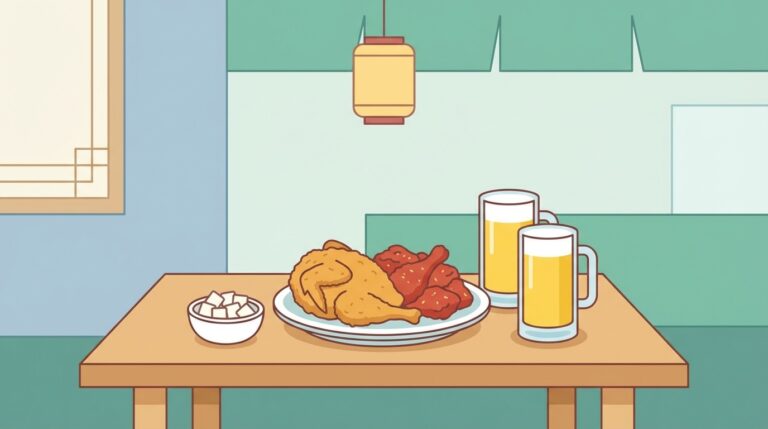
The Ultimate Guide to Korean ‘Chimaek’: Order Chicken & Beer Like a Local!
Phase 1: Empathy & The K-Culture Connection
Hello! It’s your Daily Hangul Editor.
Picture this: It’s a Friday night in Seoul. You’re watching a K-Drama—maybe My Love from the Star or Weightlifting Fairy Kim Bok-joo—and the main characters are sitting at a cozy pub or by the Han River. They clink their frosty beer mugs and bite into incredibly crispy, perfectly glazed fried chicken. You can practically hear the crunch through the screen.
You already know the words for “chicken” and “beer.” But when you actually walk into a bustling Korean chicken Hof (pub), the menu looks like a novel, the waiter is standing there waiting, and suddenly, you freeze. Do you just say “One chicken, please?” (Spoiler alert: No!)
Don’t worry. This guide is based on real SOS messages from my students who ended up ordering three whole chickens for two people! Today, we’re going to learn the insider phrases that will make you look like a true Korean local. Grab your tiny tongs, and let’s dive into the world of Chimaek (치맥)!
Phase 2: Deep Dive into Core Expressions
Let’s master the 3 essential phrases you need for a flawless Chimaek night.
1. 치맥 하러 갈래? (Wanna go for Chimaek?)
- Pronunciation: chi-maek ha-reo gal-lae? [chi-mac sounds like ‘Big Mac’ but with ‘chi’. gal-lae sounds like ‘gal’ + ‘let’]
- Meaning: Let’s grab chicken and beer. (Literal: Wanna go do Chimaek?)
- K-Culture Moment: This is the ultimate “you survived the workday” phrase. In dramas, when the team leader finally leaves the office, the cool coworker leans over and whispers this to you. It’s a sign of camaraderie and bonding.
- Editor’s Insight: Think of this as “Let’s grab a pint,” but specifically tailored to Korea’s favorite soul food. It’s a warm, inviting question that says, “Let’s relieve some stress together.”
- Situation Spectrum:
[🚫 Formal] ———— [⚠️ Semi-formal] ———— [✅ Casual]
- Close Friends (Casual): ✅ (Perfect!)
- Coworkers (Semi-formal): ⚠️ (Use ‘치맥 하러 가실래요?’ instead)
- Boss/Elders (Formal): 🚫 (Too casual)
- 🤔 Think About It: Why did Koreans combine ‘Chicken’ and ‘Maekju’ (Beer) into one word? What other food combos in your culture are so iconic they deserve their own portmanteau?
2. 반반 무 많이요! (Half and half, lots of radish!)
- Pronunciation: ban-ban mu man-i-yo! [ban sounds like ‘bahn’, mu sounds like a cow’s ‘moo’]
- Meaning: Half fried, half seasoned, and extra pickled radish please!
- K-Culture Moment: When ordering delivery on the phone, this phrase used to be the holy grail. It shows you know exactly what you want and you don’t want to compromise between crispy original and sweet-and-spicy!
- Editor’s Insight: ‘반반’ (ban-ban) means 50/50. ‘무’ (mu) is the cubed pickled white radish that acts as a palate cleanser. Koreans love this radish so much that asking for extra is practically a reflex!
- Situation Spectrum:
[🚫 Formal] ———— [⚠️ Semi-formal] ———— [✅ Casual]
- To the waiter/staff: ✅ (Always polite because of the ‘요’ at the end)
- 🤔 Think About It: Why do Koreans love “half and half” so much? (Hint: It relates to the ‘Jjamjjamyeon’—half noodles, half black bean paste—culture of wanting to try everything!)
3. 순살로 주세요 (Boneless, please)
- Pronunciation: sun-sal-lo ju-se-yo [sun sounds like ‘soon’, sal sounds like ‘sal’ in salad]
- Meaning: I’d like the boneless version, please.
- K-Culture Moment: Picture a romantic Han River picnic. You don’t want to be aggressively tearing meat off a bone in front of your crush, right? That’s when you smoothly order ‘순살’ (pure meat).
- Editor’s Insight: While many chicken purists argue that bone-in (뼈 있는 치킨) tastes better, boneless is incredibly convenient when eating outdoors or while watching a concert.
- Situation Spectrum:
[🚫 Formal] ———— [⚠️ Semi-formal] ———— [✅ Casual]
- To the waiter/staff: ✅
Phase 3: Textbook vs. Real Korean
| Situation | 📖 Textbook Korean | 🗣️ Real Korean | 💡 Why the difference? |
|---|---|---|---|
| Ordering half and half | 저는 양념치킨 반과 후라이드 치킨 반을 원합니다. (I want half seasoned and half fried.) | 반반 주세요. (Half and half please.) | “Bbali-bbali” (Hurry up) culture values efficiency. Short and sweet! |
| Asking for beer | 맥주를 주시겠어요? (Would you please give me a beer?) | 생맥 두 잔이요! (Two draft beers please!) | ‘생맥주’ (Draft beer) is shortened to ‘생맥’. Numbers + counters + 요 is the fastest way to order. |
| Complimenting the food | 겉은 바삭하고 속은 촉촉합니다. (The outside is crispy and the inside is moist.) | 완전 겉바속촉이네! (Totally crispy-out-soft-in!) | Koreans love four-syllable acronyms to describe food textures. |
Phase 4: Cultural Context — K-Culture Deep Dive
4-1. Non-verbal Context: The Call Bell & The Tiny Tongs
When you enter a Korean pub (Hof), don’t awkwardly try to make eye contact with the busy waiter. Look at your table! There is almost always a small button. Press it (Ding-dong!), and they will come directly to you.
Also, when your chicken arrives, you might be given a small fork and a pair of tiny tongs. Don’t ask for a knife! Use the tongs in your non-dominant hand to hold the chicken piece, and the fork in your dominant hand to pull the meat off. It’s a game-changer!
4-2. K-Food & K-Drama Connection: The Healing Power of Chimaek
Why is Chimaek so heavily featured in K-Dramas? It’s not just product placement. In Korea, Chimaek is the ultimate “comfort food” ritual. Whether a character just failed a job interview, got dumped, or had a massive fight with their boss, the scene usually cuts to them aggressively biting into a chicken leg and downing a cold glass of draft beer (생맥주). It represents washing away the day’s stress. When you invite someone for Chimaek, you’re essentially saying, “I’m here to listen to your problems.”
Phase 5: Practical Roleplay Scenario
Setting: Friday evening, 7:00 PM. You and your coworkers are at a famous Chicken Hof near Gangnam Station. The place is packed, K-Pop is blasting in the background, and the smell of frying oil is heavenly.
Characters:
– YOU: A foreign professional who has been working in Seoul for a few months.
– Min-su (32): Your friendly Korean coworker who acts as your local guide.
Dialogue:
Min-su: 아, 이번 주 진짜 힘들었어요. 우리 치맥 어때요? 🍗🍺
(a, ibeon ju jinjja himdeureosseoyo. uri chimaek eottaeyo?)
[Ah, this week was so hard. How about Chimaek?]
YOU: 완전 좋죠! 제가 치킨 진짜 좋아하잖아요.
(wanjeon jotjyo! jega chikin jinjja joahajannayo.)
[Absolutely! You know I really love chicken.]
Min-su: (Looking at the menu) 여기 양념치킨이 진짜 맛있어요. 근데 후라이드도 바삭해서 좋은데…
(yeogi yangnyeomchikini jinjja masisseoyo. geunde huraideudo basakaeseo joeunde…)
[The seasoned chicken here is really good. But the fried one is also nice and crispy…]
🔀 Your Turn! How should you respond?
– A) “그럼 치킨 두 마리 시켜요!” (Then let’s order two chickens!)
– B) “그럼 반반으로 시키는 거 어때요?” (Then how about we order half and half?)
– C) “아무거나 시키세요.” (Just order anything.)✅ Best Choice: B — Korean chicken portions are huge (one chicken = one whole bird!). Ordering two chickens for two people is usually too much. “Ban-ban” is the smartest and most culturally accurate choice!
⚠️ Choice A Analysis: You will have way too much food left over.
(Assuming you chose B)
YOU: 그럼 반반으로 시키는 거 어때요? 순살로요!
(geureom banbaneuro sikineun geo eottaeyo? sunsalloyo!)
[Then how about we order half and half? Boneless!]
Min-su: 오, 역시! 한국 사람 다 됐네요.
(o, yeoksi! hanguk saram da dwaenneyo.)
[Oh, as expected! You’ve completely become a Korean.]
(Min-su presses the call bell on the table: Ding-dong!)
Waiter: 네, 주문하시겠어요?
(ne, jumunhasigesseoyo?)
[Yes, would you like to order?]
YOU: 사장님, 여기 반반 무 많이 주세요! 그리고 생맥 두 잔이요!
(sajangnim, yeogi banban mu mani juseyo! geurigo saengmaek du janiyo!)
[Boss, half and half with lots of radish here, please! And two draft beers!]
Waiter: 네, 알겠습니다~
(ne, algetseumnida~)
[Yes, understood~]
Min-su: 와, 발음 진짜 자연스러워요. 오늘 치킨은 제가 쏠게요!
(wa, bareum jinjja jayeonseureowoyo. oneul chikineun jega ssolkkeyo!)
[Wow, your pronunciation is really natural. I’ll treat you to the chicken today!]
YOU: 에이~ 저번에도 사셨잖아요. 오늘은 제가 낼게요!
(ei~ jeobeonedo sasyeotjannayo. oneureun jega naelkkeyo!)
[Hey~ You bought it last time. I’ll pay today!]
🎬 Bonus K-Culture Roleplay: Han River Delivery
(You are at the Yeouido Han River Park. You ordered chicken via an app. The delivery driver calls you.)
Driver: 배달 도착했습니다. 어디 계세요?
(baedal dochakaetseumnida. eodi gyeseyo? – Delivery has arrived. Where are you?)
YOU: 아, 저 배달존 2번에 있어요!
(a, jeo baedaljon ibeone isseoyo! – Ah, I’m at Delivery Zone 2!)
Driver: 네, 오토바이 앞으로 오세요.
(ne, otobai apeuro oseyo. – Yes, please come to the front of the motorcycle.)
Phase 6: 10-Second Shadowing Drill
Practice this sentence to sound like a local when the waiter approaches your table. Remember the pacing!
🗣️ 😊 사장님~ / 여기 / 반반 무 많이 / 주세용!
(sa-jang-nim~ / yeo-gi / ban-ban mu man-i / ju-se-yong!)
Smile gently, raise your hand slightly, and stretch the ‘yong’ at the end just a little bit to sound friendly!
Phase 7: K-Culture Mini Dictionary
| Korean | Romanization | English | Cultural Context |
|---|---|---|---|
| 호프 | hopeu | Hof / Pub | Derived from the German word ‘Hof’. It refers to casual Korean pubs that serve beer and anju (bar snacks) like fried chicken. |
| 안주 | anju | Bar snacks | Food specifically meant to be eaten with alcohol. In Korea, drinking without ‘anju’ is very rare! |
| 생맥주 (생맥) | saeng-maek-ju | Draft beer | The default pairing for fried chicken. Served in heavy, freezing cold glass mugs. |
| 겉바속촉 | geot-ba-sok-chok | Crispy outside, soft inside | A trendy slang acronym used to describe perfectly fried food. |
| 배달존 | bae-dal-jon | Delivery Zone | Specific spots at massive parks (like Han River) where delivery drivers meet customers. |
Phase 8: Traveler’s Survival Kit
If you’re visiting Korea soon, taking a picture of this section will save your Friday night!
🆘 Survival Phrases for Chicken Pubs
– 🇰🇷 “여기 생맥주 500(오백) 두 잔 주세요.” (yeogi saeng-maek-ju obaek du jan juseyo.)
– 🗣️ Meaning: “Two 500cc draft beers here, please.”
– 📍 Where to use: Any Hof or Pub.
– 💡 Pro Tip: Koreans order beer by the CC. “500” (O-baek) is the standard pint size!📌 Editor’s Travel Note: The ID Check
Even if you are 40 years old, Korean pubs are very strict about checking IDs, especially if you look youthful! Always bring your physical Passport or ARC (Alien Registration Card) when going for Chimaek. A picture on your phone usually won’t work.
Phase 9: Critical Thinking Corner — “One Step Deeper”
Food & Identity: The Culture of Sharing (함께 먹기)
🧠 Think Deeper:
Have you noticed that in a Korean chicken restaurant, you don’t order “your” plate of chicken and “my” plate of chicken? Instead, one massive platter is placed in the center of the table, and everyone shares. This reflects Jeong (정), a deep-rooted Korean concept of communal affection and bonding. Sharing food from the same plate breaks down social barriers faster than anything else. When you share a plate of Chimaek, you’re no longer just colleagues; you’re “us.”💬 Your Turn: Does your culture prefer individual portions, or do you have a shared-dish culture like Korea? How does it change the dining atmosphere? Share in the comments!
Phase 10: FAQ & Common Mistakes
Q: Is it rude to eat chicken with my hands in Korea?
Yes and no. At home or by the Han River, using hands (often with plastic gloves provided by the restaurant) is perfectly fine. But in a nice pub, try to use the tongs and fork provided. It keeps your hands clean for clinking beer glasses!
Q: What if I can’t eat spicy food?
Always ask: “이거 많이 매워요?” (Is this very spicy?). If you want no spice at all, stick to Fried (후라이드) or Soy Garlic (간장치킨 – ganjang-chikin), which is sweet and savory.
❌ Common Mistake #1: Ordering “One Chicken” per person.
✅ Do this instead: In Korea, “One Chicken” (치킨 한 마리) means an entire bird cut into pieces. One order is enough for 2 people. If there are 3-4 people, order two chickens!❌ Common Mistake #2: Tipping the waiter or delivery driver.
✅ Do this instead: Korea has a strict No Tipping culture. If you try to give extra money, the driver will likely chase you down the street to give your change back! Just say “감사합니다” (Thank you) warmly.
Phase 11: Summary & Action Items
One-Liner Summary: To conquer a Korean chicken pub, remember to press the bell, order “Ban-ban” (Half & Half), and share the platter with good friends!
Your Action Missions for Today:
– 🥉 Bronze (Solo): Stand in front of the mirror and confidently order: “반반 무 많이요!” 3 times.
– 🥈 Silver (Online): Find a scene in a K-Drama where they eat Chimaek. Can you spot the tiny tongs or the pickled radish?
– 🥇 Gold (Real Life): Visit a Korean fried chicken restaurant (or use a delivery app) and order a “Ban-ban” combo using the Korean phrases you learned today!
Did you survive your first Chimaek experience? What’s your favorite flavor? Let me know below! 👇
Phase 12: Quiz — Interactive Challenge
1. Fill in the Blank:
You want half fried and half spicy chicken. You say to the waiter: “사장님, ______ 주세요!”
– A) 생맥주
– B) 반반
– C) 순살
2. True or False – K-Culture Edition:
– If the service was excellent at the Chicken Hof, you should leave a 10% tip on the table. (T / F)
3. Situational Judgment:
You are at the Han River park, and the delivery driver calls you. What is the most important thing you need to tell them?
– A) Your passport number.
– B) The specific “Delivery Zone” (배달존) number you are at.
– C) What you ordered.
(Answers: 1. B, 2. False – No tipping in Korea!, 3. B)
Frequently Asked Questions (FAQ)
Q: What does "치맥 하러 갈래? (Wanna go for Chimaek?)" mean in Korean and how do you pronounce it?
A: In Korean, "치맥 하러 갈래? (Wanna go for Chimaek?)" is pronounced [chi-maek ha-reo gal-lae? [chi-mac sounds like 'Big Mac' but with 'chi'. gal-lae sounds like 'gal' + 'let'] and means: Let's grab chicken and beer. (Literal: Wanna go do Chimaek?)
Q: What does "반반 무 많이요! (Half and half, lots of radish!)" mean in Korean and how do you pronounce it?
A: In Korean, "반반 무 많이요! (Half and half, lots of radish!)" is pronounced [ban-ban mu man-i-yo! [ban sounds like 'bahn', mu sounds like a cow's 'moo'] and means: Half fried, half seasoned, and extra pickled radish please!
Q: What does "순살로 주세요 (Boneless, please)" mean in Korean and how do you pronounce it?
A: In Korean, "순살로 주세요 (Boneless, please)" is pronounced [sun-sal-lo ju-se-yo [sun sounds like 'soon', sal sounds like 'sal' in salad] and means: I'd like the boneless version, please.







