

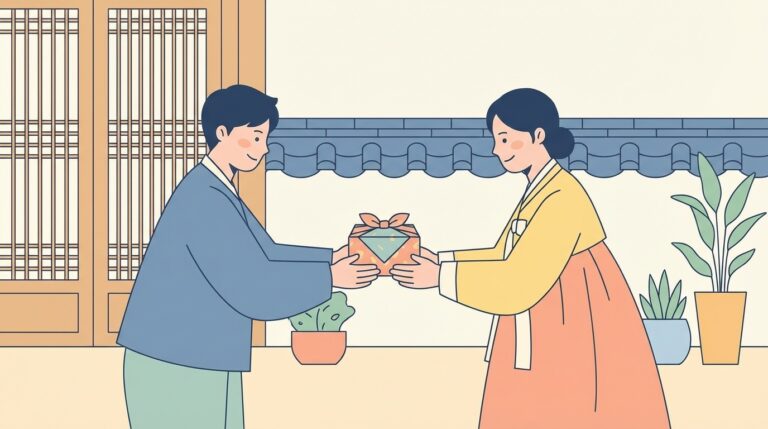
Phase 1: Empathy & K-Culture Cold Open
Hello! I’m your Daily Hangul Editor.
Picture this: You are watching your favorite K-Drama. The main character nervously hands a beautifully wrapped, clearly expensive box of red ginseng to their future mother-in-law. Do they say, “I bought you this amazing, expensive gift!”?
Nope. The subtitles read: “It’s nothing, really. I just picked it up on the way.”
Wait, what? Why on earth do Koreans downplay their gifts like that? If you’ve ever felt confused when a Korean friend hands you a bag of goodies and says, “I didn’t prepare much,” you are not alone.
In many Western cultures, we highlight the effort we put into a gift. In Korea, however, giving a gift is all about making the receiver feel comfortable. If you emphasize how expensive or difficult the gift was to get, the receiver might feel burdened.
This guide is based on real questions from my beginner students who wanted to give a “Thank You” gift to their Korean teachers, Airbnb hosts, or friends without making it awkward. Today, we’ll learn the magic phrase that makes you look humble, polite, and totally local!
Phase 2: Core Expressions Deep Dive
Let’s look at the absolute must-know phrases for giving a gift.
1. 작은 성의예요 (It’s a small token of my appreciation)
- Pronunciation: Jageun seong-ui-yeyo.
- Sound-alike guide: ‘Jageun’ sounds like jag-eun. For ‘ui’ (의), smile wide and say “uh-ee” really fast.
- Meaning: Literal = “It is a small sincerity.” / Real nuance = “It’s a small token of my appreciation/gratitude.”
- K-Culture Moment: You’ll see this in business dramas or office settings. When an employee brings a box of premium pastries to another department to ask for a favor, they slide it across the desk and say this with a warm smile.
- Editor’s Insight: This phrase is perfect because it packages your gratitude nicely. It says, “The item is small, but my heart is big.” It’s polite but not overly stiff.
- Situation Spectrum:
[🚫 Never] ———— [⚠️ Caution] ———— [✅ Freely]
- Close Friends (Casual): ⚠️ (A bit too formal for besties)
- Coworkers (Semi-formal): ✅
- Boss/Elders (Formal): ✅
- 🤔 Think About It: Why is “sincerity” (성의) used to describe a physical item? In Korea, the physical gift is just a vessel; the true gift is the thought behind it.
2. 별거 아니에요 (It’s nothing special)
- Pronunciation: Byeol-geo a-ni-e-yo.
- Sound-alike guide: ‘Byeol’ sounds like the English name Björk with an L at the end. ‘eo’ (어) sounds like the “uh” in “uh-oh.”
- Meaning: Literal = “It is not a special thing.” / Real nuance = “It’s just a little something / Don’t feel burdened.”
- K-Culture Moment: At a K-Pop fan meeting! When a fan hands a cute headband or a snack to their favorite idol, they often say, “오빠, 별거 아니에요!” (Oppa, it’s nothing special!).
- Editor’s Insight: This is the ultimate “humble” phrase. Use it when handing over a souvenir from your home country to a Korean friend.
- Situation Spectrum:
[🚫 Never] ———— [⚠️ Caution] ———— [✅ Freely]
- Close Friends (Casual): ✅ (Drop the ‘yo’: 별거 아니야)
- Coworkers (Semi-formal): ✅
- Boss/Elders (Formal): ⚠️ (Better to use 작은 성의예요 for elders)
- 🤔 Think About It: Does downplaying a gift in your culture seem rude, or is it considered polite modesty like in Korea?
Phase 3: Textbook vs. Real Korean
| Situation | 📖 Textbook Korean | 🗣️ Real Korean | 💡 Why is it different? |
|---|---|---|---|
| Giving a gift to a friend | 이것은 당신을 위한 선물입니다. (This is a gift for you.) | 오다 주웠어. (I picked it up on the way.) | The textbook is too robotic! “오다 주웠어” is a popular K-Drama joke for pretending you don’t care when you actually do (Tsundere style). |
| Giving a gift to a coworker | 제 선물을 받아주세요. (Please accept my gift.) | 약소하지만… 작은 성의예요. (It’s humble, but… it’s a small token of my appreciation.) | Emphasizing humility makes the receiver feel less pressure to return the favor immediately. |
Bottom Note for A1: You don’t need to memorize the long textbook sentences! Just smile, hand them the item, and say “별거 아니에요!” (Byeol-geo a-ni-e-yo).
Phase 4: Cultural Context — K-Culture Deep Dive
4-1. Non-verbal Communication: The “Two-Hand” Rule
Language is only half the battle. When handing over a gift in Korea, always use two hands! If the item is small, hold it with your right hand and lightly support your right wrist or elbow with your left hand. It’s a sign of deep respect. Also, expect the receiver to say “Oh, you shouldn’t have!” (아유, 뭘 이런 걸…) at least once. It’s Korean Nunchi (social tact)—they must refuse slightly before accepting to show they aren’t greedy!
4-2. K-Drama Trope: The “Tsundere” Giver
If you watch K-Dramas like Crash Landing on You or Reply 1988, you’ve seen the “Tsundere” trope. A character acts cold but has a warm heart. They will throw a beautifully wrapped gift at their crush and grunt, “오다 주웠어” (I picked it up on the street).
Critical View: Please do NOT use “오다 주웠어” with your boss or an Airbnb host! It is a casual joke used among close friends or lovers. For everyone else, stick to “별거 아니에요.”
Phase 5: Interactive Roleplay Scenario
Setting: It’s the last day of your trip in Seoul. You are sitting at a cozy Hanok cafe in Bukchon with Min-ji, a Korean friend who showed you around the city all week. You bought a lovely hand-cream set for her.
Characters:
– YOU: A grateful traveler trying to show appreciation.
– Min-ji (28): Your friendly, energetic Korean host.
Dialogue:
YOU: 민지 씨, 이거… (Min-ji ssi, i-geo…)
[Translation] Min-ji, this is…
(🎭 Stage Direction: You slide a small, pretty shopping bag across the table using both hands.)
Min-ji: 헉! 이게 뭐예요? (Heok! I-ge mwo-ye-yo?)
[Translation] Gasp! What is this?
YOU: 작은 성의예요. (Ja-geun seong-ui-ye-yo.)
[Translation] It’s a small token of my appreciation.
Min-ji: 에이, 뭐 이런 걸 다… 안 주셔도 되는데! (E-i, mwo i-reon geol da… an ju-syeo-do doe-neun-de!)
[Translation] Oh my, what is all this… You really didn’t have to give me anything!
YOU: 제가 너무 고마워서 그래요. (Je-ga neo-mu go-ma-wo-seo geu-rae-yo.)
[Translation] It’s because I’m just so thankful.
Min-ji: 우와, 포장 너무 예뻐요. 열어봐도 돼요? (U-wa, po-jang neo-mu ye-ppeo-yo. Yeo-reo-bwa-do doe-yo?)
[Translation] Wow, the wrapping is so pretty. Can I open it?
YOU: 네! 별거 아니에요. (Ne! Byeol-geo a-ni-e-yo.)
[Translation] Yes! It’s nothing special.
(🎭 Stage Direction: Min-ji opens it and gasps at the expensive hand cream)
Min-ji: 헐, 이거 비싼 거잖아요! 너무 무리하신 거 아니에요?
[Translation] Omg, this is expensive! Didn’t you overdo it?
🔀 Your Turn! How should you respond?
– A) “네, 진짜 비쌌어요.” (Yes, it was really expensive.)
– B) “아니에요, 마음에 들었으면 좋겠어요.” (No, I just hope you like it.)
– C) “오다 주웠어요.” (I picked it up on the street.)✅ Best Choice: B — It deflects the pressure gracefully and focuses on her happiness.
⚠️ Choice A Analysis: Saying “Yes, it was expensive” will make Min-ji feel incredibly burdened (부담), and she might feel she needs to buy you dinner immediately!
⚠️ Choice C Analysis: A funny K-drama joke, but might be slightly awkward depending on how close you are.
Phase 6: 10-Second Shadowing Drill
Practice these sentences out loud. Pay attention to the pauses (/) and the emotion tags!
- 😊 밝고 따뜻하게 (Warmly)
이거 / 작은 / 성의예요.
(I-geo / ja-geun / seong-ui-ye-yo.) -
🥺 부끄러운 듯이 (Humbly / Modestly)
진짜 / 별거 / 아니에요.
(Jin-jja / byeol-geo / a-ni-e-yo.) -
😊 환하게 웃으며 (Smiling brightly)
마음에 / 들었으면 / 좋겠어요!
(Ma-eu-me / deu-reo-sseu-myeon / jo-ke-sseo-yo!)
Phase 7: K-Culture Mini Dictionary
| 한국어 (Korean) | Romanization | English | Context & Meaning |
|---|---|---|---|
| 부담 | bu-dam | Burden / Pressure | Koreans often downplay gifts to reduce the receiver’s bu-dam of having to return the favor. |
| 정 | jeong | Affection / Attachment | A unique Korean concept of emotional connection. Gifts are a physical manifestation of jeong. |
| 눈치 | nun-chi | Social tact / Wits | Having quick nunchi means knowing when to gracefully accept a gift after refusing it once. |
| 답례 | dap-rye | Return gift | It is customary in Korea to give a small return gift (like buying coffee) when you receive a present. |
Phase 8: Traveler’s Survival Kit
To give a gift, you first have to buy one! If you are shopping for souvenirs in Insadong or Myeongdong, these are your lifeline phrases.
🆘 Survival Phrase #1: Buying the Gift
– 🇰🇷 “이거 얼마예요?” (I-geo eol-ma-ye-yo?)
– 🗣️ Meaning: How much is this?
– 📍 Where to use: Traditional markets, underground malls, small boutiques.
– 💡 Pro Tip: If numbers in Korean are too hard, just point and hand the vendor your phone calculator. They will type the price for you!🆘 Survival Phrase #2: Making it Look Nice
– 🇰🇷 “포장해 주세요.” (Po-jang-hae ju-se-yo.)
– 🗣️ Meaning: Please wrap it for me.
– 📍 Where to use: Department stores, bakeries, cosmetics shops.
📌 Editor’s Travel Note:
– Tipping Culture: Remember, there is NO tipping in Korea! Leaving cash on the table at a restaurant is not considered a “small token of appreciation”—the waiter will chase you down the street thinking you forgot your change!
Phase 9: Critical Thinking Corner — “One Step Deeper”
🧠 Think Deeper: Communication Style & Modesty
Why do Koreans insist “it’s nothing” when they clearly spent hours preparing a gift or cooking a massive meal? In Korean society, harmony and humility are highly valued. By lowering the perceived value of your effort, you elevate the status of the receiver. It prevents the other person from feeling a “debt” (부담 – budam). However, paradoxically, the receiver knows you worked hard, and your modesty actually makes them appreciate you even more!
💬 Your Turn:
In your culture, how do you respond when someone gives you a gift? Do you open it right away in front of them, or do you wait until you get home? Let me know in the comments!
Phase 10: FAQ & Avoiding Mistakes
Q: Can I give money as a gift in Korea?
Yes, but context matters! Cash is the standard gift for weddings, funerals, and babies’ first birthdays (put it in a crisp white envelope). However, handing your Korean language tutor or friend raw cash as a “thank you” is considered very strange and a bit rude. Stick to coffee gift cards or small physical items!
Q: Should I open a gift immediately?
In the West, it’s polite to rip open the wrapping paper immediately. In Korea, it’s safer to ask, “열어봐도 돼요?” (May I open it?) first, or simply wait and open it later in private.
❌ Common Mistake #1: Handing over a gift with one hand while looking away.
✅ Do This Instead: Present the gift with both hands, make warm eye contact, and say “작은 성의예요.”
Phase 11: Summary & Action Items
- One-Liner Summary: When giving a gift in Korea, reduce the pressure and show humility by saying “작은 성의예요” (It’s a small token of my appreciation) or “별거 아니에요” (It’s nothing special).
-
Action Mission:
- 🥉 Bronze (Solo): Grab a random object on your desk, hand it to your reflection in the mirror with both hands, and say “별거 아니에요.”
- 🥈 Silver (Online): Tag a friend in the comments below and tell them what imaginary gift you’d give them using today’s phrase!
- 🥇 Gold (Real Life): Next time you meet your Korean friend or tutor, buy them a small iced Americano and say “작은 성의예요!”
- K-Culture Mission: Watch one episode of a K-Drama this week. Pay close attention to how the characters hand items (files, drinks, gifts) to each other. Can you spot the two-handed gesture?
Phase 12: Quiz — Interactive Challenge
Q1. Situational Judgment:
You just bought a $50 box of Korean sweets for your boss to thank them for their help. You hand it to them with two hands. What should you say?
A) 이거 아주 비싼 거예요. (This is very expensive.)
B) 별거 아니에요. (It’s nothing.)
C) 작은 성의예요. (It’s a small token of my appreciation.)
Q2. True or False – K-Culture Edition:
Leaving a $5 tip at a Korean BBQ restaurant is a great way to show a “small token of appreciation” to the staff. (T/F)
👀 Click here to reveal the answers!
A1: C! Since it is your boss, “작은 성의예요” is the perfect blend of polite and humble. “별거 아니에요” (B) is a bit too casual for a strict boss, and (A) will make you look arrogant!
A2: False! Korea does not have a tipping culture. Giving extra money can cause confusion. If you want to show appreciation, a polite “잘 먹었습니다!” (I ate well!) or a good review online is the best gift!
Frequently Asked Questions (FAQ)
Q: What does "작은 성의예요 (It's a small token of my appreciation)" mean in Korean and how do you pronounce it?
A: In Korean, "작은 성의예요 (It's a small token of my appreciation)" is pronounced [Jageun seong-ui-yeyo.] and means: a key conversational Korean expression covered in this lesson.
Q: What does "별거 아니에요 (It's nothing special)" mean in Korean and how do you pronounce it?
A: In Korean, "별거 아니에요 (It's nothing special)" is pronounced [Byeol-geo a-ni-e-yo.] and means: a key conversational Korean expression covered in this lesson.







