

Phase 1: Empathy (The K-Culture Cold Open)
Hello! I’m your Daily Hangul Editor.
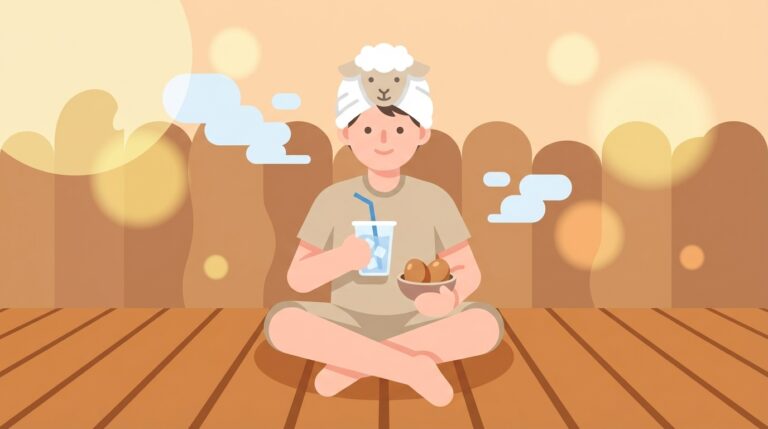
Picture this: You are watching a K-Drama. The main character just had a huge argument with their family, or maybe they are on a quirky, budget-friendly date. Cut to the next scene—they are sitting on a heated wooden floor, wearing oversized matching t-shirts and shorts. On their heads? Adorable towels folded to look like sheep ears (양머리). And in their hands, they hold an icy, sweet brown drink in a plastic cup and a strangely brown-colored hard-boiled egg.
Welcome to the Korean Jjimjilbang (찜질방).
Going to a Korean sauna isn’t just about taking a bath. It’s a full-day cultural experience of communal resting, sweating out your stress in an 80°C salt room, and—most importantly—treating yourself to a cold glass of Sikhye (식혜).
But what happens when you confidently march up to the snack bar, only to realize you don’t know how to order, or worse, you try to hand the cashier wet cash? Don’t worry. This guide is built from the real, slightly embarrassing, and ultimately hilarious experiences of my B1 students who braved the Jjimjilbang. Let’s learn how to order like a local and enjoy the ultimate Korean relaxation.
Phase 2: Core Expressions Deep Dive
1. 식혜 하나 주세요.
- Pronunciation: Sikhye hana juseyo. [Shee-kyeh ha-na joo-seh-yo]
- Meaning: Please give me one Sikhye (Literal) / I’ll have a Sikhye, please (Real nuance).
- K-Culture Moment: You just walked out of the blazing hot ‘Bulgama’ (fire sauna). You’re sweating profusely. You walk up to the Jjimjilbang Maejum (snack bar) and say this magical phrase. The icy, sweet rice punch is the ultimate reward for your endurance.
- Editor’s Insight: Sikhye is a traditional sweet Korean rice beverage. While you can buy it in cans at convenience stores, Jjimjilbang Sikhye hits differently because it’s usually served semi-slushy in a large plastic cup with a straw.
- Situation Spectrum:
[🚫 Absolutely Not] ———— [⚠️ Caution] ———— [✅ Freely]
- Close Friends (Casual): ✅ (Just say: “식혜 하나!”)
- Snack Bar Staff (Formal/Polite): ✅ (Use “주세요”)
- 🤔 Think About It: Why do Koreans crave something ice-cold and intensely sweet right after sweating in a boiling room? Does your culture have a specific “post-sauna” or “post-workout” comfort drink?
2. 구운 계란도 같이 주세요.
- Pronunciation: Gu-un gyerando gachi juseyo. [Goo-oon gyeh-ran-doh gah-chee joo-seh-yo]
- Meaning: Please give me roasted eggs together with it.
- K-Culture Moment: You can’t have Sikhye without its soulmate: the roasted egg (구운 계란 or 맥반석 계란). In dramas, this is the exact moment someone playfully smashes the egg on their friend’s head to crack the shell!
- Editor’s Insight: “같이 (gachi)” means “together.” Using it makes you sound so much more natural than placing two entirely separate orders. It shows you understand the iconic pairing!
- Situation Spectrum:
[🚫 Absolutely Not] ———— [⚠️ Caution] ———— [✅ Freely]
- Strangers/Staff: ✅
- 🤔 Think About It: In many Western countries, eggs are strictly for breakfast. In Korea, they are the ultimate sauna snack. How does the context of a food change its appeal?
3. 아, 시원하다~
- Pronunciation: Ah, siwonhada~ [Ah, shee-won-ha-dah]
- Meaning: Ah, it’s refreshing/cool!
- K-Culture Moment: You will hear this twice at the Jjimjilbang. Once when an older Korean man steps into a boiling hot bath, and again when you take your first sip of icy Sikhye.
- Editor’s Insight: This is a B1-level cultural secret. “시원하다” literally means “cool,” but Koreans use it to mean “refreshing” or “relieving.” So, whether it’s cold ice sweeping down your throat, or hot water relaxing your stiff muscles, the feeling of relief is “시원하다.”
- Situation Spectrum:
[🚫 Absolutely Not] ———— [⚠️ Caution] ———— [✅ Freely]
- Muttering to yourself/Friends: ✅
- Boss/Elders: ⚠️ (Use “시원하네요”)
- 🤔 Think About It: Is there a word in your language that describes a physical feeling of relief, regardless of whether the temperature is hot or cold?
Phase 3: Textbook vs. Real Korean
| Situation | 📖 Textbook Korean | 🗣️ Real Korean | 💡 Why is it different? |
|---|---|---|---|
| Ordering at the snack bar | 저기요, 식혜 한 잔 주시겠어요? (Excuse me, could you give me a glass of Sikhye?) | 이모님, 여기 식혜 하나요! (Auntie, one Sikhye here!) | Friendly term “이모님 (Auntie)” builds rapport in casual, cozy environments like saunas. |
| Cracking the egg | 계란 껍질을 까주세요. (Please peel the eggshell.) | 내 머리에 깨! (Crack it on my head!) | K-Drama trope! Friends often joke around by cracking the hard-shell roasted eggs on each other’s heads. |
| Feeling relaxed | 기분이 아주 좋습니다. (I feel very good.) | 아~ 시원하다! (Ah~ So refreshing!) | Koreans express emotional and physical relief through sensory words rather than literal emotional states. |
Phase 4: Cultural Context — K-Culture Deep Dive
4-1. Non-Verbal Cues: The Art of the Egg Smash
Language isn’t just spoken. If you decide to crack the Jjimjilbang egg on your friend’s head (as seen on TV), remember the golden rule of Nunchi (눈치): Tap it gently first! Those roasted eggs have shells much harder than standard boiled eggs. A full-force swing will result in genuine pain and a ruined relaxing vibe.
4-2. The K-Drama Connection: The Ultimate Safe Haven
Have you noticed that in K-Dramas, when a character runs away from home, they almost always sleep at a Jjimjilbang? (Think of “Crash Landing on You” or “Legend of the Blue Sea”).
Why? Because Jjimjilbangs are open 24/7, incredibly cheap, and safe. You pay a small entrance fee, get your sauna clothes, and can sleep on the heated floor all night. The snack bar (Maejum) serves as the communal dining room. Ordering a Sikhye here isn’t just about thirst; it’s about embracing the communal, comforting vibe of a place that acts as a “second living room” for the Korean public.
Phase 5: Real-Life Roleplay Scenario
Setting: Saturday afternoon, inside a grand Jjimjilbang in Seoul. You just survived 15 minutes in the Himalayan Salt Room. You are wearing your damp orange sauna uniform and a sheep-head towel. You desperately need hydration. You approach the glowing sign of the Maejum (snack bar).
Characters:
– YOU: A traveler who desperately needs cold sugar.
– Auntie (이모님 – Imonim): The friendly, fast-moving lady running the Jjimjilbang snack bar.
Dialogue:
YOU: 이모님, 안녕하세요! 식혜 하나 주세요.
(Imonim, annyeonghaseyo! Sikhye hana juseyo.)
[Auntie, hello! One Sikhye, please.]
(🎭 Stage Direction: You point at the large tub of slushy brown liquid)
Auntie: 네~ 구운 계란은 안 필요해요? 식혜랑 찰떡인데!
(Ne~ Gu-un gyeraneun an piryohaeyo? Sikhyerang chaltteoginde!)
[Sure~ Don’t you need roasted eggs? They are a perfect match with Sikhye!]
YOU: 아, 그럼 구운 계란도 같이 주세요!
(Ah, geureom gu-un gyerando gachi juseyo!)
[Ah, then please give me roasted eggs together with it too!]
Auntie: 네, 다 해서 육천 원입니다. 결제 도와드릴게요.
(Ne, da haeseo yukcheon wonimnida. Gyeolje dowadeurilgeyo.)
[Yes, it’s 6,000 won in total. I’ll help you with the payment.]
(🎭 Stage Direction: She looks at your wrist, not your wallet)
🔀 Your Turn! How do you pay?
– A) (Pull out a wet 10,000 won bill from your pocket) “현금 여기 있어요!” (Here is cash!)
– B) (Hold up your locker key wristband to the scanner) “이걸로 할게요!” (I’ll do it with this!)
– C) “저 돈 없는데요…” (I don’t have money…)✅ Best Choice: B — Most modern Jjimjilbangs operate on a cashless system inside the sauna. Your locker key has an RFID chip. You tap it to buy food, massage chairs, and drinks, and you pay the total bill when you exit the building!
⚠️ Choice A Analysis: Cash is rarely accepted inside the wet/sauna areas anymore for hygiene and convenience reasons. Plus, where were you hiding that wet cash?!
Phase 6: 10-Second Shadowing Drill
Let’s practice the ultimate Jjimjilbang combo order! Pay attention to the pauses.
😊 이모님, / 식혜 하나랑 / 구운 계란 주세요!
(Emo-nim, / sikhye hanarang / gu-un gyeran juseyo!)
(Brightly) Auntie, / one Sikhye and / roasted eggs please!
Phase 7: K-Culture Mini Dictionary
| Korean | Romanization | English | Context |
|---|---|---|---|
| 찜질방 | jjimjilbang | Korean Sauna | A 24/7 public bathhouse with hot tubs, kilns, and communal sleeping areas. |
| 식혜 | sikhye | Sweet Rice Punch | A traditional sweet drink, essential for cooling down post-sauna. |
| 양머리 | yangmeori | Sheep Head | A specific way of folding a towel to look like sheep ears. Very popular for photos! |
| 매점 | maejum | Snack Bar/Kiosk | The little convenience store inside the sauna. |
| 찰떡 | chaltteok | Perfect Match | Literally “sticky rice cake,” but used as slang to mean two things go perfectly together (like Sikhye & eggs). |
Phase 8: Traveler Survival Kit
🆘 Survival Expression #1: Paying with your wristband
– 🇰🇷 “이거 락커 키로 결제되나요?” (Igeo rakkeo kiro gyeoljede-nayo?)
– 🗣️ English Sound: [Ee-geo lah-keo kee-ro gyeol-jeh-dweh-na-yo?]
– 📍 Where to use: The sauna snack bar, massage chairs, arcade inside the Jjimjilbang.
– 💡 Pro Tip: If you don’t want to say the whole sentence, just hold up your wristband with a smile and say, “이걸로요?” (With this?).
📌 Editor’s Travel Note
– Tattoos: Some traditional saunas strictly prohibit tattoos. However, larger, tourist-friendly Jjimjilbangs (like Spa Land in Busan or major ones in Seoul) are becoming more lenient. It’s best to call ahead or check their website!
– Tipping: There is NO tipping culture in Korea, not even for the Auntie at the snack bar or the person giving you a body scrub (세신 – Sesin).
Phase 9: Critical Thinking Corner — “One Step Deeper”
Food & Identity: The Comfort of Communal Suffering and Healing
Koreans love communal activities, and the Jjimjilbang is the epitome of this. But why is the Sikhye and Egg combo so important? It reflects a cultural rhythm of “endurance and reward.” Koreans often joke about ‘I-yeol-chi-yeol’ (이열치열 – fighting heat with heat). You endure the extreme heat of the sauna together, sweating out the toxins of stressful daily life. The icy-cold Sikhye shared afterward isn’t just a drink; it’s a shared celebration of relief. It transforms an uncomfortable physical extreme into a bonding experience.
💬 Your Turn: Does your culture have a tradition where people endure something uncomfortable (like extreme heat, cold plunges, or spicy food) together, just to enjoy the relief afterward? Share it in the comments!
Phase 10: FAQ & Avoiding Misunderstandings
- Q: Can I use “이모님 (Imonim/Auntie)” anywhere?
- A: Maybe. It is perfectly natural in casual, older establishments like Jjimjilbang snack bars, traditional markets, or old BBQ restaurants. But do not use it in fancy cafes, department stores, or fine-dining restaurants. Use “저기요 (Excuse me)” instead.
- Q: Why does the older man next to me say “시원하다” when the water is literally burning my skin?
- A: Cultural difference! For Koreans, “시원하다” in a hot bath means the heat is melting away their muscle tension. It’s the “refreshing” feeling of stress leaving the body, not the literal temperature.
❌ Common Mistake #1: Trying to pay with physical credit cards inside the wet area.
✅ Do This Instead: Leave everything in your locker. Your numbered wristband is your ultimate credit card for the day.
Phase 11: Summary & Action Items
One-Liner Summary: A trip to the Jjimjilbang is incomplete without tapping your wristband to buy a cold cup of Sikhye and a roasted egg!
Action Mission 3 Steps:
– 🥉 Bronze (Solo): Fold a towel into a “Yangmeori” (search a tutorial on YouTube!) and practice saying “식혜 하나 주세요” in the mirror.
– 🥈 Silver (Online): Go to an Asian supermarket in your country, buy a canned Sikhye, and post a photo in your Korean learning community with the caption “아~ 시원하다!”
– 🥇 Gold (Real Life): Visit a real Jjimjilbang in Korea (or a local K-town), brave the hot sauna, and order the Sikhye-Egg combo entirely in Korean!
K-Culture Mission:
Find a Jjimjilbang scene in a K-Drama on Netflix (hint: ‘Reply 1988’ or ‘Crash Landing on You’ have great ones). Spot the brown roasted eggs and the plastic cups of Sikhye. How do the characters look when they drink it?
Phase 12: Quiz — Interactive Challenge
1. Fill in the Blank:
You just walked out of the hot sauna. You take a big gulp of ice-cold Sikhye. What is the most natural Korean exclamation to use here?
“아, ________!”
2. True or False – K-Culture Edition:
You should leave a small tip for the snack bar Auntie (이모님) when buying Sikhye at the Jjimjilbang.
3. Situational Judgment:
You want to ask if you can pay for your Jjimjilbang snacks using your locker wristband. What should you say?
A) 여기 현금 받나요? (Do you take cash here?)
B) 락커 키로 결제할게요. (I’ll pay with my locker key.)
C) 지갑 가져올게요. (I’ll go get my wallet.)
(Scroll down for answers!)
(Answers: 1. 시원하다! 2. False! Tipping is not a thing in Korea. 3. B!)
Frequently Asked Questions (FAQ)
Q: What does "식혜 하나 주세요." mean in Korean and how do you pronounce it?
A: In Korean, "식혜 하나 주세요." is pronounced [Sikhye hana juseyo. [Shee-kyeh ha-na joo-seh-yo] and means: Please give me one Sikhye (Literal) / I'll have a Sikhye, please (Real nuance).
Q: What does "구운 계란도 같이 주세요." mean in Korean and how do you pronounce it?
A: In Korean, "구운 계란도 같이 주세요." is pronounced [Gu-un gyerando gachi juseyo. [Goo-oon gyeh-ran-doh gah-chee joo-seh-yo] and means: Please give me roasted eggs together with it.
Q: What does "아, 시원하다~" mean in Korean and how do you pronounce it?
A: In Korean, "아, 시원하다~" is pronounced [Ah, siwonhada~ [Ah, shee-won-ha-dah] and means: Ah, it's refreshing/cool!







