

Phase 1: Empathy (The K-Culture Cold Open)
Hello! I am the Lead Editor of Daily Hangul.
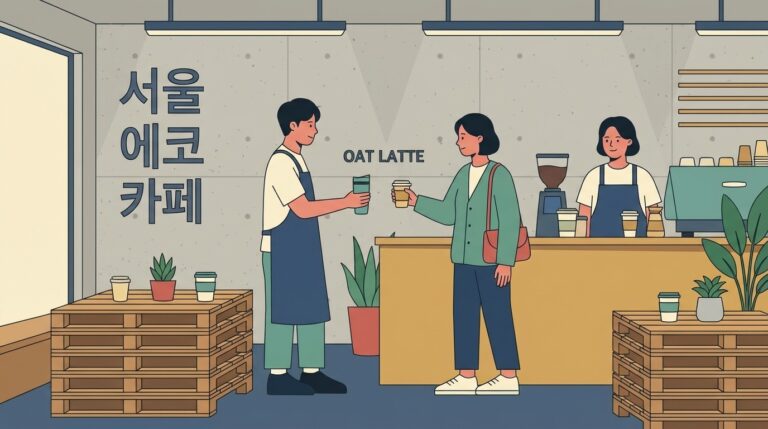
Picture this: You are walking through the trendy alleys of Seongsu-dong, Seoul’s equivalent to Brooklyn. You step into a newly opened café. Instead of pristine painted walls, you see exposed concrete. The tables are made from old shipping pallets, and the barista serves your oat milk latte with a glass straw. Your Korean friend looks around admiringly and says, ‘와, 여기 공간 기획 진짜 잘했다. 본연의 멋을 살렸네.’ (Wow, the space planning here is amazing. They really brought out its natural charm.)
If you were reading a traditional textbook, you might just think of ‘재활용’ (recycling) or ‘친환경’ (eco-friendly). But at the C2 level, we are moving beyond basic vocabulary. As zero-waste and sustainable living become explosive trends in Korea—from ‘Almeng Market’ in Mangwon-dong to high-end upcycling brands—the language used to describe these spaces has evolved into something highly sophisticated.
If you want to discuss interior design, sustainability, and aesthetic philosophy with Korean architects, designers, or just your hip friends, you need to know how to speak their language. Today, we are not just learning Korean; we are diving into the aesthetic mind of modern Seoul.
This guide is crafted for advanced learners based on real conversations I’ve had with foreign interior designers and expat business owners in Korea. Let’s elevate your Korean to the next level!
Phase 2: Deep Dive into Core Expressions
At the C2 level, it is all about nuance. We are swapping out basic verbs for expressive, evocative vocabulary.
1. 불필요한 마감재를 과감히 덜어내다
- Pronunciation: [Bulpilyohan magamjaereul gwagamhi deoreonaeda] -> Think of the ‘eo’ in ‘deoreonaeda’ like the sound you make when you are slightly disgusted (‘uh’), but short and crisp.
- Meaning: (Literal) To boldly strip away unnecessary finishing materials. / (Real nuance) Embracing a raw, minimalist aesthetic by intentionally leaving out excess decorations.
- K-Culture Moment: This is the exact phrase an interior designer would use in an interview for a lifestyle magazine when explaining why a trendy Seongsu-dong café looks like an abandoned factory.
- Editor’s Insight: The verb ‘덜어내다’ (to scoop out / subtract) is crucial here. In advanced Korean aesthetics, beauty isn’t just about adding things (더하기); it is about the art of subtraction (비움의 미학).
- Situation Spectrum:
[🚫 Never] ———— [⚠️ Be Careful] ———— [✅ Freely]- Casual with friends: ⚠️ (A bit too formal/pretentious for grabbing a beer)
- Professional/Design discussions: ✅ (Perfectly sophisticated)
- Formal presentations: ✅
- 🤔 Think About It: Why do Koreans value the concept of ‘여백의 미’ (the beauty of empty space) in traditional art, and how does this modern zero-waste trend reflect that ancient philosophy?
2. 지속 가능한 라이프스타일을 공간에 녹여내다
- Pronunciation: [Jisok ganeunghan laipeuseutaileul gonggane nogyeonaeda]
- Meaning: (Literal) To melt a sustainable lifestyle into the space. / (Real nuance) To seamlessly integrate eco-friendly values into the interior design.
- K-Culture Moment: You will see this written on the sleek, recycled-paper brochures of high-end eco-hotels in Jeju Island.
- Editor’s Insight: ‘녹여내다’ (to melt something into) is a beautiful C2-level expression. You do not just ‘put’ a concept into a room; you ‘melt’ it so it becomes one with the environment. It implies a natural, unforced harmony.
- Situation Spectrum:
[🚫 Never] ———— [⚠️ Be Careful] ———— [✅ Freely]- Everyday casual talk: ⚠️ (Sounds like you are reading a brochure)
- Business proposals / SNS captions for your business: ✅
- Formal interviews: ✅
- 🤔 Think About It: Does your native language use physical metaphors like ‘melting’ to describe integrating abstract concepts into a physical space?
3. 소재 본연의 물성을 살리다
- Pronunciation: [Sojae bonyonui mulseongeul sallida]
- Meaning: (Literal) To revive the physical properties of the original material. / (Real nuance) To highlight the natural, raw texture of the materials (like unpolished wood or bare concrete) rather than covering them up with paint or plastic.
- K-Culture Moment: Imagine a K-Drama where the wealthy, chic CEO of an architecture firm is inspecting a new eco-friendly flagship store. He touches a reclaimed wooden table and says this line.
- Editor’s Insight: ‘물성’ (physical property) and ‘본연’ (original/intrinsic nature) are highly advanced vocabulary words that instantly make you sound like an art critic or a master architect.
- Situation Spectrum:
[🚫 Never] ———— [⚠️ Be Careful] ———— [✅ Freely]- Casual conversation: 🚫 (Your friends will ask why you are speaking like a philosophy professor)
- Professional/Academic: ✅
Phase 3: Textbook vs. Real Korean
Let’s compare intermediate (textbook) Korean with C2 (real, sophisticated) Korean.
| Situation | 📖 Textbook Korean (B1-B2) | 🗣️ Real Advanced Korean (C1-C2) | 💡 Why the difference? |
|---|---|---|---|
| Explaining eco-friendly design | 친환경 가구를 많이 썼습니다. (I used a lot of eco-friendly furniture.) | 환경을 고려해 가치소비를 실천한 새활용 가구로 들였어요. | C2 Korean uses socio-cultural buzzwords like ‘가치소비’ (value-based consumption) and the native Korean word for upcycling (‘새활용’). |
| Describing minimalism | 물건이 별로 없고 깨끗합니다. (There are few things and it is clean.) | 불필요한 장식을 배제하고 미니멀한 무드를 연출했어요. | ‘배제하다’ (exclude) and ‘연출하다’ (direct/curate) elevate the sentence from simple description to professional design critique. |
| Talking about zero waste | 쓰레기를 안 만들려고 노력해요. (I try not to make trash.) | 제로 웨이스트 동참을 위해 일회용품 사용을 지양하고 있습니다. | ‘지양하다’ (to reject/avoid doing) is a high-level formal word commonly used in corporate ESG reports and high-end brand statements. |
Phase 4: Cultural Context — K-Culture Deep Dive
4-1. Non-verbal Nuances: The ‘Nunchi’ of Eco-Spaces
In modern Seoul, ‘Nunchi’ (눈치) extends to environmental consciousness. If you visit a vegan, zero-waste café in Mangwon-dong, asking for a plastic straw or a disposable cup for a dine-in order shows a lack of eco-nunchi. The non-verbal cue here is bringing your own tumbler and casually handing it to the barista with a polite nod. It is a silent flex of your sustainable lifestyle.
4-2. The ‘Industrial Café’ Paradox
If you have watched any recent K-Dramas set in Seoul or visited cafes owned by K-Pop idols, you have noticed the ‘Industrial Interior’ trend. Abandoned printing presses, public bathhouses (목욕탕), and shoe factories transformed into massive coffee shops.
While this originally started as an upcycling and zero-waste initiative (reusing existing structures rather than demolishing and creating construction waste), it has become a bit of a meme in Korea. Netizens joke about ‘cafes that look like construction sites where you might get tetanus.’
Critical View: There is a fine line in Korea right now between genuine ‘sustainable upcycling’ (새활용) and merely mimicking a ‘raw aesthetic’ (감성 카페) while still being wasteful behind the scenes.
Phase 5: Real-world Roleplay Scenario
Setting: A sunny Friday afternoon in Yeonnam-dong. You are planning to open a small zero-waste lifestyle shop. You are having a consultation with Minsu, a trendy Korean interior designer.
Characters:
* YOU: An expat entrepreneur opening a zero-waste store. You want the space to reflect your values.
* Minsu (34): A passionate, slightly hipster interior designer who loves using high-level design jargon.
Dialogue:
Minsu: 이번 숍의 메인 콘셉트는 어떻게 잡고 싶으신가요? (How would you like to set the main concept for this shop?)
YOU: 제로 웨이스트 숍인 만큼, 인테리어 과정에서도 쓰레기가 최소화되었으면 해요. (Since it’s a zero-waste shop, I want waste to be minimized even during the interior design process.)
Minsu: 아, 완벽히 이해했습니다. 그럼 기존 건물의 골조는 그대로 노출시키는 게 어떨까요? (Ah, I perfectly understand. Then how about we leave the original building’s framework exposed?)
YOU: 좋아요. 불필요한 마감재는 과감히 덜어내고 싶어요. (I like it. I want to boldly strip away unnecessary finishing materials.)
Minsu: 훌륭합니다. 그럼 진열장 같은 가구들은 어떻게 할까요? 새것으로 맞출까요? (Excellent. Then what about furniture like display cabinets? Should we custom-order new ones?)
🔀 Your Turn! How should you reply to impress Minsu?
* A) “아니요, 그냥 싼 중고 가구 아무거나 살게요.” (No, I’ll just buy whatever cheap used furniture.)
* B) “아니요, 철거 현장에서 나온 목재를 새활용(업사이클링)해서 본연의 물성을 살려보면 어떨까요?” (No, how about we upcycle wood from demolition sites and bring out its original physical properties?)
* C) “환경을 위해서 가구는 아예 없애버리죠!” (For the environment, let’s just get rid of furniture altogether!)✅ Best Choice: B — This perfectly utilizes C2 vocabulary (‘새활용’, ‘본연의 물성’) and clearly communicates your eco-friendly philosophy like a true professional. Minsu will respect you instantly.
⚠️ Choice A Analysis: Too blunt and loses the ‘premium’ aesthetic focus of your brand.
Phase 6: 10-Second Shadowing Drill
Time to practice your pacing and intonation! Remember, advanced Korean is spoken smoothly, with confident pauses.
😌 저희 브랜드의 / 지속 가능한 철학을 / 공간에 자연스럽게 / 녹여내고 싶습니다.
(jeohui beuraendeueui / jisok ganeunghan cheolhageul / gonggane jayeonseureopge / nogyeonaego sipseumnida.)
Emotion: Calm, confident, and highly professional.
Phase 7: K-Culture Mini Dictionary (Zero-Waste Edition)
| Korean | Romanization | English | Context |
|---|---|---|---|
| 가치소비 | gachisobi | Value-based consumption | Buying products that align with one’s ethical or environmental beliefs. A huge trend among Korean Gen Z and Millennials. |
| 새활용 | saehwaryong | Upcycling | The pure Korean word created to replace the English term ‘Upcycling’. Adding ‘새’ (new) to ‘활용’ (use). |
| 비건 지향 | bigeon jihyang | Vegan-oriented | Used to describe spaces, materials (like vegan leather furniture), or menus that lean towards veganism, even if not 100% strict. |
| 플로깅 | peulloging | Plogging | Jogging while picking up trash. A popular weekend activity for eco-conscious clubs around the Han River. |
Phase 8: Traveler Survival Kit (Refill Station Edition)
If you visit a Zero-Waste ‘Refill Station’ (where you bring your own bottles for shampoo, detergent, or cosmetics) in Korea, you will need these practical expressions.
🆘 Survival Expression #1: Weighing your container
* 🇰🇷 “공병 영점 먼저 맞춰주실 수 있나요?” (gongbyeong yeongjeom meonjeo matchwojusil su innayo?)
* 🗣️ Meaning: “Could you tare (zero out) my empty bottle first?”
* 📍 Where to use: Almeng Market, Aromatica Refill Stations.🆘 Survival Expression #2: Buying by weight
* 🇰🇷 “이거 10그램(g) 당 얼마예요?” (igeo sip geuraem dang eolmayeyo?)
* 🗣️ Meaning: “How much is this per 10 grams?”📌 Editor’s Travel Note
* Eco-discounts: Many Korean cafes (like Starbucks Korea or local indie cafes) offer a 300~500 KRW discount if you bring your own ‘텀블러’ (tumbler). Just say: “개인 컵에 담아주세요” (Please put it in my personal cup).
* Receipts: To save paper, clerks often ask “영수증 드릴까요?” (Would you like a receipt?). Say “아니요, 버려주세요” (No, please throw it away) or “모바일로 받을게요” (I’ll receive it on mobile via app).
Phase 9: Critical Thinking Corner — “One Step Deeper”
Korean in the Global Era: The Paradox of ‘Zero Waste’
🧠 Think Deeper:
Have you noticed something ironic? In Korea, the movement to protect the environment is heavily branded using English terms: Zero Waste, Eco-friendly, Upcycling, Vegan. As Korean society rapidly globalizes, English is often used to make a lifestyle movement seem ‘trendier’ or ‘more premium.’ However, Korean linguistic purists and eco-activists are pushing back. They argue that true sustainability should start with language, advocating for beautiful native words like ‘새활용’ (Upcycling) and ‘쓰레기 없애기’ (Zero waste). This reflects a broader tension in modern Korea: the desire to be globally sophisticated versus the need to preserve authentic Korean identity.💬 Your Turn: Does your country use English loanwords to make environmental trends sound cooler? Or do you use native terminology? Share in the comments!
Phase 10: FAQ & Avoiding Common Mistakes
- Q: Can I use ‘덜어내다’ (strip away) when talking to my boss about a project?
- Yes! It is a highly professional and poetic way to say “Let’s simplify this.” (e.g., “보고서에서 불필요한 내용은 덜어내는 게 좋겠습니다.”)
- Q: Are ‘재활용’ and ‘새활용’ completely interchangeable?
- No. ‘재활용’ is recycling (crushing glass to make glass). ‘새활용’ is upcycling (turning a glass bottle into a beautiful lamp).
❌ Common Mistake #1: Saying “쓰레기 인테리어” to mean “Interior using waste.”
✅ Do this instead: That sounds like the interior is garbage! Always use “폐자재를 활용한 인테리어” (Interior utilizing discarded materials) or “업사이클링 인테리어”.
Phase 11: Summary & Action Items
One-Liner Summary: To speak about eco-friendly interiors at a C2 level, move beyond ‘recycling’ and embrace sophisticated vocabulary like ‘새활용’ (upcycling) and ‘본연의 물성을 살리다’ (bringing out intrinsic properties).
Your Action Missions:
* 🥉 Bronze (Solo): Stand in your living room and practice the shadowing drill (Phase 6) three times, pretending you are a famous architect.
* 🥈 Silver (Online): Find an Instagram post of a Korean cafe and leave a C2-level comment: “공간에 브랜드의 철학을 잘 녹여냈네요!”
* 🥇 Gold (Real World): Visit a cafe in Korea with your own tumbler and use the phrase: “개인 컵에 담아주시고, 영수증은 버려주세요!”
🌱 Special K-Culture Mission:
Next time you watch a modern K-Drama, look closely at the CEO’s office or the main character’s hip apartment. Can you spot any upcycled (새활용) elements or minimalist (마감재를 덜어낸) concrete walls?
Phase 12: Quiz — Interactive Challenge
1. Situational Judgment: You are presenting your eco-friendly office design to a corporate board in Seoul. What is the most sophisticated way to explain that you didn’t use unnecessary decorations?
* A) 장식을 별로 안 했습니다.
* B) 쓰레기를 줄이려고 장식을 버렸습니다.
* C) 불필요한 장식을 과감히 덜어내고 소재 본연의 가치에 집중했습니다.
* Answer: C. A is too basic, B sounds unprofessional. C uses perfect C2 vocabulary.
2. True or False – K-Culture Edition:
In Korea, “새활용” means exactly the same thing as taking your plastic bottles to the recycling bin on apartment recycling day.
* Answer: False. Taking trash to the bin is ‘분리수거’ or ‘재활용’. ‘새활용’ is the artistic/functional upcycling of materials into new high-value products.
3. Fill in the Blank:
“이 카페는 버려진 공장의 ( )을/를 그대로 살려 멋진 공간을 연출했습니다.”
(This cafe utilized the original [ ] of the abandoned factory to create a wonderful space.)
* Answer: 물성 (physical properties) or 본연의 멋 (intrinsic charm).
Did you get them all right? You are officially ready to debate interior design in Seongsu-dong! Let me know in the comments which expression was your favorite today.
Frequently Asked Questions (FAQ)
Q: What does "불필요한 마감재를 과감히 덜어내다" mean in Korean and how do you pronounce it?
A: In Korean, "불필요한 마감재를 과감히 덜어내다" is pronounced [Bulpilyohan magamjaereul gwagamhi deoreonaeda] and means: (Literal) To boldly strip away unnecessary finishing materials. / (Real nuance) Embracing a raw, minimalist aesthetic by intentionally leaving out excess decorations.
Q: What does "지속 가능한 라이프스타일을 공간에 녹여내다" mean in Korean and how do you pronounce it?
A: In Korean, "지속 가능한 라이프스타일을 공간에 녹여내다" is pronounced [Jisok ganeunghan laipeuseutaileul gonggane nogyeonaeda] and means: (Literal) To melt a sustainable lifestyle into the space. / (Real nuance) To seamlessly integrate eco-friendly values into the interior design.
Q: What does "소재 본연의 물성을 살리다" mean in Korean and how do you pronounce it?
A: In Korean, "소재 본연의 물성을 살리다" is pronounced [Sojae bonyonui mulseongeul sallida] and means: (Literal) To revive the physical properties of the original material. / (Real nuance) To highlight the natural, raw texture of the materials (like unpolished wood or bare concrete) rather than covering them up with paint or plastic.







