

Phase 1: Empathy (The K-Drama Moment)
Hello! I’m the lead editor at Daily Hangul.
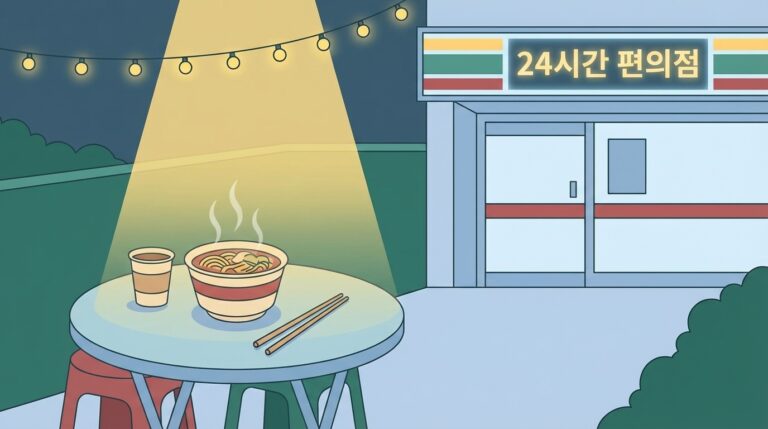
Picture this: It’s 11 PM in Seoul. You just watched a K-Drama where the main characters have a deep, romantic conversation over steaming cup noodles at a convenience store. Inspired, you walk into a brightly lit GS25 or CU. You successfully buy your Shin Ramyun, pour in the hot water, step out to the plastic tables, and… wait.
How are you supposed to eat this? With your hands?
You look around. You forgot the chopsticks! You walk back inside, make awkward eye contact with the cashier, and start doing a weird hand-pinching mime to show you need chopsticks. Does this sound familiar?
Don’t worry. This is a classic rite of passage for every A1 beginner in Korea! Knowing how to ask for wooden chopsticks (and understanding the cashier’s rapid-fire questions) will save you from soggy ramen and awkward charades.
This guide is based on real panic moments from my beginner students. Let’s turn you into a convenience store insider!
Phase 2: Core Expressions Deep Dive
Let’s master the magic words that will save your late-night snack.
1. 나무젓가락 주세요. (namujeotgarak juseyo)
- Pronunciation: [na-mu-jeot-ga-rak ju-se-yo]
Sound-alike guide: ‘Nah-moo’ (like a cow saying moo) + ‘jut-gah-rahk’ + ‘joo-seh-yo’.- Meaning: (Literal) Wooden chopsticks give me. / (Real nuance) Can I have wooden chopsticks, please?
- K-Culture Moment: You’ll use this the moment the cashier hands you your receipt. Often, the chopsticks are kept behind the counter, so you must ask!
- Editor’s Insight: “나무” (namu) means wood, and “젓가락” (jeotgarak) means chopsticks. Add “주세요” (please give me), and you can literally ask for anything in Korea!
- Situation Spectrum:
[🚫 Never] ———— [⚠️ Caution] ———— [✅ Freely]
- To friends (Casual): 🚫 (Too polite, just say “젓가락 줘”)
- To cashiers/staff (Semi-formal/Formal): ✅ (Perfectly polite!)
- 🤔 Think About It: Notice how Korean doesn’t use “Can I…” or “May I…” here? Just “Item + Give me.” Why do you think Korean communication at stores is so direct yet polite?
2. 몇 개 필요하세요? (myeot gae piryohaseyo?)
- Pronunciation: [myut geh pi-ryo-ha-se-yo]
- Meaning: (Literal) How many items are needed? / (Real nuance) How many chopsticks do you need?
- K-Culture Moment: If you buy three cup noodles, the cashier might just give you three. But if you buy one big ramen and a bunch of snacks, they will ask you this to be sure.
- Editor’s Insight: You don’t need to speak this phrase, but you must recognize the sound “myeot gae” (how many). When you hear it, just hold up your fingers!
- Situation Spectrum:
[🚫 Never] ———— [⚠️ Caution] ———— [✅ Freely]
- You saying this to the cashier: 🚫 (They are asking you!)
- The cashier asking you: ✅
- 🤔 Think About It: Why don’t they just leave a huge box of chopsticks out for people to grab? In Korea, taking only exactly what you need is an unspoken rule of etiquette.
3. 하나만 주세요. (hanaman juseyo)
- Pronunciation: [ha-na-man ju-se-yo]
- Meaning: (Literal) Only one give me. / (Real nuance) Just one, please.
- K-Culture Moment: Perfect for solo travelers! “하나” (hana) is one, and “만” (man) means only. It shows you are considerate and not being greedy.
- Editor’s Insight: If you need two, say “두 개 주세요” (du gae juseyo). But for A1, using your fingers while saying “주세요” works perfectly fine!
- Situation Spectrum:
[🚫 Never] ———— [⚠️ Caution] ———— [✅ Freely]
- At any store asking for quantity: ✅
Phase 3: Textbook vs. Real Korean
| Situation | 📖 Textbook Korean | 🗣️ Real Korean | 💡 Why the difference? |
|---|---|---|---|
| Asking for chopsticks | 젓가락을 주시겠습니까? (Would you kindly give me chopsticks?) | 나무젓가락 주세요. (Wooden chopsticks, please.) | Convenience stores run on “Pali-pali” (hurry up) culture. Keep it short and sweet! |
| Asking for one | 한 개를 주십시오. (Please give one item.) | 하나요. / 하나만요. (Just one.) | Dropping the verb “give” and just adding “yo” (polite marker) is the ultimate Korean shortcut. |
Bottom Note for A1: Don’t stress about full sentences. Noun + “주세요” (juseyo) will make you survive 90% of shopping situations in Korea!
Phase 4: Cultural Context — K-Culture Deep Dive
4-1. Non-verbal Cues: The Art of the Quick Nod
In a Korean convenience store, eye contact isn’t deeply necessary. Cashiers are scanning items incredibly fast. When you say “나무젓가락 주세요”, a slight bow of your head (just a quick nod) when they hand it to you is the perfect touch of local Nunchi (social sense).
4-2. K-Drama Connection: The Convenience Store Romance
If you’ve watched K-Dramas like Backstreet Rookie or Crash Course in Romance, you know the convenience store (편의점) is not just a shop. It’s a dining room, a breakup spot, and a place to cure a hangover.
Critical View: In dramas, characters always seem to have beautiful, slow-motion moments while eating ramen on the store patio. In reality? You’re sweating, trying not to spill spicy soup on your shirt, while businessmen rush past you. But grabbing those wooden chopsticks, splitting them apart, and rolling the noodles? That feeling is 100% as magical as the dramas make it look.
Phase 5: Real-Life Roleplay Scenario
Setting: A rainy Friday night, 11:30 PM. A glowing CU convenience store near Hongdae Station. You just bought a spicy Buldak Ramen and a banana milk.
Characters:
– YOU: A beginner Korean learner, craving a late-night snack.
– Cashier (Ji-hoon, 21): A university student working the night shift. He talks fast.
Dialogue:
Ji-hoon: (Scanning items quickly)
봉투 필요하세요?
(bongtu piryohaseyo?)
[Do you need a plastic bag?]
YOU: (Remembering your lessons)
아니요, 괜찮아요.
(aniyo, gwaenchanayo.)
[No, it’s okay.]
Ji-hoon: (Taps the screen)
4,500원입니다. 카드를 꽂아주세요.
(sacheonobaegwonimnida. kadeureul kkojajuseyo.)
[That’s 4,500 won. Please insert your card.]
(🎭 Stage Direction: You pay. Ji-hoon hands you the receipt. But you realize there are no chopsticks on the counter!)
🔀 YOUR TURN! How do you reply?
– A) “저기요… 나무젓가락 주세요.” (Excuse me… wooden chopsticks please.)
– B) “젓가락 내놔!” (Give me chopsticks!)
– C) Point at the ramen and do the pinching mime.✅ Best Choice: A — It is polite, natural, and gets exactly what you need.
⚠️ Choice B Analysis: This is extremely rude! It sounds like a villain in a historical drama demanding money. Never use this to a cashier!
YOU: 저기요… 나무젓가락 주세요.
(jeogiyo… namujeotgarak juseyo.)
[Excuse me… wooden chopsticks, please.]
Ji-hoon: 아, 네! 몇 개 드릴까요?
(a, ne! myeot gae deurilkkayo?)
[Ah, yes! How many should I give you?]
YOU: 하나만 주세요.
(hanaman juseyo.)
[Just one, please.]
Ji-hoon: 네, 여기 있습니다.
(ne, yeogi itseumnida.)
[Here you go.]
Phase 6: 10-Second Shadowing Drill
Let’s practice the flow. Read aloud, following the pauses (/) and the mood!
😊 (Polite and clear)
저기요 / 나무젓가락 / 주세요!
(jeogiyo / namujeotgarak / ju-se-yo!)
🥺 (If you need one more because you dropped yours)
하나만 / 더 / 주세요~
(hanaman / deo / ju-se-yo~)
Tip: Stretch the ‘yo’ slightly at the end to sound friendly and apologetic!
Phase 7: K-Culture Mini Dictionary
| Korean | Romanization | English | Context |
|---|---|---|---|
| 편의점 | pyeonuijeom | Convenience Store | Open 24/7. GS25, CU, 7-Eleven, Emart24. |
| 나무젓가락 | namujeotgarak | Wooden Chopsticks | Disposable chopsticks used for takeout/ramen. |
| 컵라면 | keomnamyeon | Cup Noodles | The soul food of Korean convenience stores. |
| 눈치 | nunchi | Social awareness | Reading the room (e.g., taking only one pair of chopsticks when you buy one ramen). |
| 봉투 | bongtu | Plastic bag | Cashiers will always ask if you need one. |
Phase 8: Traveler’s Survival Kit
Since you are at a convenience store, here are the absolute must-know phrases to survive the checkout counter!
🆘 Survival Phrases TOP 3
– 🇰🇷 “이거 얼마예요?” (igeo eolmayeyo?)
– Meaning: How much is this?
– 🇰🇷 “봉투 주세요.” (bongtu juseyo)
– Meaning: Please give me a bag.
– 🇰🇷 “영수증 버려주세요.” (yeongsujeung beoryeojuseyo)
– Meaning: Please throw away the receipt.📌 Editor’s Travel Note
– Self-Checkout: Many Korean convenience stores now have self-checkout kiosks at night. If you use one, you can usually find the wooden chopsticks stored in a small drawer right beneath the scanner!
– T-Money Card: You can buy and recharge your transportation card (T-Money) at the cashier. Just hand them the card, cash, and say “충전해 주세요” (chungjeonhae juseyo – please recharge).
Phase 9: Critical Thinking Corner — “One Step Deeper”
🧠 Think Deeper: Food & Identity
Have you ever wondered why Korean convenience store food culture feels so communal, even when you’re eating alone? In Korea, eating is historically a shared activity. Even the simple act of breaking apart disposable wooden chopsticks (나무젓가락) often happens on a plastic table shared with friends after a night out, or among coworkers needing a quick break. By asking the cashier, “How many do you need?”, the language itself assumes you might be taking food back to share with others.
💬 Your Turn:
Does your culture have a “quick, cheap comfort food” that people eat late at night? Do you usually eat it alone or with friends? Share in the comments!
Phase 10: FAQ & Avoiding Mistakes
Q: Do I have to pay for the wooden chopsticks?
No! If you purchase food that requires them (like ramen, sausage, or lunch boxes), they are free.
Q: Can I just grab them myself?
Maybe. If they are sitting in a cup on the customer side of the counter, yes. But usually, they are hidden behind the cashier’s side, so you must ask.
Q: Can I take 5 pairs of chopsticks if I only bought 1 ramen?
Technically no one will arrest you, but it goes against Korean Nunchi. The cashier will definitely give you a strange look.
❌ Common Mistake #1: Saying “너 젓가락 줘” (You, give me chopsticks).
✅ Do this instead: Never use “너” (you) to strangers. Always use the polite “나무젓가락 주세요.”
Phase 11: Summary & Action Items
One-Liner Summary: To get chopsticks for your ramen, just smile and say, “나무젓가락 주세요” (namujeotgarak juseyo)!
Action Mission 3 Steps:
– 🥉 Bronze (Solo): Stand in front of a mirror and ask your reflection for chopsticks 3 times using today’s phrase.
– 🥈 Silver (Online): Go to a K-Drama YouTube clip featuring a convenience store and comment: “I know how to ask for 나무젓가락 now!”
– 🥇 Gold (Real Life): Go to a local Korean mart or convenience store and successfully ask the cashier for wooden chopsticks!
K-Culture Mission:
Next time you watch a K-Drama, pay close attention to the convenience store scenes. Can you spot where they keep the wooden chopsticks? Are they on the tables, or did the cashier hand them over?
Phase 12: Quiz — Interactive Challenge
1. You bought a lunch box (도시락) at Emart24. The cashier asks: “몇 개 필요하세요?” (myeot gae piryohaseyo?). You are eating alone. What do you say?
A) 나무젓가락 주세요.
B) 하나만 주세요.
C) 아니요, 괜찮아요.
Reveal Answer: B! They asked “how many”, so you reply with “Just one, please” (하나만 주세요).
2. True or False: In Korea, it is normal to leave a tip for the convenience store cashier if they give you extra chopsticks.
Reveal Answer: False! There is no tipping culture in Korea. Giving a tip will confuse the cashier and they might chase you down the street to return your money!
3. Fill in the blank: To ask for a plastic bag, you say “(_____) 주세요.”
Reveal Answer: 봉투 (bongtu).
Great job today! You are now fully prepared for your midnight ramen run in Seoul. See you in the next lesson! 👋
Frequently Asked Questions (FAQ)
Q: What does "나무젓가락 주세요. (namujeotgarak juseyo)" mean in Korean and how do you pronounce it?
A: In Korean, "나무젓가락 주세요. (namujeotgarak juseyo)" is pronounced [na-mu-jeot-ga-rak ju-se-yo] and means: (Literal) Wooden chopsticks give me. / (Real nuance) Can I have wooden chopsticks, please?
Q: What does "몇 개 필요하세요? (myeot gae piryohaseyo?)" mean in Korean and how do you pronounce it?
A: In Korean, "몇 개 필요하세요? (myeot gae piryohaseyo?)" is pronounced [myut geh pi-ryo-ha-se-yo] and means: (Literal) How many items are needed? / (Real nuance) How many chopsticks do you need?
Q: What does "하나만 주세요. (hanaman juseyo)" mean in Korean and how do you pronounce it?
A: In Korean, "하나만 주세요. (hanaman juseyo)" is pronounced [ha-na-man ju-se-yo] and means: (Literal) Only one give me. / (Real nuance) Just one, please.







