

Phase 1: Empathy (Welcome to the K-Market!)
Hello! I’m your lead editor at Daily Hangul.
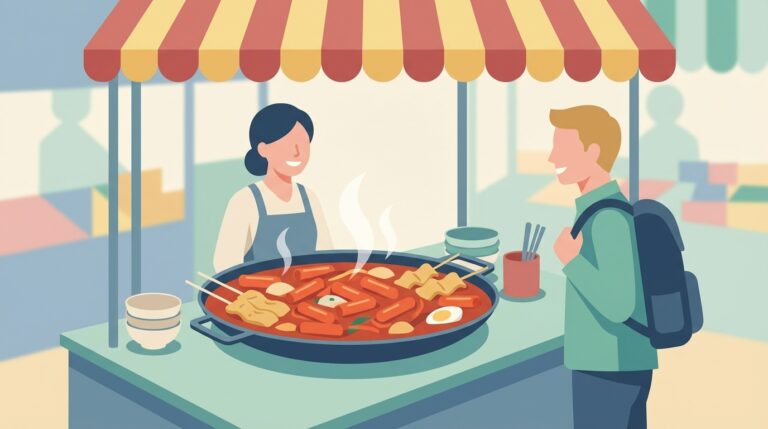
Picture this: Steam is rising into the chilly night air. A warm, glowing street stall is filled with people standing shoulder-to-shoulder. In the center, a giant iron pan bubbles with bright red, mouth-watering Tteokbokki (spicy rice cakes). It’s the exact K-Drama scene where the main character grabs a quick bite and a drink after a long, dramatic day at work.
You want to join in. You want to taste that exact red sauce. But as you step closer to the Pojangmacha (street food tent) or the traditional market stall, panic sets in. The menu is entirely in Korean, there are no price tags, and the lovely owner is looking right at you, asking a question you don’t understand.
Don’t worry! Every Korean learner has been there. If you don’t know the right phrases, you might end up ordering enough food for five people, or accidentally getting the spiciest dish that will leave you in tears.
Today, I’m going to teach you the real, survival Korean phrases you need to confidently order Tteokbokki like a true local. These are the exact expressions my students use when they explore Gwangjang Market or the bustling streets of Hongdae. Let’s dive in!
Phase 2: Core Expressions Deep Dive
1. 떡볶이 1인분 주세요. (One serving of Tteokbokki, please.)
- Pronunciation: [Tteok-bok-ki il-in-bun ju-se-yo]
(Sound tip: ‘Tteok’ sounds like ‘duck’ but with a strong, tense ‘T’. ‘bun’ sounds like ‘boon’ but shorter.) - Meaning: Literal = Give me 1 person’s portion of Tteokbokki. / Real nuance = I’ll have one order of Tteokbokki.
- K-Culture Moment: In Korea, street food isn’t usually ordered by the “bowl” or “plate.” It’s ordered by in-bun (인분), which means “serving per person.” When K-Pop idols do street food Mukbangs, you’ll often hear them playfully say, “이모님, 여기 3인분 같은 1인분 주세요!” (Auntie, please give me 1 serving that looks like 3 servings!).
- Editor’s Insight: This is your magic formula. [Food name] + [Number]인분 + 주세요. Memorize this, and you won’t starve in Korea.
- Situation Spectrum:
[🚫 절대 금지] ———— [⚠️ 주의] ———— [✅ 자유롭게]- Friends (Casual): 🚫 (Use “1인분 줘” instead)
- Stall Owner (Formal/Polite): ✅
- 🤔 Think About It: Why does Korean specify “portions per person” instead of just saying “one plate”? How does this reflect the Korean culture of sharing meals?
2. 이거 많이 매워요? (Is this very spicy?)
- Pronunciation: [I-geo ma-ni mae-wo-yo?]
(Sound tip: ‘I-geo’ sounds like ‘eagle’ without the ‘L’. ‘mae-wo’ sounds like ‘may-woah’.) - Meaning: Literal = Is this a lot spicy? / Real nuance = I can’t handle too much spice, how bad is it?
- K-Culture Moment: You’ve probably seen variety shows where K-Pop stars sweat and cry over spicy food. Korean spice can be intense! At a street stall, Tteokbokki is pre-cooked in a giant pan, so you can’t ask them to “make it less spicy.” You have to ask how spicy it is before you commit.
- Editor’s Insight: If the owner says “안 매워요” (It’s not spicy), be careful! A Korean “not spicy” might still burn your tongue if you are a beginner to Korean food!
- Situation Spectrum:
[🚫 절대 금지] ———— [⚠️ 주의] ———— [✅ 자유롭게]- Anywhere, to anyone polite: ✅
- 🤔 Think About It: Koreans love spicy food to relieve stress. Does your culture have a specific flavor or “comfort food” tied to stress relief?
3. 포장해 주세요 / 먹고 갈게요. (Please pack it to go / I will eat it here.)
- Pronunciation: [Po-jang-hae ju-se-yo / Meok-go gal-ge-yo]
- Meaning: Literal = Please do packaging / I will eat and go.
- K-Culture Moment: You finally ordered! But the owner is holding a plastic bag and some tongs, looking at you. They are waiting to know if it’s takeout (포장 – Pojang) or for here (먹고 갈게요 – Meokgo galgeyo).
- Editor’s Insight: If you say “Takeout please” in English, older stall owners might not understand. Always use “Pojang” for takeout!
- Situation Spectrum:
[🚫 절대 금지] ———— [⚠️ 주의] ———— [✅ 자유롭게]- Restaurants/Cafes/Markets: ✅
Phase 3: Textbook vs. Real Korean
| Situation | 📖 Textbook Korean | 🗣️ Real Korean | 💡 Why is it different? |
|---|---|---|---|
| Asking the price | 이것은 얼마입니까? (Igeoseun eolma-imnikka?) | 이거 얼마예요? (Igeo eolmayeyo?) | ‘-입니다/입니까’ is too formal for a market. ‘-예요/이에요’ is polite but natural. |
| Asking for soup | 국물을 주시겠어요? (Gungmureul jusigesseoyo?) | 국물 좀 주세요. (Gungmul jom juseyo.) | Adding “좀” (a little) makes commands softer and friendlier in daily life. |
| Paying | 계산해 주십시오. (Gyesanhae jusipsio.) | 계산할게요. (Gyesanhalgeyo.) | “I will pay” is the standard way to initiate the bill, rather than “Please calculate.” |
Bottom Note: Stick to the “Real Korean” column to sound like you’ve been living in Seoul for months!
Phase 4: Cultural Context — K-Culture Deep Dive
4-1. The Non-Verbal Language of Street Food
When you eat at a Traditional Market (전통 시장), your body language is just as important as your words.
– The Toothpick (이쑤시개): Tteokbokki is usually eaten with long wooden toothpicks or small skewers, not chopsticks.
– The Free Broth: See that warm, steamy fish cake (Odeng) broth? It’s usually free! You can just grab a paper cup and scoop it yourself. But a polite “이모님, 국물 좀 먹을게요” (Auntie, I’ll have some broth) will get you a warm smile.
4-2. The “Emo-nim” Culture (K-Food Connection)
In a K-Drama, you might hear customers calling the middle-aged female stall owners “이모님” (Imo-nim), which literally means “Aunt” (mother’s sister). It is a term of endearment and respect. Using “아줌마” (Ajumma) can sometimes sound rude or condescending depending on your tone. If you want to be treated like a favorite regular, call her “Emo-nim” with a bright smile!
Phase 5: Real-Life Roleplay Scenario
Scenario A: Your First Street Food Adventure
- Setting: Friday night, 8 PM. A bustling street stall near Myeongdong. It’s chilly, and the smell of spicy food is irresistible.
- Characters:
- YOU: A hungry traveler craving Tteokbokki.
- Emo-nim (50s): The friendly, fast-moving stall owner.
Emo-nim: 어서 오세요! 뭐 줄까?
(Eoseo oseyo! Mwo julkka?)
[Welcome! What can I give you?]
(🎭 Stage Direction: Emo-nim stirs the giant pan of red tteokbokki)
YOU: 이모님, 안녕하세요! 떡볶이 1인분 주세요.
(Imo-nim, annyeonghaseyo! Tteokbokki il-in-bun juseyo.)
[Hello, Auntie! One serving of Tteokbokki, please.]
Emo-nim: 네~ 매운 거 잘 먹어요?
(Ne~ Maeun geo jal meogeoyo?)
[Okay~ Are you good at eating spicy food?]
YOU: 아… 이거 많이 매워요?
(Ah… igeo mani maewoyo?)
[Ah… is this very spicy?]
Emo-nim: 에이, 하나도 안 매워. 맛있게 매워요.
(Ei, hanado an maewo. Masitge maewoyo.)
[Hey, it’s not spicy at all. It’s “deliciously spicy.”]
YOU: 다행이네요. 그럼 1인분 주세요.
(Dahaeng-ineyo. Geureom il-in-bun juseyo.)
[That’s a relief. Then 1 serving, please.]
Emo-nim: 포장해 줄까, 먹고 갈 거야?
(Pojanghae julkka, meokgo gal geoya?)
[Shall I pack it, or will you eat it here?]
🔀 YOUR TURN! How do you reply?
– A) “집에 가요!” (I go home!)
– B) “먹고 갈게요!” (I will eat it here!)
– C) “포장해 주세요!” (Please pack it to go!)✅ Best Choice: B or C, depending on what you want!
⚠️ Choice A Analysis: While grammatically okay, it’s unnatural. Always use the verbs “먹고 가다” (eat and go) or “포장하다” (to pack/take out) for food.
(Assuming you chose B)
YOU: 먹고 갈게요!
(Meokgo galgeyo!)
[I will eat it here!]
Emo-nim: 그래요. 자, 여기 떡볶이! 오뎅 국물은 저기서 떠다 마셔요.
(Geuraeyo. Ja, yeogi tteokbokki! Odeng gungmureun jeogiseo tteoda masyeoyo.)
[Sure. Here is the Tteokbokki! You can scoop and drink the fish cake broth over there.]
YOU: 감사합니다! 잘 먹겠습니다!
(Gamsahamnida! Jal meokgetseumnida!)
[Thank you! I will eat well!]
Phase 6: 10-Second Shadowing Drill
Practice speaking like a local! Pay attention to the pauses (/) and the emotion tags.
😊 이모님~ / 여기 / 떡볶이 1인분 / 주세요!
(Imo-nim~ / yeogi / tteokbokki il-in-bun / juseyo!)
😥 저기요... / 이거 / 많이 / 매워요?
(Jeogiyo… / igeo / mani / maewoyo?)
🎒 다 먹었어요! / 계산 / 할게요.
(Da meogeosseoyo! / gyesan / halgeyo.)
Phase 7: K-Culture Mini Dictionary
| Korean | Romanization | English | Context/Meaning |
|---|---|---|---|
| 포장마차 | pojangmacha | Street food stall / tent | Literally “covered wagon.” The iconic Korean street stalls you see in dramas. |
| 1인분 | il-in-bun | 1 portion / serving | The standard measuring unit for ordering food in Korea. |
| 이모님 | imo-nim | Auntie (Respectful) | The friendly way to address a middle-aged female staff member or owner. |
| 먹방 | mukbang | Eating broadcast | Derived from 먹다 (eat) + 방송 (broadcast). Perfect word to use when enjoying your street food! |
| 맵찔이 | maepjjiri | Spicy food weakling | A funny slang term for someone who can’t handle spicy food. Are you a maepjjiri? |
Phase 8: Traveler’s Survival Kit
If you are visiting a traditional market like Gwangjang Market or Namdaemun Market, save this cheat sheet!
🆘 Survival Phrases TOP 3
– 🇰🇷 “이거 얼마예요?” (Igeo eolmayeyo?) – “How much is this?”
– 🇰🇷 “조금만 주세요.” (Jogeumman juseyo.) – “Please give me just a little bit.” (Use this if the portions look huge!)
– 🇰🇷 “계좌이체 되나요?” (Gyejwa-iche doenayo?) – “Can I do a bank transfer?”📌 Editor’s Travel Note
– Cash is King at Markets: While Korea is a “card-free” society everywhere else, traditional markets and street stalls often prefer cash or direct bank transfers. Always bring some 10,000 won and 1,000 won bills!
– Napkin Etiquette: Look around for a roll of toilet paper hanging from the ceiling or sitting on the table. In markets, it’s perfectly normal to use this as napkins!
– No Tipping: Never leave a tip. The owner will chase you down the street to return your money!
Phase 9: Critical Thinking Corner — “One Step Deeper”
Food & Identity: The Culture of the Shared Pan
Have you ever noticed that at a Korean street stall, everyone stands around the same cooking pan, pointing at what they want? The owner serves you right out of the communal pot. This isn’t just about saving space; it’s a reflection of 정 (Jeong)—the Korean concept of deep emotional connection and community. Sharing space, breathing the same winter air, and eating from the same source breaks down social walls. For those 15 minutes while eating Tteokbokki, strangers become temporary neighbors.
💬 Your Turn: Does your country have a street food culture that brings strangers together? Share it in the comments below!
Phase 10: FAQ & Common Mistakes
Q: Can I customize my Tteokbokki (e.g., “Can I get it without fish cakes?”)
A: At a traditional street stall, usually No. It is cooked in a giant batch. However, if you order from a delivery app or a franchise restaurant (like Yupdduk), you can customize almost everything!
Q: How do I ask for water?
A: Water is usually self-serve! Look for a water purifier (정수기) and small metal or paper cups. You’ll often see a sign saying “물은 셀프” (Water is self-serve).
❌ Common Mistake #1: Saying “계산서 주세요” (Give me the bill) at a street stall.
✅ Do This Instead: Street stalls don’t have paper bills. Just say “얼마예요?” (How much is it?) when you are ready to leave.❌ Common Mistake #2: Blocking the stall for too long.
✅ Do This Instead: Traditional markets are fast-paced. Eat your food, enjoy the vibe, but don’t linger for an hour taking photos if other people are waiting to eat.
Phase 11: Summary & Action Items
One-Liner Summary: Remember “1인분 주세요” (1 portion please) and “포장해 주세요” (To go, please), and you are ready to conquer any Korean street stall!
Action Mission:
– 🥉 Bronze (Solo): Stand in front of a mirror and ask your reflection, “이거 많이 매워요?” (Is this very spicy?) 3 times!
– 🥈 Silver (Online): Comment below: Are you a Maepjjiri (spicy food weakling) or a spice lover?
– 🥇 Gold (Real World): Visit a local Korean restaurant or grocery store, buy some Tteokbokki, and say “감사합니다, 잘 먹겠습니다!” to the staff.
🎬 K-Culture Mission:
Watch a food vlog or K-Drama set in a market today. See if you can spot the customers standing around the stall, drinking fish cake broth from paper cups!
Phase 12: Quiz — Interactive Challenge
1. Situational Judgment: You want to buy some Tteokbokki to eat at your hotel. What is the most natural thing to say to the Emo-nim?
– A) “저 집에 갑니다.”
– B) “포장해 주세요.”
– C) “먹고 갈게요.”
2. True or False – K-Culture Edition:
“When eating at a traditional Korean market stall, you should always leave a 10% tip for good service.”
3. Fill in the Blank:
To order two servings of Tteokbokki, you say: “떡볶이 2( ___ ) 주세요.”
(Answers below!)
Click to reveal answers!
1. B) 포장해 주세요. (Please pack it to go. ‘A’ sounds awkward, and ‘C’ means you’ll eat it there.)
2. False. There is no tipping culture in Korea! It will only cause confusion.
3. 인분 (in-bun). “떡볶이 2인분 주세요” means “Two servings of Tteokbokki, please.”
Frequently Asked Questions (FAQ)
Q: What does "떡볶이 1인분 주세요. (One serving of Tteokbokki, please.)" mean in Korean and how do you pronounce it?
A: In Korean, "떡볶이 1인분 주세요. (One serving of Tteokbokki, please.)" is pronounced [Tteok-bok-ki il-in-bun ju-se-yo] and means: Literal = Give me 1 person's portion of Tteokbokki. / Real nuance = I'll have one order of Tteokbokki.
Q: What does "이거 많이 매워요? (Is this very spicy?)" mean in Korean and how do you pronounce it?
A: In Korean, "이거 많이 매워요? (Is this very spicy?)" is pronounced [I-geo ma-ni mae-wo-yo?] and means: Literal = Is this a lot spicy? / Real nuance = I can't handle too much spice, how bad is it?
Q: What does "포장해 주세요 / 먹고 갈게요. (Please pack it to go / I will eat it here.)" mean in Korean and how do you pronounce it?
A: In Korean, "포장해 주세요 / 먹고 갈게요. (Please pack it to go / I will eat it here.)" is pronounced [Po-jang-hae ju-se-yo / Meok-go gal-ge-yo] and means: Literal = Please do packaging / I will eat and go.







