

Phase 1: Empathy (The K-Culture Cold Open)
Hello! I’m your Daily Hangul Editor.
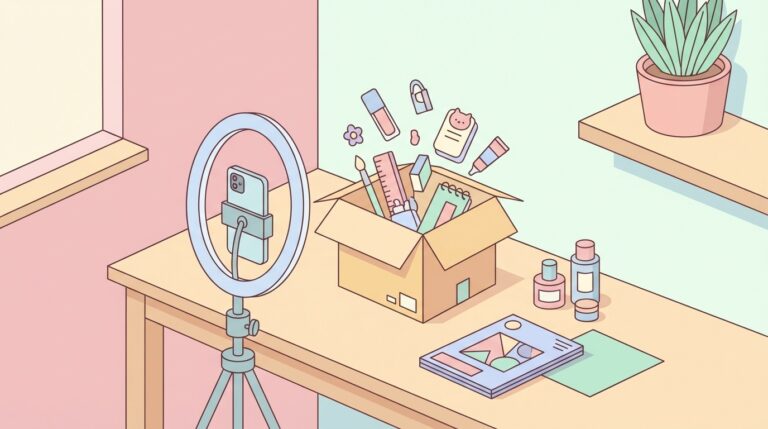
Picture this: You’re scrolling through YouTube, and you click on a K-Pop album unboxing or a K-Beauty haul. The creator carefully slices the tape of a brown box, does a little ASMR tap on the packaging, and suddenly gasps, yelling something at the camera. The subtitles read, “It’s so pretty!” or “I bought this myself!”
But wait—if you listen closely to the Korean they are actually speaking, you won’t hear the textbook phrases like “저는 이것을 샀습니다” (I bought this). Instead, you hear fast, trendy slang that instantly builds trust with their viewers.
If you’re a B2 learner, you already know how to say “I like this.” But what if you want to leave a glowing review on a Korean shopping site? Or what if you want to film your own TikTok unboxing and sound like a true Korean insider? Today, we are stepping out of the textbook and into the creator’s studio. This guide is built from the exact questions my students ask me when they want their Korean internet persona to sound 100% authentic.
Phase 2: Core Expressions Deep Dive
Let’s look at the absolute must-know expressions for filming an unboxing video or writing an online review in Korea.
1. 내돈내산
- Pronunciation: Naedonnaesan [neh-don-neh-sahn]
- Meaning: Literal: My money, my buying. / Real nuance: “I bought this with my own money (100% honest review, not sponsored).”
- K-Culture Moment: If you watch any Korean vlog or read a blog review about a new cafe, cosmetic, or gadget, you will see this hashtag: #내돈내산. It guarantees the reviewer isn’t secretly getting paid to say good things.
- Editor’s Insight: This isn’t just a word; it’s a badge of honor. It tells your audience, “You can trust me.” It’s short for 내(My) 돈주고(paying money) 내가(I) 산거(bought thing).
- Situation Spectrum:
[🚫 절대 금지] ———— [⚠️ 주의] ———— [✅ 자유롭게]
- Friends / Online Followers (Casual): ✅
- Co-workers (Semi-formal): ✅ (Fun to use when treating someone: “이 커피 내돈내산이야!”)
- Formal Business/Boss (Formal): 🚫 (Too internet-slangy)
- 🤔 Think About It: Why did “Naedonnaesan” become so popular? A few years ago, Korea had a massive “hidden ad” (뒷광고) scandal involving top YouTubers. This phrase emerged as a social demand for transparency. Does your culture have a specific slang word just to prove you aren’t sponsored?
2. 실물 깡패네요
- Pronunciation: Silmul kkangpaeneyo [shil-mool ggahng-peh-neh-yo]
- Meaning: Literal: It’s a real-life gangster. / Real nuance: “It looks unbelievably gorgeous in person (way better than the photos).”
- K-Culture Moment: You pull your ultimate bias’s photocard from an album. The camera doesn’t do justice to the holographic shine. You look at the lens and scream, “와, 이거 진짜 실물 깡패예요!” (Wow, this is a real-life gangster!)
- Editor’s Insight: Kkangpae means gangster or bully. In Korean slang, if something is a “gangster,” it means it completely dominates everything else because it’s so overwhelmingly good. Silmul means “the actual object/real life.”
- Situation Spectrum:
[🚫 절대 금지] ———— [⚠️ 주의] ———— [✅ 자유롭게]
- Friends / Online Followers (Casual): ✅
- Co-workers (Semi-formal): ⚠️ (Okay with close peers)
- Formal Business/Boss (Formal): 🚫
- 🤔 Think About It: Koreans love attaching aggressive words like “gangster” (깡패) or “crazy” (미쳤다) to describe beautiful things. It shows overflowing passion. Do you use extreme or negative-sounding words to mean “amazing” in English?
3. 가성비 최고예요
- Pronunciation: Gaseongbi choegoyeyo [gah-sehong-bee chweh-go-yeh-yo]
- Meaning: Literal: The cost-performance ratio is the highest. / Real nuance: “It’s a total steal / Best bang for your buck.”
- K-Culture Moment: You’re reviewing a giant haul of clothes from a cheap online mall. They actually look high-quality. You hold one up and say this phrase to let your viewers know it’s worth every penny.
- Editor’s Insight: Koreans are hyper-focused on efficiency and value. Ga (Price) Seong (Performance) Bi (Ratio). If you want to sound like a smart consumer, you must use this word in your reviews.
- Situation Spectrum:
[🚫 절대 금지] ———— [⚠️ 주의] ———— [✅ 자유롭게]
- Friends / Online Followers (Casual): ✅
- Co-workers (Semi-formal): ✅
- Formal Business/Boss (Formal): ✅ (Safe for almost any context!)
- 🤔 Think About It: Korea’s fast-paced, highly competitive market birthed words like “가성비” (cost-effective) and “가심비” (emotional satisfaction per cost). What does this tell you about modern Korean consumer habits?
Phase 3: Textbook vs. Real Korean
When you leave a review or film a video, sounding like a textbook makes you seem like a bot. Let’s fix that.
| Situation | 📖 Textbook Korean | 🗣️ Real Korean | 💡 Why the difference? |
|---|---|---|---|
| Starting the video | 포장을 뜯겠습니다. (I will tear the packaging.) | 언박싱 가보자고! (Let’s go unboxing!) | English loanwords combined with internet meme phrases (“가보자고” – Let’s go) show trendy excitement. |
| Describing beauty | 정말 예쁩니다. (It is very pretty.) | 실물 영롱하네요✨ (The real thing is radiant.) | “영롱하다” (radiant/sparkling) is the ultimate compliment for K-beauty packaging or K-Pop merch. |
| Recommending | 이것을 사세요. (Buy this.) | 이건 무조건 사야 해. (You unconditionally have to buy this.) | Koreans express strong recommendations using “무조건” (unconditionally/absolutely) for emphasis. |
| Honesty Check | 제가 직접 샀습니다. (I bought it myself.) | 내돈내산 찐 후기 (My-money-bought real review) | Shortened slang (찐 = real/authentic) fits better in video titles and Instagram captions. |
Bottom Note: For B2 learners, using words like “영롱하다” or “찐” will instantly elevate your Korean from “student” to “content creator.”
Phase 4: Cultural Context — K-Culture Deep Dive
4-1. Non-Verbal Elements: The Nunchi of Reviewing
Even when doing an unboxing in your own room, Korean Nunchi (social awareness) applies. If a Korean creator bought something they don’t like, they rarely say “이거 쓰레기예요” (This is trash). Instead, they use polite softening techniques: “제 취향은 아니네요” (It’s not my taste) or “호불호가 갈릴 것 같아요” (I think it will be hit or miss). It’s about being honest but maintaining social harmony.
4-2. K-Culture Connection: The Idol Photocard Ritual
If you’re unboxing a K-Pop album, there’s a strict cultural ritual. You don’t just rip it open. You slide the album out, cover the photocard with your hand so you don’t spoil it for yourself, and slowly slide your thumb down to reveal the member’s hair. This is called “쪼이기” (squeezing/teasing). When you finally pull your favorite member (최애 – choeae), you scream. This shared ritual is why K-Pop unboxing vocabulary is so universally understood across the Korean internet.
Phase 5: Real-Life Roleplay Scenario
Setting: A Friday night in your cozy room. Your ring light is on. You just received a highly anticipated package from Olive Young. Your Korean friend, Minji, is holding the camera for your TikTok Live.
Characters:
– YOU: A B2 Korean learner and K-beauty enthusiast.
– Minji (24): Your supportive Korean friend, acting as your hype-woman behind the camera.
Dialogue:
Minji: 자, 라이브 켰어! 인사해! (Okay, I turned the live on! Say hi!)
YOU: 안녕하세요 여러분! 오늘 드디어 택배가 왔어요. (Hi everyone! The package finally arrived today.)
Minji: (Reading comments) 다들 뭐 샀냐고 물어보는데? (Everyone’s asking what you bought in the comments?)
YOU: 짠! 이거 진짜 구하기 힘든 쿠션이에요. (Tada! This is a really hard-to-get cushion foundation.)
Minji: 오~ 그거 협찬받은 거야? (Oh~ Did you get sponsored for that?)
YOU: 아뇨! 내돈내산 찐 후기입니다! 언박싱 해볼게요. (No! It’s a my-money-bought real review! I’ll do the unboxing.)
(🎭 Stage Direction: You cut the tape and open the shiny pink compact.)
Minji: 대박… 케이스 진짜 예쁘다. (Jackpot… The case is really pretty.)
🔀 Your Turn! How should you respond to describe how it looks?
– A) “네, 참 예쁩니다.” (Yes, it is very pretty.)
– B) “진짜 실물 깡패네요! 영롱해요!” (It’s a total real-life gangster! So radiant!)
– C) “가성비 최고예요.” (It’s the best cost-performance.)✅ Best Choice: B — This perfectly captures the dramatic excitement of an unboxing live stream.
⚠️ Choice A Analysis: Grammatically flawless, but way too stiff for a fun live stream. It sounds like a news anchor!
⚠️ Choice C Analysis: It might be true, but “가성비” focuses on the price, whereas Minji was complimenting how pretty it is.
YOU: 와, 진짜 실물 깡패네요! 영롱해요! (Wow, it’s a total real-life gangster! So radiant!)
Minji: 화면에 다 안 담겨서 아쉽다. 리뷰 별점 몇 점 줄 거야? (It’s a shame the screen can’t capture it all. How many stars will you give it in the review?)
YOU: 무조건 5점이죠! (Unconditionally 5 stars, of course!)
Phase 6: 10-Second Shadowing Drill
Time to practice your influencer voice! Read this aloud, following the pauses (/) and the emotion tags.
😊 여러분, / 이건 / 협찬 아니고요, (yeoreobun, / igeon / hyeopchan anigoyo,)
😤 백 퍼센트 / 내돈내산 / 찐 후기입니다. (baek peosenteu / naedonnaesan / jjin hugi-imnida.)
🥺 진짜 / 실물 깡패니까 / 무조건 사세요! (jinjja / silmul kkangpaenikka / mujogeon saseyo!)
Phase 7: K-Culture Mini Dictionary
Before you hit record or write that review, memorize these key internet shopping terms:
| 한국어 (Korean) | Romanization | English | Context |
|---|---|---|---|
| 택배 | taekbae | Package / Delivery | The lifeblood of Korea. Often arrives within 24 hours. |
| 영롱하다 | yeongnonghada | Radiant / Dazzling | Used to describe shiny makeup, jewelry, or K-pop photocards. |
| 품절 대란 | pumjeol daeran | Out-of-stock crisis | When a product is so viral it’s sold out everywhere. |
| 최애 | choeae | Ultimate bias/favorite | “최고로 애정하는” – Your absolute favorite member or item. |
| 득템 | deuktem | Great catch / Loot | Slang for successfully buying something rare or at a great price. |
Phase 8: Traveler’s Survival Kit 🧳
Even if you aren’t filming a YouTube video, if you travel to Korea, you will engage in the shopping and delivery culture. Korean delivery is world-famous, and yes, tourists can use it!
🆘 Survival Expression #1: Asking about delivery
– 🇰🇷 “호텔로 택배 받을 수 있나요?” (hotello taekbae badeul su innayo?)
– 🗣️ English Guide: Can I receive packages at the hotel?
– 📍 Where to use: At your hotel front desk before ordering online.
– 💡 Pro Tip: Most hotels allow this, but always ask first. Make sure the name on the package matches your passport exactly!🆘 Survival Expression #2: Buying unboxing items in-store
– 🇰🇷 “새 상품으로 주세요.” (sae sangpumeuro juseyo.)
– 🗣️ English Guide: Please give me a new (unopened) one.
– 📍 Where to use: Olive Young, Artbox, underground shopping malls.
– 💡 Pro Tip: Don’t buy the display model if you want that fresh unboxing experience back at your hotel!
📌 Editor’s Travel Note:
Want the ultimate K-travel unboxing? Order food delivery (배달 – baedal) to your Han River picnic spot. Using apps like Yogiyo or Baedal Minjok might require a Korean phone number, but many hotels will happily order fried chicken for you if you ask nicely at the desk!
Phase 9: Critical Thinking — “One Step Deeper”
Global Era Korean: The Demand for Authenticity
Why does a simple phrase like “내돈내산” (I bought it with my own money) hold so much power in Korean internet culture? In recent years, as Korean influencers gained immense global and domestic power, a massive scandal broke out: “뒷광고” (back-door advertising). Creators were pretending to unbox items they “accidentally” found, while secretly being paid millions of Won by brands.
The feeling of betrayal among Korean netizens was profound. In Korean culture, trust and community (Jeong) are deeply valued. The “Naedonnaesan” trend, and the legal requirement to now clearly state sponsorships, reflects a society that values authentic connections over corporate polish. The language adapted to create a shield of trust between the creator and the viewer.
💬 Your Turn: Have influencers in your country ever faced backlash for hidden sponsorships? Does your language have a specific slang word to prove a review is 100% genuine? Share in the comments!
Phase 10: FAQ & Avoiding Misunderstandings
Q: Can I use “실물 깡패” to describe a person who looks better in real life?
Yes, but be careful! Among close friends, you can say “와, 너 오늘 실물 깡패다!” (Wow, you look amazing today!). But NEVER say this to someone older than you, a boss, or an idol at a fan meeting unless you want to see their security guard panic. Stick to using it for objects.
Q: Do I write “언박싱” in English or Korean on Instagram?
Both are fine, but writing #언박싱 (in Hangul) will attract Korean viewers to your algorithm!
❌ Common Mistake #1: Leaving a review saying “이것은 나쁩니다” (This is bad).
✅ Do This Instead: Koreans rarely write so directly on public review boards unless they are furious. A more natural, native-sounding negative review is “기대 이하여서 아쉬워요” (It’s below my expectations, so it’s a shame).
Phase 11: Summary & Action Items
One-Liner Summary: To sound like a native Korean creator, drop the textbook formality and use trendy, trust-building expressions like Naedonnaesan and Silmul Kkangpae.
Action Mission:
– 🥉 Bronze (Solo): Stand in front of your mirror with any item on your desk and announce: “언박싱 가보자고!”
– 🥈 Silver (Online): Find an unboxing video on YouTube (search: 앨범 언박싱 or 올리브영 하울). Leave a comment saying: “실물 영롱하네요! ✨”
– 🥇 Gold (Real-world): Next time you buy a Korean product, post a story on Instagram/TikTok using the hashtag #내돈내산.
K-Culture Mission: Go to YouTube right now and type “내돈내산 리뷰” in the search bar. Click on any video. I guarantee you will hear the creator say “진짜” (really) at least 5 times in the first minute!
Phase 12: Interactive Quiz
1. Situational Judgment: You just bought an incredibly cheap but high-quality phone case online. You want to leave a 5-star review. Which title is the most natural?
– A) 저는 싼 케이스를 샀습니다. (I bought a cheap case.)
– B) 가성비 최고! 내돈내산 찐 후기 (Best cost-performance! My-money-bought real review)
– C) 이 케이스는 깡패입니다. (This case is a gangster.)
Answer: B! (A is too robotic, and C makes it sound like the case is going to beat you up!)
2. True or False — K-Culture Edition:
“Korean online shopping is so fast that some deliveries arrive by 7 AM the very next morning.”
Answer: True! It’s called “새벽배송” (Dawn Delivery), and it’s a staple of the “Ppalli-ppalli” (hurry-up) culture!
3. Fill in the blank:
When opening a package to show your friends, you should say: “_________ 해볼게요!”
(Hint: English loanword for taking something out of a box)
Answer: 언박싱 (Eonbaksing)
Did you get them all right? Keep practicing, and I’ll see you in the next Daily Hangul module! 화이팅! (Fighting!)
Frequently Asked Questions (FAQ)
Q: What does "내돈내산" mean in Korean and how do you pronounce it?
A: In Korean, "내돈내산" is pronounced [Naedonnaesan [neh-don-neh-sahn] and means: Literal: My money, my buying. / Real nuance: "I bought this with my own money (100% honest review, not sponsored)."
Q: What does "실물 깡패네요" mean in Korean and how do you pronounce it?
A: In Korean, "실물 깡패네요" is pronounced [Silmul kkangpaeneyo [shil-mool ggahng-peh-neh-yo] and means: Literal: It's a real-life gangster. / Real nuance: "It looks unbelievably gorgeous in person (way better than the photos)."
Q: What does "가성비 최고예요" mean in Korean and how do you pronounce it?
A: In Korean, "가성비 최고예요" is pronounced [Gaseongbi choegoyeyo [gah-sehong-bee chweh-go-yeh-yo] and means: Literal: The cost-performance ratio is the highest. / Real nuance: "It’s a total steal / Best bang for your buck."







